Ended Jul 16
Mary Ramsden
For Newness of the Night
Jun 10 – Jul 16, 2022
More from Mary Ramsden on Gallop
You are chasing what drives you! This paradoxical remark, uttered by a friend trying to make sense of the nervous restlessness that stirs those peculiar productive episodes every creator knows, gets to the heart of what it means to make something new. The innocent wisdom of this comment is that of mixed metaphors, the fact that despite its aphoristic reduction and confident delivery the sentence contains an impossibility: to chase what drives you means to run after the thing that you are being chased by. This impossibility, the simultaneous being ahead of oneself and lagging behind that can only be held in thought as a movement, is what in our hunger for words we have come to call intuition. When we reach into the dark we do so as two selves that seemingly contradict each other. It is exactly here that a space between knowing and not knowing opens in which the unknown can take shape as the new. Mary Ramsden describes this state as the sensation of another presence in the studio, which she compares to the feeling of knowing for certain someone is behind you before you turn. She tells me she’s been reading about mountaineers who often experience the feeling of an extra walker in tow, someone at the other end of the rope. Even though we often reach for spiritual metaphors to describe what happens in creation, Ramsden points out that this sensation is actually very physical. As if muscle memory were taking over, sending ripples along the rope by continuously rearranging herself and her routines, a somatic conjuring rather than spiritual conjecture.
In creation imagination and memory go hand in hand. Which is why Siri Hustvedt describes her own work process as “trying to remember something that actually happened but I can’t bring to light.” Finding the right form or character feels not like cognition, but recognition, which, too, sounds paradoxical. Yet, if we weren’t able to recognise the new as meaningful, creation would be arbitrary. We know a work is finished, because the new feels familiar. This space between self and self holds the moments when “light is put away” and our eyes have yet to find purchase in the dark. Those moments of promiscuous abstraction Emily Dickinson invokes in her poem We Grow Accustomed to the Dark that lends this exhibition its title. Dickinson is famous for her use of dashes instead of punctuation, long fingers pointing into the void after each line — a relation between two elements, one of which is only present as absence. “A something overtakes the mind” Dickinson writes elsewhere, “we do not hear it coming.” Even if we might not hear it, we can sense the negative weight of the other in tow as reminiscence of the unknown. This notion of a something is present in all of Ramsden’s recent work, but probably most pronounced in her paintings within paintings, which Ramsden describes as portraits of possible paintings or historic ones of her own. She tells me that she has always been distracted by those self-referential echos in the work of Matisse and Vuillard. Distracted. For Hans Blumenberg distraction is where culture begins because it is a form of thought or thoughtfulness that does not seek the shortest connection between two points. Getting distracted is to make room for a something to take over by giving the other in tow some slack. The other, as much should have become clear by now, might as well be yourself.
—Marie von Heyl
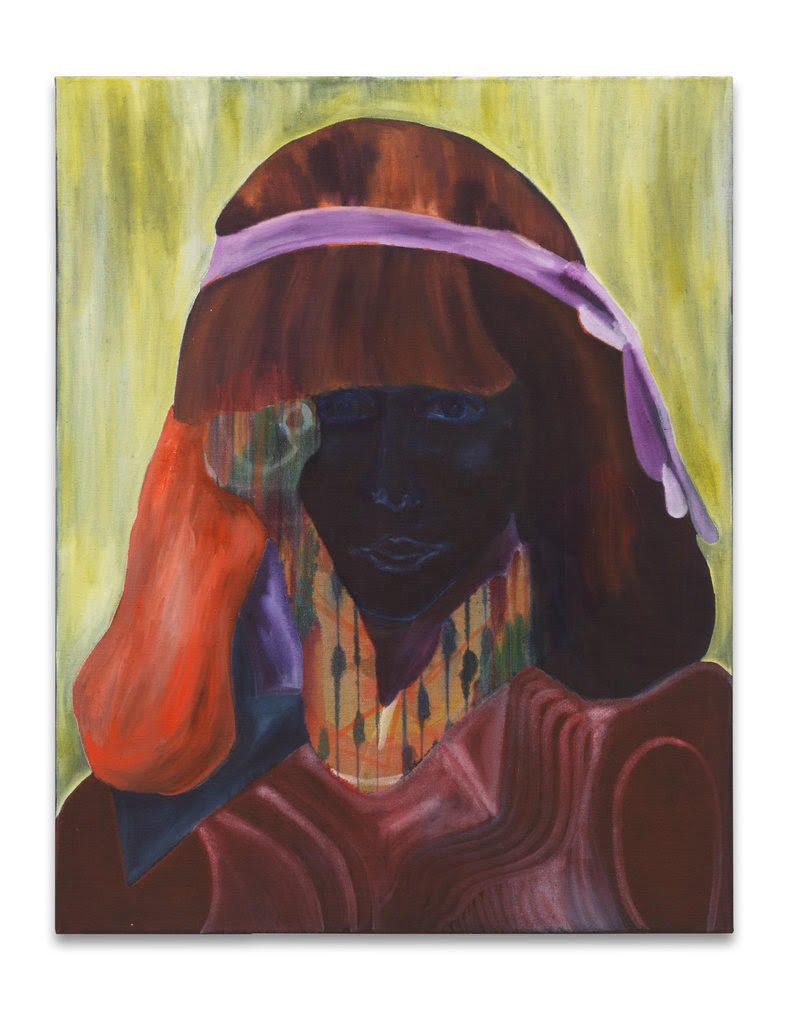
Mary Ramsden has become primarily known for her abstract paintings, from which her latest works are markedly different. In an experimentally abstract way, Ramsden creates spaces that spring from her memory - sometimes with thick brushstrokes and areas of paint, sometimes in a sketchy manner, and in this way develops an entirely new, unique visual language.
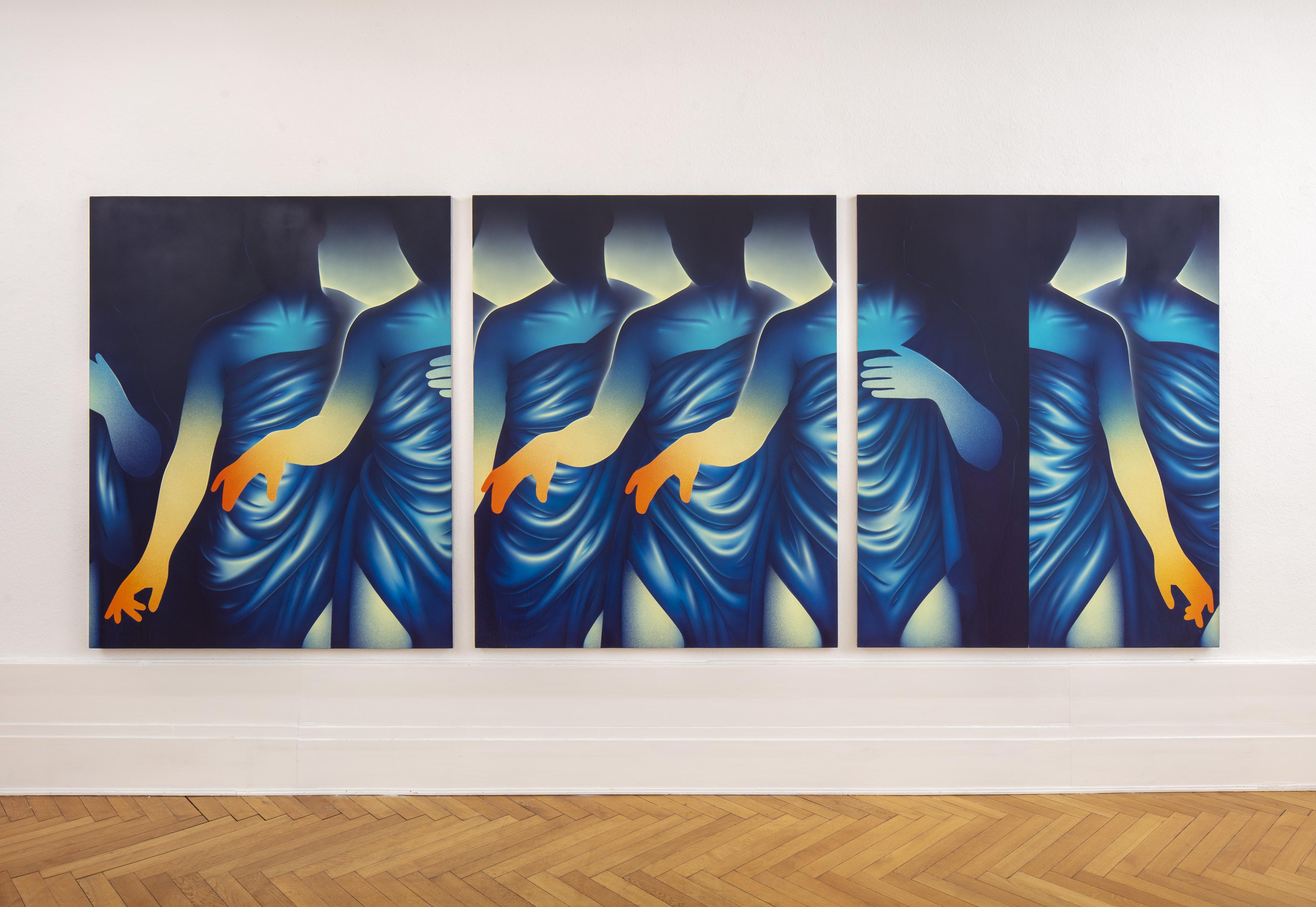
As viewers, we find ourselves in front of large-format paintings that, sometimes realized as triptychs, direct our gaze to interiors furnished with tables, lamps, or vases. Due to their scale, we almost feel immersed in the paintings.
Ramsden's paintings are in the tradition of still life painting and reflect the influence of late 19th-century French art in particular. Like Cezanne, she focuses on objects that change their perspective when we approach them. Or, like the members of the Nabis school, she uses vibrant areas of color – in her case, she focuses on rich acid yellows, pale pink and blocks of aquamarine and sea green.
Mary Ramsden (b. 1984) lives and work in London. She studied at the Royal Academy in London; the Edinburgh College of Art and the Leith School of Art in Edinburgh.
Mary has had solo exhibitions at Pilar Corrias, London, GB | The Aspen Art Museum, US | Atticsalt Gallery, Edinburgh, GB. She was part of group exhibitions in institutions such as Tate Britain, London, GB | Sid Motion Gallery, London, GB | The Drawing Biennial 2019, London, GB | The Drawing Room, London, GB | Victoria Miro; London, GB | Saatchi Gallery, London, GB.