
Ended
Chalisée Naamani
Goodwill
Sep 4 – Oct 11, 2025
"I think of all the images she must carry in her body." [1]
—Warsan Shire
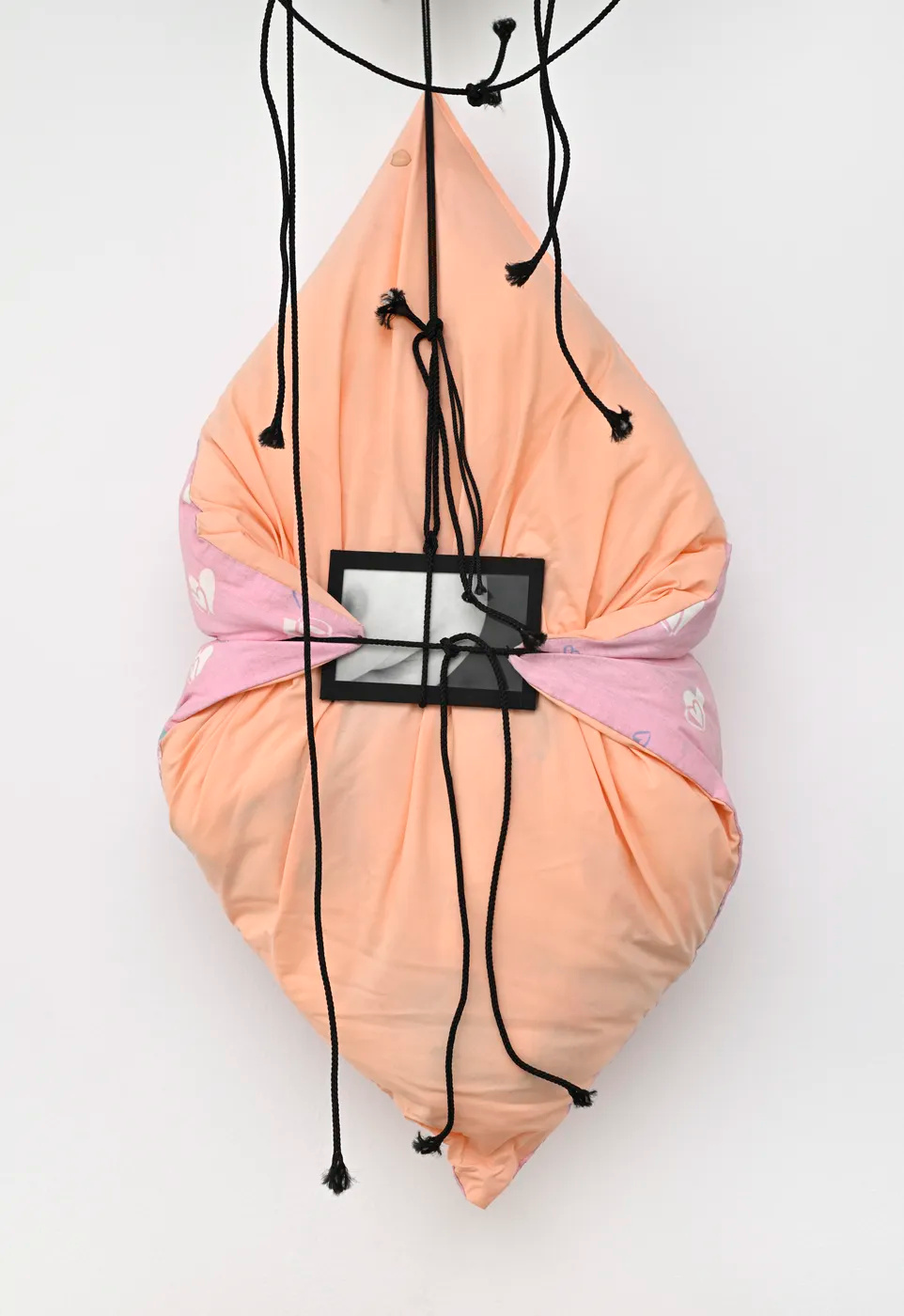
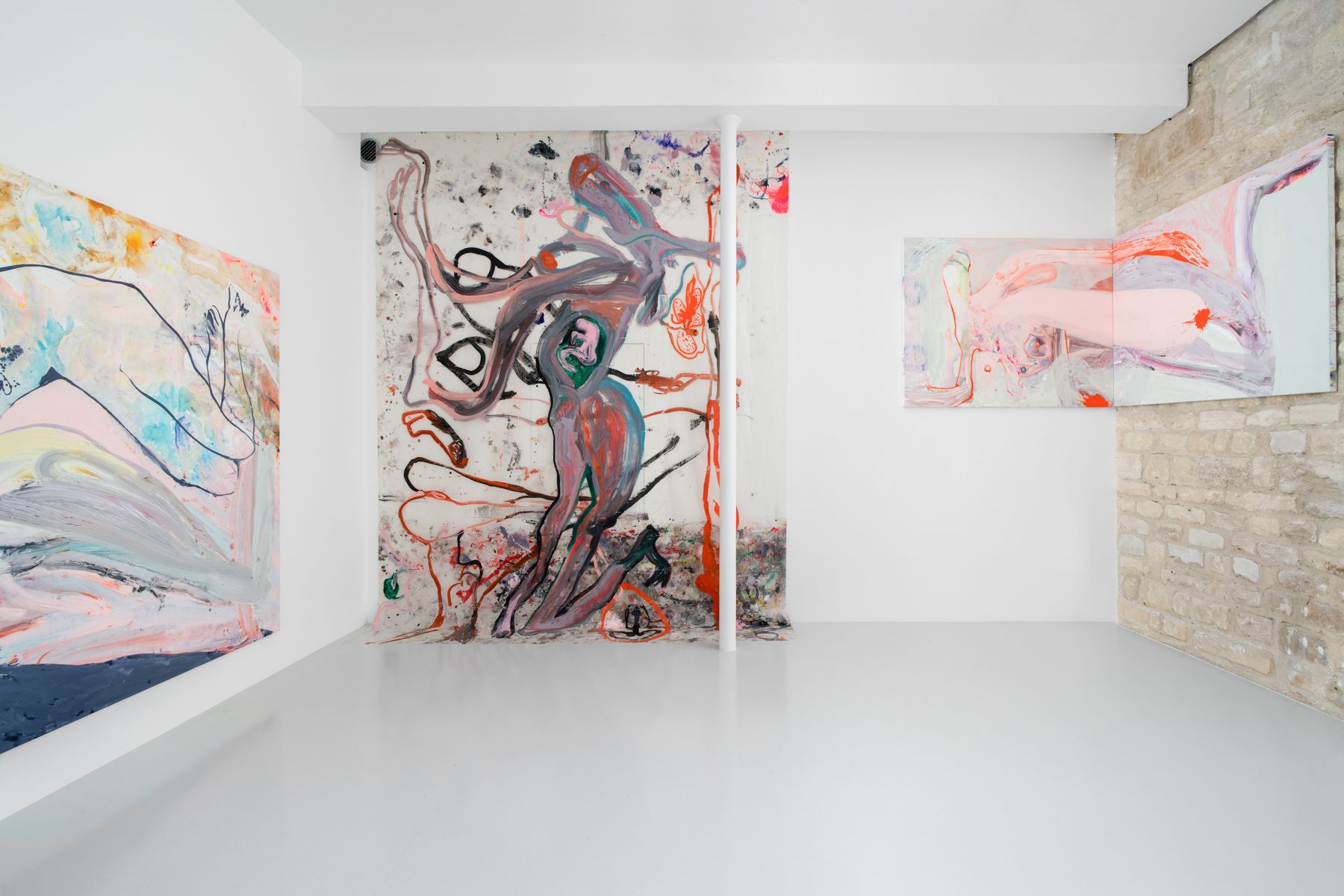
If you type good will into a search engine, the first result will be a concept in accounting ["the difference between market value and the net asset value of a company's balance sheet"]. Google will then tell you that goodwill is what can be translated as "good will," a form of benevolence. In third position, bridging the gap between transaction and human quality, there’s Good Will Industries, a U.S.-based nonprofit organization specializing in professional integration and known for its gigantic warehouses where second-hand furniture, accessories, and clothes pile up - some of which become the raw material for Chalisée Naamani's works. Here, the print on a bag, that of a T-shirt covered in donuts, mingles with other textiles found online or in warehouses. You find icons of Americana - a starry fabric of star- spangled banners [2], Disney heroines, or those from Westerns - distorted in a patchwork, or by a lining that reveals the distinctive boteh jegeh patterns of Persian tapestries. Among the gestures that characterize Chalisée Naamani’s work is the act of assembling and continually turning things inside out, revealing with a simple folding what would otherwise cling to the skin: sewing a poem over a rug, writing a mantra on the inside of a bathrobe - Do what makes you happy like a Co-Star notification, advice whispered in the ear to help us choose between two dresses laid out on a mattress as if between two destinies, an outfit for celebration or mourning, the little black dress as a crossroads.
It is a similar tension that the object of the screen (paravent) evokes, amplifying the effects of the reverse side to juxtapose two images and place them back to back. By occupying the gallery space in this way, Chalisée Naamani replaces the display with the dressing room; for while the screen evokes the domestic world, the boundary between what is shown and what is kept private, the artist uses it more as a compact set, capable of holding multiple spaces through the effects of trompe-l'oeil and double-sidedness. There is something theatrical about this reversible billboard, this bathrobe barely hanging in its corner, and this unpacked suitcase from which images spill out. We find ourselves here as if in the wings, before or after the action. The exhibition suggests gestures that go beyond mere dressing, instead pointing to its ritual: what we hang up, what we unpack, what we suspend without quite putting away. Goodwill transforms accessories into props, ready to be worn like parts of a costume. It’s a reminder that "lining" is also a theatrical term, not just a role but its substitute; a character squared. But theater here speaks less of theater than of Chalisée Naamani’s obsession with the signs of staging. The objects do not seek to create illusion; rather, they highlight their artificial nature. An unarmed holder in the shape of a toy, its ammunition replaced by artificial roses; a military mesh that no longer camouflages anything, transformed by fashion into a tool of distinction—to be sexy, to be a fighter, to be a "street fighter", to be cool, to express political opinions, to dress cheaply with second-hand clothing, to dress practically, with many pockets [...] [3] - as many reasons to wear it, according to the list drawn up by the artist and former Swiss soldier Thomas Hirschhorn.
In the subtext of Goodwill, over its outfits, one will thus read evocations of war; a knot that etymology already highlights, as the English word garments [clothes] derives from the French garnement, meaning military equipment, and by extension, those who wear it. The pejorative sense of the term is also well-known, as garnement refers, as the search engine tells me this time, to "someone who is no better than their clothes." It is this relationship of identity between the individual and their coverings that the artist’s work constantly questions. Who she was wrapped up with what she wore [4] - one might say here, borrowing the words of American author Dodie Bellamy about her friend Kathy Acker, during a tribute exhibition that suspended Acker’s outfits on clotheslines. Chalisée Naamani also seizes the garment for what it is made of; she restores thickness to images, weight to representations, and invites us to take our fictions seriously. Goodwill thus tells of a soft power, a violence all the more violent for being rubbery, softened by fuchsia or candy pink, miniaturized by a child’s size.
The exhibition also stages a plastic femininity, a deceitful masculinity (Boys lie!); it reminds us that clothing is one of the mechanisms by which the body "ceases to be a purely biological space" [5], forming a synthetic epidermis where roles are performed and can also be reversed. Chalisée Naamani disrupts what we believe to be fixed through portmanteau words, sculpture-clothes, selfies in trunks, poems sewn onto rugs. Her assemblages weave together cultural legacies, ages, and geographies. They operate like a kaleidoscope, allowing us to glimpse several things at once; a logic of accumulation that mirrors that of warehouses, or the feed of images we capture and compile. This grammar of the reverse reminds things of a multiple, shifting principle. It also speaks of a diasporic existence, shared between France, Iran, and the United States; a life straddling childhood and parenthood; and images that, from one point to another, form folds, linings, and back-and-forths.
—Salomé Burstein
1 - Warsan Shire, “My Foreign Wife is Dying and Does Not Want To Be Touched” in Teaching my mother how to give birth, the mouthmark poetry pamphlet series, 2011.
2 - In addition to being the title of the U.S. national anthem, Star-Spangled Banner—literally "star-strewn banner" - is one of the expressions used to refer to the American flag.
3 - Thomas Hirschhorn, Utopia Utopia = One World, One War, One Army, One Dress, Aubervilliers, 2005. Available online on the artist's website.
4 - Dodie Bellamy quoted by Derek McCormack in Judy Blame’s Obituary, Writings on Fashion and Death, London, Pilot Press, 2021, p.100.
5 - Emanuele Coccia, Alessandro Michele, La Vie des formes, philosophie du réenchantement, Paris, Flammarion, 2025, p.71.