
Exhibition · Geary
Roberto Visani
Do It Yourself: An Introduction to the Cardboard Slave Kits
May 14 – Jun 26
About the show
To make an appointment, please visit: bit.ly/2SA37DK
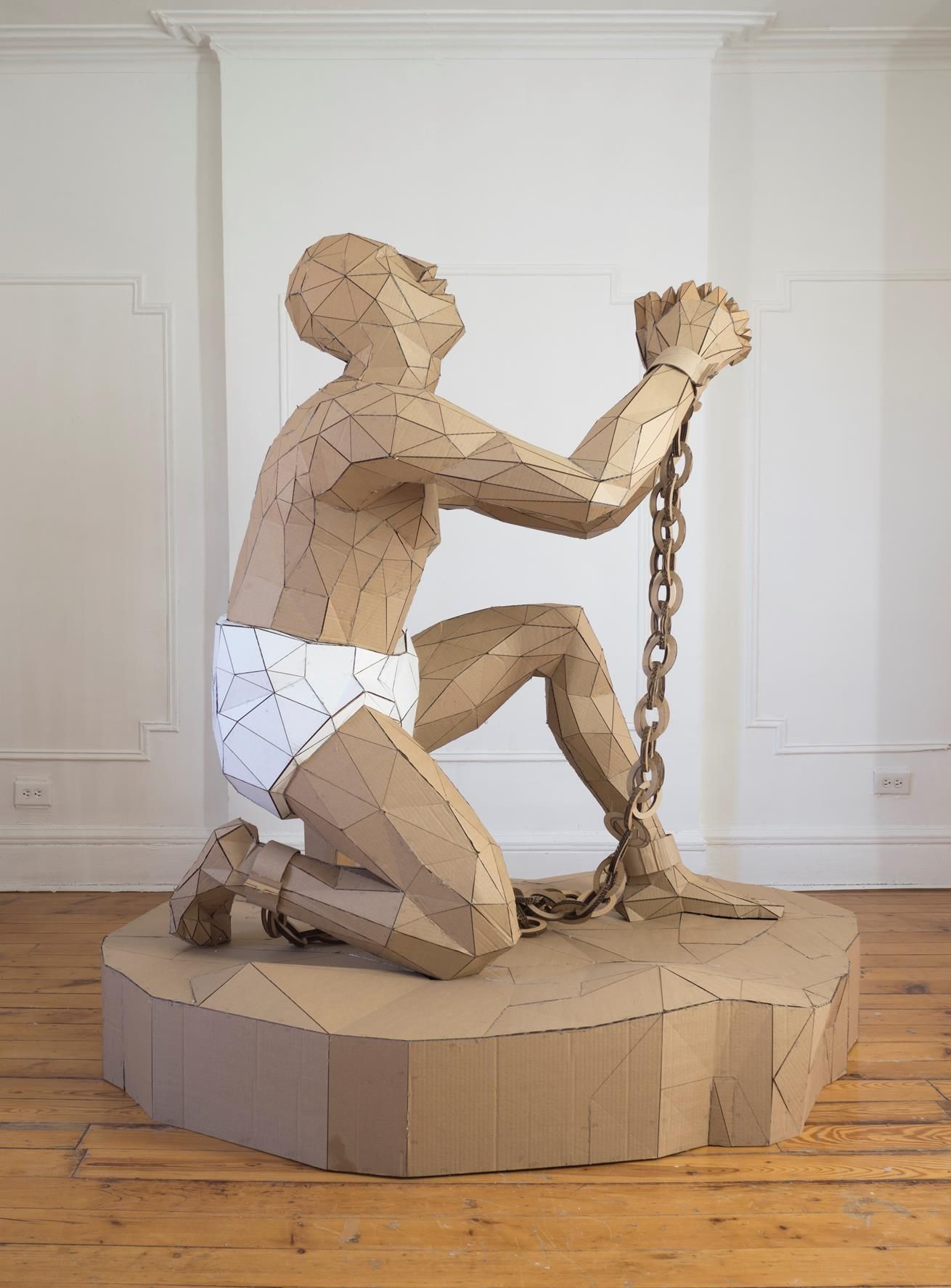
Geary is pleased to present Do It Yourself: An Introduction to the Cardboard Slave Kits, Roberto Visani's first solo exhibition with the gallery. The exhibition also marks the first public showing of Visani’s kits, a series of do-it-yourself flat pack sculptures based on art historical imagery depicting the institution of slavery. The two kits included in Do It Yourself are based on two of art history’s most iconic works depicting enslaved individuals, the seal of the Society for Effecting the Abolition of the Slave Trade from 1787, and Hiram Powers’ Greek Slave of 1848. Visani has digitized each of these and recreated them as larger than life cardboard sculptures. The boxed flat pack kits accompany the sculptures in the exhibition with accompanying instructions and material enclosed, thereby enabling any D.I.Y.er the potential to create a ‘slave sculpture’ of their own. Accompanying the assembled sculptures and kits are a series of laser cut drawings mounted in antique oval frames. The drawings isolate the sculptures from varying points of view and expand upon the complex narratives contained within Visani’s project.
In Do It Yourself, Visani invites us to consider the creation, proliferation, and abolishment of slavery as a series of systems built on conflicting notions of servitude, cooperation, ownership, enterprise, and propaganda. Visani’s use of digital tools in the creation of his kits, point to both the empowering and oppressive potential of technology. As a whole, Do It Yourself is part exhibition, part salon, and part marketplace for ideas and commerce. The artist states, “We inherited these objects and images. They are part of our past, yet resonate in our present. In many ways the realities of slavery are alive to this day. For me, making this work is an attempt to try and grasp a small part of the impact that slavery and its legacy has had on us all and to consider how we carry that forward. My goal ultimately is to engage others in this meaningful work.”
An essay by Sara Reisman, below, accompanies the exhibition.
Roberto Visani is a multi-media artist residing in Brooklyn, New York. He has exhibited at the New Museum of Contemporary Art, The Studio Museum in Harlem, The Bronx Museum, Yerba Buena Center for the Arts, and Barbican Galleries. Visani has been awarded residencies from Lower Manhattan Cultural Council, Chelsea College of Art and Abrons Art Center. He is a NYFA Fellow in Sculpture and was a Fulbright Fellow to Ghana. His work has been reviewed by the New York Times, Art Forum, Art News, and Frieze among others. Since 2004 he has taught at John Jay College of Criminal Justice where he is an associate professor of art.
—
The now famous motto 'Am I Not a Man and a Brother?’ guided the activist efforts of the Society for Effecting the Abolition of the Slave Trade, a non-denominational British abolitionist group formed by six Quakers and three Anglicans in 1787. That same year, the United States constitution was being written. One of the society’s members, Josiah Wedgewood, a potter and entrepreneur, created the jasperware cameo derived from the society’s seal, which popularized the very image that has informed Roberto Visani in making cardboard slave kit: abolitionist blend (2020). [1]
One of two ‘slave kits’ that Visani has produced for his solo exhibition, Do It Yourself, the open-edition sculptural works are reinterpretations of what may possibly be two of the most iconic slave figures in art history. Visani has rendered them - one Black and male, the other white and female - in his signature beveled cardboard technique, a process in which he uses 3-D modeling software as a means of abstraction. The kneeling posture of the male silhouette depicted in abolitionist blend is typical of Black figurative representation of the 18th Century. Recognizing that the image of the supplicant slave is problematic, Visani writes, “while it is viewed as the symbol of struggle for abolition and eventual emancipation, it also depicts the enslaved African as begging for their freedom, pleading for the kindness and generosity of others so that they might be set free.” Visani’s project questions what it means now to visualize and reproduce the form of an enslaved Black body in more elaborate, formal terms.
Presented alongside cardboard slave kit: abolitionist blend, Visani’s cardboard slave kit: h powers blend (2021) draws on American artist Hiram Powers’ renowned 1843 sculpture The Greek Slave. At the time of its reception, The Greek Slave was one of the most widely seen works of art [2] This upright figure transposes many of the political implications of the kneeling figure in abolitionist blend. One of the first nude sculptures to be publicly received in American art history, the statue’s nudity was controversial, garnering greater visibility for the work. [3] Its gender and race (female and European) combined with Powers’ reference to Ottoman-era enslavement of Greeks by the Turks [4] made it possible for U.S. audiences to empathize with the subject, in spite of their own relationships to slavery, several decades before the Emancipation Proclamation. [5]
Produced over the last year, the works featured in Do It Yourself marks Visani’s deep and distilled investigation of the representation of the enslaved throughout art history. Consider the two individuals whose cultural output informs Visani’s exhibition: Hiram Powers, an American neoclassical sculptor, and Josiah Wedgwood, an English potter. Could their current-day counterparts - white artists - do this work in 2021?
Josiah Wedgewood’s cameo of the kneeling black figure conjures visuals of taking a knee, a gesture of protest enacted by American athletes against police brutality, [6] one that also evokes the brutality of the 2020 murder of George Floyd. The contradictory implications of the kneeling figure - attributed to Wedgewood, a white artist - point to the complexities of authorship, specifically, who has the right to represent the racialized other in visual culture and political life? In formal terms, Visani’s use of 3-D modeling software, a tool intended for architectural rendering, allows him to reimagine historical information as art. The intricate structural facets of each artwork, including the two sculptures and accompanying drawings, make space for the viewer to reflect on entrenched and all-encompassing aspects of slavery that continue to reverberate today. Each of the two-dimensional works hones in on details of the abolitionist blend and h powers blend. With titles like chains, far away, hands and cuffs, and sideways glance, the drawings offer views of the figures to further humanize and complicate the imagery of slavery.
The open-ended edition of Visani’s two cardboard slave kits enables them to be reproduced endlessly, at the artist’s discretion, making the cardboard figures accessible for use in schools, museums, and other public venues. Within these contexts, the collective act of assembling the sculpture will become a performative, relational exchange, echoing artists like Sol LeWitt, whose instructions give his wall pieces site-specific and mobile possibilities. As multiples, the cardboard slave kits are ideally assembled by a group - students, members of the public, museum staff - that follows Visani’s instructions; in this sense, they follow the logic of Fluxkits conceived by George Maciunas and other Fluxus artists, whose practices attempted to decentralize access to art objects, which, in conventional art settings would otherwise remain rarified. Other precedents for the cardboard slave kits include the traveling exhibition Do It, curated in 1993 by Hans Ulrich Obrist, and based on artists’ instructions, or ‘scores.’ Conceived by Obrist to be produced on site by each venue, the show can be realized more widely than a conventional exhibition, actualizing Marcel Duchamp’s proposition that “art is a conversation between all people of all periods.” [7]
The content for Visani’s kits however are firmly rooted within the problematic historical archive of slavery. The creation of the kit is similarly intended to prompt its participants to engage in a more dispersed and durational act of memorialization. while opening up questions about collective and individual accountability to racial equity and justice. Without this type of active discourse, the politics of this country’s slave history will continue to be sublimated, blocking open discussion about how racism can be abolished. Perhaps taking a cue from Josiah Wedgewood’s contemporaries in their mission to abolish the slave trade, Visani’s cardboard slave kits are poised to contribute to a national conversation about how monuments to the confederacy can be rethought and ultimately replaced with a new type of memorial, one that unpacks the act of commemorating the lives and contributions of unnamed slaves, whose descendants are entitled to accountability and justice.
—Sara Reisman
1 - “Africans in America/Part 2/Am I Not a Man and Brother.” PBS. Public Broadcasting Service. Accessed April 24, 2021. https://www.pbs.org/wgbh/aia/part2/2h67.html. Note that the artist who engraved the cameo is unknown, but the design has been attributed to William Hackwood or Henry Webber, both modelers at the Wedgwood factory.
2 - “The Greek Slave.” Art Object Page. Accessed April 25, 2021. https://www.nga.gov/collection/art-object-page.166484.html.
3 - Powers, Hiram. “Greek Slave.” Smithsonian American Art Museum. Accessed April 23, 2021. https://americanart.si.edu/artwork/greek-slave-20061.
4 - Ibid.
5 - “The Emancipation Proclamation.” National Archives and Records Administration. National Archives and Records Administration. Accessed April 25, 2021. https://www.archives.gov/exhibits/featured-documents/emancipation-proclamation.
6 - “Take a Knee.” TAKE A KNEE | definition in the Cambridge English Dictionary. Accessed April 25, 2021. https://dictionary.cambridge.org/us/dictionary/english/take-a-knee.
7 - Do It. Accessed April 26, 2021. https://doingit.fba.up.pt/en/about/do-it/.
About Geary
Geary Contemporary was founded in the Lower East Side of Manhattan in 2013 by Jack Geary and Dolly Bross Geary. Geary opened a Millerton, NY location in 2020 – showing through 2025. Our Salisbury, Connecticut location opened in 2026. The gallery represents emerging and mid-career artists working in a variety of media.
More about Geary →