
Ended
Johan Creten
How to Explain the Sculptures to an Influencer?
Jan 18 – Mar 23, 2024
[Scroll down for French version / Veuillez trouver ci-dessous la version française]
"Man is a political animal."
—Aristotle
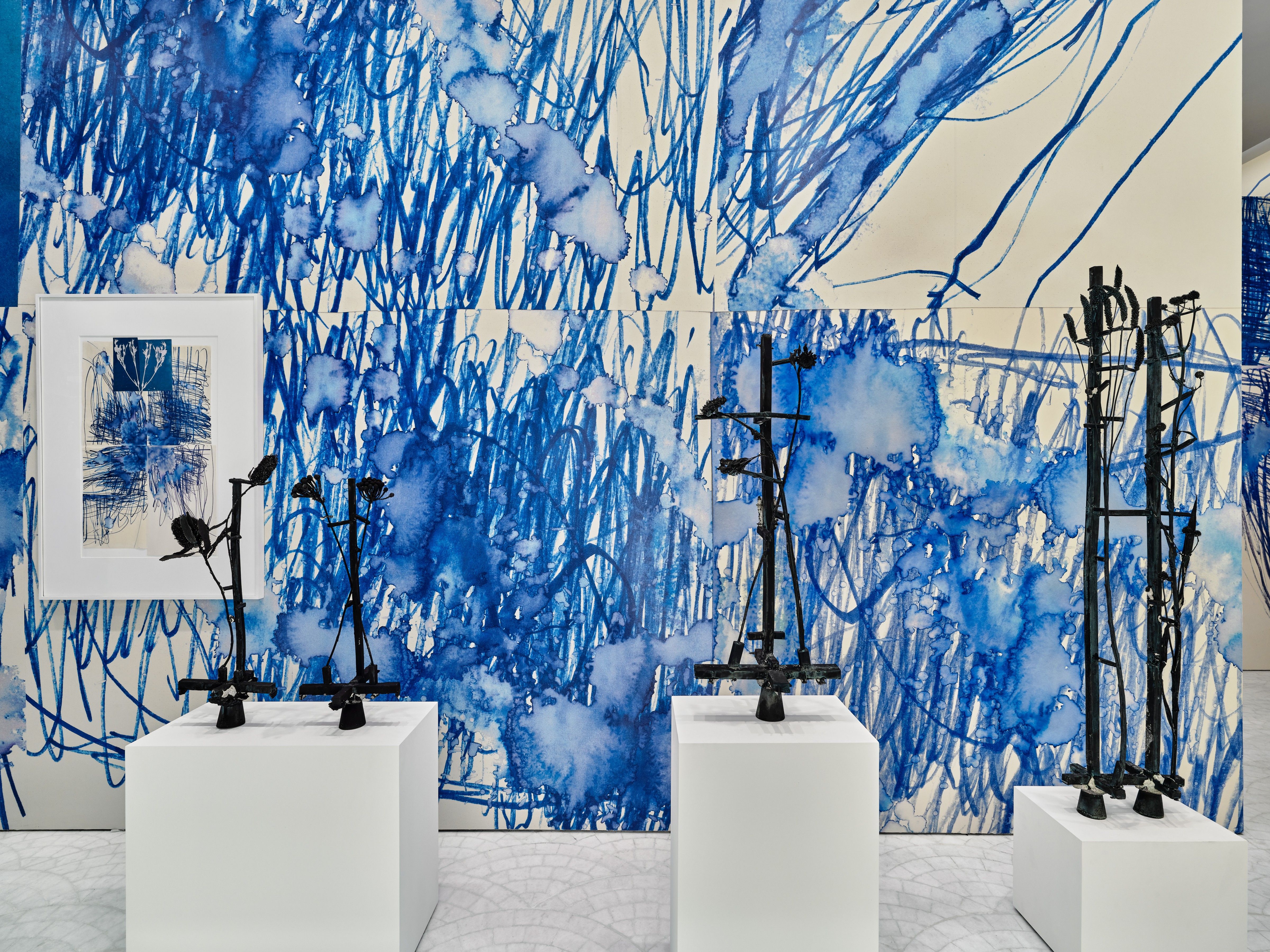
Perrotin is pleased to present How to Explain the Sculptures to an Influencer?, the eighth solo exhibition by Johan Creten at the gallery – the fourth in Paris. On this occasion, the artist presents new basreliefs, sculptures and furniture sculptures in bronze and clay.
Johan Creten (born 1963, Sint-Truiden, Belgium, lives and works in Paris) explores the conditions under which a work appears in the real. The artist presents contemporary social mores in different contexts, such as public, domestic, and white cube spaces. Using a title[1] that references art history (specifically Joseph Beuys’ 1965 performance at Schmela Gallery in Düsseldorf during which he explained art to a dead hare[2]) and the contemporary world, the exhibited pieces form a narrative, plastic, and political whole. The sculptor-ceramist studied painting at the Royal Academy of Fine Arts of Ghent and then at the Beaux-Arts in Paris, where he worked on performance art before shifting his focus to the object. Johan Creten works with clay and bronze, not only for their plastic potential but also for their intrinsic narratives. Clay represents the foundation of a society in the making, while bronze tells us about our relationship with history, mainly through monuments.
The exhibition features a collection of bas-reliefs, sculptures, and furniture sculptures. Like Beuys and Austin, Creten is concerned with language: La Langue ( The Tongue/ The Language) was the object of the artist’s first performance in 1986 while still a student at the Beaux-Arts. Exhibited during the day at Galerie Meyer, near the Beaux-Arts, the artist took the sculpture with him across the city at night. C’est dans ma nature (It’s in My Nature), from the eponymous project (2001 - 2021), and La Rencontre (The Encounter) explore the transmission of cultural heritage in a setting where the living no longer occupies center stage. Mounted on rolling panels, the pieces were used to restore damaged housing facades in Aulnay-sous-Bois and Mechelen. Can one story conceal another? In a rapidly changing world in search of ideals of stability, Creten often refers to Maurice Maeterlinck’s The Life of Bees, which presents the beehive as a model for a communal utopia where everyone works for the common good.
Small bronze figures cast in lost wax[3] on a platform present a half-human, half-animal bestiary. Like characters from the Commedia dell’arte, grasshopper, wild boar, sheep, seahorse, Hypocrite, dead fly, and herring woman form a merry theatrical troupe. The scale of the figures contrasts with the grandeur and norms of traditional public monuments.
The animals tell the story of a social body that is beginning to fracture, similar to William Golding’s human fable Lord of the Flies, in which a group of children, left to their own devices, must learn to self-organize and end up reproducing the same patterns they learned from their upbringing in a more extreme manner. Johan Creten has placed his sculptures on a colored ceramic socle4 that stands on a pedestal, which symbolizes the concept of a diverse and ideal society; however, it also represents the homogenizing effects of self-promotion on social media. The sculptures are hollow inside, like a Brillo box, poking fun at the fleeting fame and self-indulgence of an over-connected world.
Finally, Points d’observation (Observation Points) features seven performative sculptures in bronze and enameled stoneware. In a nod to Marcel Broodthaers and his Musée des Aigles, Johan Creten invites the body, both individual and collective, to take a seat. Featured in collections such as the Musée d’Art Moderne de Paris, the bronzes emphasize the importance of sustainable social structures and a shared habitat. Bernard Palissy, a French potter, enameller, painter, writer, and scholar of the 16th century, was one of the first to understand that fossils, which are the remains of plants and animals, were proof of the shifting of the seas caused by global warming. Creten’s works call for a reconsideration of our relationship with beauty and the forms of life that existed long before us.
Beuys said of his performance, “The Hare (...) incarnates itself in the earth: it’s the only thing that matters.” Johan Creten uses the soil to shape the new, elevating beauty to an art of living.
—Agnès Violeau
1 - The title refers to instructional guides that promise quick success such as How to Get Famous Fast. It also refers to the essay How to Do Things with Words (1962) by the philosopher of language J.L. Austin, who experimented with such deceptive titles long before the days of TikTok tutorials.
2 - Wie Man Dem Toten Hasen die Bilder erklärt (How to Explain Pictures to a Dead Hare).
3 - For Beuys, wax is a healing balm, but in Christian iconography, it symbolizes obedience.
*****
"L’homme est un animal politique."
—Aristote
La galerie Perrotin est heureuse de présenter How to Explain the Sculptures to an Influencer?, la huitième exposition personnelle de Johan Creten à la galerie – la quatrième à Paris. À cette occasion, l’artiste présente un nouvel ensemble de bas-reliefs, sculptures et sculptures-mobilier en bronze et argile.
Johan Creten (1963, Sint-Truiden, Belgique, vit et travaille à Paris) interroge dans son travail les conditions d’apparition d’une œuvre dans le réel. L’espace public, domestique, ou celui du white cube sont autant de contextes dans lesquels l’artiste met en scène le théâtre social contemporain. Réunies sous un titre[1] alliant histoire de l’art (précisément une référence à Joseph Beuys lorsqu’il tente, en 1965, d’éduquer un lièvre mort à l’art à la galerie Schmela de Düsseldorf[2]) et mondes modernes, les pièces forment un ensemble à la fois narratif, plastique et politique. Le sculpteur-céramiste étudie la peinture à l’Académie royale des Beaux-Arts de Gand, puis à Paris où il travaille la performance pour arriver à l’objet. La terre et le bronze sont des matériaux que Johan Creten travaille tant pour leur potentiel plastique que pour les récits qu’ils sous-tendent. L’argile en tant que fondement d’une société en devenir ; le bronze pour ce qu’il raconte de notre rapport à l’histoire, notamment à travers le monument.
L’exposition regroupe un ensemble de bas-reliefs, sculptures et sculptures-mobilier. Comme chez Beuys et chez Austin, c’est pour Creten avant tout une histoire de langue: La Langue était l’objet de la première performance de l’artiste en 1986, lorsqu’il était encore étudiant aux Beaux-Arts. Exposée en journée Galerie Meyer, rue des Beaux-Arts, la sculpture traversait avec l’artiste la ville pendant la nuit. C’est dans ma nature, issue de l’action éponyme (2001 - 2021), et La Rencontre, évoquent la circulation d’un patrimoine culturel dans un décor où le vivant n’occupe plus la première place. Les saynètes, fixées sur des panneaux roulants, étaient conduites jusqu’à Aulnay-sous-Bois et Mechelen où elles devaient restaurer des façades accidentées. Un récit peut-il en recouvrir un autre? Alors que des idéaux de fixité persistent dans un monde en mouvement, Creten se réfère volontiers au livre La vie des abeilles de Maurice Maeterlinck, qui entrevoit le modèle fonctionnel d’une ruche comme utopie communautaire, où chacun.e œuvrerait au bien commun.
Sur une estrade, de petits bronzes moulés à la cire perdue constituent un bestiaire mi-humain mi-animalier. Tels des personnages de laCommedia dell’arte, sauterelle, sanglier, mouton, hippocampe, Hypocrite, mouche morte et femme au hareng constituent le plateau d’une joyeuse troupe théâtrale. Les figures viennent contredire, par leur échelle modélisée, la grandiloquence et les normes3 du monument public tel qu’il fait valoir l’histoire. Les animaux racontent ici un corps social dont la patine craquelle, un peu comme dans la fable humaine Sa majesté des mouches de William Golding : livrés à eux-mêmes dans la nature, des enfants doivent s’organiser, pour finir par reproduire à l’excès les schèmes qui les ont éduqués. En plaçant les bronzes sur des socles4 en céramique colorée, eux-mêmes installés sur un piédestal, Johan Creten nous parle d’un idéal de société dans sa diversité. Également, du self-staging ou mise en scène du soi construit par des réseaux homogénéisants. À travers ces sculptures, évidées dans leur intérieur comme l’est la boîte Brillo, l’artiste s’amuse des quinze minutes de gloire d’un monde surconnecté qui fréquente un peu trop l’autosatisfaction.
Enfin, les Points d’observation sont sept sculptures à performer, en bronze et grès émaillé. En clin d’œil à Marcel Broodthaers et son musée des Aigles, Johan Creten invite le corps, physique et collectif, à trouver une assise. Présents au sein de collections - dont celle du musée d’Art Moderne de Paris - les bronzes préconisent la soutenabilité de nos structures sociales, nous invitant à un habitat partagé. Le potier, émailleur, peintre, écrivain et savant français Bernard Palissy (XVIe siècle) avait déjà compris que les fossiles, restes de plantes et d’animaux, constituaient la preuve du déplacement des mers dû au réchauffement climatique. Les œuvres de Creten appellent à repenser notre rapport au beau, mais également à un vivant présent bien avant nous.
Beuys disait de sa performance «le Lièvre (...) s’incarne dans la terre: c’est la seule chose qui importe. » Johan Creten fait d’elle le terreau dans lequel façonner l’inédit, édifiant la beauté au rang d’un art de vivre.
—Agnès Violeau
1 - Le titre renvoie aux tutoriels du fast-learning comme Comment être célèbre facilement ?. Dans son essai How To Do Things With Words (1962), le philosophe du langage John Austin, bien avant l’heure des tutos sur tik-tok, jouait déjà
avec un titre faussement pédagogique.
2 - Wie Man Dem Toten Hasen die Bilder erklärt (Comment expliquer les tableaux à un lièvre mort).