

Exhibition · WNTRP
Louisa Clement & Studio Miessen
Fractures
Apr 27 – Jul 7
2 images · swipe
About the show
[Please scroll down for German version / Für Deutsch bitte scrollen Sie nach unten]
WNTRP presents a collaboration between Louisa Clement & Studio Miessen.
In recent years, Louisa Clement repeatedly used mannequins in her photographic series in order to pose questions about real and simulated bodies. The frame of references ranges from Edgar Adget’s shop-window photographs from the early twentieth century to more recent developments such as the genesis of the digital avatar at the last turn of the century. In both cases, a quite concrete “animation” – in the etymological sense – of the objects behind the window or the screen was at issue. In Clements recent series Avatar (2016), a mannequin of bright acrylic resin becomes a means to an end — a kind of placeholder – to interrogate forms of communication between avatars. In her new video series Not lost in you (2017) a hand touches this avatar in a very hesitant, tentative manner. The tight-fitting glove, however, prevents direct contact, any immediate sensory experience, and, in spite of the closeness and almost erotic interaction, ensures a clear and cool distance. Clement is interested here in the interface of the virtual and the real — the avatar can be in front of us, be touched, and yet a real reaction from it is impossible. Even the shaking of the mannequin is externally controlled.
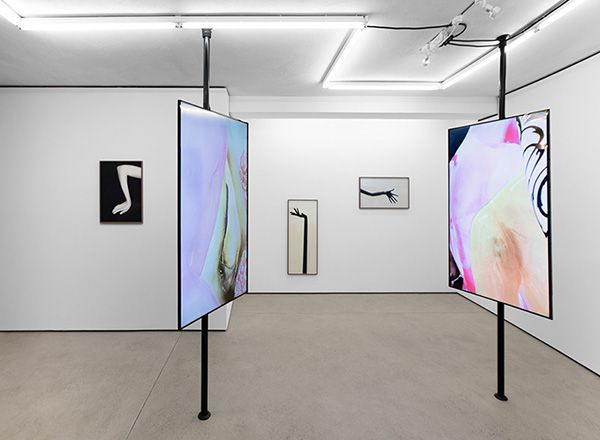
In her series Fractures (2016), the artist takes up questions of identity formation. Everyday, humans construct their own identity and that of their opposites from different parts, and sometimes they make mistakes. In Fractures, we see curved and distorted body parts of mannequins that are sometimes put together wrongly, which symbolizes the construction of identities.
The exhibition design by Studio Miessen is conceived as a ‘background actor’. The focus here is on the complex relationship of the artist’s filmic works and its beholder, especially in regards to the relationship between space and the dynamic of the real and the precarious that opens up between corporeality and its digital projection in the age of artificial intelligence. Since the video works approximate the scale of the human body, the experience in this space is quite physical: the beholder is captures by the works and becomes a part of it. This direct interaction with the works then becomes a projection surface for the other beholders observing this. The abstract identity of the Fractures is thus further accelerated.
Louisa Clement (born 1987 in Bonn, Germany) lives and works in Bonn and Düsseldorf, Germany. From 2010 – 2014 she was a master student of Andreas Gursky at the Kunstakademie Düsseldorf, where she graduated in 2015.
In 2016 Louisa Clement had solo and group exhibitions at Bundeskunsthalle Bonn, Kunsthalle Recklinghausen and Kunsthalle Düsseldorf in Germany; at Cité Internationale des Arts in Paris and Rencontres Photographiques de Toulouse, France as well at On Stellar Rays Gallery in New York.
In 2017 works by Louisa Clement have been presented in a solo exhibition at the Wallraff-Richartz-Museum in Cologne, Germany and the artist participated in the group show Lyrics on a Battelfield at Gladstone Gallery in New York, USA.
In May Clement’s solo exhibition Language of realities opens at Kunstraum Riehen in Basel, Switzerland. Furthermore she takes part in two major group exhibitions at the Huis Marseille in Amsterdam and the Museum für Photographie in Braunschweig.
For 2017, Louisa Clement received the EHF 2010 Stipendium from the Konrad-Adenauer-Stiftung, Germany. In addition, she was awarded the Förderpreis des Landes Nordrhein-Westfalen and a prize from the Cité Internationale des Arts in France. In 2016, she received the Artistic Residency of the 6th Marrakech Biennial.
Clement’s works are part of the collections of Huis Marseille, Amsterdam, The Netherlands, Atlanta Kulturstiftung, Bad Homburg, Germany; Collection of the City of Brühl, Germany; Collection Ringier, Zurich, Switzerland and numerous private collections in Europe, Asia and the US.
Markus Miessen is a Berlin-based architect, writer, and Professor at the Academy of Design, University of Gothenburg, Sweden. He received his PhD from the Centre for Research Architecture at Goldsmiths, London, supervised by Eyal Weizman. The initiator of the Participation tetralogy, his work revolves around questions of critical spatial practice, institution building, and spatial politics. Miessen has previously taught at the Architectural Association (London, UK), and has been a Harvard Fellow. Most recently, he has held a Stiftungsprofessur for Critical Spatial Practice at the Städelschule (Frankfurt, DE), and was Distinguished Professor of Practice at the University of Southern California (Los Angeles, US). Amongst many other books and writings, Miessen is the author of “The Nightmare of Participation” and “Crossbenching” (both Sternberg Press, Berlin).
His architectural design practice, Studio Miessen, works closely with a number of artists such as Hito Steyerl and Flaka Haliti, and is currently involved in the spatial re-conceptualization of the Martin Gropius Bau (Berlin, DE) under the new directorship of Stephanie Rosenthal. The studio has realised projects with and for clients such as: Artists Space (New York, US), Artsonje (Seoul, KR), Bergen Assembly (NO), Berlin Biennale (Berlin, DE), HKW Haus der Kulturen der Welt (Berlin, DE), IMA Institute of Modern Art (Brisbane, AU), Istanbul Biennale (TR), Kunsthalle Wien (Vienna, AT), Kunstverein in Hamburg (DE), n.b.k. Neuer Berliner Kunstverein (Berlin, DE), Performa Biennial (New York, US), Serpentine Gallery (London, UK), The Art Institute of Chicago (US), Witte de With (Rotterdam, NL), and Weltkulturen Museum (Frankfurt, DE).
*****
Zum diesjährigen Gallery Weekend Berlin präsentiert WNTRP eine Kollaboration zwischen Louisa Clement & Studio Miessen.
In den letzten Jahren hat sich Louisa Clement in ihren fotografischen Serien immer wieder Schaufensterpuppen zu Nutze gemacht, um so weiterführende Fragen nach wirklichen und simulierten Körpern zu stellen. Der Referenzrahmen reicht hier von Edgar Atgets Schaufensterfotografien des frühen 20. Jahrhunderts zu jüngeren Entwicklungen, wie der Genese des digitalen Avatars der letzten Jahrhundertwende. In beiden Fällen stand eine im etymologischen Sinn konkret gemeinte „Animierung“ – also Beseelung – der Objekte hinter den Scheiben oder Screens zur Diskussion. In Clements unlängst realisierter Serie des Avatars (2016) wird eine Puppe aus leuchtendem Acrylharz Mittel zum Zweck – zu einer Art Platzhalter – um Formen der Kommunikation und das Aufeinandertreffen zwischen Avataren zu befragen. Für ihre neue Videoserie Not lost in you (2017) streicht zögernd, tastend eine Hand über eben jenen Avatar. Der eng anliegende Handschuh verhindert jedoch die direkte Berührung, das unmittelbare Empfinden und schafft bei aller Nähe und beinahe erotischer Interaktion dennoch deutliche und kühle Distanz. Clement geht es hier um die Überschreitung der Schnittstelle des Virtuellen und Realen – man hat den der Avatar real vor sich, begreift ihn haptisch, jedoch ist eine reale Reaktion des Gegenübers ausgeschlossen. Selbst das Wackeln der Puppe geht nicht von ihr selbst aus.
In ihrer Serie Fractures (2016) greift die Künstlerin Fragen der Identitätsbildung auf. Tagtäglich konstruiert der Mensch seine eigene Identität oder die seines Gegenübers und setzt sie aus verschiedenen Teilen zusammen – manchmal auch fehlerhaft. In Fractures sehen wir geschwungene und verdrehte, zum Teil fehlerhaft zusammengesetzte Körperteile von Schaufensterpuppen, die sinnbildlich für das Zusammensetzen von Identitäten stehen.
Das Ausstellungsdesign von Studio Miessen versteht sich als Akteur im Hintergrund. Im Fokus steht hierbei das Beziehungsgeflecht aus den Film-Arbeiten der Künstlerin und dessen Betrachter, vor Allem in Bezug auf die Auseinandersetzung zwischen Raum und der real-prekären Dynamik, die sich zwischen Körperlichkeit und deren digitaler Projektion im Zeitalter von Artificial Intelligence aufspannt. Da sich die Video-Arbeiten dem Maßstab des menschlichen Körpers nähern ist die Erfahrung in diesem Raum durchaus physisch: der Betrachter wird von der Arbeit eingenommen und Teil von ihr. Dieser direkte Austausch mit der Arbeit wird wiederum zur Projektionsfläche der übrigen, beobachtenden, Betrachter. Die abstrakte Identität der Fractures wird dadurch noch weiter beschleunigt.
Louisa Clement (geboren 1987 in Bonn) lebt und arbeitet in Bonn und Düsseldorf. Von 2010 – 2014 war sie Meisterschülerin von Andreas Gursky an der Kunstakademie Düsseldorf, an der sie 2015 ihren Abschluss machte.
2016 hatte Louisa Clement Einzel- und Gruppenausstellungen in der Bundeskunsthalle Bonn, Kunsthalle Recklinghausen und Kunsthalle Düsseldorf; im Cité Internationale des Arts in Paris und Rencontres Photographiques de Toulouse, sowie bei On Stellar Rays Gallery in New York.
In 2017 wurden ihre Werke in einer Einzelausstellung im Wallraff-Richartz-Museum in Köln präsentiert, zudem nahm sie an der Gruppenausstellung Lyrics on a Battelfield bei Gladstone Gallery in New York teil.
Im Mai diesen Jahres eröffnet Clements Einzelausstellung Language of realities im Kunstraum Riehen in Basel. Weiter ist sie Teil von zwei großen Fotografie-Gruppenausstellungen im Museum für Photographie in Braunschweig und dem Huis Marseille in Amsterdam.
2017 erhielt Louisa Clement das EHF 2010 Stipendium der Konrad-Adenauer-Stiftung. Sie ist Trägerin des Förderpreises des Landes Nordrhein-Westfalen des Preises der Cité Internationale des Arts in France. 2016 bekam sie die Artistic Residency of the 6th Marrakech Biennial.
Clement’s Arbeiten sind Teil der Sammlungen des Huis Marseille, Amsterdam; Atlanta Kulturstiftung, Bad Homburg; der Sammlung der Stadt Brühl; der Sammlung Ringier, Zürich sowie zahlreichen Privatsammlungen in Europa, Asien und den USA
Markus Miessen ist ein in Berlin lebender Architekt und Autor, und Professor an der Hochschule der Künste, Göteborg. Er promovierte bei Eyal Weizman am Londoner Goldsmiths College. Als Initiator der Partizipations-Tetralogie beschäftigt sich Miessen seit 2007 mit Fragen der Raumpolitik, kritischer Raumpraxis und dem Aufbau –– physisch und programmatisch –– von Institutionen. In der Vergangenheit hat Miessen an der Architectural Association (London, UK) unterrichtet, hatte eine Stiftungsprofessur an der Städelschule (Frankfurt, DE) und der University of Southern California (Los Angeles, US) inne, und war Harvard Fellow (Cambridge, US). Neben einer Vielzahl anderer Publikationen ist er der Autor von “The Nightmare of Participation” und “Crossbenching” (beide Sternberg Press und Merve, Berlin).
Sein Architekturbüro, Studio Miessen, arbeitet in enger Kollaboration mit Künstlern wie Hito Steyerl und Flaka Haliti und ist derzeit mit der Rekonzeptualisierung der Räume des Martin Gropius Bau unter der neuen Direktorin Stephanie Rosenthal betraut worden. Studio Miessen hat in der Vergangenheit, unter anderem, an Projekten mit und für Kunden wie Artists Space (New York, US), Artsonje (Seoul, KR), Bergen Assembly (NO), Berlin Biennale (Berlin, DE), HKW Haus der Kulturen der Welt (Berlin, DE), IMA Institute of Modern Art (Brisbane, AU), Istanbul Biennale (TR), Kunsthalle Wien (Vienna, AT), Kunstverein in Hamburg (DE), n.b.k. Neuer Berliner Kunstverein (Berlin, DE), Performa Biennial (New York, US), Serpentine Gallery (London, UK), The Art Institute of Chicago (US), Witte de With (Rotterdam, NL), and Weltkulturen Museum (Frankfurt, DE) gearbeitet.