Ended Jun 21
Spotlight: Peter Halley
May 21 – Jun 21, 2025
More from Spotlight: Peter Halley on Gallop
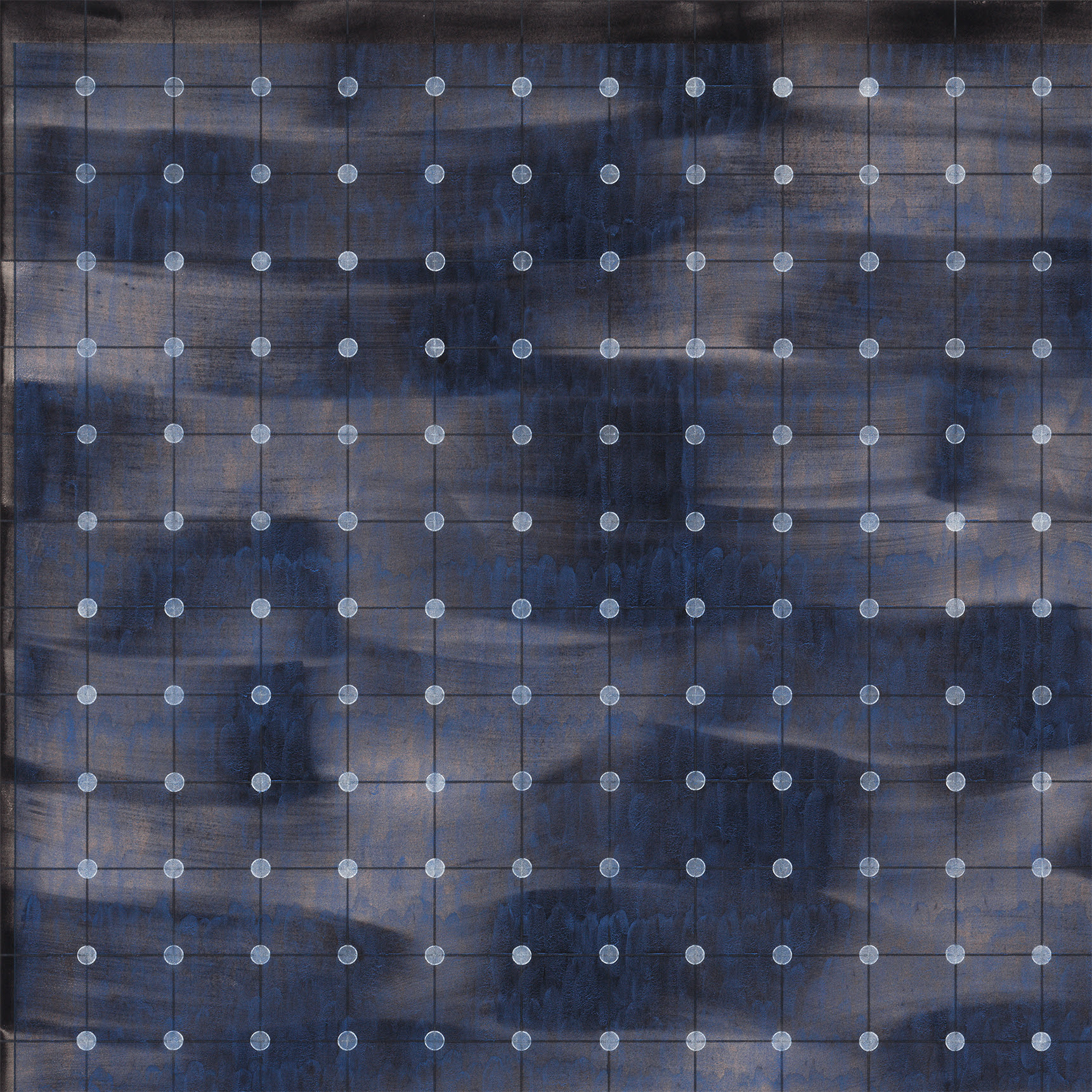
The Spotlight series includes a new or never-before-exhibited artwork paired with a commissioned piece of writing, creating focused and thoughtful conversations between the visual arts and authors, critics, poets, scholars, and beyond. In this iteration, the Spotlight features Peter Halley's Altar, 2025. A text by poet Elaine Equi accompanies the presentation.
"1.
I stand before a brick wall.
"It's a humble brick wall, only the bricks happen to be gold."
A gold better than real or fool's gold – a gold only to be found at Home Depot.
Actually, it's more a brick box, a cupboard, a medicine chest, a little theater.
It's like an inside-out vault. You break in to steal its emptiness.
But there's something else. Do I need to know what?
Yes, I'm curious. It's got my attention.
Haven't you ever wanted to stare at a wall and watch it like a movie?
Wait as long as it takes for it to open and tell you its story.
2.
Now the brick sea parts and other colors emerge in all their dayglo glory.
Colors are the actors. Colors bring the drama.
There is even an explosion! More on that later.
This is a moving picture with moveable parts.
A blue and red unfolding. A pink and orange waiting in the wings.
You can alter your mood by looking.
You can open these panels of color like shutters on a window.
You can look through this picture into another one.
Haven't you ever wanted to look inside a picture?
3.
A digression on altars and their pieces.
An altar is a table set in the soul kitchen of the sky.
It is a square crossed by languid girls and boys who ring bells – carry incense and bread while we perform the dance of circling, standing, sitting, kneeling, as the choir sings a hymn to him and her and they and them.
An altar is a battery for recharging a frayed and fretting – a fried mind.
Its silence absorbs us – drinks us in.
No church is needed.
One can fashion an altar in the smallest of spaces from the simplest things – offering a flower to a painted being.
I have an altar to perfume. I have an altar to candy. I have an altar to Ganesha. I have an altar to Isis. I have an altar to Elvis. I have an altar to Brando. I have an altar to Rimbaud. I have an altar to St. Joe Brainard who was himself a maker of altars.
4.
Where is the spark?
Match held in the cave of a cupped hand.
Lightgeist.
The blank light of a page around a word.
The light of a word in the mind.
Learning the language the luminous light-headed ones speak.
Sipping cocktails of water and light. Fizzy lemon and limelight.
("to pin to the shimmer a name")
Ordinary light waving a warm greeting -- or is it a warning?
Atomic Trumpet Blast
Desert music.
Sonic light echoing -- the everywhere-all-at-once-ness of it.
Sudden bright out-of-body lightness.
Hot-headed light. Heavy light.
Does this light make me look fat?
I remember during a long stretch of insomnia – climbing up every morning to the altar of my roof-deck to be startled by the cool beauty of dawn.
"Eden, glossolalia of light Mountain the gods stepped from"
Looking with darkness for light lost and found."
—Elaine Equi, Altared States
Peter Halley (b. 1953, New York, NY) is an American artist recognized as a key figure in the Neo-Conceptualist movement of the 1980s. Since the 1980s, Halley's lexicon of "prisons," "cells," and "conduits," have been used to examine the technological forces that regulate daily life. Known for his use of fluorescent colors and Roll-a-Tex, Halley embraces materials that are anti-naturalistic and commercially manufactured. Halley's work has been the subject of major one-person exhibitions at the Museo Nacional Thyssen-Bornemisza, Madrid, Spain (2024); Musée d'Art Moderne Grand-Duc Jean (Mudam), Luxembourg, Luxembourg (2023); the Santa Barbara Museum of Art, Santa Barbara, CA (2015); Musée d'Art Moderne et Contemporain, Saint-Étienne, France (2014); Museum Folkwang Essen, Germany (1998); Museum of Modern Art, New York, NY (1997-98); and Musée d'art contemporain (CAPC), Bordeaux, France (1991). He has executed installations at the NSU Art Museum, Fort Lauderdale, FL (2024); Museo Nivola, Orani, Sardinia, Italy (2021); Greene Naftali, New York, NY (2019); Venice Biennale, Venice, Italy (2019); Lever House, New York, NY (2018); Schirn Kunsthalle, Frankfurt, Germany (2016); Disjecta, Portland, OR (2012); the Gallatin School, New York University, New York, NY (2008, 2017); the Museum of Modern Art, New York, NY (1997); and the Dallas Museum of Art, Dallas, TX (1995). Halley served as professor and director of the MFA painting program at the Yale School of Art, New Haven, CT, from 2002 to 2011. From 1996 to 2005 he published Index Magazine, which featured interviews with figures from diverse creative fields. In 2013, Halley's essays on art and culture, in which he explores themes from French critical theory and the impact of burgeoning digital technology, were published in Selected Essays, 1981-2001. Halley's work is in the collections of the Centre Pompidou, Paris, France; Museo Nacional Centro de Arte Reina Sofia, Madrid, Spain; the Museum of Modern Art, New York, NY; and Tate Modern, London, UK, among others.
Elaine Equi (b. 1953, Oak Park, IL) is a poet living and working in New York, NY. Equi has published numerous books, including Voice-Over(1998, San Francisco State Poetry Award); Ripple Effect: New and Selected Poems (2007, finalist, L.A. Times Book Award); and The Intangibles (2019). Equi has taught in numerous creative writing programs, including New York University, City College of New York, and The New School, New York, NY. Equi's writing has been included in many publications, including the American Poetry Review , Brooklyn Rail , Big Other , The Nation , The New Yorker , among others. She is the recipient of the Guggenheim Fellowship (2024). Her work has been translated into Italian, French, Spanish, Russian, Chinese, and Arabic. Her most recent collection is Out of the Blank (2025) from Coffee House Press.