
Ended
Garth Evans
Names Are Misleading Things
Nov 7 – Dec 14, 2019
Next Door Guest: Kalup Linzy "Searching in Resemblance"
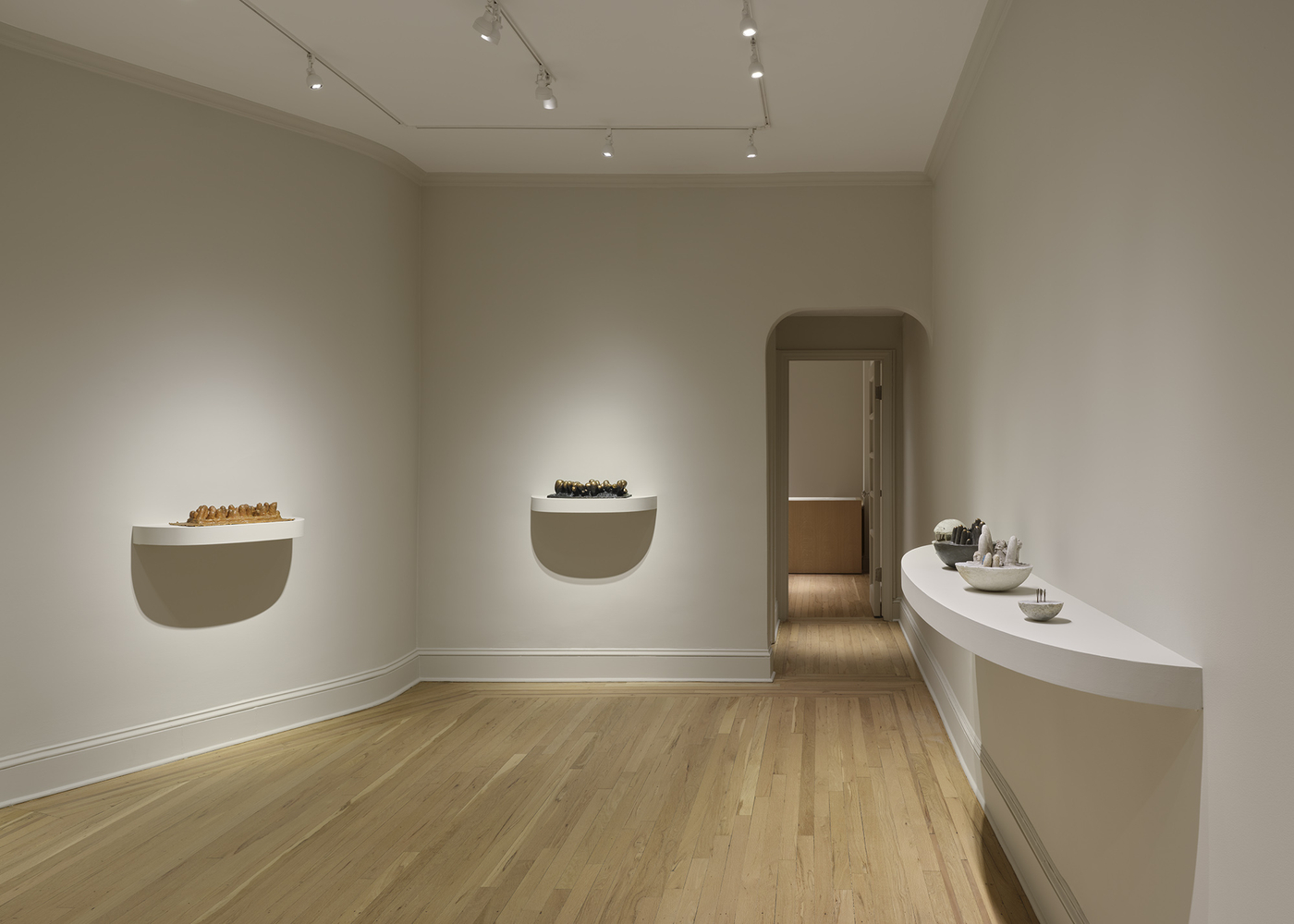
Johannes Vogt Gallery is pleased to present its third exhibition by British sculptor Garth Evans, Names are Misleading Things. The show focuses on plywood wall mounted sculptures created by the artist shortly after emigrating to the United States in the early 1980s. It comes on the heels of the opening of the artist’s recent retrospective, But Hands Have Eyes, in Cardiff and the return of a monumental sculpture he made for the city.
In 1979 Evans was invited to Mount Holyoke College in Massachusetts for a two-year visiting artist residency. At the conclusion of that residency and although well established in the U.K. Evans decided to stay in the United States and relocated to Canal Street in Manhattan.
In the U.K., Evans was primarily known for large expansive works, some of which covered entire floors. At Mount Holyoke, surrounded by the openness of rural America, Evans’ work moved in a new and surprising direction; instead of responding to the largeness of American culture by making even larger works as one might expect, Evans began to question the need for sculpture to physically occupy great volumes of space. He began making works that are intimate in scale, demanding the attention of the viewer through formal considerations.
These works were initiated at Mount Holyoke. Collectively titled Canal, they began as small models made in cardboard that Evans intended to realize as larger sculptures. Over time, cardboard models began to clutter his studio as he worked. In order to free up space, Evans began moving the cardboard models from the floor to the wall. There, the cardboard models caught and held his attention. Eventually he was obliged to accept that they were not “models” at all, but potential sculptures. He began reworking some of them using plywood. He recounts having had a nagging feeling as he worked; a troubling concern that he had seen something similar to the pieces he was making, perhaps similar works that he could not locate. His attention kept returning to one particular plywood sculpture on the wall of his studio. One day, staring at this work he suddenly realized where he had seen it before – the sculpture reminded him of of a dead rabbit, a dead rabbit in a painting by Chardin!
The parallel between the plywood object and the dead rabitt was not primarily a matter of the image but rather the result of the way the two occupied space and responded to gravity as well as the combination of implied stiffness and softness. From this point on Evans began to discover other hidden sources in these plywood sculptures. Often, although formally resolved, the objects bothered him until the memory they were making a connection to revealed itself.
Although Evans did not title these works, simply giving them the designation, Canal and a number. He notes
From time to time I’ve been accused of giving titles that are actually misleading, and it’s true that I have done that. But they’re only misleading because they’re not the first thing you think of, nor the second nor the third thing...
It is misleading to regard these works as pure, although they are geometric and formal, dictated by material constraints and concerns such as being made from plywood, needing to have an engagement with the wall and having to hang from a single point. Through the long process of production and gestation each arrives at a discrete moment of consciousnesses.
Garth Evans was born in 1934 in Cheshire, England. He is a British sculptor and draughtsman. His work, which is central to the narrative of British Sculpture, has been exhibited widely in both the UK and the United States. He is known for his use of everyday materials together with a restless self questioning approach, rejecting any aesthetic position that has become too comfortable. He currently lives and works between Woodstock, Connecticut and New York. Evans’ work has been shown in many solo shows, including shows at Rowan Gallery, London, Robert Elkon Gallery, Tibor de Nagy Gallery, New York, and Charles Cowles Gallery, New York. His works can be seen in collections including the Metropolitan Museum of Art, New York, Museum of Modern Art, New York, The Tate Gallery, London, and the Victoria and Albert Museum, London.
Johannes Vogt Gallery is committed to bringing attention to the complex artistic and cultural ties that bind New York to Europe, the Americas, and beyond. The gallery program features a strong roster of emerging to mid-career artists and has become known for reintroducing established artists to new audiences, including Garth Evans, Mernet Larsen, and Abby Leigh, among others. Founded in 2011, Johannes Vogt first opened at 526 West 26th Street in New York City’s Chelsea neighborhood, where it resided before relocating to 55 Chrystie Street in the Lower East Side. In September 2018, the gallery relocated to the Upper East Side at 958 Madison Avenue.