Ended Apr 6
Mary Stephenson
Soft Footing
Apr 2 – Apr 6, 2024
More from Mary Stephenson on Gallop
[Scroll down for French version / Veuillez trouver ci-dessous la version française]
After you ordered our drinks, I tried to reminisce with you about the room where we all slept as children. All five of our beds were slotted in that one room, and there was a window with a direct view of the front of the Blue Café.
The name and the interior of the café were incongruous: the walls were yellow, the chairs were metal, and the tables were a white-washed wood. This provoked in me a humming anxiety, a feeling similar to the one I got when you dressed our Barbie in clothes from other toys, which hung off her in strange ways, the proportions wrong, her glamour and perfection undermined. Once, I asked our mother if the furniture or interior of the Blue Café had been blue before, when she first moved into our house, but she said she couldn’t remember. You then asked her who arrived on the street first – her or the Blue Café - and she said she couldn’t remember that either. I didn’t believe her, as our mother remembered much more specific things than this – the exact time the BBC announced the death of Princess Diana (4.41pm), the t-shirt our father wore the last time she ever saw him (grey, with the Wilson logo), the name and parents’ names of the boy I was out with when she caught me smoking by the canal (Matthew, Mark and Debbie) - but why would she lie? My mother had been raised to see a good memory as key to winning an argument, essential to a moral high ground. Without memory, one could lose one’s grasp of the ways one had been wronged, and in turn, could no longer righteously perform stoicism. I suppose she just felt ambivalent about the Blue Café. It was simply another thing she passed by, anonymously, each day.
Do you remember the time you, Jane and I stopped there, because she had lost the front door key again, and you and I noticed that the bathroom was painted blue? It was clearly old paintwork, unlike the yellow out in the front room. We could tell because there were empty screw-holes from an absent towel rail, above the new hand-dryer, which hadn’t been painted over. But do you remember how triumphant we were, to know, basically for sure, that the Blue Café was called that because, for a time, it was blue? How we felt as if we’d solved a riddle? The easy relief of children.
Who remembers the Blue Café from when it was blue? Our mother doesn’t, she says. Maybe our father would, but we have no way of knowing. Maybe Mrs Cleaver - who lived at number 44 and was, for over 15 years, the oldest person on our street - remembered it best, for a while. Maybe she once looked from her window to see blue walls and blue tables and small white flowers in blue vases and maybe that was just one of the many visions that died with her, when she eventually went, just like the view of her parents’ kitchen – the burning logs, the fat in the jar – that she carried alone after their death, and the death of her siblings. Did she know that she was the only person in the world who could picture it, before it was extinguished with her? Life makes everything so temporary, doesn’t it – little sparks and flashes, burning for a while, going out when we do? Whole rooms now dark.
From our beds, you could see the front three tables of the Blue Café. If you sat on Jane’s bed you could only see the corner table, though you could hear the hum of the extractor fan loudly, a hum that I still associate with the café, even though it’s a common enough sound. The whirl retains a sense of promise to me. It is the sound of the coming future – the Blue Café was the outside world, with all the allure of the unfamiliar. Our brothers’ beds were too far back to see much at all, apart from the top of the Blue Café’s sign. I don’t remember ever talking to them much about the Blue Café, likely because it wasn’t one of the images that they lived alongside – they didn’t wake to it, didn’t see it behind their eyes while dreaming, didn’t picture it as part of the carousel of “home” motifs that they longed for when staying over at a friend’s house, scared by the weird smells of someone else’s mother’s cooking, the oddness of other people’s routines. But you and I had a prime view, from our beds, and watching the café bookended our days. We knew the regulars – Hat Man, the smokers, the beautiful boy with the folded paper bags, the lady who was scared of pigeons. The day you got rejected by Cardiff University, the final university not to have rejected you up until then, you came into our room with the letter still in your hand, and saw me sitting on my bed looking out the window, and told me in a sharp voice that I hadn’t heard before – the unfamiliarity, rather than the tone, shocked me - that staring at people was really weird and that I was a real freak for always looking out like that, always creeping on people, always being so fucking creepy just staring out the window making notes of who was eating what and who was arriving with who, which was strange to me because staring at the Blue Café was something that we’d always done together, and it was you, not me, that made the notes that time in the red diary you got given for Christmas.
The morning after that, you got straight in the shower when you woke up, even before Jane, who always showered first, so I watched the Blue Café alone. The sign seemed to pulse that morning, fuzzing like when you try and watch television while you’re crying, not that I cried because you weren’t watching the Blue Café with me like usual, I was fine with it, because all the regulars were there and it was comforting watching them. They weren’t my friends – we hadn’t formally met - but they weren’t exactly not my friends either, in the sense that I knew their predilections and could have picked any one of them out in the crowd, could have told anyone the rhythm of their day. The line between me and them was real enough – it was a thread that pulled me into a world of independence and preference and desire. I became a real proper person, as the smokers lit up for the first, second and third time. That morning, I felt sure that if I’d run in the opposite direction – away from the sound of the shower water on your head, out our back door, across the Lewiston Road and way, way, way down the hill they would have all been pulled with me, connected by teaming ribbons, banging and bumping on the ground as I sped away, like tin cans tied to the back of a wedding car.
That morning two women came into the café, about the age we are now. I hadn’t seen them before. The one with the feathery hair was holding a large bouquet of flowers, which is quite a dramatic look for seven thirty in the morning. And she kept on holding onto them even after she sat down, didn’t lay them on the wooden table, didn’t seem to want to let them out of her sight. The other woman – the one with the longer black coat - went up to the counter, even though one of the benefits of the Blue Café is that there is table service – they are quite quick actually, or they were that time we went in when Jane lost the key, and we saw the hand dryer screw marks, and they gave us Coca Cola even though Jane explained to them that we weren’t with our mum so didn’t have any money on us (not that she would have had any for us anyway). Do you remember?
From the way they regarded each other across the room, it was clear to me that the women were a couple. And I pictured them in bed that morning, the one at the counter with her arms wrapped around the one with the flowers. I imagined their room: books by the bedside, probably even more flowers in vases - they looked like nice people, people with good taste and money for things like that. They met at university, both on the same literature course, both reading the same books, both into the same jazz music. In the future that I knew was theirs, they spend their Saturdays cooking experimental recipes from books that their acquaintances bring back from far-off travels. They marry a few years after that day, and spend one weekend each month totally alone together at home - seeing no friends, talking to no one but each other. They would find that rejuvenating.
But back in the other present, at the Blue Café, the woman at the counter had sat down at the table and she had a stiffness to her when next to the woman with the flowers and it was suddenly clear that they were not a couple at all. In fact, from the way that she sat, her shoulders hunched and her handbag arranged in her lap, and her nervous glances around the room – to others and then back to her bag - it was obvious that she was old. Much older than her companion. The one with the flowers had her head bowed. She looked tense, reticent even, and it was obvious in this moment that rather than lovers, they were a mother and daughter, likely estranged. They had not seen each other in years and were meeting up to clear the air. The one with the flowers was cowed by the shame of not seeing her mother enough, not calling and not checking in, and that’s why she’d bought the flowers, to apologise, though she still felt that she’d not done enough. This was worrying her – she was concerned for the future and the thought that one day her mother would die and her shame would only intensify and she’d wish that she’d taken time to notice her mothers’ humanity, and ask her questions about her life, her hopes. She’d wish that she hadn’t cringed when her mother danced, or when her make-up smudged, wish she’d told her she looked beautiful, hadn’t found her expressions of effort so pitiful. She’d wish especially that she hadn’t rolled her eyes when her mother talked about how the people in the crowds by the palace hugged each other the day Princess Diana died, and how if everyone could be more loving the world would be a better place for people like us.
So, now in the future, simultaneously as the women are getting married, laughing together, one is mourning the other, picking out a coffin, reading a short eulogy as a crematorium technician nods encouragingly. Elsewhere, but in parallel time, they are colleagues dancing, old school friends reuniting. They are everyone you’ve ever known.
How many other people on our street saw those two women that day? And how many futures were conjured by those impressions: whole possible lives, spreading like tentacles into the great abyss that is time?
Jane sits down at my side, on my bed, in our room, and she follows my gaze through the window to the Blue Café and says she could be sure she recognises that woman, that one in the café with them flowers. She asks the boys to come look – boys, come look at that lady with them flowers, we know her, right? Don’t we actually know her? And together they try to remember where they know her from, but I know for sure that she is not in my memory, that I know her present and future, but only the lightest shades of her past. And I know that today, if someone was looking down at the Blue Café and saw you and me sitting here as we are now, in our best black clothes, me with the flowers, you at the counter with mum’s eulogy printed large – size 20 Arial – in your pocket, they wouldn’t recognise us either, wouldn’t even know that we are sisters, because no one from our street still lives here now. No one we know has lived here in years. And you look up at our old window, as our coffee arrives, and you say that of course you remember, that you remember it all so well: the watching, the lives we invented for people, the stories, the characters, the theories, some of which were undoubtedly true.
—Lou Stoppard
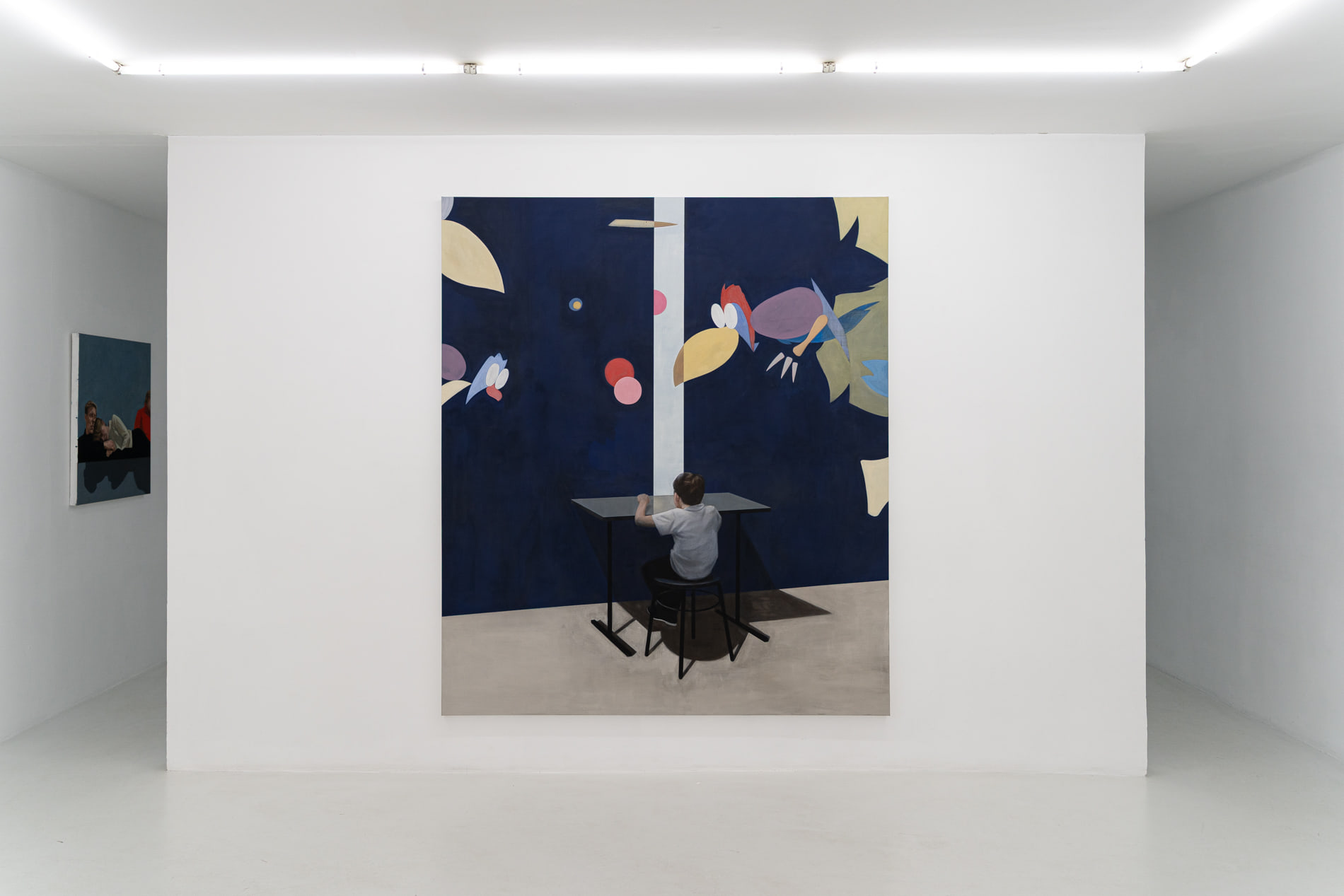
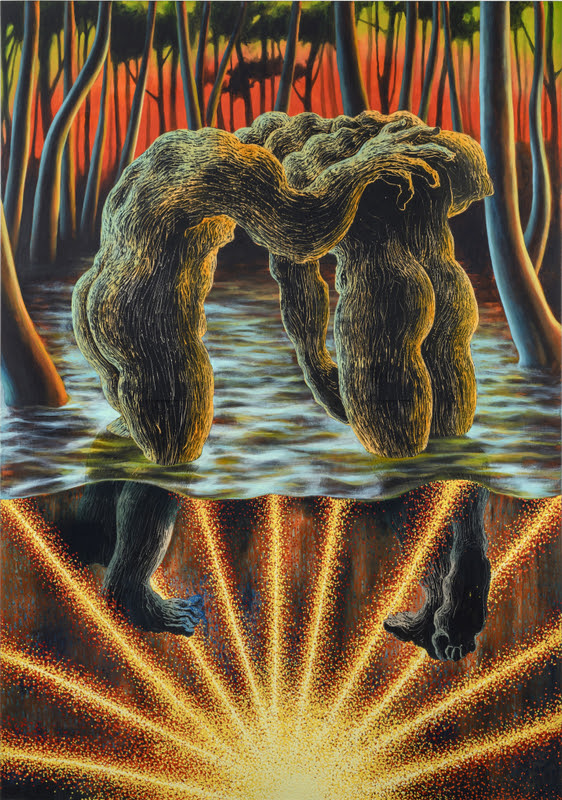
Mary Stephenson (b. 1989, London, lives and works in London) establishes an elusive and cinematic domain that fosters the unfurling of the unconscious. Delving into the liminal space situated between corporeal and internal states, the artist employs her discernible and highly saturated aesthetic universes to traverse the continuum from the familiar to the uncanny.
In Stephenson’s artistic realm, the inanimate becomes as crucial as the animate, with objects assuming a central role in the intricate tapestry of her narratives. Through her discerning lens, the paintings metamorphose into sorting rooms of excess thoughts, deftly layering narratives and conflicting emotions that illuminate the tumultuous nature of one’s projected self.
Stephenson’s oeuvre serves as a metaphorical magnifying glass, inviting viewers to scrutinise their own constructed identities. In this contemplative journey, her work acts as a mirror reflecting the manifold facets of human existence, offering a profound examination of the intricacies of self- perception and the societal pressures that shape our desires. When discussing her work, the artist likens her canvases to that of “pregnant spaces”. Through her art, Stephenson beckons us to confront the manifold layers of our projected selves and invites a thoughtful exploration of the narratives we construct to fit into the complex tapestry of human existence.
Mary Stephenson graduated from The Royal Academy, London in 2023. Her work has been acquired by The Loewe Art Collection, Madrid and the Government Art Collection, London. Recent solo exhibitions include ‘Soft Serve,’ at Linseed Project in Shanghai (2022) and ‘Suddener Than We Fancy’ at Incubator in London (2022). Recent group exhibitions include; ‘Absent Presence’ (two person show with Rachel Whiteread) at Jeremy Scholar in London (2023); ‘On The Edge of Fashion’ at Rose Easton Gallery in London (2023); ‘Interior’ at Michael Werner Gallery in London (2022), ‘Civil Twilight’ at Giny On Frederick in London (2022).
*****
Après avoir commandé nos boissons, j'ai essayé de te rappeler la chambre où nous dormions tous quand nous étions enfants. Cette pièce abritait nos cinq lits et une fenêtre avec vue directe sur la façade du Blue Café.
Le nom et l'intérieur du café étaient incongrus : les murs étaient jaunes, les chaises en métal et les tables en bois blanchi. Cela provoquait en moi une inquiétude assourdissante, un sentiment similaire à celui que j'éprouvais lorsque tu habillais notre Barbie avec des vêtements d'autres jouets, qui lui pendaient dessus de façon étrange, les proportions étaient fausses, son glamour et sa perfection dissouts. Un jour, j'ai demandé à notre mère si les meubles ou l'intérieur du Blue Café avaient été bleus avant, lorsqu'elle a emménagé dans notre maison, mais elle m'a répondu qu'elle ne s'en souvenait pas. Tu lui as alors demandé qui était arrivé le premier dans la rue - elle ou le Blue Café - et elle a répondu qu'elle ne s'en souvenait pas non plus. Je ne l'ai pas crue, car notre mère se souvenait de choses bien plus précises que cela - l'heure exacte à laquelle la BBC a annoncé la mort de la princesse Diana (16 h 41), le t-shirt que portait notre père la dernière fois qu'elle l'a vu (gris, avec le logo Wilson), les prénoms des parents du garçon avec qui j'étais sortie lorsqu'elle m'a surpris en train de fumer au bord du canal (Matthew, Mark et Debbie) - mais pourquoi mentirait-elle ? Ma mère avait été élevée dans l'idée qu'une bonne mémoire était la clé pour gagner un argument, essentielle pour assurer une position morale élevée. Sans mémoire, on risquait de ne plus comprendre comment on avait été lésé et, par conséquent, on ne pouvait plus faire preuve d'un stoïcisme de bon aloi. Je suppose qu'elle avait des sentiments ambivalents à l'égard du Blue Café. C'était simplement une ennième chose devant laquelle elle passait, anonymement, chaque jour.
Tu te souviens de la fois où toi, Jane et moi nous sommes arrêtées là, parce qu'elle avait encore perdu la clé de la porte d'entrée, et que nous avons remarqué que la salle de bains était peinte en bleu ? C'était manifestement une vieille peinture, contrairement au jaune de la pièce principale. Nous le savions parce qu'il y avait des trous de vis vides d'un porte-serviettes absent, au-dessus du nouveau sèche- mains, qui n'avait pas été repeint. Mais te souviens-tu de notre triomphe de savoir, avec certitude absolue, que le Blue Café s'appelait ainsi parce que, pendant un certain temps, il était bleu ? Nous avions l'impression d'avoir résolu une énigme. Le soulagement simple des enfants.
Qui se souvient du Blue Café quand il était bleu ? Notre mère ne s'en souvient pas, dit-elle. Peut-être que notre père s'en souviendrait, mais nous n'avons aucun moyen de le savoir. Peut-être que Mme Cleaver - qui vivait au numéro 44 et qui a été, pendant plus de 15 ans, la personne la plus âgée de notre rue - s'en souvenait le mieux, pendant un certain temps. Peut-être a-t-elle un jour regardé de sa fenêtre les murs bleus, les tables bleues et les petites fleurs blanches dans des vases bleus, et peut-être n'était-ce là qu'une des nombreuses visions qui sont mortes avec elle, lorsqu'elle a fini par partir, tout comme la vue de la cuisine de ses parents - les bûches brûlantes, la graisse dans le pot - qu'elle a portée seule après leur mort, et la mort de ses frères et sœurs. Savait-elle qu'elle était la seule personne au monde à pouvoir l'imaginer, avant qu'elle ne s'éteigne avec elle? La vie rend tout si temporaire, n'est-ce pas - de petites étincelles et des éclairs, brûlant pour un temps, s'éteignant avec nous ? Des pièces entières sont désormais sombres.
De nos lits, on pouvait voir les trois premières tables du Blue Café. Si l'on s'asseyait sur le lit de Jane, on ne voyait que la table du coin, mais on pouvait entendre le ronronnement de la hotte aspirante, un ronronnement que j'associe toujours au café, même s'il s'agit d'un son assez courant. Le bruit du tourbillon conserve pour moi un sens de promesse. C'est le son de l'avenir – le Blue Café était le monde extérieur, avec tout l'attrait de l'inconnu. Les lits de nos frères étaient trop éloignés pour qu'on puisse voir grand-chose, à part le haut de l'enseigne du café. Je ne me souviens pas leur avoir parlé du Blue Café, probablement parce qu'il ne faisait pas partie des images qu'ils côtoyaient - ils ne se réveillaient pas avec lui, ne le voyaient pas derrière leurs yeux en rêvant, ne l'imaginaient pas comme faisant partie du carrousel de motifs "maison" qu'ils désiraient ardemment lorsqu'ils séjournaient chez un ami, effrayés par les odeurs bizarres de la cuisine de la mère de quelqu'un d'autre, l'étrangeté des routines d'autres personnes. Mais toi et moi avions une vue imprenable, depuis nos lits, et regarder le café occupait nos journées entières.
Nous connaissions les habitués – Hat Man – L’Homme à Chapeau, les fumeurs, le beau garçon avec les sacs en papier pliés, la dame qui avait peur des pigeons. Le jour où tu as été refusée par l'université de Cardiff, la dernière université à ne pas t'avoir refusée jusque-là, tu es entrée dans notre chambre, la lettre encore à la main, tu m'as vu assise sur mon lit en train de regarder par la fenêtre, et tu m'as dit d'une voix tranchante que je n'avais jamais entendue auparavant - la méconnaissance, plus que le ton, m'a choqué - que fixer les gens était vraiment bizarre et que j'étais un vrai monstre pour toujours regarder comme ça, de toujours épier les gens, d'être si flippante à regarder par la fenêtre en notant qui mangeait quoi et qui arrivait avec qui, ce qui était étrange pour moi parce que regarder le Blue Café était quelque chose que nous avions toujours fait ensemble, et c'était toi, pas moi, qui avait pris les notes cette fois-là dans l'agenda rouge qu'on t'avait offert à Noël.
Le lendemain matin, tu es allée directement sous la douche en te réveillant, avant même Jane, qui se douchait toujours en premier, et j'ai donc regardé le Café toute seule. L'enseigne a semblé pulser ce matin- là, se brouiller comme lorsqu'on essaie de regarder la télévision en pleurant, non pas que j'aie pleuré parce que tu ne regardais pas le Blue Café avec moi comme d'habitude, cela me convenait, mais parce que tous les habitués étaient là et que c'était réconfortant de les regarder. Ils n'étaient pas mes amis - nous ne nous étions pas rencontrés officiellement - mais ils n'étaient pas non plus tout à fait pas mes amis, dans le sens où je connaissais leurs préférences et que j'aurais pu repérer n'importe lequel d'entre eux dans la foule, j'aurais pu raconter à n'importe qui le rythme de sa journée. La ligne de démarcation entre eux et moi était bien réelle - c'était un fil qui m'entraînait dans un monde d'indépendance, de préférences et de désirs. Je suis devenue une personne à part entière, tandis que les fumeurs allumaient leurs cigarettes pour la première, la deuxième et la troisième fois. Ce matin-là, j'étais persuadée que si j'avais couru dans la direction opposée - loin du bruit de l'eau de la douche sur ta tête, en sortant par notre porte arrière, en traversant Lewiston Road et en descendant la colline, ils auraient tous été entraînés avec moi, reliés par des rubans, frappant et heurtant le sol pendant que je filais, comme des boîtes de conserve attachées à l'arrière d'une voiture de jeunes mariés.
Ce matin-là, deux femmes sont entrées dans le café, à peu près de l'âge que nous avons aujourd'hui. Je ne les avais jamais vues auparavant. Celle qui avait les cheveux fins tenait un gros bouquet de fleurs, ce qui est une vue assez spectaculaire pour sept heures et demie du matin. Et elle a continué à les tenir même après s'être assise, elle ne les a pas posées sur la table en bois, elle ne semblait pas vouloir les perdre de vue. L'autre femme - celle avec le manteau noir plus long - est allée au comptoir, même si l'un des avantages du Blue Café est qu'il y a un service à table - ils sont assez rapides en fait, ou ils l'étaient la fois où nous sommes entrés quand Jane a perdu la clé, et nous avons vu les marques de vis du sèche-mains, et ils nous ont donné un Coca Cola, même si Jane leur a expliqué que nous n'étions pas avec notre mère et que nous n'avions donc pas d'argent sur nous (pas qu'elle en aurait eu pour nous de toute façon). Tu t’en souviens ?
À la façon dont elles se regardaient à travers la pièce, il était clair pour moi que ces femmes étaient en couple. Je les ai imaginées au lit ce matin-là, celle qui était au comptoir entourant de ses bras celle qui portait les fleurs. J'ai imaginé leur chambre : des livres au chevet du lit, probablement encore plus de fleurs dans des vases - elles avaient l'air de personnes sympathiques, de personnes qui avaient du goût et de l'argent pour ce genre de choses. Elles s'étaient rencontrés à l'université, dans le même cours de littérature, toutes deux lisant les mêmes livres, toutes deux aimant la même musique de jazz. Dans le futur que je savais être le leur, elles passent leurs samedis à cuisiner des recettes expérimentales tirées de livres que leurs amis ramènent de voyages lointains. Elles se marient quelques années après ce jour et passent un week-end par mois totalement seules à la maison, sans voir d'amis, sans parler à personne d'autre que l'uns et l'autre. Elles trouveraient cela rajeunissant.
Mais de retour dans l'autre présent, au Blue Café, la femme au comptoir s'était assise à la table et elle avait une certaine raideur lorsqu'elle se trouvait à côté de la femme aux fleurs et il était soudain clair qu'elles n'étaient pas du tout un couple. En fait, à la façon dont elle était assise, les épaules voûtées et son sac à main posé sur ses genoux, et à ses regards nerveux dans la pièce - vers les autres puis vers son sac - il était évident qu'elle était âgée. Beaucoup plus âgée que sa compagne. Celle qui portait les fleurs avait la tête baissée. Elle avait l'air tendue, réticente même, et il était évident à cet instant que, plutôt que des amantes, il s'agissait d'une mère et d'une fille. Elles ne s'étaient pas vues depuis des années et se retrouvaient pour mettre les choses au clair. Celle qui portait les fleurs était intimidée par la honte de ne pas avoir vu sa mère suffisamment, de ne pas l'avoir appelée, de ne pas avoir pris de ses nouvelles, et c'est pour cela qu'elle avait acheté les fleurs, pour s'excuser, même si elle avait toujours l'impression de ne pas en avoir fait assez. Elle s'inquiétait pour l'avenir et à l'idée qu'un jour sa mère mourrait et que sa honte ne ferait que s'intensifier, elle aurait souhaité prendre le temps de remarquer l'humanité de sa mère, de lui poser des questions sur sa vie, sur ses espoirs. Elle souhaiterait ne pas avoir tressailli quand sa mère dansait, ou quand son maquillagecoulait, souhaiterait lui dire qu'elle était belle, ne pas avoir trouvé ses expressions d'effort si pitoyables. Elle aimerait surtout ne pas avoir levé les yeux au ciel lorsque sa mère a raconté que les gens dans la foule près du palais s'étaient serrés les uns contre les autres le jour de la mort de la princesse Diana, et que si tout le monde pouvait être plus aimant, le monde serait un meilleur endroit pour des gens comme nous.
Ainsi, dans le futur, alors que les deux femmes se rient ensemble, l'une pleure l'autre, choisit un cercueil, lit un court éloge funèbre sous le regard encourageant d'un technicien du crématorium. Ailleurs, mais en parallèle, ce sont des collègues qui dansent, de vieux amis d'école qui se retrouvent. Ce sont tous ceux que tu as connus.
Combien d'autres personnes dans notre rue ont vu ces deux femmes ce jour-là ? Et combien d'avenirs ont été évoqués par ces impressions : des vies entières possibles, s'étendant comme des tentacules dans le grand abîme qu'est le temps ?
Jane s'assoit à mes côtés, sur mon lit, dans notre chambre, et elle suit mon regard à travers la fenêtre du Blue Café et dit qu'elle est sûre de reconnaître cette femme, celle qui est dans le café avec les fleurs.
Elle demande aux garçons de venir voir - les garçons, venez voir cette femme avec les fleurs, nous la connaissons, n'est-ce pas ? On la connaît, n'est-ce pas? Et ensemble, ils essaient de se rappeler d'où ils la connaissent, mais je sais avec certitude qu'elle n'est pas dans ma mémoire, que je connais son présent et son avenir, mais seulement les nuances les plus légères de son passé.
Et je sais qu'aujourd'hui, si quelqu'un regardait le Blue Café et nous voyait, toi et moi, assises ici comme nous le sommes maintenant, dans nos plus beaux vêtements noirs, moi avec les fleurs, toi au comptoir avec l'éloge funèbre de maman imprimé en grand - taille 20 Arial - dans ta poche, ils ne nous reconnaîtrait pas non plus, ne saurait même pas que nous sommes sœurs, parce que personne de notre rue n'habite encore ici maintenant. Personne que nous connaissons n'a vécu ici depuis des années. Et tu regardes notre vieille fenêtre, tandis que notre café arrive, et tu dis que, bien sûr, tu te souvien, que tu te souviens bien de tout cela : l'observation, les vies que nous avons inventées pour les gens, les histoires, les personnages, les théories, dont certaines étaient sans aucun doute vraies.
—Lou Stoppard