Ended Apr 22
Keramik
Mar 17 – Apr 22, 2023
Seyni Awa Camara, Tony Cragg, Richard Deacon, Martin Disler, Bettina Pousttchi, Rosemarie Trockel, Masaomi Yasunaga
[Please scroll down for German version / Für Deutsch bitte scrollen Sie nach unten]
With Keramik, the Buchmann Galerie presents an exhibition of ceramic sculptures by seven artists who have each made a significant contribution to the field of contemporary ceramic art.
Ceramic art is one of the earliest forms of cultural expression. Ceramic materials have always been used for decorative and utilitarian purposes as well as for pure artistic expression, lending the medium an ambivalence that visual artists have so often found in their relationship to it. Too closely associated with craft and design for some, others have found ways to use ceramics and transform them into modes of free artistic expression. Both artists’ embrace of the ceramic arts and their rejection of it have happened in the context of the many artistic phases since 20th-century modernism. Today, ceramics are once again in focus despite the conclusiveness of the global digitization of our lived environment. Although they have found their way into aviation and medical technologies, the originality of ceramic materials and the archaic nature of their processing, which has not changed significantly since its inception, appears like a counter-image to an artificial world of pixels and algorithms.
Exhibitions such as The Flames at the Musée d’art Moderne in Paris in 2021 or Toucher Terreat the Fondation Villa Datris in 2022 have each engaged this wide range of ceramic referents. The exhibition Keramik at the Buchmann Galerie focuses on the work of artists whose ceramic experiments go beyond the materials’ utilitarian connotations, instead exploring the technical limits imposed by each substance and its application. Visitors to the exhibition will have the opportunity to see ceramic sculptures from large-scale installations to smaller, more intimate works.
Initiated as a child into traditional ceramic techniques by her mother, the practice of Seyni Awa Camara (b. 1945 in Bignona, Senegal) quickly moved away from the utilitarian to the artistic. Camara has evolved her own distinct and expressive form of sculpture in which she creates works that range in size from just over 40 centimetres to a more totemic scale of up to 180 centimetres tall. Modelled by hand, the sculptures are fired on a wooden pyre in the yard in front of the artist’s house, sometimes adding ore or treating the clay with putrefied tree pods to create a burnished finish on the surface of the terracotta. Camara’s figurative work is based on legends, observation, objects and landscapes as well as on her own personal experiences.
The glazed sculpture In Camera by Tony Cragg (b. 1949 in Liverpool, UK) and the sandblasted white porcelain sculpture Silent Conversation – featuring two figurines of Chinese noblemen – explore the possibilities of form and texture with dissonant results. Protected by a thick metallic glaze, In Camera reminds one of some unknown piece of machinery whose function remains open. This invented form contrasts with the two found decorative porcelain figures of Silent Conversation and the perforated white surfaces that highlight the fragility of their material. A peculiar silence is inherent in this latter sculpture, which seems like a contrast to the strong rhythmical form of In Camera.
The work Flat 59 by Richard Deacon (b. 1949 in Bangor, Wales, UK) is a large, flat rectangular plate of fired ceramic material, which leans against a stand like an unhung full-size mirror or large picture frame. The plate’s size and technical perfection is exceptional. Deacon combines the minimalist form with an expressive and painterly glaze of many colours, surrounded by a thin red glaze around the edges. This contrast accentuates the object’s invocation of boundaries and lines of demarcation.
Martin Disler (1949, Seewen, Switzerland–1996, Geneva, Switzerland) has always evinced a fascination with ancient legends and myths. In Disler’s works, the expression of life, love and death plays a central role, as is the case in this large terracotta vase. Drawings of skulls and faces were scratched into the wet clay and remain as traces of the artist’s hand, even after being fired.
The sculptures of Bettina Pousttchi (b. 1971 in Mainz, Germany) often reference architecture and its social implications. Stemming from the artist’s interest in transforming functional objects, these works take inspiration from architectural cornice stones whilst utilizing a dense coloured glaze. In the use of prefabricated modules lies a conceptual connection to Minimal Art and a reference also to Marcel Duchamp’s Readymades.
Like much of her oeuvre, Rosemarie Trockel’s (b. 1952 in Schwerte, Germany) intricate and visually captivating ceramic works engage with themes of gender and identity. She plays with traditional forms and techniques – one sculpture is completely covered by black and white glazes while the other work remains unglazed – creating abstract shapes that challenge the viewer’s imagination. The evocative work entitled Kinderkrippe inspires an array of associations, displaying openly visible traces of the artist’s fingers that show the force and energy with which the material was modelled.
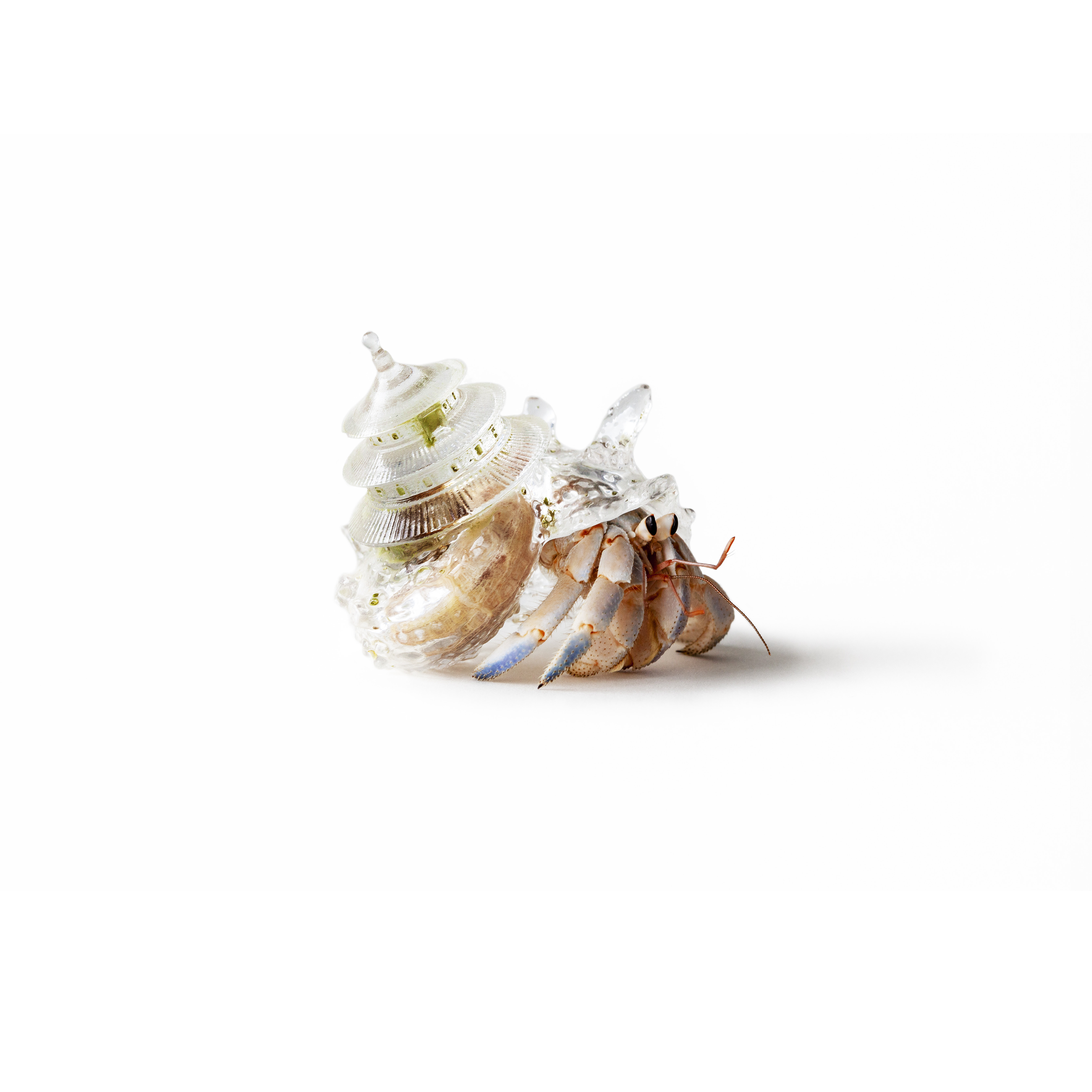
The inventive works by Masaomi Yasunaga (b. 1982 in Osaka Prefecture, Japan) challenge the presumed functionality of the materials used in ceramic art, thus advancing its sculptural directive. His most recent works cannot technically be categorized as ceramic, as there is no clay present in his finished forms. Unlike pottery, usually made of clay and finished with a glazed surface, Yasunaga sculpts glaze as the primary material of his objects that are pit-fired, buried in sand and combined with unique raw materials such as feldspar, glass and metal powders. The viscous glaze melts, collapses and aggregates with these materials, hardening to a stone-like consistency in the kiln. The resulting objects, mostly non-functional vessels, shells and empty containers, have the appearance of lost and found archaeological relics.
*****
Mit der Ausstellung Keramik präsentiert die Buchmann Galerie eine Ausstellung mit Keramikskulpturen von sieben Künstler*Innen, die alle einen bedeutenden Beitrag zur zeitgenössischen Keramikkunst geleistet haben: Seyni Awa Camara, Tony Cragg, Richard Deacon, Martin Disler, Bettina Pousttchi, Rosemarie Trockel und Masaomi Yasunaga.
Keramik ist eine der ältesten kulturellen Ausdrucksformen, die bis in die Altsteinzeit (ca. 24.000 v. Chr.) zurückverfolgt werden kann. Sie wurde seit jeher zu dekorativen, utilitaristischen und künstlerischen Zwecken verwendet. Allerdings hatten bildende Künstler*innen, die mit dem Material arbeiteten, oft ein ambivalentes Verhältnis zur Keramik. Für einige war das Material zu eng mit Handwerk und Design verbunden, während es anderen gelang, das Medium zu nutzen und es in einen freien künstlerischen Ausdruck zu verwandeln. Seit dem Modernismus des 20. Jahrhunderts hat die Hinwendung oder Ablehnung der bildenden Künstler*innen zur Keramik viele Phasen durchlaufen. Interessanterweise steht die Keramik heute – im Zeichen der sich weltweit vollziehenden Digitalisierung unserer Lebenswelt – wieder im Fokus der Künstler*innen. Die Ursprünglichkeit des Materials und die archaische Art seiner Verarbeitung, die sich seit ihren Anfängen nicht wesentlich verändert hat, erscheint wie ein Gegenbild zur artifiziellen Welt der Pixel und Algorithmen, wenngleich die Keramik auch in der Hochtechnologie der Luftfahrt oder der Medizin Einzug gehalten hat.
Ausstellungen wie The Flames im Musée d'art Moderne in Paris im Jahr 2021 oder Toucher Terre in der Fondation Villa Datris im Jahr 2022 zeigten jüngst diese Bandbreite der Keramik in der Kunst. Die Ausstellung Keramik in der Buchmann Galerie konzentriert sich auf künstlerische Positionen, die das Material zweckfrei verwenden und die technischen und formalen Grenzen und seine Anwendung ausloten.
Seyni Awa Camara (geb. 1945 in Bignona, Senegal) wurde als Kind von ihrer Mutter in die traditionellen Techniken der Keramik eingeführt. Bald schon wandelte sich ihre Arbeit von der angewandten Keramik hin zu einer originären künstlerischen Praxis. Camara hat eine ganz eigene und ausdrucksstarke Form der Plastik entwickelt, bei der sie Skulpturen von knapp über 40 cm bis hin zu totemistisch anmutenden Arbeiten von bis zu 180 cm Höhe schafft. Die Skulpturen werden von Hand modelliert und auf einem Holzbrennofen im Hof vor dem Haus der Künstlerin gebrannt, gelegentlich unter Zugabe von Erz oder durch Behandlung des Tons mit verfaulten Baumschoten, um der Terrakotta eine brünierte Oberfläche zu verleihen. Ihre figurativen Arbeiten basieren auf Legenden, Beobachtungen, Objekten und Landschaften sowie auf ihren persönlichen Erfahrungen.
Die glasierte Skulptur In Camera von Tony Cragg (geb. 1949 in Liverpool, UK) und die sandgestrahlte weiße Porzellanskulptur mit dem Titel Silent Conversation, die zwei Figuren chinesischer Adliger zeigt, erkunden die Möglichkeiten von Form und Textur. In Camera erinnert an ein Maschinenteil, dessen Funktion offen bleibt und das mit einer dicken Metallglasur geschützt ist. Diese geschaffene Form steht im Kontrast zu den beiden gefundenen dekorativen Porzellanfiguren von Silent Conversation. Die perforierte weiße Oberfläche unterstreicht die Zerbrechlichkeit des Materials. Ihr wohnt eine eigentümliche Stille inne, die wie ein Kontrast zur starken rhythmischen Form von In Camera wirkt.
Bei der Arbeit Flat 59 von Richard Deacon (geb. 1949 in Bangor, Wales, UK) handelt es sich um eine große flache rechteckige Platte aus gebrannter Keramik, die wie ein großer Spiegel oder ein Bilderrahmen an einem Ständer lehnt. Mit seiner Größe und technischen Perfektion ist der Arbeit eine Sonderstellung beschieden. Deacon kombiniert die minimalistische Form mit einer fast expressiven, stark farbigen, malerischen Glasur auf der Oberfläche bzw. einer dünnen roten Glasur an den Rändern, die das Objekt als eine Art Markierungslinie akzentuiert.
Martin Disler (1949, Seewen, CH - 1996, Genf, CH) wurde schon immer von Legenden und Mythen der Vergangenheit angezogen. In seinem Werk spielt der Ausdruck von Leben, Liebe und Tod eine zentrale Rolle, wie in der großen unbetitelten Terrakotta-Arbeit aus der Werkgruppe „Steinzeug und gebrannte Erde“ von 1993. In den nassen Ton hat Martin Disler Zeichnungen von Schädeln und Gesichtern geritzt, die nach dem Brennen im Ofen als Spuren der Hand des Künstlers erhalten bleiben.
Die Skulpturen von Bettina Pousttchi (geb. 1971 in Mainz, DE) beziehen sich häufig auf den Bereich der Architektur und ihrer sozialen Implikationen. Ausgehend vom Interesse der Künstlerin an der Transformation funktionaler Objekte sind ihre Arbeiten in der Ausstellung von architektonischen Schmucksteinen abgeleitet, welche mit einer kräftigen Farbglasur versehen sind. In der Verwendung von vorgefertigten Modulen liegt eine konzeptionelle Verbindung zur Minimal Art und auch ein Bezug zu den Readymades von Marcel Duchamp.
Die Arbeiten von Rosemarie Trockel (geb. 1952 in Schwerte, DE) beschäftigen sich mit Themen wie Gender und Identität. Trockels keramische Arbeiten sind komplex und visuell fesselnd. Sie spielt mit traditionellen Formen und Techniken - eine Skulptur in der Ausstellung besitzt eine schwarz-weiße Glasur, die die gesamte Skulptur bedeckt, während das andere Werk unglasiert bleibt - und schafft abstrakte Formen, die die Imagination des Betrachters herausfordern. Die atmosphärische Arbeit mit dem Titel Kinderkrippe weckt zahlreiche Assoziationen. Die Spuren der Hände des Künstlers sind deutlich sichtbar und zeugen von der Kraft und Energie, mit der das Material herausgearbeitet wurde.
Die innovativen Arbeiten von Masaomi Yasunaga (geb. 1982 in der Präfektur Osaka, JP) stellen die vorausgesetzte Funktionalität von Keramik in Frage und erforschen die skulpturale Präsenz des Materials. Yasunagas jüngsten Werke sind technisch gesehen keine Keramik, da in den fertigen Formen kein Ton vorhanden ist. Im Gegensatz zu Töpferwaren, die in der Regel aus Ton hergestellt werden und deren Oberfläche mit Glasur überzogen ist, verwendet Yasunaga Glasur als primäres Material für seine Objekte, die in Sand gebrannt und mit einzigartigen Rohstoffen wie Feldspat, Glas und Metallpulvern kombiniert sind. Die zähflüssige Glasur schmilzt, zerfällt und verbindet sich mit diesen Materialien und härtet nach dem Brennvorgang zu einer steinartigen Konsistenz aus. Die so entstandenen Objekte, meist nicht-funktionale Gefäße, Schalen und leere Behälter, haben oft das Aussehen von gefundenen archäologischen Relikten.