Ended Feb 3
Elizabeth Jaeger
Prey
Nov 30, 2023 – Feb 3, 2024
More from Elizabeth Jaeger on Gallop
[Scroll down for French version / Veuillez trouver ci-dessous la version française]
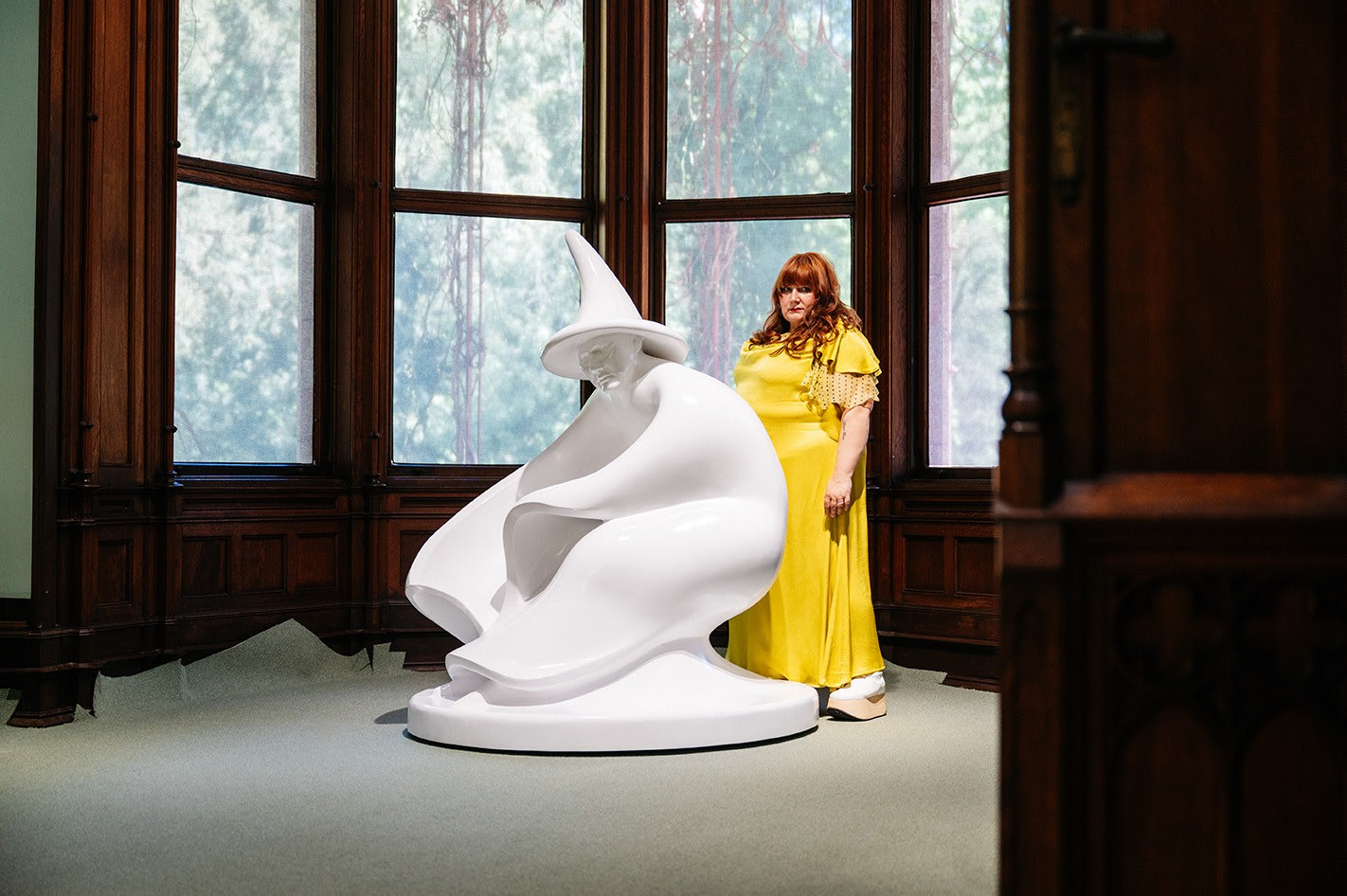
To live in a densely populated environment is to be on view while viewing others; to exchange intimate moments with strangers. Elizabeth Jaeger’s curiously animate clay worlds reflect the psychological effects that accompany this experience of looking and being looked at. Sculpted by hand, her objects and beings embody the effects of the gaze through a number of distortions including scale shifts, fragmentation, and anthropomorphization. These expressive traits impose an indistinct fluidity between figures, beings and things. If looking often implies a relationship of power, Jaeger’s objects complicate expected hierarchies between humans and our surroundings.
This shift between observer and observed is central to prey, which unfolds across two distinct environments. In the first, a series of black cubes line the walls of the gallery. What appear here first as stark, minimalist sculptures reveal themselves upon closer inspection to be containers for shadowy worlds populated by miniature beings and their tiny belongings: a room full of unclaimed luggage, an inscrutable domestic exchange, a kept critter. Though the boxes share similar features such as slats, holes and windows, a simple rotation transforms their functions: an oculus becomes a pond for fishing, cell bars become blinds to peer through. Viewing these collective moments reproduces the experience of intimacy at a distance that is a hallmark of city dwelling.
As Susan Stewart has pointed out, miniatures have the capacity to interrupt our perception of space and time. “In its tableaulike form,” she writes, “the miniature is a world of arrested time; its stillness emphasizes the activity that is outside its borders. And this effect is reciprocal, for once we attend to the miniature world, the outside world stops and is lost to us.”[1] As we are compelled empathically towards these tiny scenes, we are also made profoundly aware of our hierarchical distance and isolation from them. We are reminded of the simultaneity of other life, and, as the exhibition’s title suggests, the precarity of our own.
Descending into the second gallery we are returned to our own scale, but to a world that is not our own. We emerge into the marsh, another scene populated once more by small beings: canines, rats, birds and insects, but this time they are watching us and each other. Following their gazes reveals tiny dramas acted out between predator and prey. Since Laura Mulvey used psychoanalysis to construct her seminal theory of the male gaze, scholars have turned to question the limits of an anthropocentric perspective altogether. Whereas a human-centered gaze is predicated on the notion of a single world inhabited by a hierarchy of living beings, we might instead consider perspectives held by other forms of life. As the philosopher Giorgio Agamben has suggested, “the fly, the dragonfly, and the bee that we observe flying next to us on a sunny day do not move in the same world as the one in which we observe them, nor do they share with us—or with each other—the same time and same space.”[2] So too it is in the marsh, where a multitude of worlds coexist across species. The dual environments that make up prey allow us to imagine a world where humans are no longer observers at the center of the universe, but rather interdependent within an ecology of living beings who watch us back.
—Marie Catalano
Born in 1988 in San Francisco, USA, Elizabeth Jaeger lives and works in New York. Elizabeth Jaeger’s dissonant yet poetic sculptures pose a challenge to binary systems, revealing them to be arbitrarily organized and driven by a hidden affective order. The artist says: “My working process is to take logic to its illogical conclusion, or a rationale to its irrational end.” With and through this, the work is an exploration and practice of empathy; empathy as both feeling beyond the limits of language, as well as considering the cognitive and emotional reactions of the viewer to the work as an integral part of the work itself.
The artist has participated in numerous solo and group exhibitions including Yours Truly at Museum Morsbroich, Leverkusen, GR; Licking the Walls at Callie’s, Berlin; Persona and Parasite at White Space, Beijing; How To Survive at the Sprengel Museum, Hannover; Mirror Cells at the Whitney Museum of American Art; Greater New York at MoMA PS1; In Practice: Fantasy Can Invent Nothing New at Sculpture Center, New York; 99 Cents or Less at the Museum of Contemporary Art Detroit, and Zombies: Pay Attention! at the Aspen Art Museum.
1 - Susan Stewart, On Longing: Narratives of the Miniature, the Gigantic, the Souvenir, the Collection, 1st paperback ed (Durham: Duke University Press, 1993).
2 - Giorgio Agamben, The Open: Man and Animal (Stanford, CA: Stanford University Press, 2004).
*****
Vivre dans un environnement densément peuplé, c’est s’exposer au regard des autres tout en les observant, c’est échanger des moments d’intimité avec des êtres qui nous sont étrangers. Les mondes d’argile curieusement animés d’Elizabeth Jaeger traduisent les effets psychologiques qui accompagnent cette expérience de regardeuse regardée. Sculptés à la main, ses objets et ses êtres personnifient les effets du regard sous forme de multiples distorsions : variations d’échelle, fragmentation et anthropomorphisation. Ces manifestations expressives introduisent une fluidité indistincte entre les figures, les êtres et les choses. Si le fait de regarder implique souvent une relation de pouvoir, les œuvres de Jaeger complexifient les hiérarchies attendues entre les humains et leur environnement.
Ce glissement entre la personne qui observe et celle qui est observée se trouve au cœur de prey, une œuvre qui se décline en deux environnements. Dans le premier, une série de cubes noirs tapissent les murs de la galerie. Ce qui apparaît à première vue comme des sculptures sobres et minimalistes se révèle, par une inspection plus attentive, être des réceptacles pour des mondes mystérieux peuplés d’êtres miniatures et de leurs petites affaires : une pièce remplie de bagages non réclamés, un échange domestique insondable, une créature gardée en captivité. Bien que ces boîtes partagent des caractéristiques communes telles que des lattes, des trous et des fenêtres, une simple rotation suffit à modifier leurs fonctions : un oculus devient un étang où pêcher, les barreaux d’une cellule se convertissent en stores à travers lesquels épier. Regarder ces moments collectifs restitue l’expérience de l’intimité à distance, propre à la vie urbaine.
Comme l’a souligné Susan Stewart, les miniatures peuvent interrompre notre perception de l’espace et du temps. « Par sa forme qui se rapproche d’un tableau, écrit-elle, la miniature compose un monde où le temps est suspendu ; son inertie accentue l’activité qui se trouve en dehors de ses contours. Cet effet est réciproque, une fois que nous nous intéressons au monde miniature, le monde extérieur se fige et nous échappe1 ». Tandis que nous nous laissons happer par ces scènes minuscules, nous prenons pleinement conscience de notre distance hiérarchique et de notre isolement vis-à-vis d’elles. Elles nous rappellent la simultanéité d’autres vies et, comme le laisse entendre le titre de l’exposition, la précarité de la nôtre.
En descendant dans la deuxième salle, nous sommes renvoyés à notre propre échelle, mais dans un monde qui n’est pas le nôtre. Nous émergeons dans le marécage, un autre décor peuplé à nouveau de petits êtres : chiens, rats, oiseaux et insectes, mais cette fois, ils nous observent et s’observent les uns les autres. En suivant leurs regards, on remarque de petits scénarios qui se jouent entre prédateurs et proies. Depuis que Laura Mulvey a fait appel à la psychanalyse pour formuler sa théorie fondamentale du male gaze [regard masculin], les spécialistes s’interrogent sur les limites d’une perspective anthropocentrique. Alors que le regard centré sur la personne humaine se fonde sur la notion d’un monde unique habité par une hiérarchie d’êtres vivants, on pourrait plutôt considérer les perspectives d’autres formes de vies. Comme l’a suggéré le philosophe Giorgio Agamben, « L’abeille, la libellule ou la mouche que nous regardons voler près de nous par un jour ensoleillé ne se déplacent pas dans le même monde que celui dans lequel nous les observons et ne partagent pas avec nous, ni entre elles, le même temps et le même espace[2]. » Il en va de même dans le marais, où une multitude de mondes coexistent parmi les différentes espèces. Les deux environnements qui composent prey nous invitent à imaginer un monde où l’humain n’est plus la figure observatrice située au centre de l’univers, mais plutôt une entité interdépendante au sein d’une écologie d’êtres vivants qui l’observent en retour.
—Marie Catalano
1 - Susan Stewart, On Longing: Narratives of the Miniature, the Gigantic, the Souvenir, the Collection, Durham, Duke University Press, 1993.
2 - Gorgio Agamben, L’Ouvert. De l’homme et de l’animal, Paris, Payot- Rivages, 2006, p. 67.