
Exhibition · Downs & Ross
Tsai Yun-Ju
A Mirror for the Romantic
Feb 2 – Mar 11
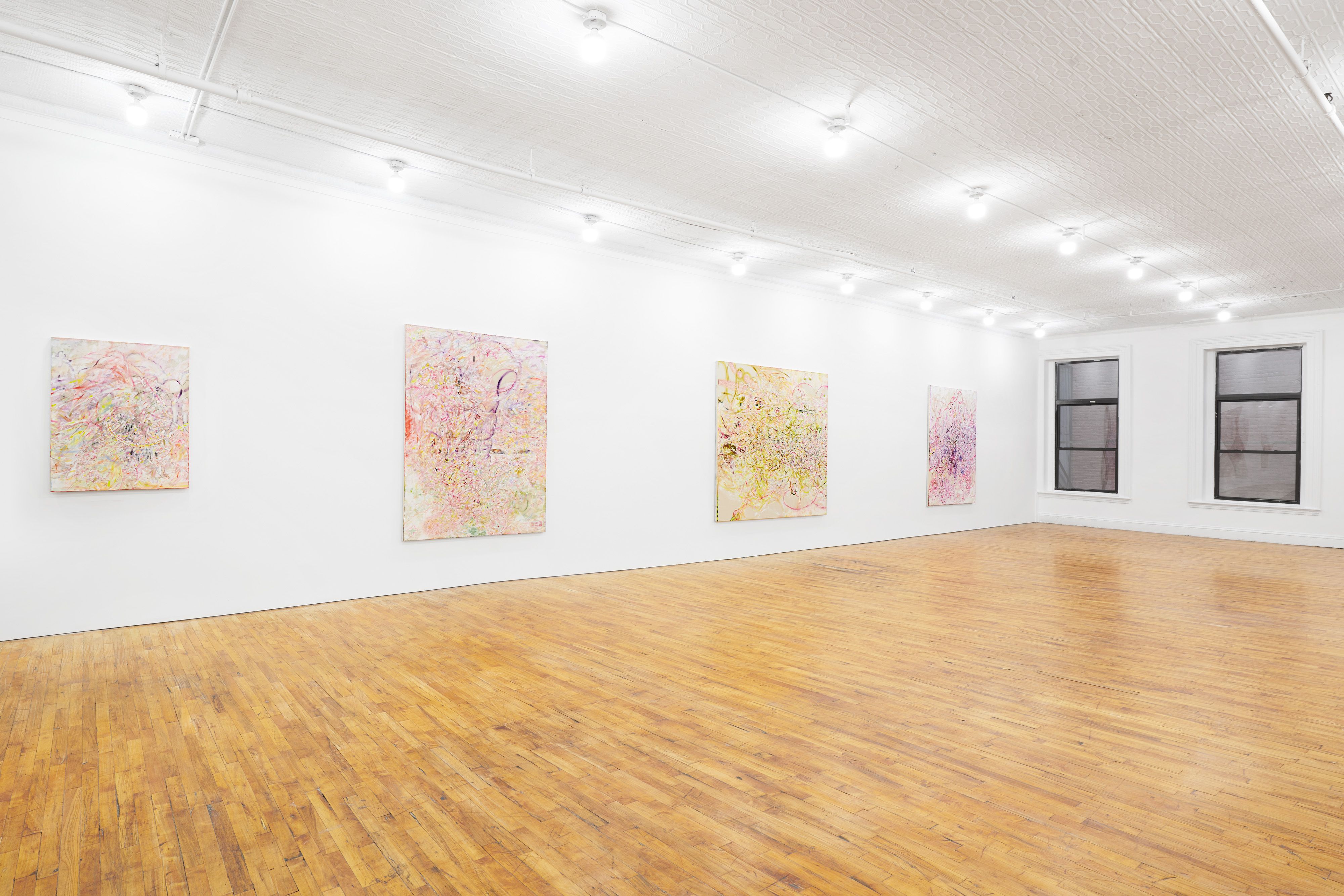
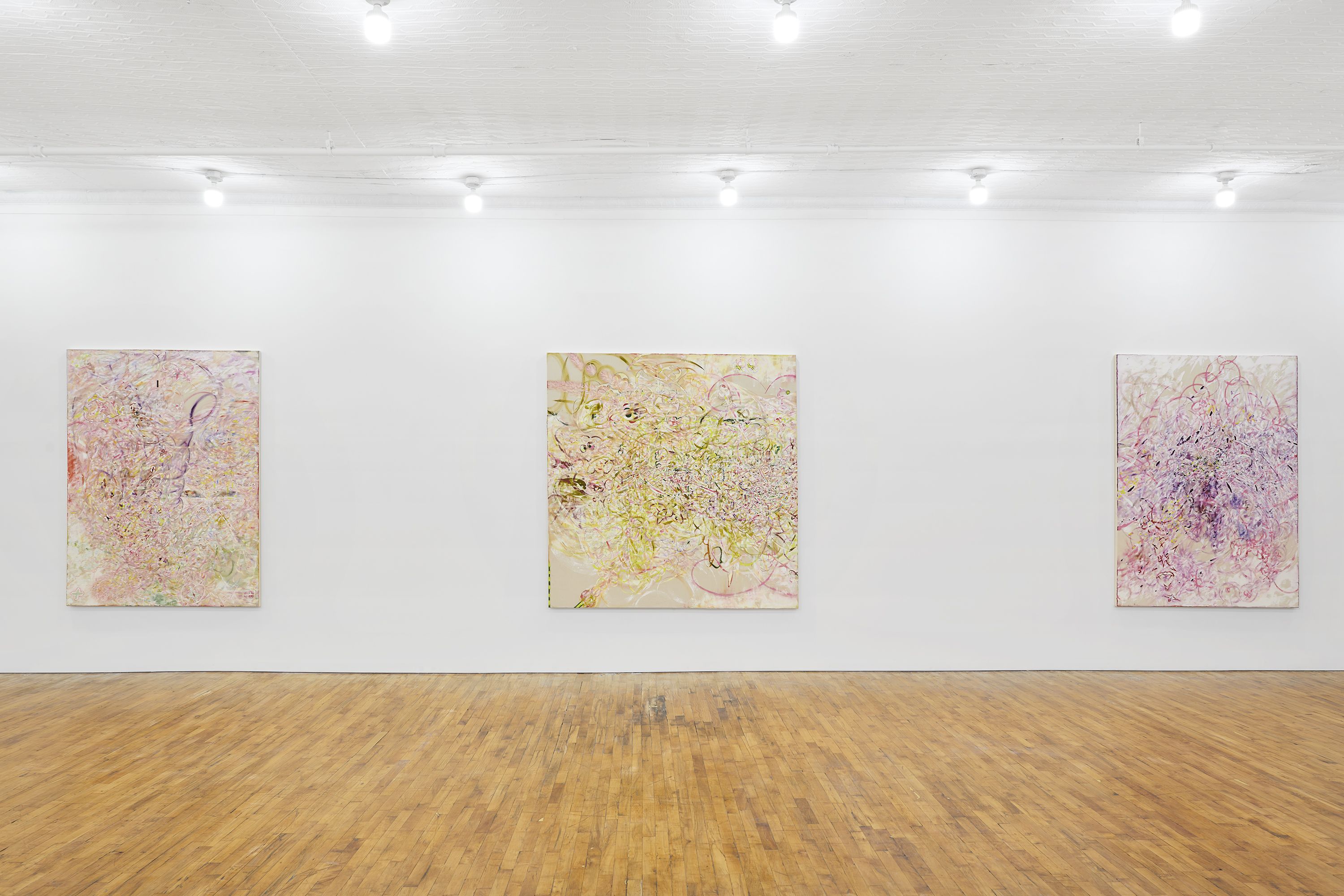
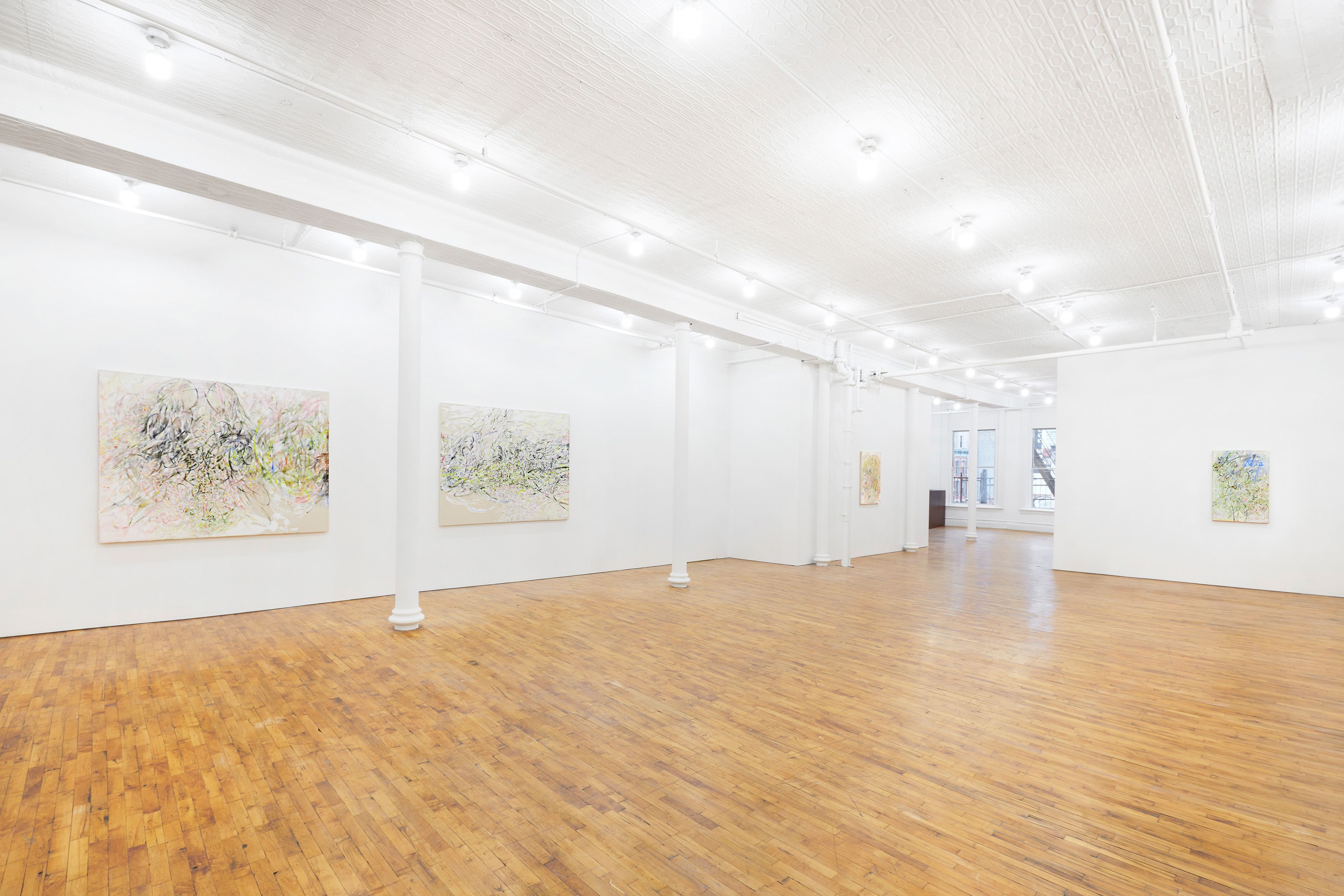
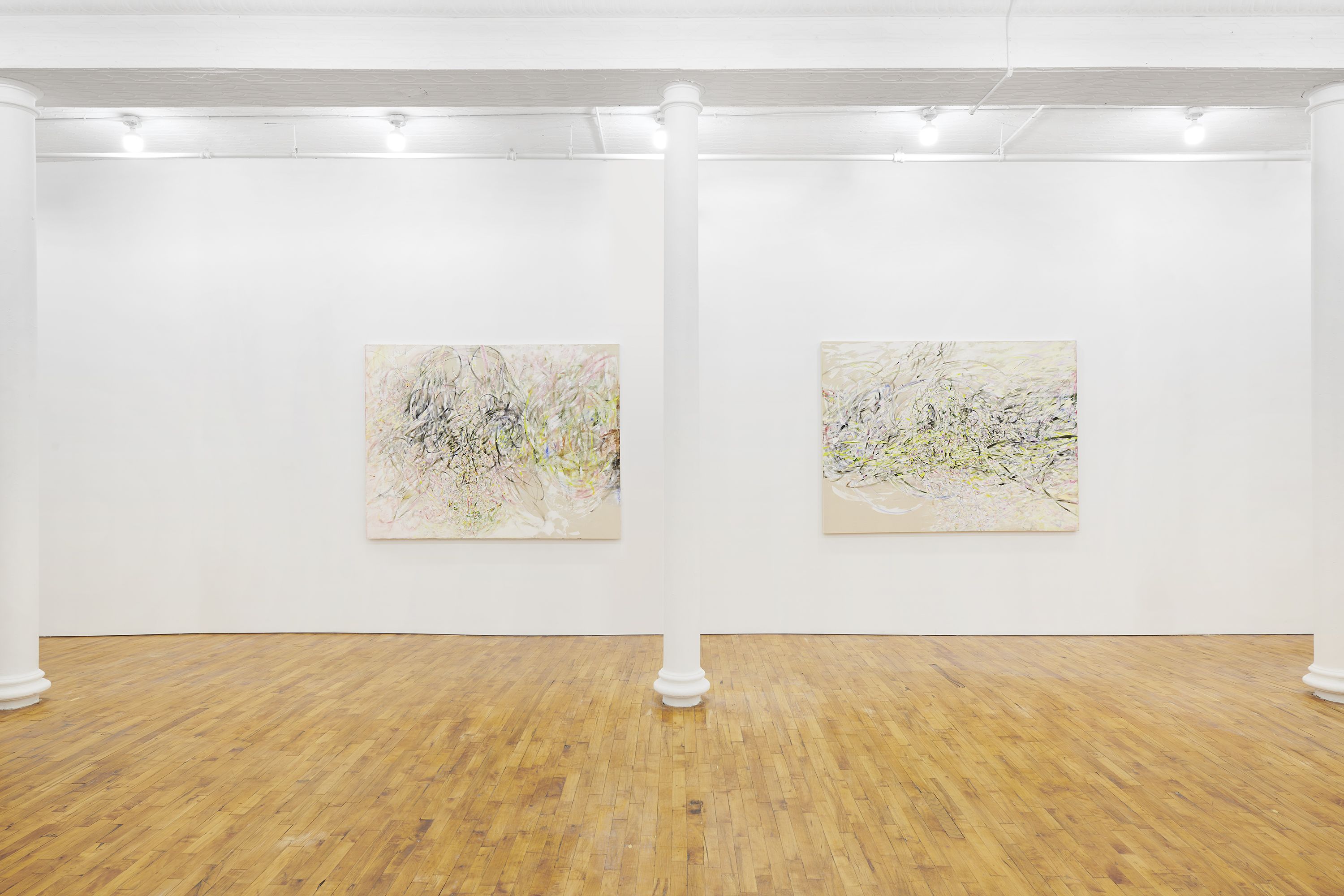
8 images · swipe
About the show
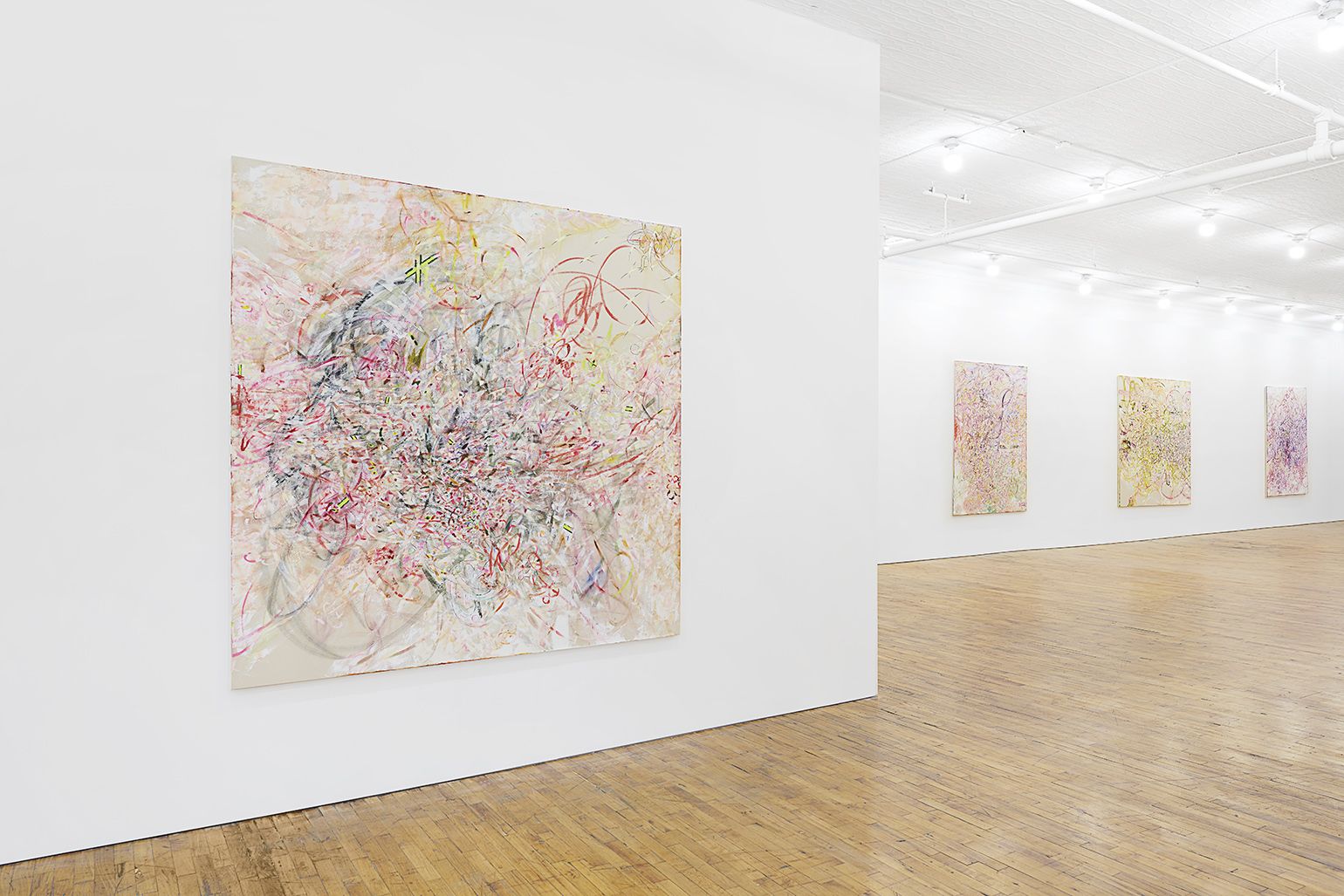
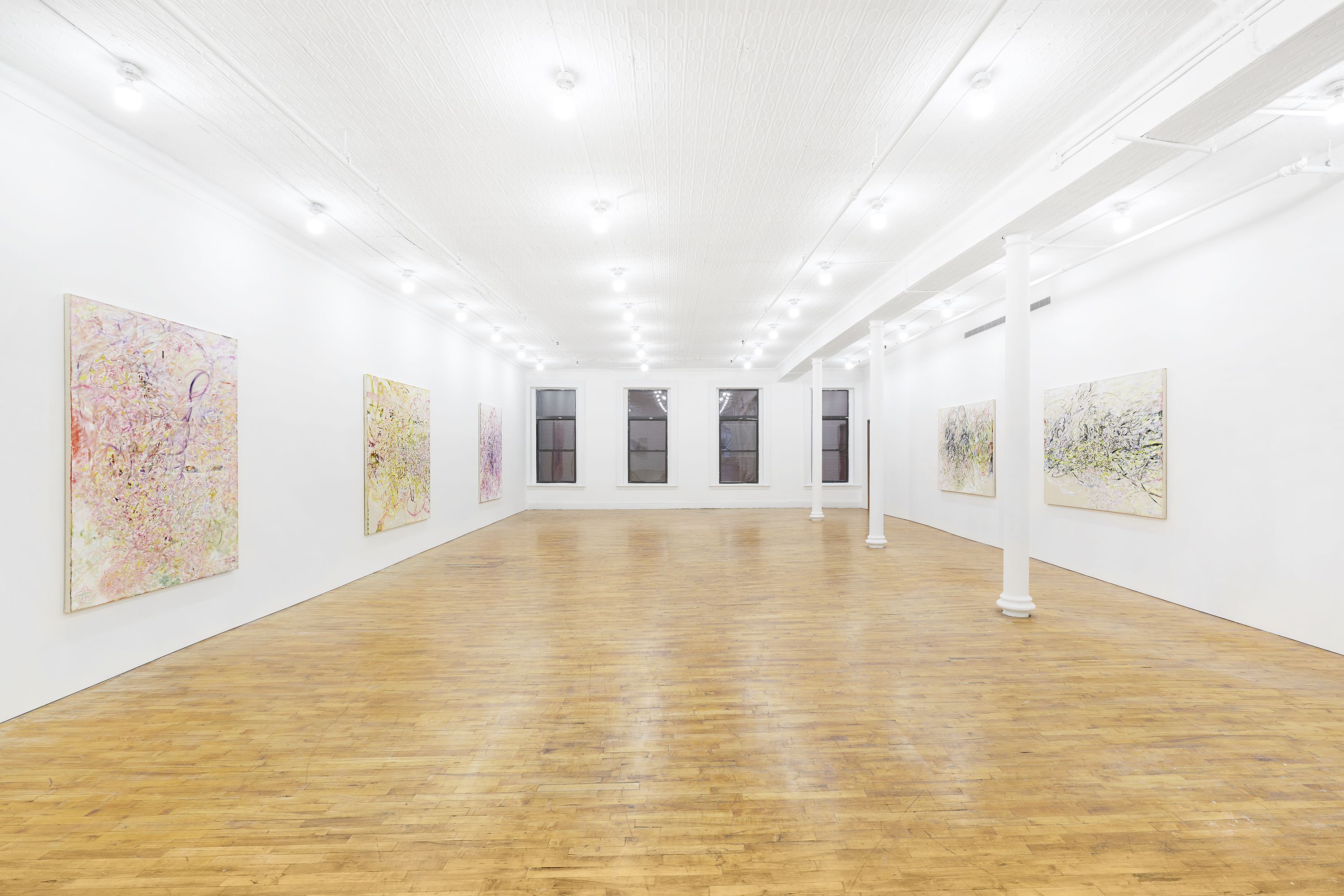
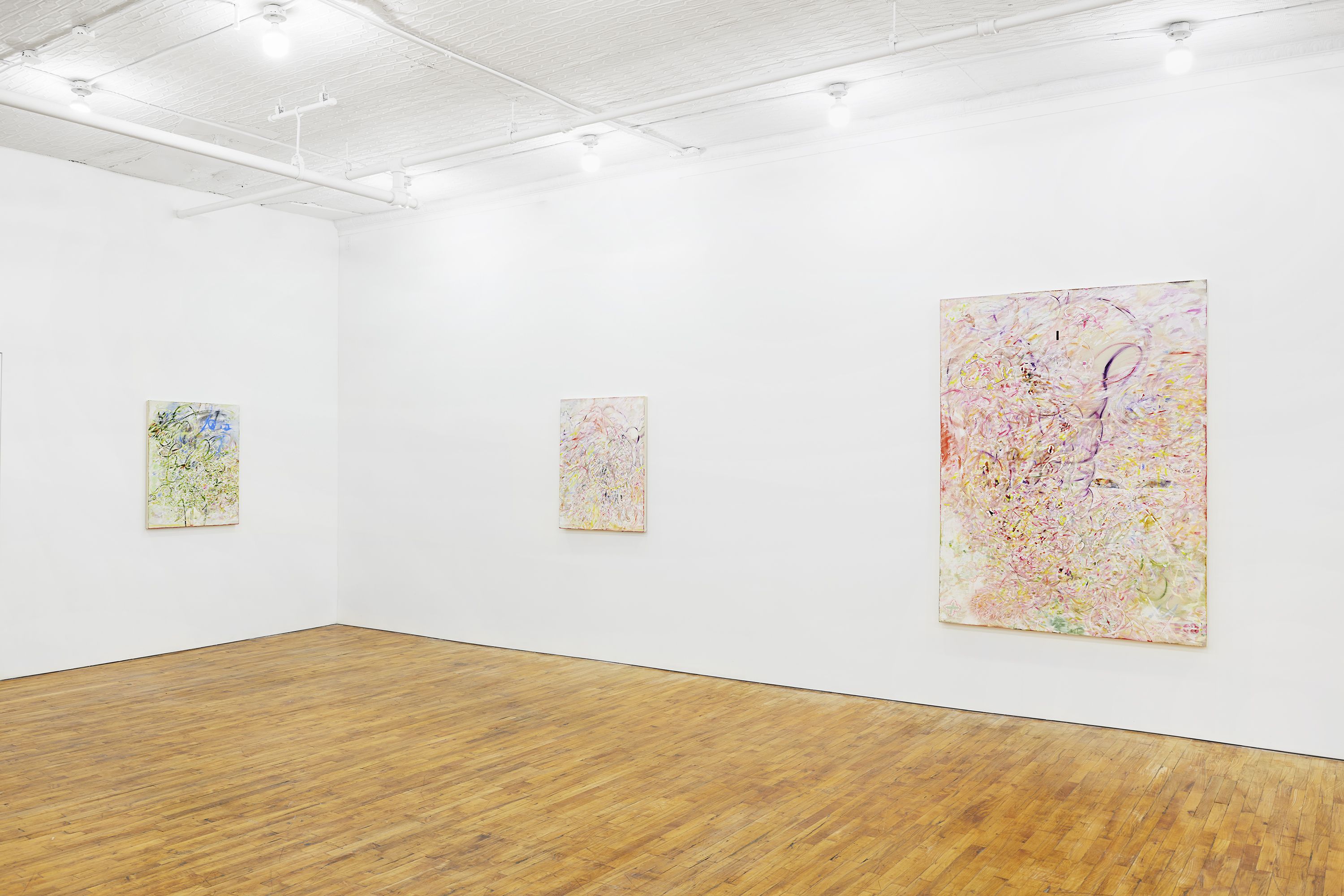
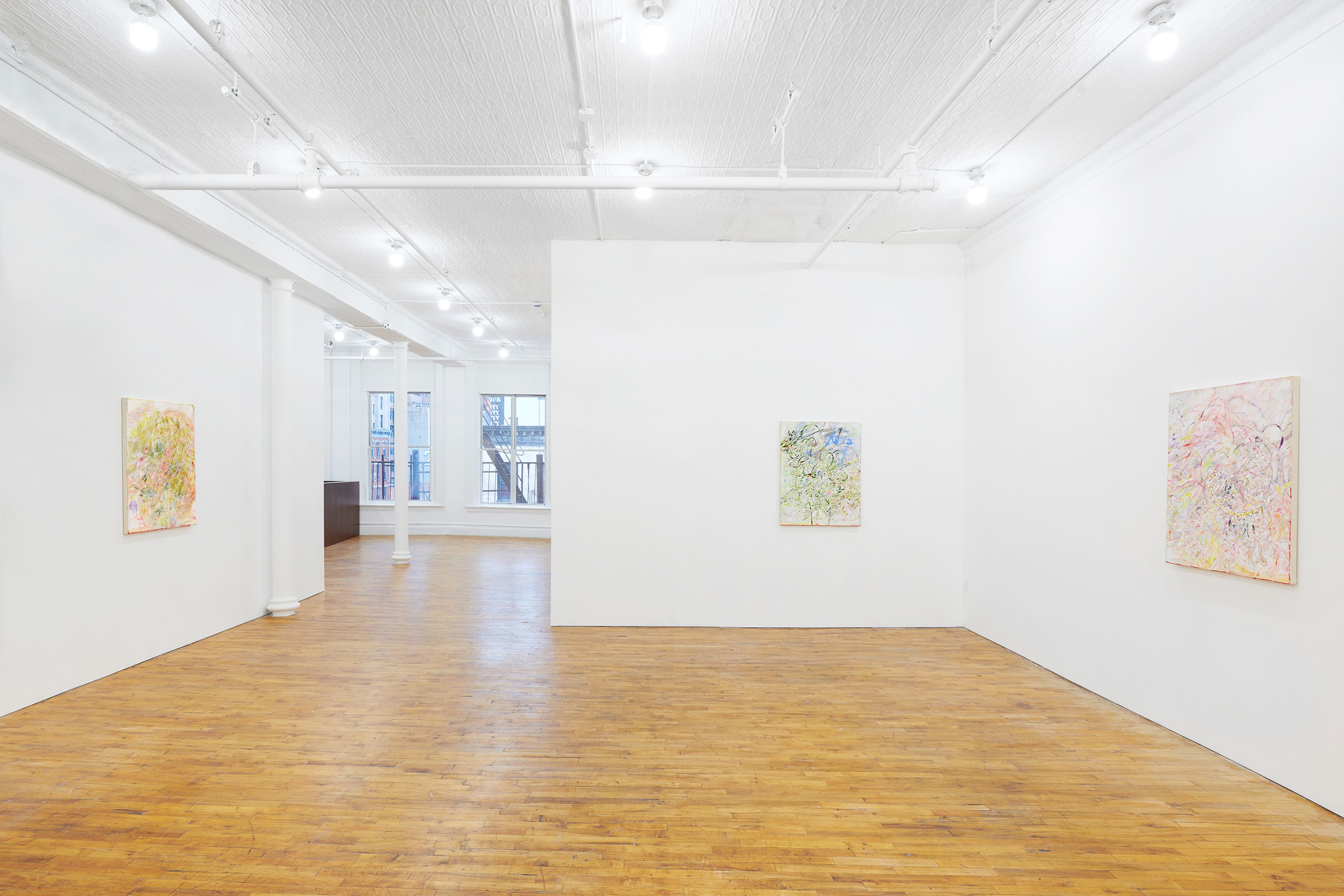
Staggering in scale and technique, Tsai Yun-Ju’s recent paintings propose a contemporary sublime, a transcendent cartography built from broad strokes, lyrically cursive lines and the gradual accumulation of slight gestures. Although Tsai is evidently a remarkable colorist, a skillful proponent of a soft pop palette, it is the artist’s play of indexical gestures — pointillist marks, sketch-like contours, smudgy moments of erasure — that animates A Mirror for the Romantic, the artist’s first solo exhibition in the United States. This exhibition comprises a collection of eruptive compositions, alternately coalescing or collapsing, an unending series of minor events writ large.
Tsai’s practice is obliquely informed by Cao Xueqin’s sprawling Dream of the Red Chamber, a Qing Dynasty-era novel first published in China near the end of the 18th century. While this literary work, one of the four classics of Chinese literature, is so expansive that an entire field of study is devoted to its interpretation, the novel’s dense constellation of characters and events ultimately orbit around the human reincarnation of a divine stone, Jia Baoyu (賈寶玉). Amidst a plethora of family drama and period detail, the novel retains its essential form as a bildungsroman, the narrative of Baoyu’s sentimental education. A paratextual tale informs us that Baoyu, born with a fragment of precious jade in his mouth (a vestige of his form as a stone) has come to earth seeking to experience the pleasures and tribulations of the terrestrial world. And as this connection between the divine and earthly might suggest, a procession of complex entanglements unfold, porous boundaries between seemingly binary notions, between reality and illusion, or daily life and dreams. The exhibition draws its title from an earlier version of the novel, referencing a magical two-sided mirror, a recurring element in the text; “Truth becomes fiction when the fiction's true,” Cao notably, mesmerizingly wrote. “Real becomes not-real where the unreal's real.”
It makes some sense that the vast cosmology of the novel would find an analogous form in painting, and in Tsai’s series of paintings particularly. This series of works seems to culminate in a “swarming multiplicity,” as Roland Barthes once described Twombly’s canvases, and something of his tabula rasa, the scraped tablet, returns in the works on view, in the artist’s frequent explications of contingency, expressive articulations of making, remaking, unmaking. In maximalist compositions such as 玻璃世界 Break into the Middle Chapter Twice, 2022, white washes mask past maneuvers and vigorous strokes of hot pink compete with cartoonish action lines, or elsewhere enclaves of contoured forms break from pure abstraction and begin to suggest a veiled vernacular of pearls, stones, atomic structures, or pictorial signs.
Yet the oscillations indicative of Tsai’s practice — between abstraction and representation, between mark-making and image production, between finely-wrought deliberation and haptic exertion, between micro- and macrocosm — emerge as well from the long tradition of Chinese literati landscape painting, a tradition that fell into abrupt decline, with the collapse of the Qing Dynasty in 1912, just as pure abstraction came to the fore in Western Europe. While Tsai’s large-scale paintings eschew any direct formal engagement with this historical juncture, these are precisely the sort of temporal and spatial conflations her works both evoke and manifest so well. They envision a perpetually unfolding narrative, a constant state of becoming, the rapture of unceasing transformation: Tsai’s canvases are paradoxically like history paintings in that they always arrive to us in medias res, in the present-tense. They are elegant dispatches from a chaotic present, reminders of events transpiring omnipotently around us, delighting us, ultimately, in our disorientation.
Tsai Yun-Ju (b. 1998, Taichung, TW) lives and works in London. She received her BA in Fine Arts from National Taipei University of the Arts, Taiwan, in 2020 and her MFA from the Slade School of Fine Art, London, in 2022. Solo exhibitions: "A Mirror for the Romantic," Downs & Ross, New York, US (2023) (forthcoming). Selected group exhibitions include “Eyes, Dusk, Phantasmagoria,” RupturXibit, London, UK (2022); “Why Don’t We Dance,” ASC Gallery, London, UK (2022); “Whirl, Bounce, Sway,” Safe House, London, UK (2022); “All the Guilty Thing,” Kiosk N1C, London, UK (2021); “Walls All Around, Fusion Unit,” Nottingham, UK (2021); “Reconnect,” Fiztrovia Gallery, London, UK (2021); “Test! Test! Test!,” Taipei, TW (2020); and “Overgrown,” CAA Xiangshan Art Commune, Hangzhou, CN (2019). Her work is included in the permanent collection of ICA Miami.
About Downs & Ross
Tara Downs is a contemporary art gallery operated by Tara Downs in New York City. The gallery represents the artists Vikky Alexander, Darja Bajagić, Alan Belcher, Justin Chance, Héloïse Chassepot, Jiang Cheng, Jacky Connolly, Kim Farkas, Ivy Haldeman, The Estate of Budd Hopkins, Preslav Kostov, Rute Merk, Tom Waring, Roger Winter, Tsai Yun-Ju, and Hou Zichao.
More about Downs & Ross →