Ended Apr 17
Analia Saban
Point to Line to Object to Stack
Nov 14, 2020 – Apr 17, 2021
More from Analia Saban on Gallop
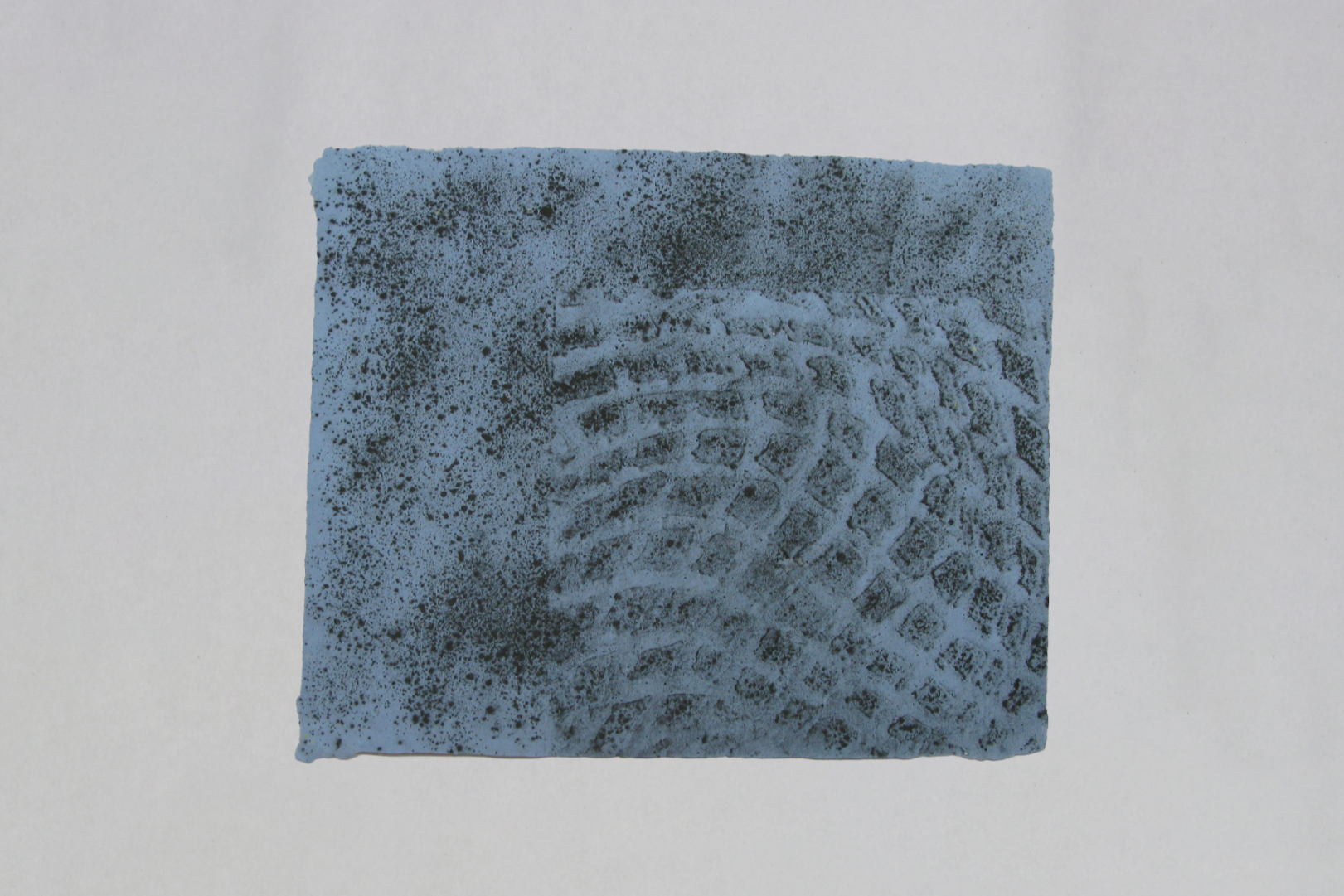
Gemini G.E.L. at Joni Moisant Weyl is pleased to present Gemini’s third collaboration with Los Angeles-based artist Analia Saban featuring six new etchings. Previously, Saban has explored the physical processes of printmaking, investigating materials and reimagining new ways to make a print. In this latest series, the artist delves into more conceptual ideas, considering the steps involved in creating and presenting an edition. The resulting works call attention to these norms in a thoughtful and refreshing way.
Flowchart (Mountains) and Flowchart (Leaves) each feature a didactic chart that playfully provides instructions in the margins about how to make the very print you are viewing. Circles with text lead us through the process of prepping an etching plate, printing each impression from the edition of 25 and preparing the stack for signing. Like a very simple computer program, the instructions direct the process based on questions with yes or no answers. Further, these pieces serve to “break the fourth wall,” that imaginary line separating the artist from the audience. Are the instructions meant for Gemini’s Master Printer Case Hudson and his etching team of Amy Toucey, Oliver Dewey, Isabelle Beausang, and Isaac Osher, or for the viewer? Questions of authorship and intention arise, and at the same time, the works reference early conceptual works like those of Sol LeWitt, which provided instructions for others to produce the artwork. Saban is laying bare the conceptual nature of printmaking, an art form where the design, plans, and decisions are normally made beforehand and the execution follows the flowchart in an algorithmic, machine-like process. However, printmaking is performed in analog fashion, with human hands performing many of the mechanical tasks.
In This One, Saban presents three etchings that illustrate different sized stacks of paper. One pile presents a full edition of 25 prints, another shows an edition of 50, and another illustrates 100 sheets of an edition (each of the piles also includes extra impressions that accompany the numbered edition, such as the AP “Artist Proofs” and SP “Special Proofs”). At once witty and satirical, Saban uses a red arrow to indicate exactly which piece of paper in the drawing corresponds to the signed-and-numbered impression of the print. By playing with formal traditions, these pieces are exponentially self-referential in a way that is most succinctly described as meta. The works comment not so much on the medium but instead encourage reflection about the nature of printmaking and the traditional distribution of the physical edition.
Lastly, an abstract black and white work titled Pong takes its title and composition from an early Atari computer game created in 1972, one of the first and historically most important video games ever produced. A simple game of visual economy, the lines and dot of the “ball” that bounces across the screen resemble early Minimalist paintings that feature geometric square and rectangular shapes, repetition of those shapes, and a neutral background. However, unlike Minimalist painting that rejects narrative, the title invokes a video game, one particular game that is rich in history and culture of the early computer age.
Born in 1980 in Buenos Aires, Argentina, Saban currently lives and works in Los Angeles. In Los Angeles, her works are included in the collections of the Hammer Museum, Museum of Contemporary Art, the Los Angeles County Museum of Art and the Marciano Foundation Art Collection. Her work is also included in Hessel Museum of Art at Bard College, New York; Norton Museum of Art in Florida; The Rubell Family Collection, Miami, Centre Pompidou, Paris, Fundación Proa in Buenos Aires, and The Israel Museum in Jerusalem, among others.