
Ended
Arnaud Adami
Scène de genres
Mar 20 – Apr 26, 2025
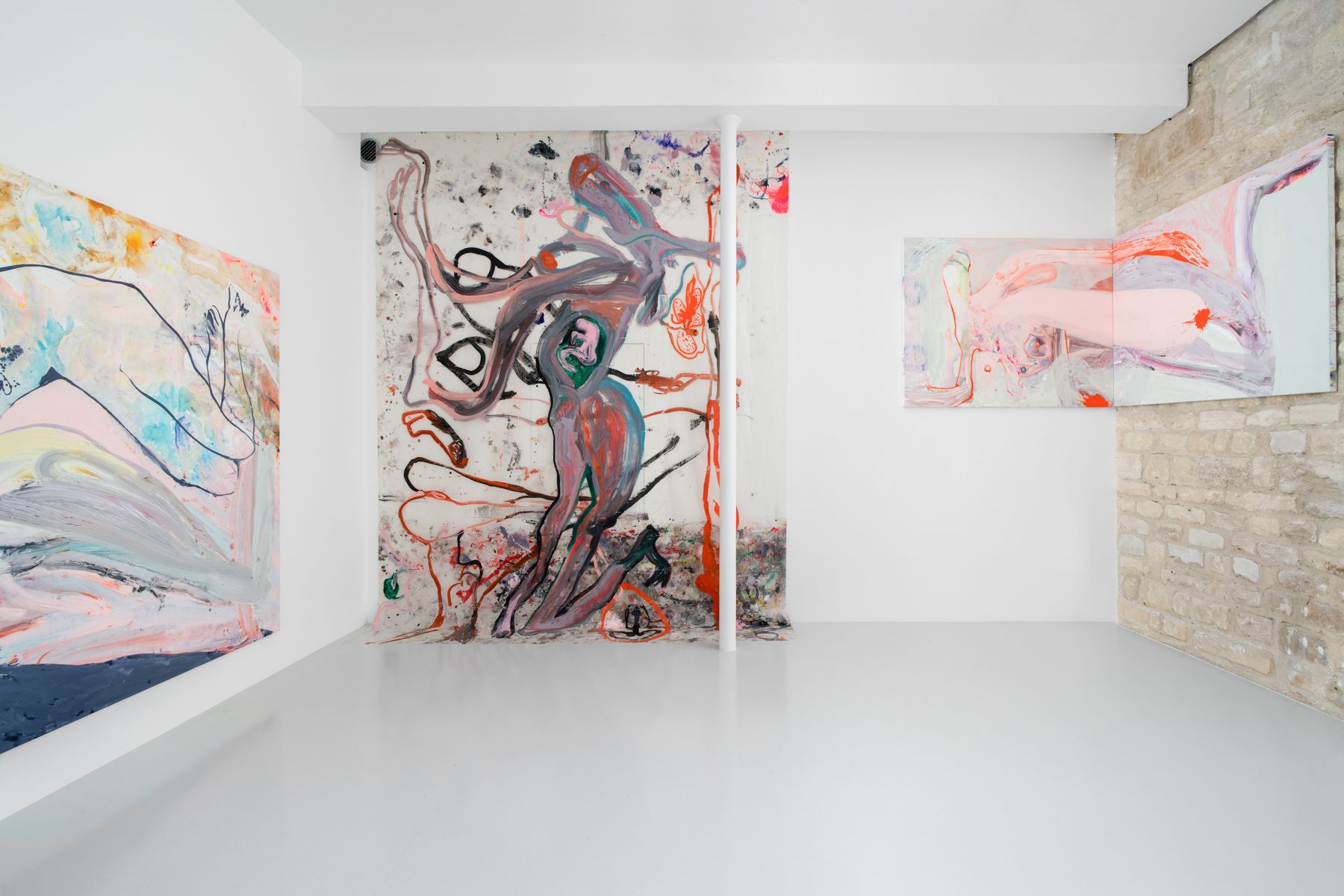
In the work of Arnaud Adami, there is a tactile dimension of the gaze. Painting appears as a privileged means of establishing a link between the eye and the material, thus sensitively approaching, through specific material and plastic qualities, individuals marked by precariousness and marginality. In other words, focusing on pictorial materials is a way of translating the concrete reality of the bodies performing these jobs. The flat surface of the painting thus becomes a meeting place.
The series of paintings presented at “Scène de genres” highlights the paradox of the bodies of sex workers, both visible and invisible, exposed and concealed. On one hand, the central perspective and theatrical lighting, almost reminiscent of Ribera, emphasize them; on the other hand, the female figure is always absorbed in her reverie or activity (embracing a plush toy, applying makeup, photographing her feet). This alliance of the intimate and the spectacular constitutes a uniquely pictorial issue: the act of retouching a painting, opening the artistic work to endless correction, with the eye and hand almost glued to the smallest details, induces a tactile closeness to the painting while attempting to give it effect. Gilles Deleuze calls this quality the haptic, meaning the sensation of touch passing through sight. This notion of retouching is also present in a text by Luce Irigaray – “I want to remain nocturnal, and retouch my night in you.” In This Sex Which Is Not One, Irigaray analyzes female desire in its diffuse nature, not centered on an object but fluctuating continuously across surfaces that never stop, constantly molding: “You touch me all at once.” A continuity of sensations, where materials touch themselves without sharp division, constitutes for the feminist philosopher a way of seeing women for what they truly are – not objects of desire but subjects learning to see: “Touch yourself, touch me, you will ‘see’.”
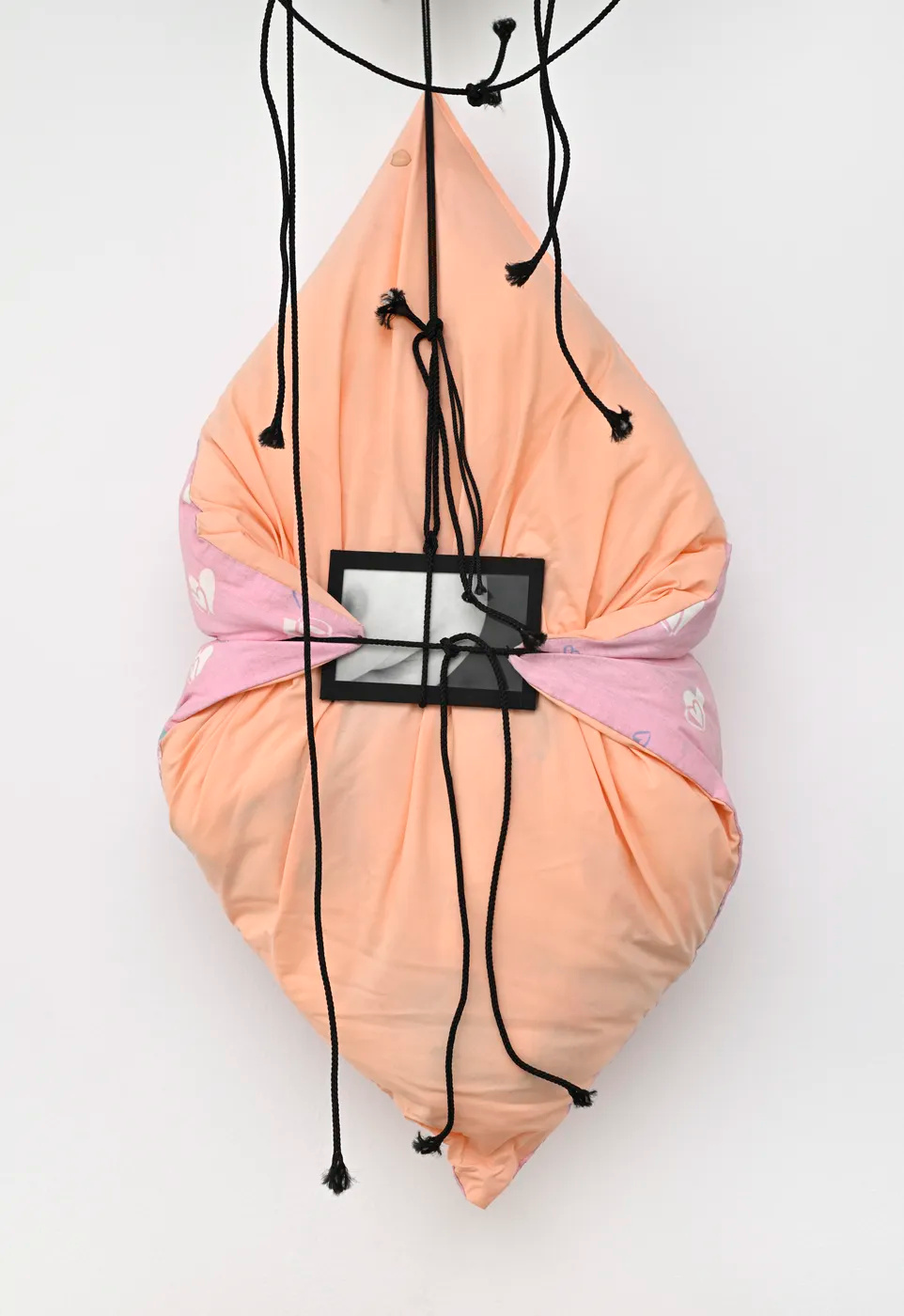
The various materials invoked in Arnaud Adami’s paintings, starting with those surrounding the intimate environment of sex workers – latex, plush, satin, sheets, neon “Bad Bitch,” or a bouquet of feathers carried by feet like a small nest – caress the gaze. However, this is less about eroticism than tenderness. The sensation of comfort and protection of the pink pig plush contrasts with the tattooed hand “ACAB” (“All Cops Are Bastards”) gripping it tightly. Two worlds embrace: that of childlike tenderness and that of revolt, social violence. This image thus speaks as much of vulnerability as of resistance, both in the social reality of these professions and in the materials worn by their protagonists. The latex boots, the feather bouquet, and the satin robe are worn with the body and have weight, even if slight.
The question of the tactile qualities of painting thus encompasses another challenge: that of incarnation. To translate into painting a material, an object, a skin, and the way light and atmosphere slide across surfaces is also to ask how painting can be incarnated – that is, as much inhabited by the body it represents as by the one representing it. The gestures and textures of the depicted profession refer to the gestures and textures of the painter, much like Paolina applying her drag queen makeup to her face as if to a skin-canvas. Unlike classic “genre scenes” which, in the 17th century, were marked by misery and morality, Arnaud Adami’s scène de genres operates an inversion, since the dignity of the individuals is not depicted despite their social status, but through it. The intimacy surrounding them thus does not fall into voyeurism, nor does it erase the respectful distance from the viewer. In hyperrealist painting, this distance is not just an optical need; it conditions the necessary step back to touch reality with one’s fingertips.
—Elora Weill-Engerer
Arnaud Adami (b. 1995, Lannion, FR) lives and works in Paris, FR.
Adami obtained his BFA from l’Ecole Nationale d’Art de Bourges (ENSA) in 2019, and his MFA at l’Ecole Nationale Supérieure des Beaux-Arts de Paris (ENSBA). He has exhibited both nationally and internatonally in solo exhibitions with Carl Kostyàl Gallery, London, UK; Hôtel-Dieu, Paris, FR; Espace Richaud, Versailles, FR; Galerie Valérie Delaunay, Paris, FR. Recent group exhibitions include Stems Gallery, Paris, FR; MAIF Social Club, Paris, FR; the Beaux Arts de Paris, Paris, FR; Stems Gallery, Brussels, BE; Poush Manifesto, Paris, FR; Palais des expostions des Beaux-Arts, Paris, FR; Galerie Sabine Bayasli, Paris, FR; Manifesta, Lyon, FR; H Gallery, Paris, FR.
He was recently awarded the Prix du portrait ‘Bertrand de Demandolx-Dedons’ from l’association des Amies des Beaux- Arts of Paris, and was selected by Hervé Mikaeloff for the focus of Art Paris in 2021.