
Exhibition · Salon 94
Anthea Hamilton
Comfort Zones
Sep 16 – Oct 24
About the show
Salon 94 presents Comfort Zones—Anthea Hamilton's first solo exhibition at a commercial gallery in the US. Born in London to Jamaican and Filipino parents, she works from a simple proposition: origin doesn't have to determine destination. Her signatures—legs, boots, pumpkins, butterflies, bricks—return here, pushed somewhere new. As Emmanuel Olunkwa writes in his essay for the exhibition: "What does it mean to return to a place you never belonged to?"
Comfort Zones runs alongside two exhibitions across our gallery: A Chair Is A Nest, Is A Foot, Is A…, Hamilton's curation of Gaetano Pesce's archive on the first floor, and Gaetano Pesce Studio: Continued, built from Pesce's own Navy Yard workshop, on the third floor. Together, the three form a layered presentation—one artist's practice read through another's, across three floors and two lifetimes of looking.
"Hamilton returns to New York for Comfort Zones at Salon 94, her first solo gallery exhibition in the United States. Born and based in London, with Jamaican and Filipino parentage, she proposes that origin need not determine destination. The places we come from remain with us, carried through forms, habits, materials, and ways of seeing, often without our knowing it. For Hamilton, these geographies need not remain separate or fixed: London is Jamaica is the Philippines is New York.
Working across sculpture, installation, image, architecture, fashion, and design, Hamilton has developed a recognizable vocabulary: legs, boots, pumpkins, butterflies, bricks. These forms have become signatures within her practice, and Comfort Zones returns to them while pushing them somewhere new. The title suggests familiarity, but also the limits familiarity can impose: what happens when an artist encounters her own work as something already recognizable? Techniques migrate between objects, materials change scale and assignment, and previous collaborations take on different terms. Nothing is reproduced exactly.
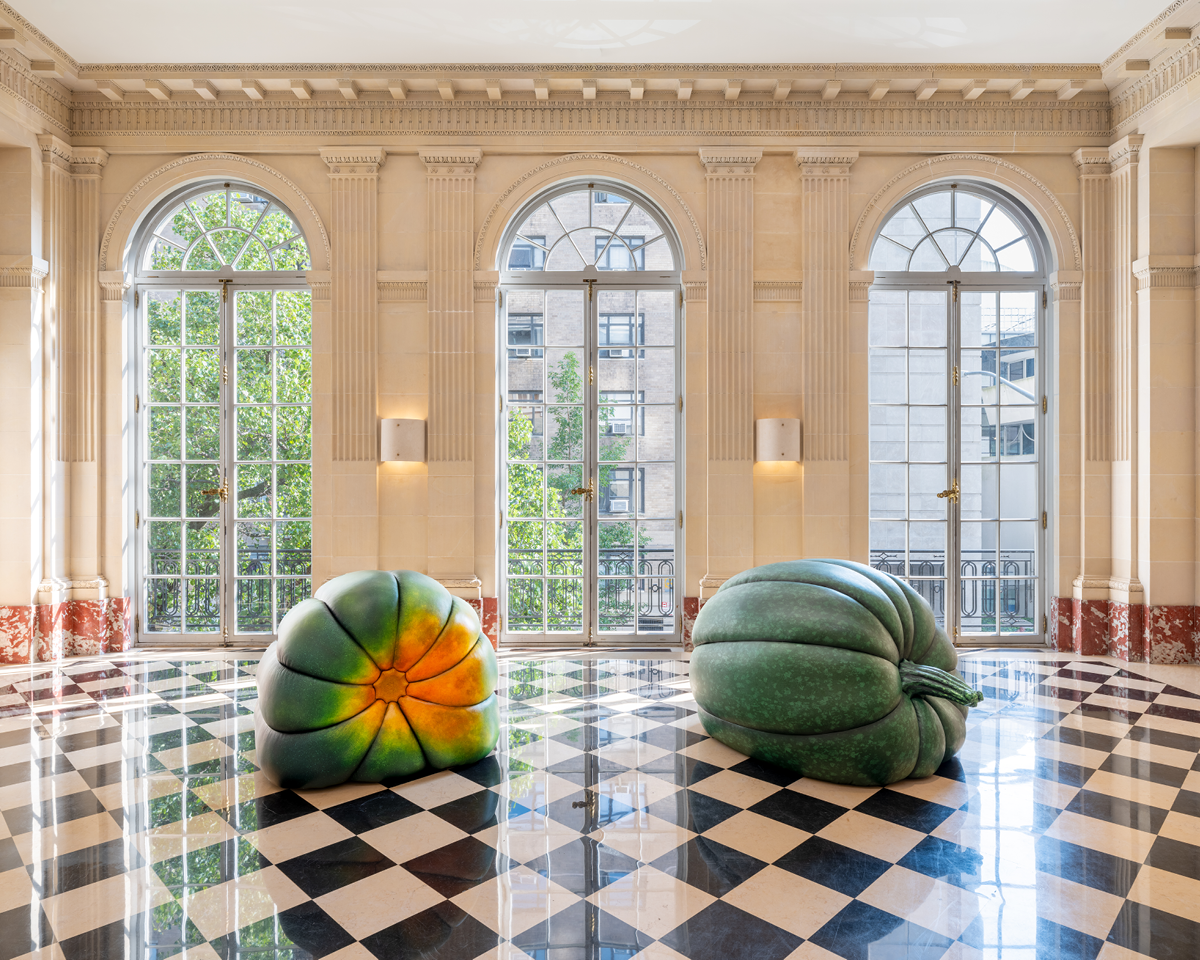
The pumpkins are carved by hand in London, clad in leather, and painted. One is giant and green; another, yellow and small enough to be portable. Here, size moves in the opposite direction while the difficulty of making escalates. "I zoomed myself into the detail," she says. Scale has not disappeared; it has changed location.
Thousands of fragments of eggshell cover a pair of red boots in rankaku, a process conventionally reserved for small decorative details. Hamilton previously applied the technique at another scale in Rankaku Desk (2025); here, working with Alice Rivalta in Rome, she moves it onto the surface of a pair of boots. A similar displacement occurs across two leg chairs clad in tiny bricks. In one, aluminum units are laser-cut, then individually sanded and glued into position by hand; in another, yellow bricks appear alongside flowers, studio ephemera, and cylinders filled with lentils. The absurdity comes partly from the disproportion between what an object appears to require and the labor she chooses to give it. A brick could simply be a brick; instead, each one becomes the site of another decision—a metaphor for labor itself. Materials and techniques are asked to perform outside their expected use. The machine can repeat; the hand introduces difference.
Gaetano Pesce enters the exhibition again through leg chairs based on his Airport Lamp. Their earlier collaboration survives here through an object that slips between functions: a chair that is also a lamp, without necessarily needing to function as either.
The fabric butterflies make another kind of refusal. Digitally printed on their fronts, the labor of their construction accumulates on their backs, largely invisible once installed. Each represents a species found in New York. She considered butterflies from Britain, where she was born and lives, and from Jamaica and the Philippines, her parents' countries of origin, before deciding against them. Migration offered too easy a correspondence between ancestry, identity, and place. The butterflies are not exotic here. They are already here, presented through the lens of a native from across the pond.
Art Nouveau, a recurring source within Hamilton's practice, enters Comfort Zones through a selection of historical objects. Its transformation of nature into style—through line, ornament, material, and architecture—belongs to a longer history of cultural translation. From Art Nouveau in Paris to Art Deco in New York and Neoclassicism in Britain, styles became associated with places other than those from which they originated. Placed alongside Hamilton's work, these objects suggest how what is borrowed can be absorbed, translated, and made into something new.
Hamilton describes the appropriate scale of appreciation for this exhibition as that of model-making. The brick must be sanded; the eggshell positioned; the reverse of a butterfly worked even when it cannot be seen. Attention accumulates in places the viewer may never encounter directly. The objects become smaller as the commitment required to produce them increases. "I had to put it somewhere," she says, "so I made it on the small when I'm known for the opposite."
There is something perverse in the exchange. What once happened at the scale of architecture now happens at the scale of material. To return is not necessarily to come home. Sometimes it is to encounter something remembered under different conditions—and discover where it might go next."
—Emmanuel Olunkwa, What does it mean to return to a place you never belonged to?
About Salon 94
Salon 94 is a contemporary art gallery founded by Jeanne Greenberg Rohatyn in 2002, located in a historic 17,500-square-foot building on New York's Museum Mile. The gallery showcases an international roster of established artists and estates known for bridging art and design, while supporting work that challenges conventional hierarchies. Their complementary S94 Design program focuses on leading global designers.
More about Salon 94 →