Ended Mar 15
Xie Lei
Mort Heureuse
Jan 11 – Mar 15, 2025
[Scroll down for French version / Veuillez trouver ci-dessous la version française]
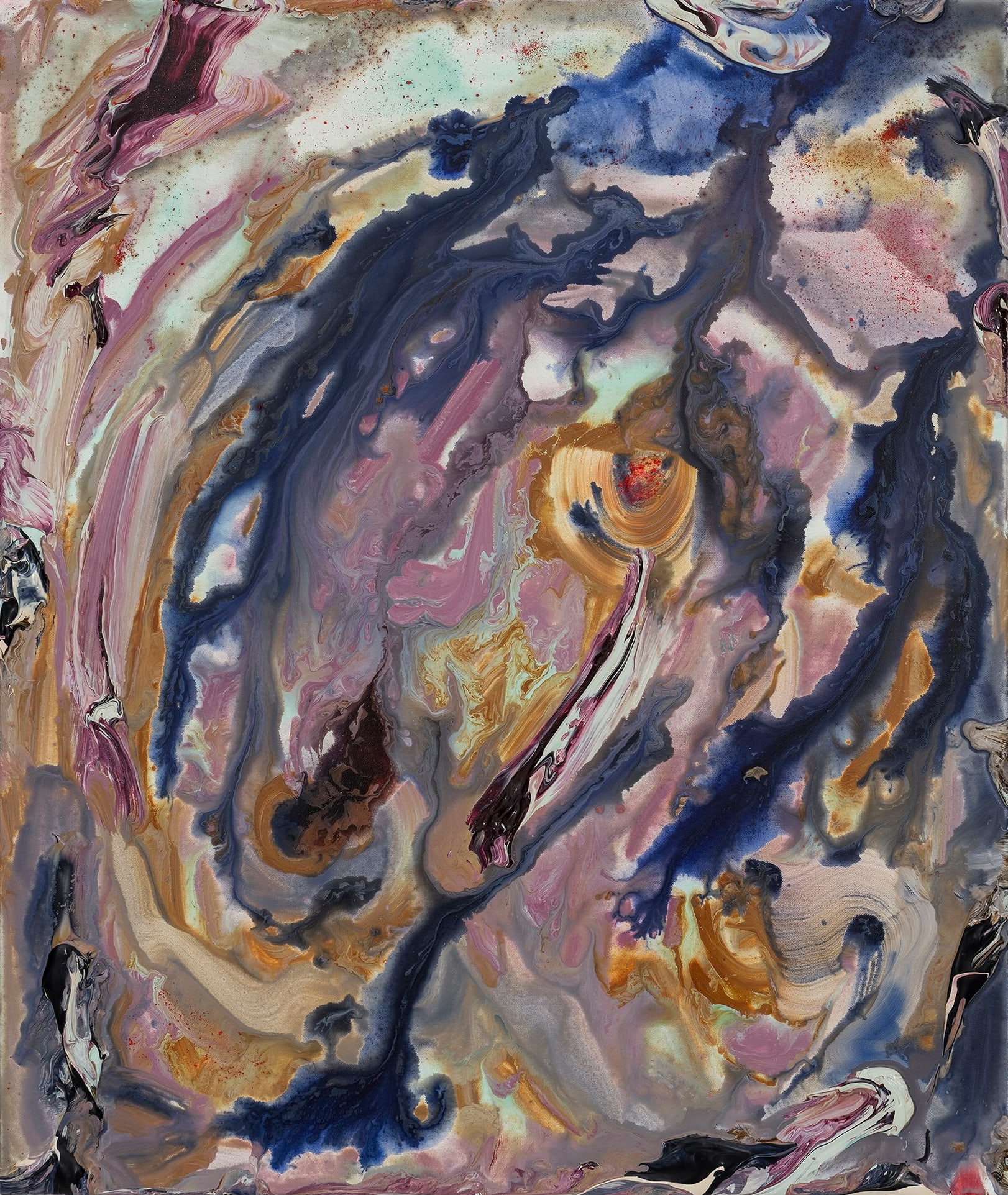
The exhibition titles Chant d’Amour [1] in 2022 and Mort Heureuse [2] in 2025 chosen by Xie Lei, evidently bring to mind Jean Genet and Albert Camus, yet these discreet tributes emancipate themselves those tutelary figures, acting in a more general manner simply as a starting point for two series of paintings. [3] The omission of the articles “un” and “la” is certainly of importance: Is it not the means Xie Lei wishes to use in order to lead us down the pathway of song(s) and death(s) that remain radically undefined?
This lack of definition or ambiguity, immediately noticeable from the titles at the threshold of the exhibition, is a significant feature of Xie Lei’s painting. It is something I already mentioned in a previous text concerning his practice: [4] the features of his figures preclude them from any form of categorization, be it gender, race or class. In an era that is justifiably concerned with positionality [5] and involvement, Xie Lei depicts bodies subjected to a kind of identity fugitivity. Indeed, his pictorial language includes, amongst other techniques, flat tints in oil, which are successively scratched and scraped—using brushes, paper and even the artists hand, the fingerprints of which can occasionally be discerned [6]—until the contours of the bodies are blurred into mysterious colored halos. It seems to me, that in his painting, Xie Lei is striving for what José Esteban Muñoz termed as the psycho-sociological concept of disidentification, [7] i.e. an aesthetic and political strategy aimed at avoiding any form of assignment.
The theoretical references cited by Xie Lei are however quite different and more familiar: Sigmund Freud and Julia Kristeva, [8] and thus linked to the field of psychoanalysis. Moreover, Xie Lei has long used the term oneirique or dreamlike to define his practice. I want to highlight this particularity since art shares with psychoanalysis a focus on exploring the question of our representations.[9] In contrast with repression which bespeaks the refusal to represent a desire seen as problematic, I’m more interested in the dynamic mechanisms of the unconscious, such as dreams and drives (including the death drive, whether happy or not, which brings us back to the title of this exhibition) and which both have something to do with desire. Xie Lei’s characters are all, sometimes indistinctly, “fighting, making love, dying or being saved.”[10] My argument here is that the impossibility of precisely characterizing the scenes the artist shows us, reflects the representation of the impossibility of linguistic intermediation (which is in fact, the very definition of the unconscious). To put it another way, what Xie Lei depicts on canvas we can only imagine and is beyond words, things that might uninhibitedly erupt into our consciousness. The scenes he has been painting ceaselessly since at least 2020, are part of an ongoing cycle, whose very subject is illegibility. The above-mentioned disidentification would be met with indescribable acts, in the linguistic rather than the moral sense.
Within this long series I’ve just mentioned, we should note that the bodies—and whatever they are doing—have been increasingly dissolving into the colored backgrounds, like the barely discernable face behind two dark hands into the blues of Intimation (2024). [11] The treatment that this ghostly presence has undergone—is it even possible to speak of a body here?—is the same as that of the background: powerful, vertical brushwork, very different from the circular touches used for the hands. Although the hands might appear black, Xie Lei never uses either black or white to compose the infinite complexity of his hues.
Finally, to emphasize the tension and duality that emerge from his paintings, Xie Lei likes to identify his works with the stylistic device of the oxymoron—“Mort Heureuse / Happy Death” is just one example. “How can one represent ambiguity in painting?” [12] asks the artist, who himself discerns oxymorons both in his work and in his own life. “As a painter, you’re confronted with white [13] and death every day. How is it possible to make something invisible appear?”
—Victorine Grataloup
1 - From Jean Genet’s sole film, Un Chant d’Amour, 1950, 26’.
2 - From Albert Camus, La Mort heureuse [1936-1938], Gallimard, Paris, 1971. This first text by Albert Camus remained unpublished until the author’s death.
3 - As Loïc Le Gall emphasizes in his text authored for the exhibition Chant d’Amour at Semiose Gallery in 2022.
4 - Artwork interpretative label, Ce à Quoi Nous Tenons. Viva Villa! La Biennale des Résidences d’Artistes, Dilecta, Paris, 2022.
5 - Defines a theoretical and reflexive approach to subjectivity in the field of human and social sciences.
6 - In an interview with the artist in his studio on October 17, 2024, Xie Lei described the process of applying his fingers to the canvas as “something quite unconscious, almost visceral, very personal.”
7 - José Esteban Muñoz, Disidentifications, University of Minnesota Press, Minneapolis / London, 1999.
8 - See Xie Lei’s interview with Claudia Buizza and Ludovic Delalande in Open Space #13, Louis Vuitton Foundation, Paris, 2023.
9 - Here, I’m summarizing in very broad terms.
10 - Interview with the artist op. cit.
11 - During the interview, Xie Lei stated that the small format paintings in his exhibitions often act as keys or as “reminders of the pathway taken.”
12 - Interview with the artist op. cit.
13 - White is associated with death and mourning in Asia.
*****
Chant d'Amour en 2022,[1] Mort heureuse en 2025:[2] les titres choisis par Xie Lei convoquent Jean Genet et Albert Camus, mais ces discrets hommages s'émancipent des figures tutélaires et fonctionnent d'une manière générale plutôt comme un point de départ pour une série de peintures.[3] Dans ces titres d'exposition, la suppression des articles est à prendre au sérieux: Xie Lei ne souhaite-t-il pas ainsi nous mettre sur la piste de chant(s), de mort(s) qui resteraient radicalement indéfinis?
Cette indéfinition ou indistinction, discernable dès les titres, à l'orée des expositions, signale significativement un élément caractéristique de la peinture de Xie Lei. Je l'avais déjà relevé dans un précédent texte sur sa pratique:[4] les traits de ses personnages les soustraient à toute catégorisation, qu'elle soit de genre, de race, de classe. Dans une époque légitimement préoccupée par la positionnalité[5] et le concernement, Xie Lei représente des corps soumis à une forme de fugitivité identitaire. D'ailleurs, son langage pictural consiste, entre autres, en aplats à l'huile puis grattages successifs – au pinceau, avec du papier, voire avec sa main, dont on devine par endroits les empreintes digitales[6] – jusqu'à estomper les contours de ces corps qui se fondent dans de mystérieux halos colorés. Il me semble que Xie Lei milite ainsi, en peinture, pour ce que José Esteban Muñoz a désigné sous le concept psycho-sociologique de désidentification, soit une stratégie esthétique et politique visant à échapper aux assignations.
Cependant, les références théoriques citées par Xie Lei sont tout autres et plus classiques: Sigmund Freud et Julia Kristeva.[8] Des références liées au champ de la psychanalyse, donc. Xie Lei a d'ailleurs longtemps utilisé le mot onirique, renvoyant au rêve, pour définir sa pratique. Je relève cette particularité dans la mesure où la psychanalyse a en commun avec l'art de travailler sur la question de nos représentations.[9] À rebours du refoulement, qui correspond au refus de se représenter un désir jugé problématique, je m'intéresse ici aux mécanismes dynamiques de l'inconscient, comme justement les rêves ou encore les pulsions (dont la pulsion de mort, heureuse ou non, qui nous ramène au titre de cette exposition) et qui ont affaire avec le désir. Chez Xie Lei les personnages sont indistinctement en train « de se battre, de faire l'amour, de mourir ou d'être sauvé·es ».[10] J'avance ici que l'impossibilité de qualifier précisément les scènes que l'artiste nous met sous les yeux indique la représentation de l'impossibilité d'une intermédiation linguistique (ce qui est la définition même de l'inconscient). Autrement dit, Xie Lei représente sur la toile ce que nous ne pouvons imaginer qu'en dehors des mots, ce qui tend à faire librement irruption dans nos consciences. Ses scènes inlassablement peintes depuis au moins 2020 participeraient alors d'un cycle au long cours dont l'illisibilité est le sujet même. À la désidentification évoquée plus haut répondraient des actes inqualifiables, au sens linguistique et non moral.
Au sein de la longue série que j'identifie, il est notable que les corps — et avec eux leurs actions — se dissolvent de plus en plus dans l'arrière plan coloré, comme le visage que l'on devine à peine derrière les deux mains sombres dans les bleus d'Intimation (2024).[11] Le traitement de cette présence fantomatique — peut-on encore ici parler de corps? — est le même que celui du fond: des coups de brosse verticaux énergiques, très différents des touches circulaires employées pour les mains. Si celles-ci paraissent noires, Xie Lei n'utilise pourtant ni noir, ni blanc pour composer l'infinie complexité de ses camaïeux.
Enfin, pour souligner la tension, la dualité qui sourd de ses peintures, Xie Lei aime ramener son travail à la figure stylistique de l'oxymore — « mort heureuse » en est un. « Comment représenter l'ambiguïté en peinture? »[12] s'interroge l'artiste, qui décèle l'oxymore aussi bien dans son travail que dans sa propre vie. « En étant peintre on se confronte tous les jours au blanc,[13] à la mort. Comment faire apparaitre quelque chose d'invisible? »
—Victorine Grataloup
1 - D’après Jean Genet, Un chant d’amour, 1950, 26’.
2 - D’après Albert Camus, La Mort heureuse [1936-1938], Paris, Gallimard, 1971. Ce premier texte d’Albert Camus est resté inédit jusqu’au décès de l’auteur.
3 - Souligné par Loïc Le Gall, texte pour l’exposition Chant d’Amour chez Semiose en 2022.
4 - Notice d’oeuvre, Ce à quoi nous tenons. Viva Villa ! La biennale des résidences d’artistes, Paris, Dilecta, 2022.
5 - Définit une approche théorique et réflexive de la subjectivité dans le champ des sciences humaines et sociales.
6 - Lors d’un entretien avec l’artiste dans son atelier le 17 octobre 2024, Xie Lei a désigné ce procédé d’application de ses doigts sur la toile comme « quelque chose de très inconscient, de presque brut, de personnel ».
7 - José Esteban Muñoz, Disidentifications, Minneapolis / Londres, University of Minnesota Press, 1999.
8 - Voir l’entretien de Xie Lei avec Claudia Buizza et Ludovic Delalande dans Open Space #13, Paris, Fondation Louis Vuitton, 2023.
9 - Je résume ici à grands traits.
10 - Entretien avec l’artiste, op. cit.
11 - Lors de l’entretien avec l’artiste, celui-ci déclarait que les petits formats fonctionnent souvent dans ses expositions comme des clefs, comme des « rappels du chemin emprunté ».
12 - Entretien avec l’artiste, op. cit.
13 - Le blanc est associé à la mort et au deuil en Asie.