Ended Jul 29
Slavs and Tatars
Hang Don't Cut
Apr 27 – Jul 29, 2023
More from Slavs and Tatars on Gallop
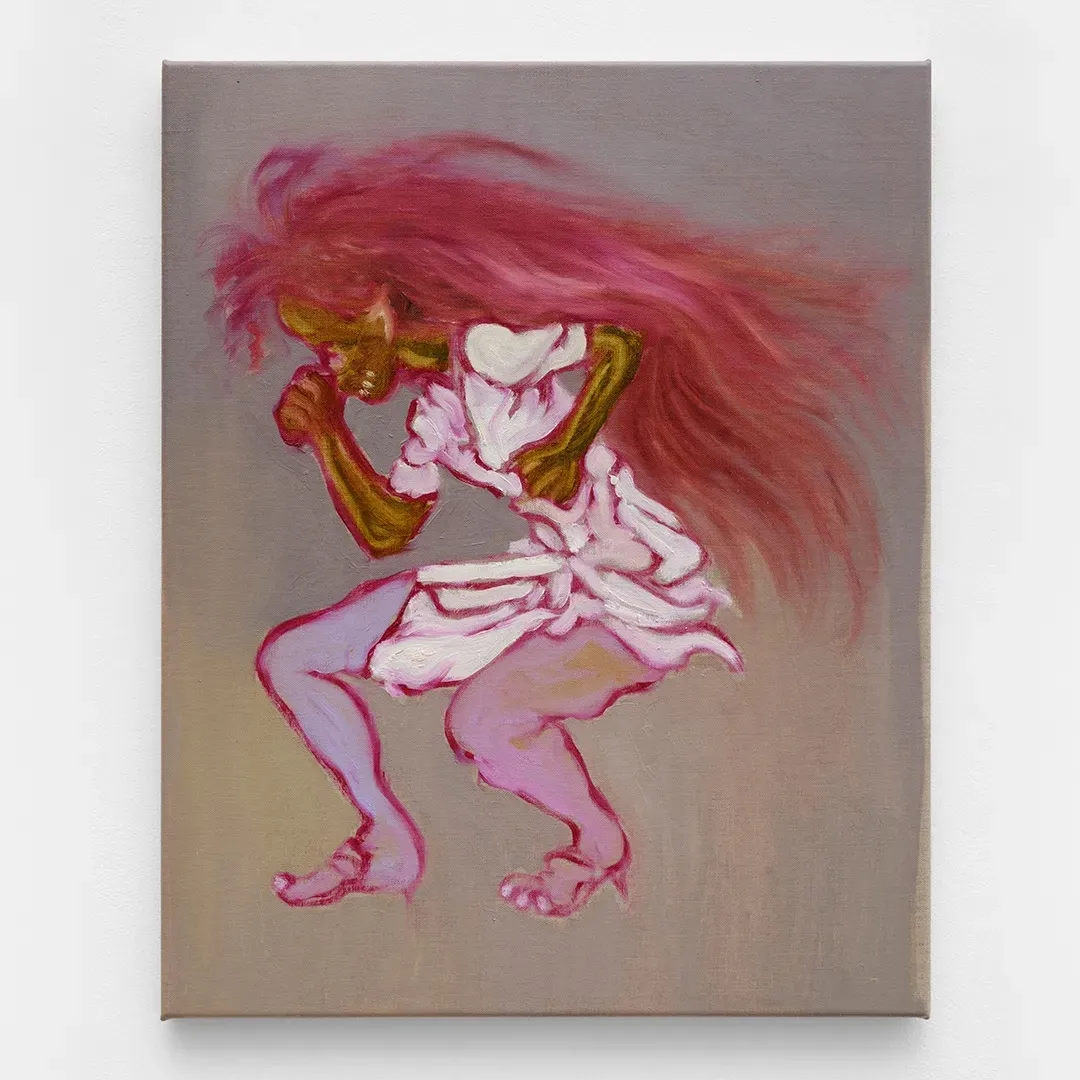
Kraupa-Tuskany Zeidler presents Hang Don't Cut, an exhibition by Slavs and Tatars featuring Andrey Anro, Dozie Kanu, Mina Masoumi, and Lin May Saeed.
Uzbek legend has it that the melon originally grew only in the Garden of Eden. One day, the people received the melon as a divine gift from the Almighty, who had inscribed a message on it before sending it to them. The presence of tiny cracks on the ripe melon caught the attention of the locals, as they appeared to be reminiscent of Arabic script. The pattern is never repeated, so with each melon, the people were not only gifted a treat, but new knowledge. Unfortunately, the people could not decipher the melons’ message. Slavs and Tatars’ newest body of work looks to a variety of melons found in Central Asia, in particular in Uzbekistan and Xinjiang, as repositories of knowledge, as vectors of writing, as well as agencies of resource extraction. Considered to be a rare delicacy, the winter melon is carefully stored in warehouses (ковунхане) to ripen late, amongst the last fruit to do so as the first frosts arrive. So it is that the melon is coveted throughout Eurasia as an exceptional, almost miraculous product of nature: a luscious, sugary yield within an otherwise increasingly barren season and landscape.
Hang Don’t Cut, Slavs and Tatars' third exhibition at the gallery, presents a taxonomy of unique glass blown lamps (the Slavic etymology of melon stems from the verb дыть or "to blow”), each paying tribute to a particular species of Central Asian melon. Mirror works feature a ‘captcha' camouflaged within the texture of a melon: a nod to the distinction between human and artificial intelligence while a new range of merch explores the discourse around melons, from cosmology to commerce.
Slavs and Tatars, founded in 2006 in Eurasia, is an internationally renowned art collective devoted to an area East of the former Berlin Wall and West of the Great Wall of China known as Eurasia. Since its inception in 2006, the collective has shown a keen grasp of polemical issues in society, clearing new paths for contemporary discourse via a wholly idiosyncratic form of knowledge production: including popular culture, spiritual and esoteric traditions, oral histories, modern myths, as well as scholarly research.
The collective’s practice is based on three activities: exhibitions, publications, and lecture-performances. The collective has published more than twelve books to date, including most recently Лук Бук (Look Book) with Distanz Verlag. In 2020, Slavs and Tatars opened Pickle Bar, a slavic aperitivo bar-cum-project space a few doors down from their studio in the Moabit district of Berlin. Slavs and Tatars participated in the 58th Venice Biennale (2019).
Solo exhibitions have taken place at Kraupa-Tuskany Zeidler, Berlin (2023); Chat, Hong Kong (2023); M HKA, Antwerp (2023); Humboldt Forum, Berlin (2022); Hacernoche, Oaxaca (2022); Neubauer Collegium Gallery, Chicago (2022); Cantor Fitz Gerald Gallery, Haverford (2021); Kunsthalle Osnabrück (2021); Hayward Gallery, London (2021); Pinakothek der Moderne, Munich (2021); Villa Arson, Nice (2020); Sugar Contemporary, Toronto (2019); Gallery «y», Minsk (2019); Kunstverein Hannover (2018); Albertinum, Dresden (2018); Westfälischer Kunstverein, Münster (2018); CAC, Vilnius (2017); Museum of Contemporary Art Belgrade (2017); Salt Galata, Istanbul (2017); Pejman Foundation, Tehran (2017); Center for Contemporary Art, Warsaw (2016). Their work has been exhibited in group exhibitions in Kestnergesellschaft, Hannover (2020), GfZK, Leipzig (2020); Kunstmusem Wolfsburg (2020). Centre Pompidu Metz (2020); Kunstmuseen Krefeld (2019); the Kunsthalle Darmstadt (2019); Walker Art Center, Minneapolis (2018); Museum of Contemporary Art, Zagreb (2018); Kunsthaus Graz (2018); the Gwangju Biennale (2017); Hessel Museum of Art, New York (2016); Hamburger Bahnhof, Berlin (2015); Asia Art Archive, Hong Kong (2015); Kunsthalle Zürich (2014); Museum of Modern Art, Warsaw (2014); The State Hermitage Museum, St. Petersburg (2014); Berlin Biennale (2014); Palais de Tokyo, Paris (2013); Centre George Pompidou, Paris (2013);Fondazione Sandretto Re Rebaudengo, Turin (2013); Museum of Modern Art, New York (2012); New Museum Triennial, New York (2012); Tate Modern, London (2011).