Ended Nov 13
Cameron Platter
I Wasn't Made I Was Made
Oct 9 – Nov 13, 2021
More from Cameron Platter on Gallop
In his latest series of abstracted pencil drawings and ceramics, I Wasn’t Made I Was Made, Cameron Platter addresses the cycle of life, beauty, and death. In an ode to his late Grandmother—once the president of the World Association of Flower Arrangers (WFAA)—Platter’s Dept. Store Ikebana references the Japanese art of flower arrangement. The drawing, like Ikebana, complies with seven principles: 1) Silence (a time to observe nature); 2) Minimalism; 3) Shape and Line (shapes should be natural, while lines are clean and graceful); 4) Form (found, not planned); 5) Humanity (a reflection of your feelings); 6) Aesthetics; and 7) Structure (a triangular composition with three points representing heaven, earth, and hell).
Like these principles, one could argue that an artist’s manifesto functions as both a mantra and an obituary. Where intentions are stated and considered alongside their results. For Platter, his manifesto is simple: question everything. Complicate stories and concepts to the point of confusion, allowing images and feelings to obfuscate into colour fields. And the content (or the moral stance, the statement, the ballot) come secondary to form, colour, and composition. Energy is channeled as a stream of colour.
I Wasn’t Made I Was Made presents, in swatches of colour, both a primal scream and a low, meditative hum. The first component to the exhibition is a series of pencil drawings, where Platter replaces his popular iconography of animated objects, animals, and graphic slogans with geometric dynamism. He explores the non-representational and repetitive as a carrier for introspection (and, possibly, even peace, stillness, and healing). This is achieved through intuitive fields of vertical pencil lines—of marks made over and over and over. These drawings are the apex between intention and chance. While Platter’s figurative drawings require the mapping of objects or forms in space, his abstracted works are born from a more rhythmic and instinctive design in line with ikebana’s approach to form being discovered rather than programmed.
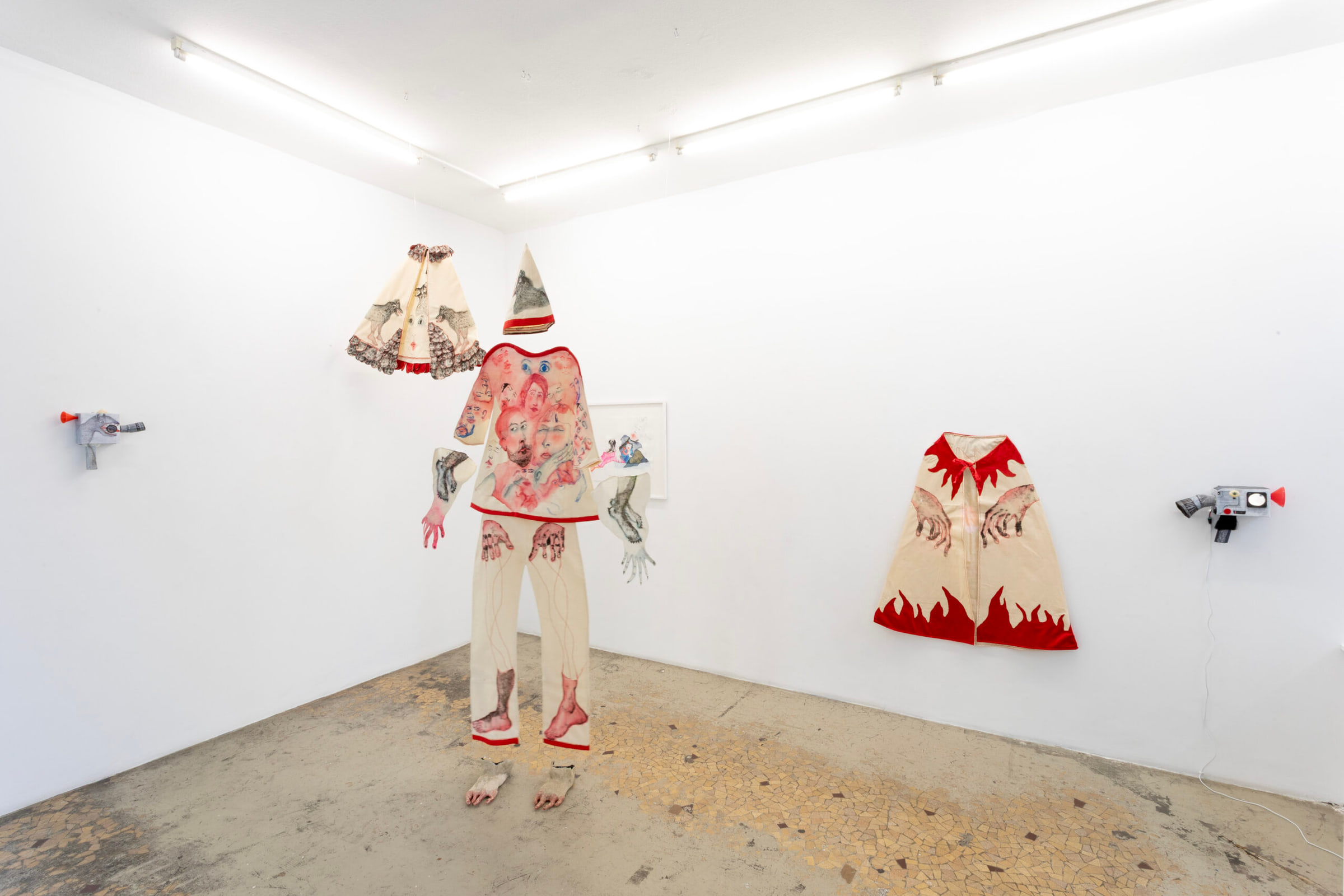
The seemingly playful is made elegant through rapid movement, giving it a maturity that can only result from doing the same movement repetitively, tirelessly, until you reach contentment. Titles such as Visualize Your Brain Melting and Sleep Therapy reflect this process, and they balance alongside the seriousness implied by Lymph Nodes and Civil Unrest. Platter pairs these drawings with ceramics. Plater considers the sculptural components of I Wasn’t Made I Was Made in the same way that one might a vase of wilting flowers or an urn. These are a Memento mori—flowers die, people die, and both are contained. Or restrained: to vase, trench or earth, to this existence. To being made, and the limitations of this.
The title was an offering from Platter’s 7 year old daughter: I Wasn’t Made I Was Made. A bizarrely personal and cynical rumination on existence coming from a child. Like Samuela Platter (a one-in-7.9 Billion human- blip, albeit a loved one), none of us were made because we asked to be, our existence is as a product of reproductivity; a predetermined biological system. What I believe Samuela means, is that she was made, but never made-made: selected piece-by-piece from a machine. She just arrived. And will one day leave. She has no other utility or function.
The ceramics, while being marked by the push-and-pull impression of hands, are all casted from a mother or ‘master’ mould. This process, of pouring slip clay, waiting for it to dry, and then smoothing it out and finishing it is a further meditation, as time spent is dictated by the material itself (as is often the case with ceramics). This would be the ‘Silence’ advocated for by the Ikebana principles. Platter acknowledges this as time spent analysing what is around him: the vermillion red of South Africa’s umSisi, or ‘Lucky Bean’, tree. “A pigment that you just cannot get from a paint tube,” Platter reconciles. The attempt to replicate this colour (and, more importantly, the bewilderment it evokes) is, as Platter suggests, fatally flawed. The luminosity and presence of the umSisi tree was not human made, and the failure of its impact only comes when humanity is involved.
I Wasn’t Made I Was Made is a reconciliation of this limitation. Rather than demanding more from the sunset (more clouds, more colour, more shocks and gasps and ‘likes’ and less reality) or from humanity’s attempt to mimic it through a Pantone, Platter makes peace with the lack therein; in the human.
—Lindsey Raymond