
Exhibition · Miguel Abreu
Jimmy Raskin & Cliché Garden
Jimmy Raskin & Cliché Garden
Jun 26 – Aug 2
2 images · swipe
About the show
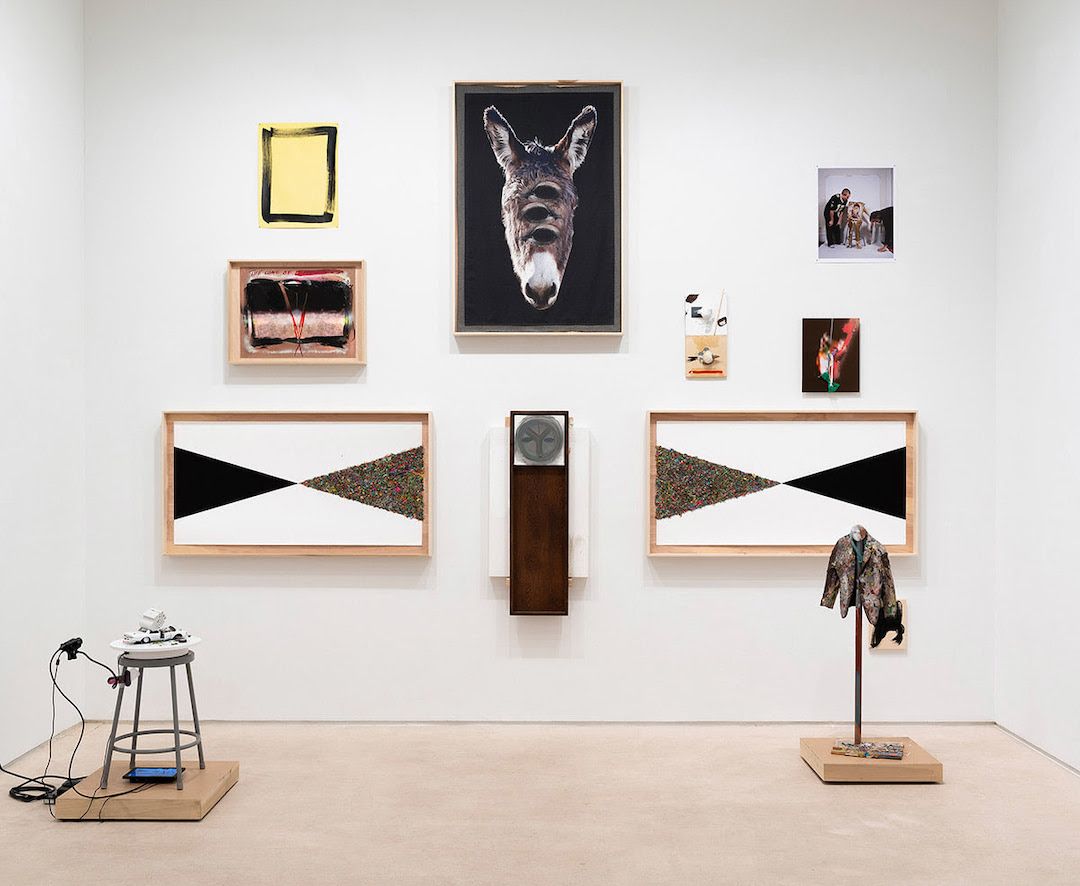
Miguel Abreu Gallery is pleased to present Jimmy Raskin’s, Cliché Garden, the artist’s fifth solo exhibition at the gallery. On view is an arrangement of recent 2D works in various media, 3D wall pieces, and kinetic sculptures.
Raskin’s initial ‘singularity’ or first strike, so the speak—that elusive initial point of stillness which becomes at once the destined through line for an artist—was viewing Arthur Rimbaud’s handwritten excerpts from Illuminations at the Huntington Library in Pasadena. The pages were displayed under glass within thick wood vitrines. Raskin was not so much drawn to the writing as such, but more to the presence of “text as both object and reading material,” as a container of thought and feeling one could literally gaze upon.
Ultimately inspired by the text-as-art strongholds of Barbara Kruger and Lawrence Weiner, Raskin early on chose his ‘devotional typeface’: Avant Garde. He embraced the font for its sturdy, plain design “perfectly fitted to hold potential zingers.” Further, he created a streamlined typographic system that allows him to capture basic phrases he calls “Cliché Candidates.” Raskin is interested in clichés as endpoints of signification. Like the pun, both are assigned the function of pluralizing meaning with the simplest of formulations in a language space where 1+1= 3. The pun’s mission is meta, that is it exists primarily to trigger the sarcastic laugh at the joke of a word’s double entendre. And yet, the cliché holds a secret key of sensitivity with its authentic attempt to instill a sense of meaningfulness within a person’s “felt-mind.” Like the pun, the cliché holds outsized meaning, yet if positioned at the right time for each encounter, it might produce a moment of felt-connection where 1+1= ∞. Alas, the cliché requires such a high degree of vulnerability of the moment to deliver a felt-experience, it nearly never finds a path to fulfillment. Thus, containing a magical paradox, “the cliché carries with its instantiation its own amor fati; as the French poet Gérard de Nerval once said, ‘The first man who compared woman to a rose was a poet, the second, an imbecile.’ Bestowed with a lack of originality, the cliché sets adrift as a sign of and for critique itself.”[1]
The Cliché Candidates survive over time in the auxiliary space of the artist’s practice. They generate works of art which bring to life not only the literal qualities of language, but the paradox itself: we are all in on the joke of how rudimentary meaning can be, yet we would not know it without the work’s capacity to expand and bring the viewer back in through Raskin’s pivotal and recurring motif of the Cone of Expression.
This idea of singular intensification reminded him of the stones set in an ancient Zen garden he visited in Kyoto a few years ago. During the contemplative tour, he received a text message from Miguel Abreu: “Objects and thoughts need to mutually reinforce one another, one cut at the time, and build up toward something objective. No sentimentality, eliminate all narcissistic impulses.”
“How did I solve this?” notes Raskin, “I brought in the witness to the self enjoying oneself in the process of making art.” The exhibition turned into an experience of Beingness. Each stone is alone, yet belongs in an ocean of sand, the erosion of the stone itself. This is epic in the mind-body, yet simple enough to elicit the right kind of laughter, the kind that releases oneself from the binds of the meta, becoming free for a moment as the witness of it all.
Space Serves I Or the rebirth of myth.
A Breeze Without A Source Or the allure of the nonsensical.
The Meta Is Not The Witness Or the pure speck of in-sight.
When I close my eyes I stare.
Jimmy Raskin (b. 1970, Los Angeles) lives and works in New York. A graduate of CalArts, Raskin has exhibited his work and staged “lecture-performances” in institutions, art galleries and alternative spaces internationally since the mid-1990s, notably at P.S.1 Contemporary Art Center, Cooper Union, SculptureCenter, Thread Waxing Place, Foundation 20 21, Greene-Naftali, and Miguel Abreu Gallery (all in New York), as well as at Centre Pompidou, Paris, Real Art Ways, Hartford, CT, Swiss Institute, Paris, and KW Institute for Contemporary Art, Berlin. In 2013, Raskin participated in Performa 13 as part of Performa After Hours, which marked his second contribution to the performance biennial, following A Certain Misgiving in the Disciple (2009). His work was selected for the Art Statements sector of Art |42| Basel (2011), and was included in For the blind man in the dark looking for the black cat that isn’t there (2010), a major group exhibition organized by Anthony Huberman at the Contemporary Art Museum St. Louis. The exhibition traveled to the Museum of Contemporary Art, Detroit, the ICA, London, de Appel Arts Center, Amsterdam, and Culturgest, Lisbon. Raskin also participated in the group exhibition Breaking New Ground Underground (2009), curated by Thea Westreich at Stonescape, a private museum in Napa Valley, California. In 2022, Raskin staged his fourth one-person exhibition at Miguel Abreu Gallery, Stations of the Last Eccentric.
Raskin’s publications include The Prologue, The Poltergeist & The Hollow Tree (Foundation 20 21, 2005), The Lisbon Lecture (Sequence Press, 2012), Corner Jump (Onestar Press, 2012), and The Final Eternal Return, published in 2019 as part of his participation in the group exhibition Tribe-Specific at Felix Gaudlitz, Vienna.
1 - Jimmy Raskin, The Final Eternal Return, artist edition, 2019.
About Miguel Abreu
Miguel Abreu Gallery is a contemporary art gallery based in New York and represents the work of Rey Akdogan, Liz Deschenes, Rochelle Goldberg, Gareth James, Sam Lewitt, Scott Lyall, Jean-Luc Moulène, Florian Pumhösl, R. H. Quaytman, Eileen Quinlan, Raha Raissnia, Jimmy Raskin, Blake Rayne, Pamela Rosenkranz, Pieter Schoolwerth, Jean-Marie Straub & Danièle Huillet as well as works by Hans Bellmer.
More about Miguel Abreu →