Ended Apr 17
Olivia Parkes
The Same River
Mar 11 – Apr 17, 2022
More from Olivia Parkes on Gallop
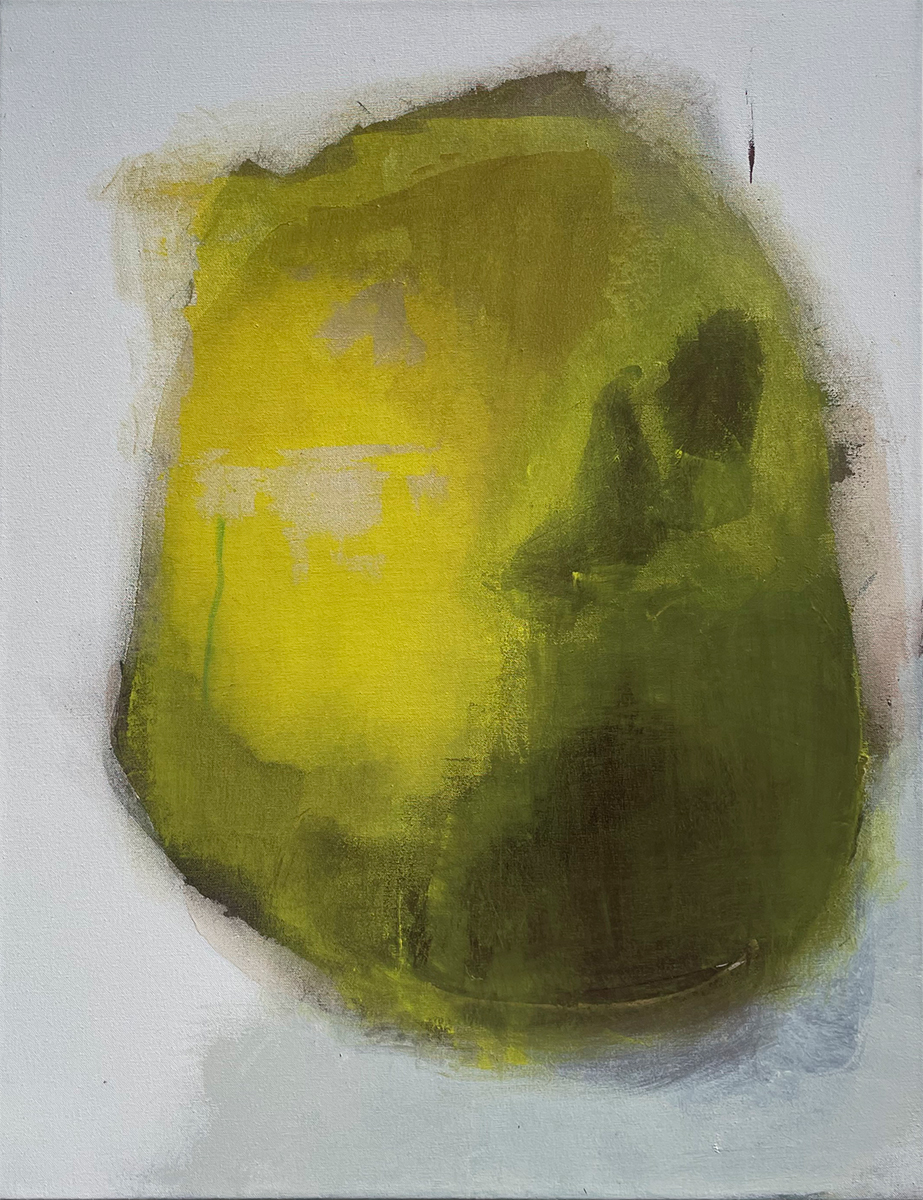
Mountains is pleased to present Olivia Parkes: The Same River, the artist's first solo exhibition with the gallery, premiering a new body of paintings that deepen the artist's attempt to find a visual language for the circular relationship between representation and reality and the collective sense of anxiety that governs contemporary life. The artist strives for a psychological as well as physical rendering of space and color, pursuing a form of saturated or hallucinatory realism that feels commensurate with the terror, comedy, and mystery of moving through the world.
—
The Same River
Akinetopsia is a rare neuropsychological disorder by which a person loses the ability to detect movement. It is also sometimes called “motion blindness.” Perhaps you are pouring a cup of tea, but because you perceive the stream that issues from the spout as static, the cup overflows, spills over, and tea drips to the floor. Or perhaps you are looking at a body of water that, though rippled, appears unmoving, and so you do what Heraclitus said no man could ever do, and step in the same river twice.
Olivia Parkes’s paintings induce a kind of motion blindness. Birds fly across the sky only because you know that they must, that there are no hooks in the clouds by which they hang suspended. Movement is cerebral, these pictures intense, like smells that should evaporate but linger. There is a different type of temporality at play here, where roads loop eternal, and it is always all times of day. In Interlude (2022), the central figure in a crowd looks out with immense saucer eyes. Over his shoulder looms another, larger face—is it the same figure, approaching from behind? Movement is exchanged for difference produced through layering and scale. The effect is an intensification of reality that reveals its instability.
When Heraclitus said that no man could ever step in the same river twice, he meant it two ways: first, that because the river always flows, it is never the same, and second, that since time, too, is a kind of stream, neither are you. I first encountered the notion of akinetopsia in an essay by the poet Denise Riley, in which she describes a state of deep grief as “time lived without its flow.” There is a way of connecting Parkes’s imagery to grief—how it traps and makes experience gigantic and strange. Living through this state, Riley realized that time was not, as people tended to think, “a clear stream, some neutral liquid, nothing finely transcendent,” rather: “it had always been thick.” Maybe akinetopsia is no sickness but the experience of the disconcerting truth that change does not occur by movement but accumulation, and time is not a matter of progression but saturation. This is not to say that Heraclitus was wrong, but that rivers are unruly in more ways than one.
Killing Time (2021) shows a woman smoking a cigarette—like Interlude, the scene is arrested by an uneasy quiet. These two paintings mark breaks in a narrative that is implied across the works but never quite actualized. Rolling hills and winding roads, we assume, must lead somewhere, but in Parkes’s paintings, action, like movement, is suspended: we know it is there, but we do not see it happen. Instead, it remains as a resonance, a vibratory visual effect. In The Color of Time, Eleonora Marangoni describes Marcel Proust’s classic novel as “a work about Time, in which the past and future are represented as ‘colorless rivers’ and only the present is colorful and dense.” Likewise, past and future are outside of Parkes’s frame, while inside is a quivering, luminous, even shrill present, claustrophobic in its relentlessness. The artist’s palette is hyperreal, saturated, uncanny. Her colors are turned up like the volume on a stereo, or, as she herself has said, tightened like a screw.
In Proust, the color and density of the present is extracted from a self-consciously imaginary past. In Parkes’s pictures, however, the narrator seems to have no memory at all, and herein lies the source of their tension. Look into the eyes of the rabbit in Stealth (2021) and the hills that swirl around it become a dream, just as the fixed, blue eyes in the review mirror of The Hunt (2021) seem unsure if they are hunting or being hunted. This sense of a narrative amputated, condensed to an intense instant, where cause becomes indistinguishable from effect, throws the ball back to the viewer. These paintings pour a steady stream of questions, and you, in your motion blindness—all you can do is watch the image overflow.
—Kristian Vistrup Madsen, 2022
Olivia Parkes (b. 1989, London, UK) is a British-American visual artist and writer based in Berlin. She received her BA in Studio Art & Art History from Wesleyan University in the US and graduated with a Meisterschüler from Berlin University of the Arts. Recent exhibitions and performances include Kunstquartier Bethanien, Berlin (2021); Dorothea Konwiarz Stiftung, Berlin (2021); Jack's Flat, curated by John Matthew Heard (2020, online); Canepa Neri, Milan, IT (2019); Gussglashalle Berlin, curated by Kunsthalleperleberg (2019); Hannah Barry Gallery, London, UK (2019); Stadium, Berlin (2017), and Berlin Masters (2016). Work by the artist is held in numerous private collections in Europe and the US.
Parkes's writing has been included in Electric Literature, Tin House, American Short Fiction, Zyzzyva, and The Baffler, among other publications. She received her MFA in Fiction from the Iowa Writers' Workshop in 2021.
Kristian Vistrup Madsen is a writer, art critic and curator based in Berlin. His art criticism has been published in magazines such as Artforum, Frieze, Mousse, The White Review, Texte zur Kunst and Kunstkritikk.
Doing Time, a collection of essays about the relationships of politics to art and experience to writing, was published by Floating Opera Press in 2021. Also this year, he curated the exhibition Hopeless Romantics at Futura Centre for Contemporary Art in Prague. His first novel is due for release by Broken Dimanche Press in summer 2022.