Opens Dec 3
Clédia Fourniau
Cent pour Cent Ça Oui
Dec 3, 2026 – Jan 30, 2027
Opening reception Thursday, Dec 3, 6–8 pm
Opens Dec 3, closes Jan 30. Get a reminder before it closes.
 or scan for the iPhone app
More from Clédia Fourniau on Gallop
Ceysson & Bénétière is delighted to present Clédia Fourniau’s first solo exhibition in Paris.
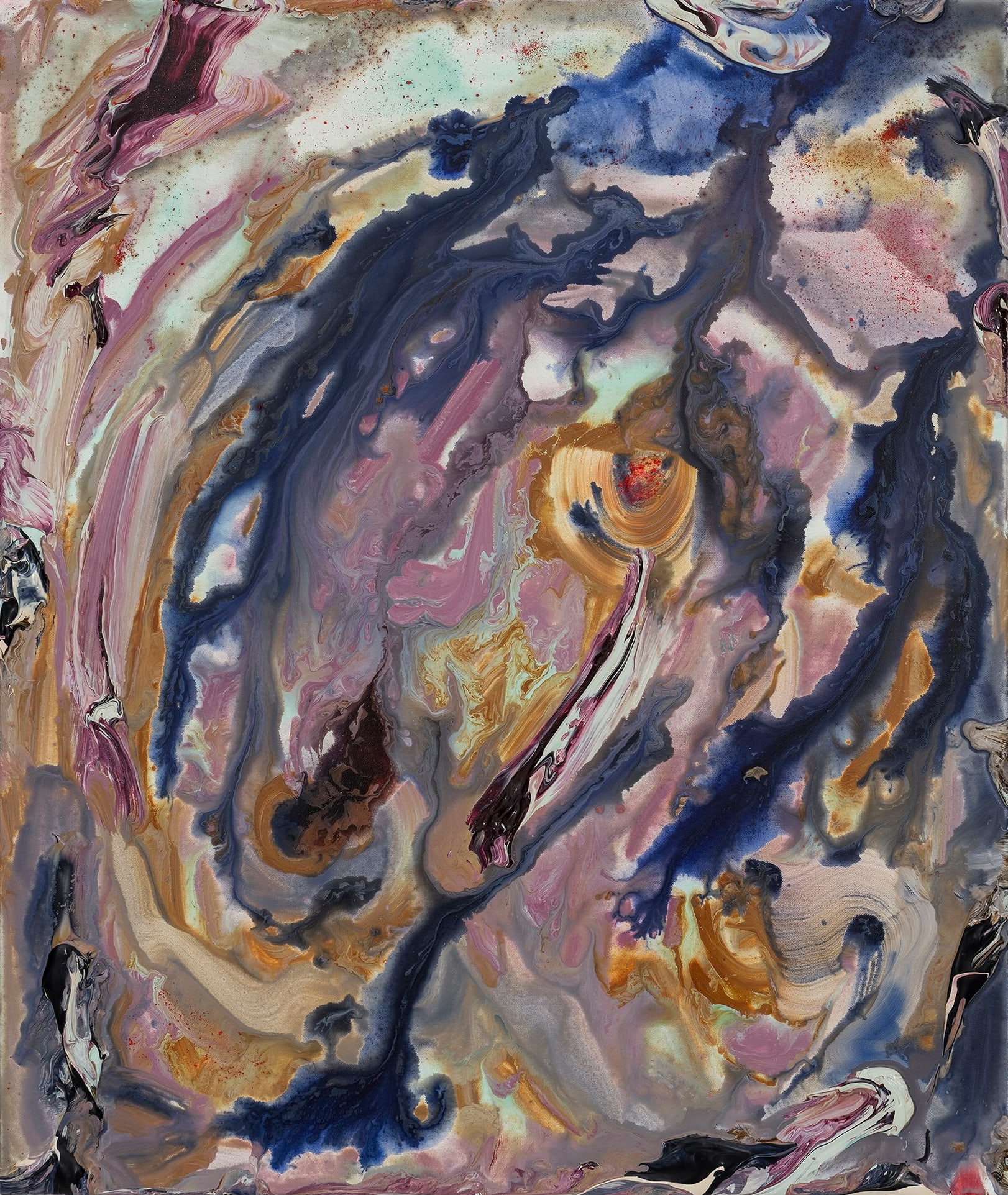
Since her beginnings, Clédia Fourniau has considerably shifted the conditions under which her painting appears. Her early works already combined textile, inks, pigments and mica with polyurethane resin which, applied in layers, modulated the depth of the colours and inscribed the painting in real space: the surface picked up the viewer’s movements, variations of light and fragments of the surrounding space. This relationship between painting and perception has grown steadily more complex as she has diversified her supports and granted her gestures ever greater autonomy. The recent works presented in this first solo exhibition at Ceysson & Bénétière bring together several painterly regimes and an extended typology of gestures. Some stretch colour into veils or oblique sweeps; others condense into striated impastos, thick commas, loops, scratches, lines of resin or paint laid onto the surface. The gesture may cross the field, isolate itself near an edge, shrink to a stain or take on the equivocal appearance of a sign. Each mark stems from a particular speed, tool and degree of attention. Their assembly forms no stable language and keeps painting in a state of availability. Colours appear in zones of temperature, surges and recessions. The eye travels from a coloured vapour to a thickness, from a dry rubbing to a fluid line, from a faint trace to a heavier mass. This path leads it to recompose, from the traces that remain on the surface, the hypothetical narrative of the operations that brought the painting into being.
X et O makes this circulation particularly palpable. A tentative grey grid organises the surface without stabilising it, drawing a loose framework, reminiscent of a window or a lattice, crossed by yellow, orange and green washes punctuated with small impastos. In OK,OK,OK, an oblique plum-coloured trace meets a series of yellow, orange and almost black touches; the relationship between colour diffusion and the punctuation of the gesture tightens. Lower down, a cluster of greens, lilacs and blues forms, then dissipates. The painting holds in the gap between the atmospheric circulation of the ground and the resistance of the signs. In Pour tous les jours, an expanse of greyed greens, ochres and muted yellows occupies the upper part, then comes undone lower down in pale blues, pinks and light reserves. The passages are stretched, rubbed, almost absorbed by the cotton. A creamy raised thread and two long obliques, one violet, one ochre, interrupt this diffusion and bring the eye back to the materiality of the surface, after the fleeting appearance of a landscape. The ambiguity of the sign becomes even more evident in Joli, mignon, gentil et sympa. A black arc crosses the lower third of the canvas; its thickness, reworkings and angular ends give it the look of a smile as much as of a pictogram. It weighs on the composition, gathers the diffuse zones around it, then pushes them back toward the edges. Above are scattered a yellow impasto, a touch of bright green, another of light blue and several rubbed passages; below appear yellow-green circular forms and a violet loop. The sign acts as a hinge, transforming a dispersion of gestures into an organised space while retaining the ambiguity of a drawing, a childlike form or an enigmatic emblem.
With the small formats, the expansion of the gesture gives way to a concentration of its effects. In Press Play, on grey jersey, two red and silver clusters occupy the centre of a translucent brown zone. The matter is pleated, scraped, raised into ridges; pale mauves, a vivid green and a thin line of blue keep the whole in suspension. In Vaping and Smoking, on a cream-coloured fabric, an intense blue forms an irregular vertical flanked by violet, grey and acid-green traces. A dark edging follows the perimeter and makes the tension of the fabric on the stretcher tangible. In I’m just an internet person, I do not exist, a veil of salmon pink, yellow and light blue permeates the white cotton; compact masses settle into it: a deep blue doubled with acid green at the left edge, a yellow shape at the top, an impasto of the same yellow lower down and a crimson vertical near the right edge. The gestures gather at the limits, leaving a more undecided zone at the heart of the painting, and the composition seems to build itself from its margins. The reduced format isolates an event of matter, calls for close looking and heightens the importance of each variation in density.
The colour of the supports, in turn, modifies the value and visibility of the gestures. On dark grounds, it absorbs light, muffles contrasts and transforms the depth of the layers. In Jeune et vieille, on a green jersey, the dark brushstrokes stand out through slight differences in matte quality and thickness. Light blue lines drawn horizontally segment the field and introduce a measure foreign to the agitation of the traces. In Purification par la boue, black absorbs the olive, ochre and reddish-brown passages; the paint seems to emerge from the support rather than rest upon it. In Cottage, greys, ochres and greens catch on the grain of the textile, while a yellow-green band along the lower edge gives the field the depth of a landscape. The coloured support determines the value of the pigments, accelerates or slows contrasts and imposes on each gesture its luminous quality. Yellow cotton and striped fabric set other kinds of resistance against the paint. In Des éclats de rires plus sonores et des histoires plus drôles, orange, red, green and blue passages sink into the yellow of the support. The colour seems stirred, keeping several states of the painting active at once. In Assez follement, the pink, sea-green and blue stripes of the fabric impose a regular beat that continues onto the edges. Over this cadence, Clédia Fourniau superimposes broad, discontinuous horizontal gestures: purplish-brown rubbings, green streaks, muted yellows, earthy reds and dark blues. The colour sometimes lets the pattern of the support reappear; elsewhere it blurs its rhythm beneath thick or glossy deposits. The painting is built from the interference of these two tempi: the continuous bands of the fabric and the irregular gestures that cover, interrupt or displace them. The treatment of the edges engages the painting in a direct relationship with space. The depth of the stretcher makes the edge visible and calls for an oblique perception of the work. The coloured fabric may wrap around the stretcher and extend the rhythm of the front; a painted border may mark the passage from one plane to the other. The painting thus articulates its own frontality, the concrete thickness of its support and the interval that separates it from the wall. It embraces the volume that carries it and makes the viewer’s movement a condition of its perception.
This extension of painting to the support and to space sheds light on the way Clédia Fourniau conceives the gesture as an action able to welcome accident. She speaks of “programming spontaneity,” of assembling the conditions in which painting can happen. The phrase contains the active principle of her work and holds together intuition, constraint, accident and reworking. A drip may be kept, interrupted or replayed; a moment of clumsiness may be absorbed into an overall organisation; an apparently immediate gesture may stem from a deferred decision. The painting bears the marks of its making without revealing with certainty the action that produced them. By preserving the sensory intensity of the gesture while rendering its origin uncertain, Clédia Fourniau shifts the question of authenticity toward that of the conditions in which painting is produced and received. The fragments of her children’s drawings, the fake signatures, pictograms, numbers and indecipherable symbols all take part in this shift. Diffuse colour and opaque sign, broad gesture and near-invisible notation, industrial textile and heavily loaded impasto, replayed clumsiness and precision produce a composition whose unity remains local, revisable, precarious. Each element redefines its place through contact with the others. The artists to whom Clédia Fourniau refers – Amy Sillman, Bernard Piffaretti, Laura Owens, Jacqueline Humphries, Charline von Heyl, Albert Oehlen and Michel Majerus – make it possible to situate this reflexive conception of painting within a shared field: the reprising of codes, the ambivalence of the gesture, the simulation of spontaneity and the possibility of continuing to paint after the crisis of individual expression.
This indeterminacy extends into the titles. Clédia Fourniau chooses them when the paintings are about to leave the studio, from a list of words and phrases she has kept for several years. Ordinary expressions, literary fragments, turns of phrase drawn from conversations or from digital vocabulary, French and English sit side by side, in a relationship to the works that remains oblique. Cottage accentuates the landscape depth of a small dark painting; Press Play associates impasto with the idea of an interrupted or restarted action; I’m just an internet person, I do not exist sets the materiality of the painting against the instability of a digital existence. These pairings never provide a key. The title fixes, in the artist’s words, “a sort of story of the painting,” without excluding the possibility of another naming. It directs the gaze, prompts a hypothesis, then lets the painting confirm, displace or undo it. When the link resists, opacity keeps open the relationship between what is read and what is seen.
The tension between decision and indeterminacy is condensed in the title of the exhibition, Cent pour Cent Ça Oui, which takes up and displaces the line “Une chose 100 % ancienne, 100 % neuve” (“A thing 100% old, 100% new”) from Laura Vazquez’s play Zéro [1]. The statement “cent pour cent ça” asserts a certainty that the addition of “oui” redoubles to the point of making it suspect. What does this “ça” designate? Painting as it presents itself? The sum of the operations that produced it? The accident reworked until it becomes necessary to the balance of the painting? Clédia Fourniau maintains this instability in a spoken formula delivered with an assurance whose very excess opens a space for doubt. The eye takes up and corrects; it identifies a form, separates what a first perception had confused, gathers what it believed to be distinct. Painting finds its strength in the mobility that separates a decision from its possible revision. Each painting makes perceptible the acts that constituted it – covering, erasing, thickening, interrupting, resuming – without ordering them into a single narrative. Everything seems to have taken place; nothing is definitively assigned. The certainty announced by the title remains traversed by whatever displaces, contradicts or relaunches it. In this regime of troubled conviction, painting retains, even in its most assertive forms, the capacity to happen yet again.
—Jean-Charles Vergne, 2026.
1 - Laura Vazquez, Zéro, Paris, Éditions du Sous-sol, “Feuilleton Fiction” series, 2024.