
Exhibition · Peggy Guggenheim Collection
Mystical Symbolism: The Salon de la Rose+Croix in Paris, 1892–1897
Oct 28 – Jan 7
About the show
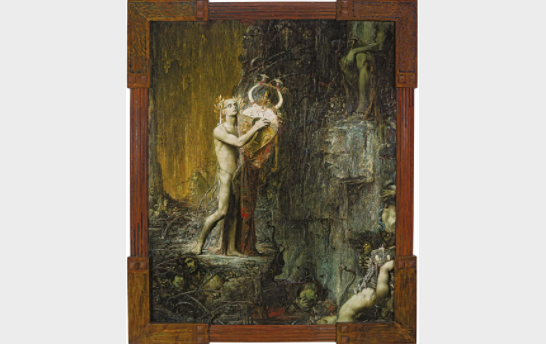
This is the first museum exhibition to examine the art of the Salons de la Rose+Croix. In 1892, Joséphin Péladan (1858–1918), an eccentric critic, author, and Rosicrucian, founded the annual Salon de la Rose+Croix in Paris to showcase mystical Symbolist art. Mysterious, visionary, and mythical themes prevailed in the works at his salons, with images of femmes fragiles and fatales, androgynous creatures, chimeras, and incubi. International in scope, the salons featured artists from Belgium, Finland, France, the Netherlands, Spain, and Switzerland, among other countries. Emile-Antoine Bourdelle, Jean Delville, Rogelio de Egusquiza, Charles Filiger, Alphonse Osbert, Armand Point, Georges Rouault, Carlos Schwabe, Alexandre Séon, Ville Vallgren, and Félix Vallotton were among those who participated, and composers such as Erik Satie were also involved. The exhibition will be organized around common themes in the works, including the role of Orpheus, the adulation of the Italian Primitives, and the cult of personality—groupings that, in turn, will underscore the diverse and sometimes opposing concepts that informed Symbolism in the 1890s.
Curated by Vivien Greene, Senior Curator, 19th- and Early 20th-Century Art, with the assistance of Ylinka Barotto, Curatorial Assistant, Solomon R. Guggenheim Museum, New York, Mystical Symbolism will portray a transnational cross section of artists, some better known than others, and allow for a fresh look at late 19th-century Symbolist art.
About Peggy Guggenheim Collection
In October 1942, Peggy opened her museum-gallery Art of This Century in Manhattan, at 30 West 57th Street. Designed by the Austrian architect Frederick Kiesler, Art of This Century consisted of innovative and visually compelling exhibition rooms and soon became the most stimulating venue for contemporary art in New York City.
More about Peggy Guggenheim Collection →