Ended Feb 15
John Phillip Abbott
New Day
Jan 11 – Feb 15, 2020
More from John Phillip Abbott on Gallop
[Scroll down for French version / Veuillez trouver ci-dessous la version française]
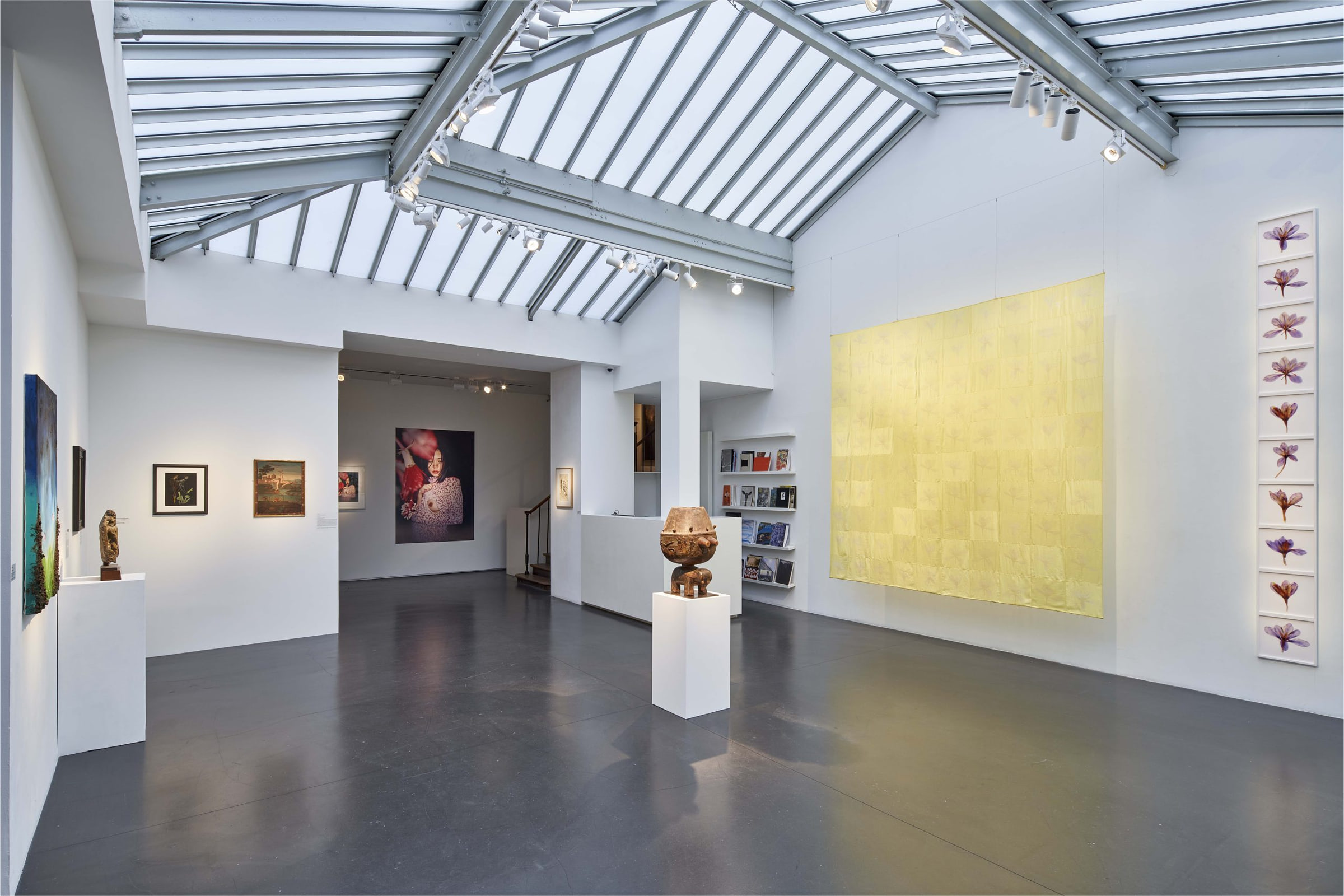
Xippas Paris is pleased to present New Day, John Phillip Abbott’s first solo show at the gallery, reuniting on both floors of the exhibition space a body of works carried out since 2012 and his most recent productions.
Since his debut, John Phillip Abbott explores the relationship between text and image, blurring the boundary between both. Words, names or short sentences organize his compositions with a grid-like structure and function as images rather than mere concepts. Complex and visually intense, his linguistic structures challenge legibility and invite the viewer to enter an interstitial zone, between “reading” and “seeing”.
Each lexical entity chosen by Abbott for his painting presents itself as a problem or a puzzle. The starting point is the word itself and its diaristic value, as it refers to his past experiences and memories. For example Pontiac was his first car. In the Pines, the song by Huddie Ledbetter, he grew up with and often listened to while painting. Phaedrus is a character in Zen and the Art of Motorcycle Maintenance by Robert M. Pirsig. As for the tennis paintings, they are reminiscent of yet another important book from his past, entitled The Inner Game of Tennis by Timothy Gallwey. This book, largely centered on being in the moment, made him reflect on sport as a metaphor for art and life and consider the process of art making as a form of cathartic exercising, physically engaging his body while painting and challenging his mind, in search of memories and associated words.
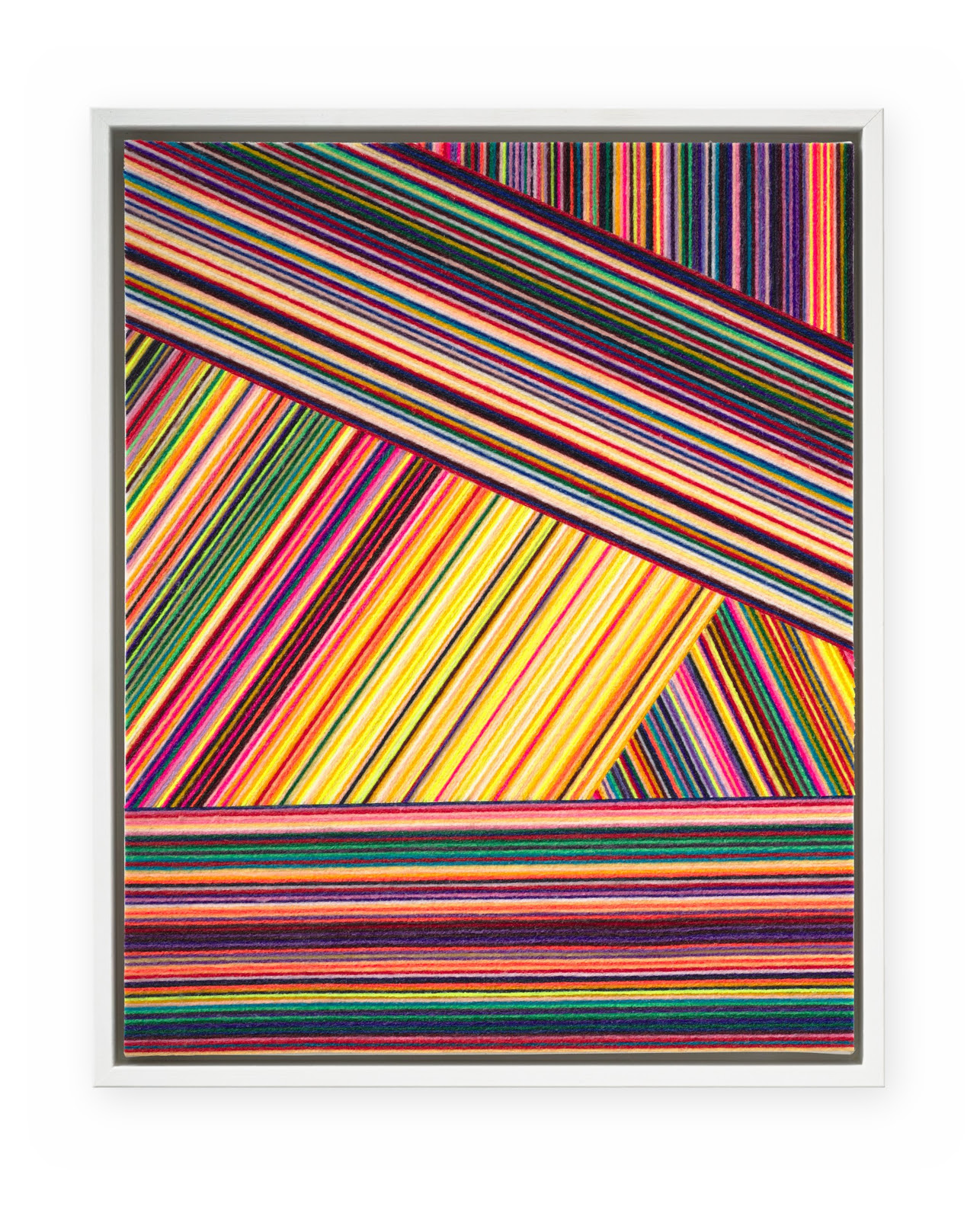
John Phillip Abbott’s creative process starts with a memory, crystallized in words. After the lexical content (dug up from his personal history) is determined and stabilized, comes the act of painting, which consists in spelling out words or short sentences, through a peculiar calligraphic vocabulary composed of geometric shapes (stripes, rectangles, diamonds, pyramids, etc.). These shapes, interweaving with words’ usual configuration, are carefully chosen as part of formal solutions to the painterly problems and situations he encounters. The act of transformation – the one that puts words in disguise and makes grids out of letters – is thus purely formal and detached from the initial semantic load. In this sense, Abbott is close to the Support/Surface movement, considering formal research to be primordial in his work. He doesn’t consider words as concepts, but rather adopts a sensuous approach towards them – like canvas or paint, words are to be felt, manipulated, experienced
The actual process of painting for Abbott may be seen as a journey of gradual detachment from the meaning of the word. Or, put differently, his creative process is a passage: from “reading” to “seeing”. Once completed, the viewer will be invited to follow the same path, only backwards, from “seeing” to “reading”. What will be read remains enigmatic due to the autobiographical nature of the words. However, sufficiently ambiguous, the paintings do not close in upon themselves, but rather stay open for possible interpretations. As a result, through Abbott’s visual formulas, the viewer may be reminded of his past or invent a brand new story.
With this balancing between “reading” and “seeing”, between memories put into words and a certain detachment from the words’ initial meaning, Abbott’s paintings enclose a paradox. On the one hand, we are confronted with the rational approach of a formal painterly research (dictated by geometry, logic or necessity). On the other hand, there is always a sentimental backstory determining the actual choice of words and formal decisions. All this turns Abbott’s paintings into something similar to Proust’s madeleine or a time-travel machine, destined to resurrect the past.
Calligraphic experimentations and time-travels are, however, not his only preoccupations. John Phillip Abbott endlessly experiments with technique as well. He combines brush strokes and spray painting, uses stencil and masking tape, works on raw or prepared canvases (and sometimes even transforms T-Shirts into a canvas). The artist is constantly inventing and reinventing his way of working and thinking about painting. He listens to materials and stays open to possible surprises, welcoming deformities and embracing imperfections. This is even more true of his newest paintings presented in the upper gallery. In this body of work, he starts to paint on the unstretched canvas, covering it with dots or stripes, then, stretches it up in order to proceed with the usual word construction. The work on the unstretched canvas gives space to more painterly accidents and unexpected twists, which is why he refers to the moment of stretching the canvas as serendipitous. As if to remind us, that despite the unknown premises and all kinds of surprises waiting ahead, there is always place for an intuition (some call it hope), which makes us believe that a new day shall come, and it will be pretty amazing.
John Phillip Abbott (born in 1975) lives and works in Albuquerque, New Mexico, USA. He received his MFA from the University of Wisconsin in 2007 and a BFA from Western New Mexico University. His work has been shown internationally and most recently at Gleichapel, Paris; County Gallery, Palm Beach, FL; Galerie Bertrand in Geneva, Switzerland; Pierogi, New York and Devening Projects, Chicago. Abbott was also included in institutional shows such as This One’s Optimistic: Pincusion at the New Britain Museum of American Art in New Britain, CT, curated by Cary Smith.
*****
Pour commencer l’année sur une note optimiste, Xippas Paris a le plaisir de présenter New Day, la première exposition personnelle de John Phillip Abbott à la galerie, rassemblant sur deux étages des œuvres allant de 2012 à ses réalisations les plus récentes.
Depuis ses débuts, John Phillip Abbott explore la relation entre le texte et l’image, brouillant la frontière entre les deux. Les mots, les noms ou les phrases courtes organisent ses compositions en une structure similaire à une grille et fonctionnent comme des images plutôt que des concepts. Complexes et visuellement intenses, ses structures linguistiques défient la lisibilité et invitent le spectateur à entrer dans une zone interstitielle, entre ”lire” et ”voir”.
Chaque entité lexicale que l’artiste incarne en peinture se présente sous forme de problème ou de puzzle. Le point de départ est un mot, qui a valeur diaristique, faisant référence à ses expériences et souvenirs passés. Par exemple, Pontiac était sa première voiture ; In the Pines de Huddie Ledbetter, un morceau avec lequel il a grandi et qu’il écoutait souvent en peignant ; Phaedrus un personnage du Traité du zen et de l’art de l’entretien des motocyclettes de Robert M. Pirsig. Quant à ses tableaux ”tennis”, ils renvoient à un autre livre, The Inner Game of Tennis de Timothy Gallwey ; un ouvrage qui traite de l’importance d’être dans l’instant présent et l’a incité à considérer le sport comme une métaphore de l’art et de la vie. Par voie de conséquence, le processus de création artistique est devenu pour l’artiste une forme d’exercice cathartique qui sollicite le corps physiquement dans l’acte de peindre et défie l’esprit, au moment où il se lance à la recherche de souvenirs et de mots associés.
Le processus créatif de John Phillip Abbott commence toujours par un souvenir cristallisé en mots. Une fois le contenu lexical (puisé dans son histoire personnelle) déterminé et stabilisé, vient l’acte de peindre, qui consiste à épeler des mots ou des phrases courtes avec un vocabulaire calligraphique composé de formes géométriques (rayures, rectangles, diamants, pyramides, etc.). Ces formes, s’entremêlant à la configuration habituelle des mots, sont soigneusement choisies et deviennent des solutions formelles aux problèmes picturaux rencontrés par l’artiste. L’acte de transformation – celui qui déguise les mots et métamorphose les lettres en grilles – est donc purement formel et s’affranchit de la charge sémantique initiale. Pour cette raison il se sent proche du mouvement Support / Surface, la recherche formelle étant primordiale. Il ne considère pas les mots comme des concepts, mais adopte une approche sensorielle à leur égard – comme la toile ou la peinture, les mots doivent être ressentis, manipulés, vécus.
L’acte de peindre peut donc être considéré comme un détachement progressif de tout sens dont le mot serait doté. Il est aussi possible de voir son processus créatif comme un passage du ”lire” au ”voir”; une fois l’œuvre réalisée, le spectateur est invité à suivre le même chemin, dans le sens inverse, en passant de l’acte de ”voir” à celui de ”lire”. Mais les mots lus dans les œuvres d’Abbott restent énigmatiques puisqu’ils sont autobiographiques et sujets à interprétation. Suffisamment ambiguës, ses peintures ne se renferment donc pas sur elles-mêmes. Elles restent ouvertes à différentes lectures. Ainsi, grâce aux formules visuelles d’Abbott, le spectateur peut se replonger dans son passé ou inventer sa propre histoire.
Basculant entre ”lire” et ”voir”, entre des souvenirs mis en mots et un certain détachement par rapport au sens initial des mots, les tableaux d’Abbott renferment un paradoxe. D’une part, on perçoit une dimension rationnelle dans sa recherche picturale formelle (dictée par la géométrie, la logique ou la nécessité). D’autre part, il y a toujours un vécu sentimental qui détermine le choix des mots et des formes. Tout cela confère aux peintures d’Abbott une dimension similaire à celle de la madeleine de Proust ou d’une machine à remonter le temps, destinée à faire ressurgir le passé.
Les expérimentations calligraphiques et les voyages dans le temps ne sont pas les seules préoccupations de John Phillip Abbott. L’artiste n’a de cesse d’expérimenter différentes techniques. Il combine le pinceau et la peinture à l’aérosol, utilise le pochoir et les rubans de masquage et travaille aussi bien sur des toiles brutes que préparées (il en arrive même à transformer des T-shirts en toile). L’artiste invente et réinvente constamment sa façon de travailler et de penser la peinture. Il reste à l’écoute des matériaux et demeure ouvert aux surprises qu’il pourrait rencontrer, bienveillant envers les déformations et les imperfections. Cela est d’autant plus vrai de ses nouvelles peintures présentées dans l’espace à l’étage. Dans ce corpus d’œuvres, John Phillip Abbott travaille d’abord sur la toile non tendue, en la recouvrant de points ou de rayures, puis il la tend pour ensuite procéder à la construction habituelle de ses mots-images. Ce travail sur la toile non tendue laisse place aux accidents picturaux et autres effets inattendus. Pour cette raison il considère le moment où il tend la toile sur châssis comme un moment de sérendipité. Comme pour nous rappeler que malgré toutes les surprises rencontrées, il y a toujours une place pour l’intuition (certains l’appellent espoir) qui nous laisse penser qu’un nouveau jour viendra, et qu’il sera cool.
John Phillip Abbott (né en 1975) vit et travaille à Albuquerque, New Mexico, les États-Unis. L’œuvre de John Phillip Abbott a fait l’objet d’expositions internationales, récemment à Gleichapel (Paris, France); COUNTY Gallery (Palm Beach, États-Unis), Galerie Bertrand (Genève, Suisse), Pierogi (New York, États-Unis) et Devening Projects (Chicago, États-Unis). Ses œuvres ont été présentées dans des expositions institutionnelles telles que This One’s Optimistic: Pincusion au New Britain Museum of American Art à New Britain (commissaire Cary Smith).