Ended Nov 16
Mickalene Thomas
Jet : Beautés du mois
Sep 25 – Nov 16, 2019
More from Mickalene Thomas on Gallop
Galerie Nathalie Obadia is very pleased to dedicate a third exhibition to the American artist Mickalene Thomas, an essential figure in the artistic scene of the United States. Thomas has contributed to the affirmation of feminine and African-American cultural identity since the start of her career, notably through her portraits of domestic interiors staged in powerfully evocative ways. The artist enjoys many recent successes marked by several solo exhibitions: Mickalene Thomas: Femmes Noires at the Contemporary Art Center of New Orleans in late 2019 into 2020 , after the Art Gallery of Ontario in Toronto, and an exhibition at the Bass Museum in Miami starting next December.
On a background of vintage wallpaper, the exhibition at the gallery will present a collection of recent paintings on wood panels and collages on paper, two mediums of choice for the artist. Thomas also works with photography, video, and 3-D—creating in the context of certain projects wholly new environments that seem to spring directly from her own pictorial compositions. Tackling head-on the issue of representation, the body of the black woman occupies a central place here and is projected into social, historical, and fantastical spaces, standing at the crossroads of multiple symbols and sources of inspiration.
The work of staging is essential in Thomas’s art, and it’s a task she devotes herself to with particular passion during photo sessions with models chosen from among those close to her. Each object, each piece of fabric, and each texture effectively contribute to a portrait of her complex identity, which is by extension that of the history of the black and LGBTQ community. It’s indeed inside these retro interiors that Mickalene Thomas choses to represent her muses, drawing from a number of vintage magazines and design encyclopedias. Through these repurposed environments, the artist creates her own iconographic repertoire with 60s-70s décor made in pop art colors, patchworks of prints, photographs, solid matte colors, and seductive materials. The resulting work contains a visual dynamism reminiscent of synthetic cubism and the cut paper collages of Romare Bearden and Matisse.
The work of Mickalene Thomas is also peppered with references to a history of art that has consistently denied the influence of black models, using this shared visual culture as a bridge to her own message of black and female empowerment. Her pieces at once pay homage to and deliver a critique of famous avant-garde portraits of the 19th century which served to mark the history of painting as well as the evolution of society itself. Her work takes on the erotic and scandalous potential of the “Odalisque” by Ingres, as well as “Olympia” or “The Luncheon on the Grass” by Manet, all while questioning notions of canon and beauty throughout the course of history.
In-depth preliminary research and preparatory studies are at the origin of the works presented in this exhibition, notably in the Jet Magazine calendars between 1971-1977, nicknamed “The Negro Bible,” and also in the erotic magazine “Nus Exotiques”, also published in the 1950s. Both have informed the art in this exhibition, with the former serving as witness to the emergence of the black civil rights movement, and the latter marking the beginning of a decisive counter-culture.
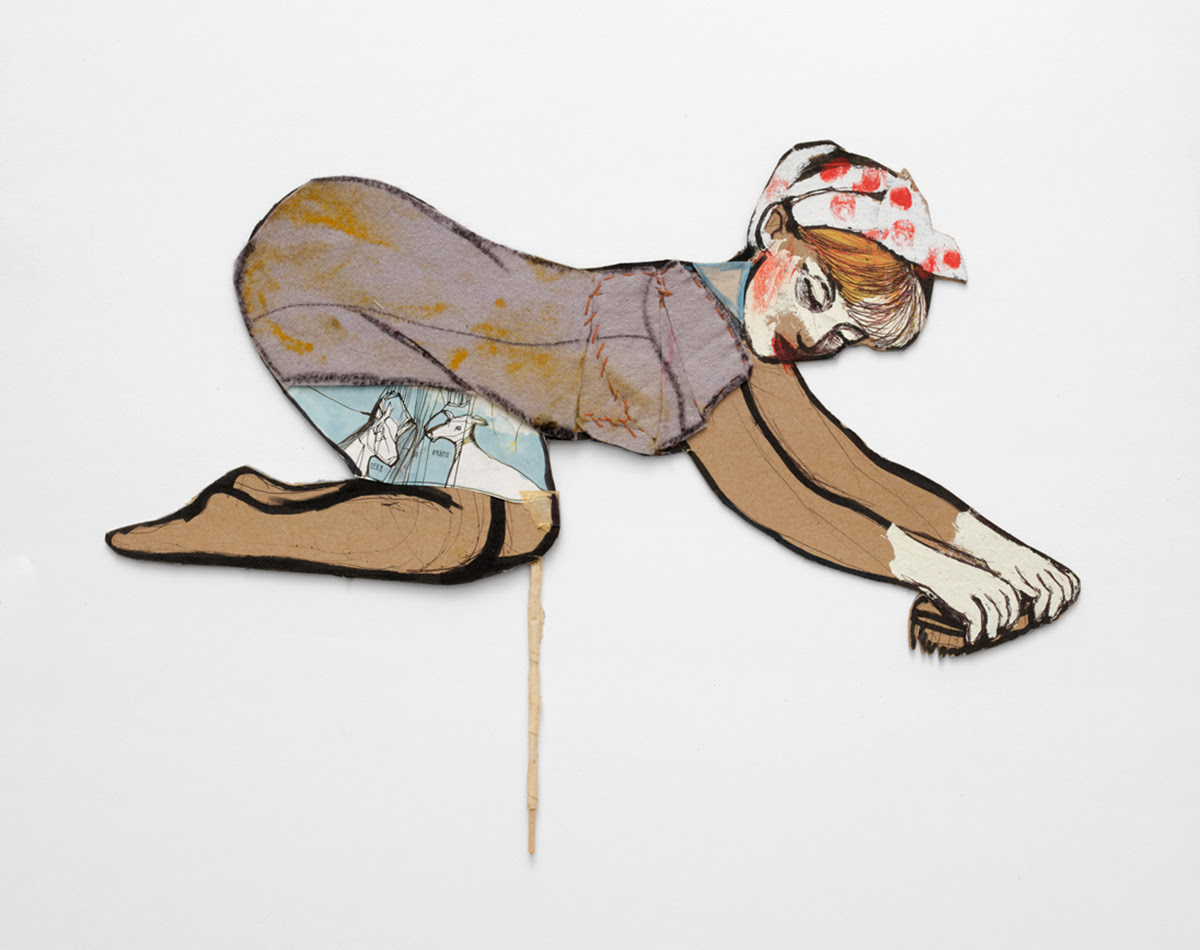
The motifs chosen by Mickalene Thomas are cut out and then freely juxtaposed during her preparatory studies, during which she also decides on the materials: silkscreen prints made in her New York studio, oil or acrylic paints, enamel, or rhinestones, which will then make up her paintings on wood panels. The multiplicity of these sources and techniques breathes great vivacity into the work of Mickalene Thomas. The vivid colors often appear in contrast to the black-and-white touches that lend an old-fashioned charm. The exuberant and almost abstract aesthetic that emerges from the paintings as well as the collages, the audacity of certain poses, and the cutting work evoke the photomontages of the Dadaists. The composite aspect of these portraits gives them a true sense of history, all while creating their own original type of mental universe, both uniquely new in their inspiration and full of cultural references. The bodies depicted here constitute a kind of meeting place for a bundle of intersecting symbols. They thereby become carriers of a political dimension, in that they appear fashioned in light of contemporary debates, history, and culture, but also by the vibrant desire of their author — let’s not forget the importance of pixelized skin, which in certain works of art seems to probe as closely as possible the DNA of the model, her skin color, and her sensuality. These paintings are decoding and reassembling the socio-cultural structures of the printed matter she sourced.
Conscious of taking part in a broader movement playing out today, Mickalene Thomas goes beyond to the walls of her studio to embody the fight for feminism and for recognition of the minority groups she represents. Through frequent involvement in meetings, events, and conversations, she engages with her communities and regularly gives advice to other young women artists.
Through an exceptionally informed body of work that knows how to combine technical mastery with visual seduction, Mickalene Thomas has established herself in the tradition of great African-American artists as one of the contemporary ambassadors of numerous societal issues.
Mickalene Thomas was born in 1971 in New Jersey; she lives and works in Brooklyn (New York).
A multidisciplinary artist among the most well-known within the contemporary art scene in the U.S., Mickalene Thomas has participated since 2003 in numerous national and international exhibitions. She is known for mixing references to art history, politics, and pop culture in order to create captivating paintings that are both figurative and non-figurative. Her work is rooted in a long study of art history and classical portraiture, into which she introduces a complex notion of femininity that questions beauty standards and aesthetic representation.
Her first major solo show took place in 2012 at the Brooklyn Museum in New York City and at the Santa Monica Museum of Art in California. In 2016, Mickalene Thomas had solo shows primarily in the U.S. in places like the Aspen Art Museum as well as the MOCA Grand in Los Angeles. The following year sent her work to the Contemporary Art Museum in Saint-Louis, Missouri among others, and in 2018 her work was exhibited at a the Wexner Center for the Arts in Columbus and the Henry Art Gallery in Seattle (USA). The artist also enjoys many recent successes marked by several solo exhibitions: Mickalene Thomas: Black Women will be presented at the Contemporary Art Center of New Orleans after the Art Gallery of Ontario in Toronto in late 2019 into 2020; the artist will also mount an exhibition at the Bass Museum in Miami starting in December.
She has also contributed to a large number of group exhibitions, including at the International Center of Photography in New York City, at the Museum of African Diaspora in San Francisco, at the San José Museum of Art, at the North Carolina Museum of Art in Raleigh, and at the New Museum of Contemporary Art in New York City. Additionally, since 2018 her exhibition—Posing Modernity: the Black Model from Manet to Matisse—can be seen in numerous museums and art centers including the Gibbes Museum of Art (North Carolina), the Museum of Fine Arts of Salt Lake City (Utah), and the Miriam and Ira D. Wallach Art Gallery in New York City.
Her artwork is included in the permanent collection of numerous American museums, among others the Art Institute of Chicago, the Museum of Fine Arts in Boston, the Saint Louis Art Museum, the Museum of Modern Art, the Brooklyn Museum, the Guggenheim Museum, the Whitney Museum of American Art, the Detroit Institute of Arts, the Hammer Museum in Los Angeles, the Seattle Art Museum, and the Smithsonian American Art Museum.