
Exhibition · DIMIN
Taj Poscé
Looking Up From Here
Sep 9 – Oct 24

2 images · swipe
About the show
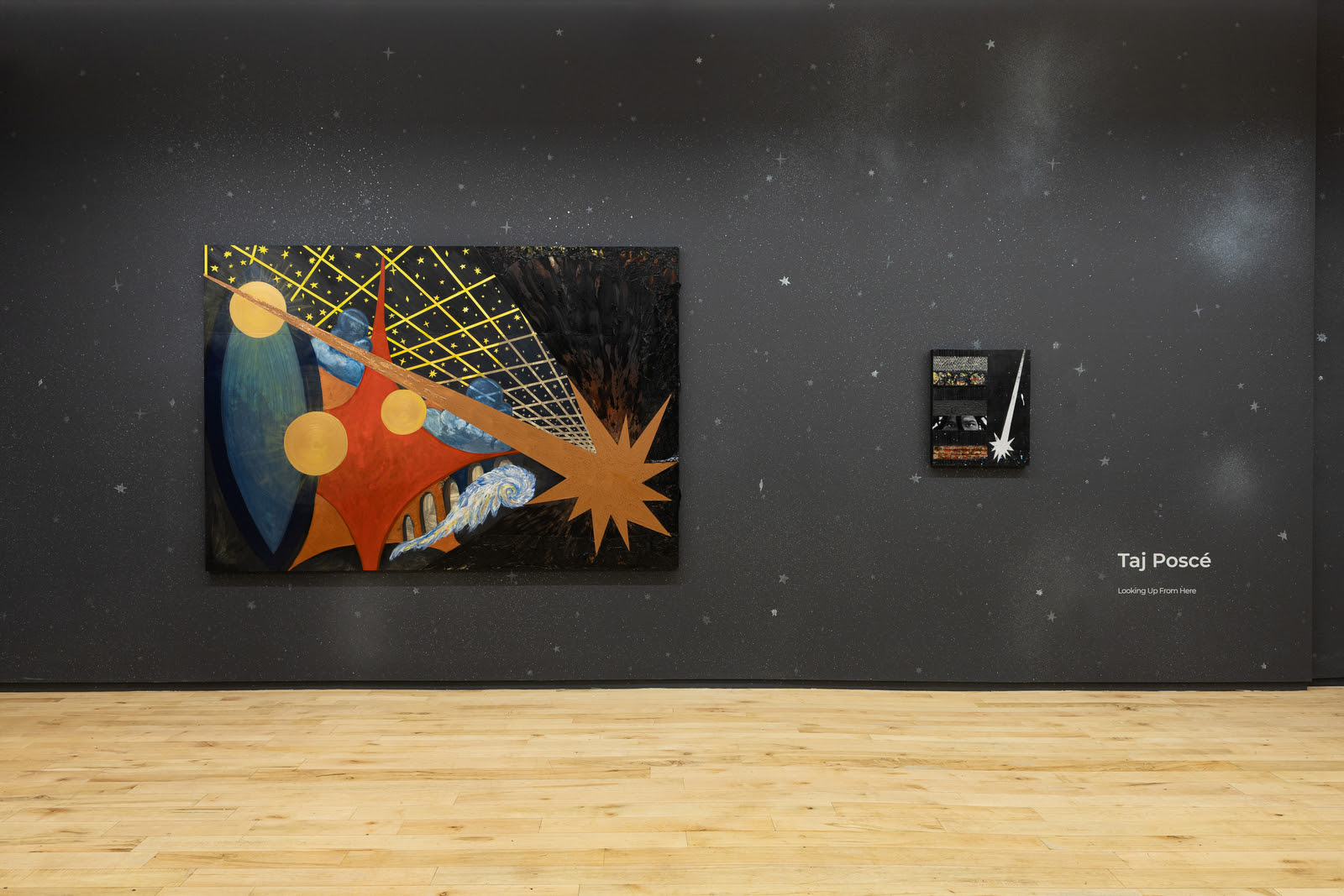
Dimin is pleased to present Looking Up From Here, the newest body of work from the Baltimore-based artist Taj Posce. Posce explores the relationship between personal memory and the larger, unseen cosmic web that binds generations, geographies, and time. The exhibition centers on an inward journey through history, spirituality, and imagination, considering how knowledge persists beyond official records and continues to shape identity across generations.
For Posce, painting functions as both relic and medium: an object that carries the traces of lived experience while serving as a vessel through which knowledge may be revealed. His works emerge from an ongoing search for truth through genealogy, observation, intuition, and the act of making. What begins as research gradually transforms into something less tangible--a convergence of symbolism, consciousness, and spiritual inquiry. Within this process, moments of grief, wonder, dismay, joy, and curiosity become the material from which each painting is built. Central to the exhibition is Posce's use of what he calls "scurochiaro," the inverse of chiaroscuro. This "dark-light" is harnessed as a sacred space of creation where revelation, contemplation, imagination, and faith become intertwined. Rather than treating darkness as absence, the artist understands it as a condition of possibility--a generative space in which intuition and belief reveal pathways that remain otherwise unseen. Like stars gradually emerging in the night sky, moments of understanding materialize through uncertainty.
The exhibition's immersive quality begins at its threshold with In & Out My Door (Freedom Flyer), a sculptural installation that serves as the entrance into the gallery space. Built by Posce to match the front door of his great-grandfather's house, the work incorporates the original cast-iron eagle, or "Freedom Flyer," that once adorned the family home. The installation points to a childhood memory of entering that house, a place where Posce remembers his parents' youth and where his own creativity began to take shape at a very young age. The black eagle remained fixed in his mind, initially evoking the black hawks found on old heraldic crests and shields, before further research revealed that the "Freedom Flyer" carried associations with veterans and homeownership. When Posce spoke with his family about the door, they believed his great-grandfather may have acquired it unintentionally from a secondhand shop; the coincidence takes on particular significance given that he was both a war veteran and a homeowner with a paid-off mortgage. In this way, the object becomes a vessel for intergenerational memory, accumulating different meanings as each generation brings its own context to the same symbol. Within Looking Up From Here, the sculpture offers a shifted perspective on the Black American experience, foregrounding histories of contribution, labor, achievement, and homeownership that have been obscured by dominant narratives. Yet the work remains deeply personal: for Posce, the notion of "looking up from here" is not only a reflection on his recent years and his success as an artist, but a deeper reckoning with his childhood self and the process of creating a life that, for many people with his background, can feel impossible. The house and the door hold memory; by physically crossing this reconstructed threshold, viewers enter a space that evokes the house that lives in Posce's mind.
Looking Up From Here reflects on the visible and invisible inheritances that shape our understanding of ourselves; ancestry, cultural fragments, obscured histories and traditions that exist beyond dominant narratives. The paintings ask what remains when names are altered, languages disappear, genealogies become fragmented, or entire systems of knowledge are pushed to the margins. What traces continue to endure? The exhibition's title operates on multiple levels. It evokes the physical act of looking toward the sky while simultaneously suggesting hope, aspiration, and transformation. It also recalls the perspective of a child looking toward an elder, an ancestor, or a guiding presence, proposing that meaning is often found beyond the immediate self--in the larger constellations of collective consciousness, record, and belief that surround us.
A central work in the exhibition, Piercing the Veil: The Knight King of Santiago, takes as its point of departure the late-16th-century Renaissance Portuguese painting Chafariz d'El-Rey (The King's Fountain), focusing on the Black figure mounted on a black stallion. Identified by the red cross on his sleeve as a member of the Order of Santiago, a upper-class of knights and stewards, the figure has also led historians to question whether he may have been a King, given his scale and stature within the painting. Posce connects this historical inquiry to the American South, where figures like the Knight King, as well as other Black Portuguese, Spanish, Moors, Jews, and Muslims, were exiled and dispersed throughout Europe, Africa, and eventually the Americas. Rather than attempting to define history, the work opens a dialogue around the ways certain histories have been forgotten or erased from our cosmic memory, asking what traces remain and how their significance might be recovered.
Through abstraction, Posce creates spaces where thought and feeling move freely. Signs, symbols, materials, and gestures become carriers of information, transmitting fragments of experience across time. His paintings function as records of what often escapes documentation: invisible people, invisible languages, invisible knowledge; a world of the unseen. Rather than offering fixed narratives, they preserve evidence of presence while acknowledging mysteries that resist complete understanding. At its core, Looking Up From Here is grounded in the belief that creation itself can become a form of revelation. Through remembrance, imagination, and faith, the exhibition considers how forgotten histories may be reconstructed and how inherited knowledge continues to inform the present. In doing so, Posce honors the enduring presence of those who came before while imagining more expansive futures for those still to come.
Taj Posce (b. 1995, Philadelphia, PA) is based in Baltimore, MD. His work was most recently included in Fade at the Studio Museum in Harlem, the latest installment in the institution's influential "F" exhibition series highlighting emerging artists of African and Afro-Latin descent. Last year he was awarded a residency at the Last Resort Artist Retreat (T.L.R.A.R.) founded by acclaimed artist Derrick Adams. In 2024, Posce presented, Just on the Other Side, a solo with Dimin -- his first solo exhibition in New York, which received a review in Artforum. Posce received his MFA from the Maryland Institute College of Arts (MICA) achieving the highest merit scholarship, the Leroy Hoffberger painting program, and the Congressional Black Caucus Visual Artist Award. He holds a BFA from the Tyler School of Arts (Philadelphia) where he studied under Odili Donald Odita and received numerous awards including the Yale Norfolk Summer Residency, and a studio abroad in Rome, Italy with Italian-American papermaker Roberto Mannino.
About DIMIN
Born and raised in New York City, Robert Dimin entered the art world twenty-five years ago as an artist. Fast forward ten years, post graduate school, and a variety of jobs later, Robert received some astute advice that perhaps his contribution was not as an individual artist, but instead as a support system for many artists.
More about DIMIN →