
Ended
Sofia Quirno
Beat Around the Bush
Mar 14 – May 4, 2024
Praxis is pleased to present Beat Around the Bush, a solo exhibition by Argentinian artist Sofía Quirno.
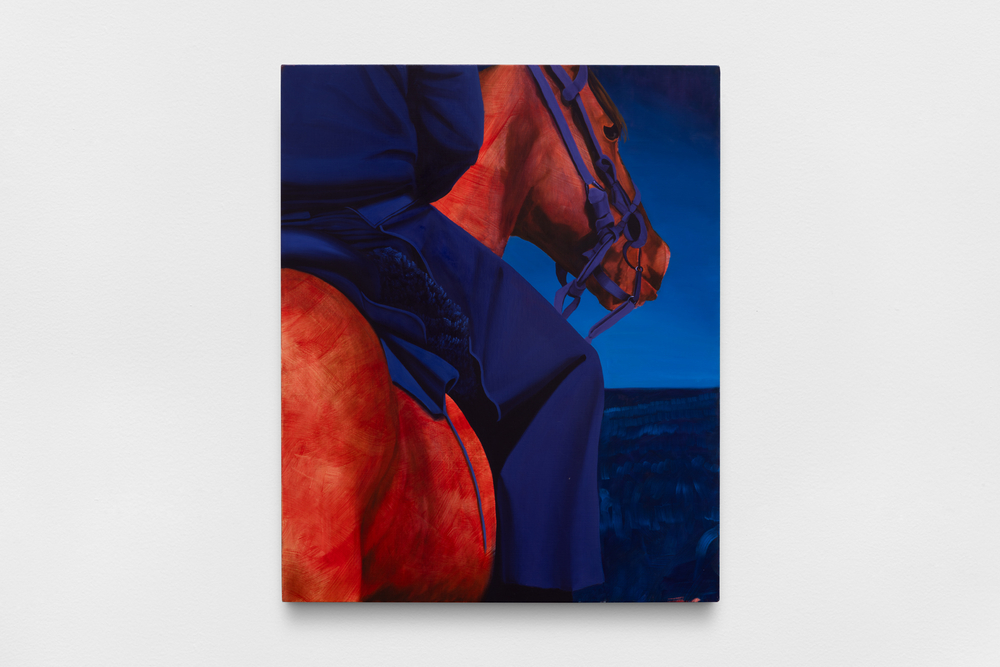
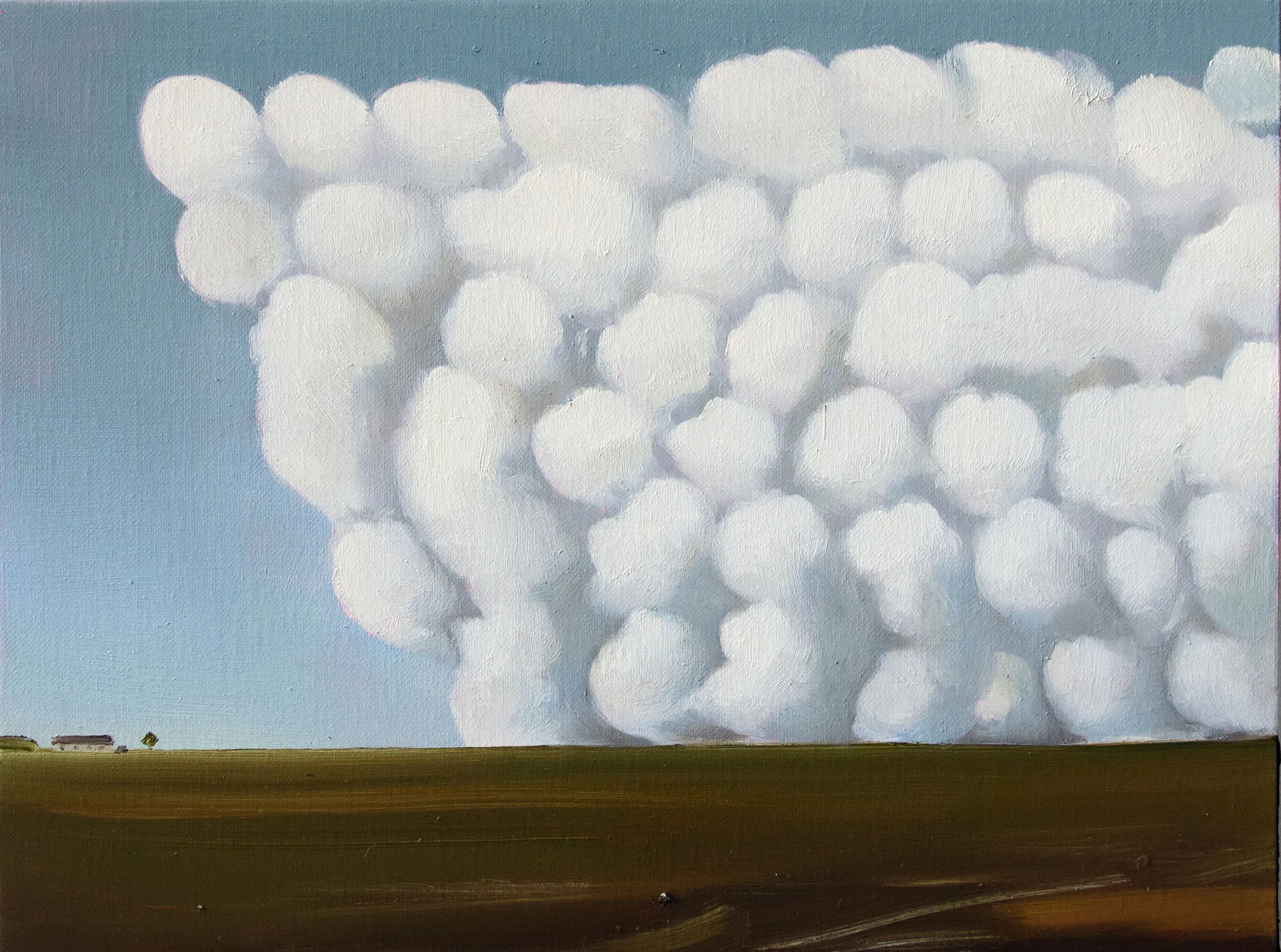
This exhibition by Sofía Quirno is made from a series of planes and images, held together by hinges. References are hinged onto paintings, paintings hinge on walls, images are split across the middle as if hinged. Nominally, these are paintings of landscapes with implications of bodies, although looking at them, it’s hard to know where to start talking about the landscapes. They unfold like landscapes, maybe, with hinges as horizons.
Still, there are tree trunks and branches, benches, something that looks like a mountain. Views out of windows and moonscapes. Some of the views are tacked-on reproductions of other artworks; some of these are painted as if they are tacked on. Nothing is painted consistently, but Quirno’s sensibility is present in her quality of line and touch, which is urgent even as it is questioning. The images interrupt themselves halfway through, changing color or scale, or their direction altogether. The paintings interrupt the wall as well, where several yonic glyphs adorn and make it, too, into a (relief) painting.
What is a landscape, even? Is it something that exists outside, or ideas and hopes that come from inside that we impose on a space? If it’s the latter, doesn’t that make every “landscape” like a child, born from the pussy of a fertile imagination? Then what’s with all the women in landscapes, the association of landscape with femme embodiment, from early glyphs to earth works? The surfaces of painted caves include icons of fertility alongside those of animals and hunting: landscape paintings authored by different people over time that wish for abundance over generations. But something else happened, too: the figure was turned into a ground, woman as landscape, to be dominated as it was adored. It’s hard to maintain subjectivity when the subject has been diffused into space. Was Ana Mendieta trying to restore the incantatory element of this association, and Louise Bourgeois its threat? Each of these questions takes a viewer a step back, returns us from the fullness of space back onto a surface, where the image of the landscape is inseparable from the language which conjures both it and bodies within it.
Beat around the bush. Beat the bush. Hand and bush. Hold the bush. Beat around, beat about. Full bushes, masturbation, foreplay. Stop beating, etc. Navel gazing, recursiveness and study. Beat and bat, bush and books. Which is another way of saying: get to the point. Enough! But the around was the point, it turns out. “Beat about the bush” comes from medieval game hunting, where the beating was meant to rouse the prey hidden within indirectly, so as to shoot it safely, for sport or sustenance. Why stop the beating and the bushes when the alternative is instant death, as opposed to something subtler and more drawn out?
For Quirno, painting is like these language games, where signification and objectification flip back and forth. There is a degree of precarity to this activity, as if the whole enterprise risks tumbling down, which is the point. Why paint if not to talk about how our reality is, in fact, contingent; hinged on conventions of thinking that have affected the material conditions of gender, nature, and image. Quirno’s paintings use these conventions as props, rendering the question of representation as DIY theater.
Some premises to keep in mind:
A painting is not a body, but a body might be a page.
An image is one of many kinds of text.
When is a door not a door? When it’s a jar.
A gesture is a bush, image, pussy, letter.
Any of these can become each other, but it’s hard for anything to become a body because you keep running into “the body.”
Imagine getting through all of this, only to find Étant Donnés—both the reproduction of Marcel Duchamp’s famous last piece in Quirno’s painting, and the meaning of the translation of the title, “what is given.” It is not really a landscape but the staging of figure in landscape, presumably a woman, and is more like a crime scene than anything else. “What is given” is a useful way of framing what Quirno’s work is reacting to, both the history of Western art, and the implicit misogyny and objectification that surrounds any consideration of what it means to have a body which is gendered.
Like everything else in these paintings, gender is hard to locate. They are “about” gender the same way one might beat “about” a bush. Gender, femininity, and feminism seem to be the true subject of the work, but Quirno refuses them a landing spot, lest they become fixed and safe (like we tend to want them). Even the pussy glyphs which literally mark the territory of this exhibition lead us not to the body but to the body as language and idea, which is to say, how the body can be taken from itself. And yet, it cannot be escaped. Quirno writes in her journal, “Body can’t get out of/shadow can’t get rid of,” as though materiality and displacement require one another.
This is making the work sound heavy, and it’s not. Quirno’s touch is light and curious, and her decisions are funny. She invites us to laugh at the impossibilities she presents, keeps us loose by showing how much pleasure there is to be found in taking paradoxes apart and putting them back together with more room to live in. The laughter can take the body’s place while we figure it out.
—Gaby Collins Fernandez
Sofía Quirno is an Argentine artist born in 1978, who lives and works in New York. Influenced by Argentine tradition of psychoanalysis, Sofía uses humor to question existing structures and address situations of vulnerability. Bringing together concrete and metaphorical images, she proposes an experience of everyday associations. Using collage as her underlying process, she experiments with montage, overlapping images and perspectives to capture the randomness of thoughts; to stretch conventional figurations; to rethink new modes of subjectivity outside of existing schemes. Art is for her a territory to reflect on issues of translation, identity, and form.
Sofía holds an MFA in Visual Arts from Parsons, The New School, and a bachelor’s degree in international studies from Universidad Torcuato Di Tella, Buenos Aires. She was a fellow at Shandaken Projects Paint School 2020, a discourse-based program for painters in NY and part of The Drawing Center Viewing Program 20/21. Sofía obtained the Sterling Clark Fellowship to attend Vermont Studio Center (2012). She was also an artist in residence at Bemis Center for Contemporary Arts (2013) and Triangle Arts Workshop (2010). Her most recent solo exhibitions include: El cuerpo es Avant Garde, Galería Hache, Buenos Aires (2023), I Went There, Praxis NY (2022); A su lado, Galería Vasari, Buenos Aires (2019); Heads and Tails, Praxis, NY (2019); Importa un pepino, Galería Hache, Buenos Aires (2017); After-noon, M E N Gallery, NY (2017); For Starters, Emily Harvey Foundation, NY (2017); Calendar Day, Praxis, NY (2016); Sunny Side Up, Sleep Center, NY (2015).