
Exhibition · König Telegraphenamt
Guten Morgen, Du Schöne
Mar 28 – Sep 14
12 images · swipe
About the show
Elvira Bach, Luciano Castelli, Rainer Fetting, Anne Jud, Helmut Middendorf, Salomé, Bernd Zimmer
Curated by Franziska Leuthäußer
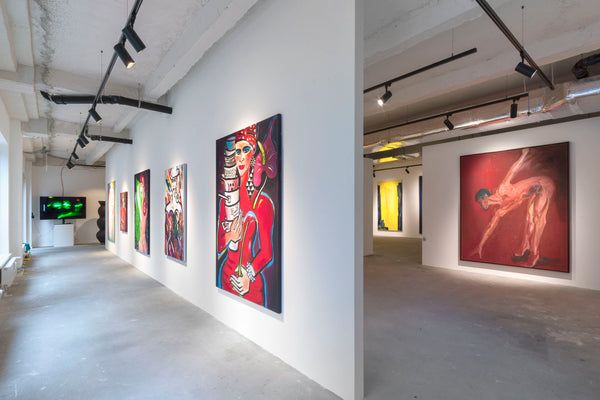
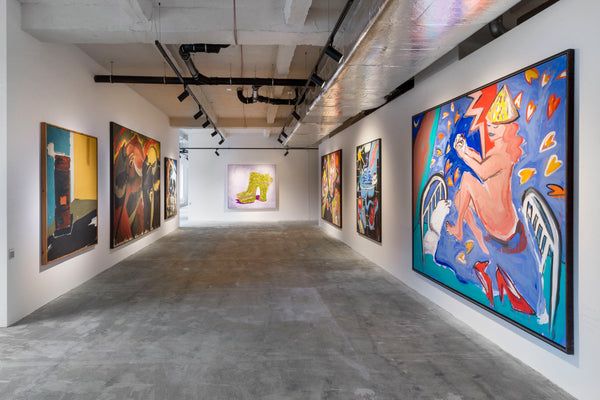
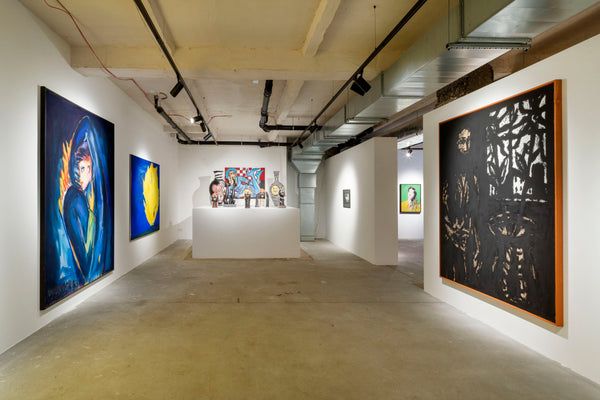
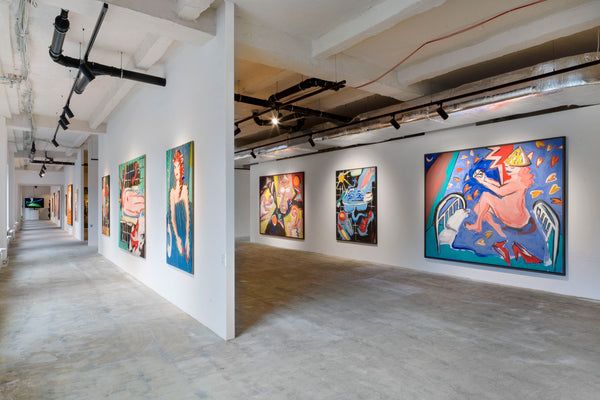
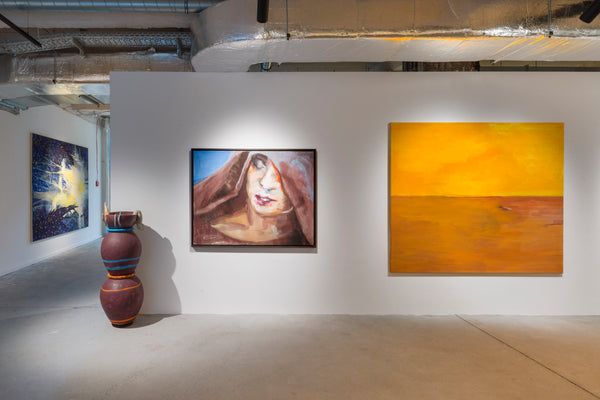
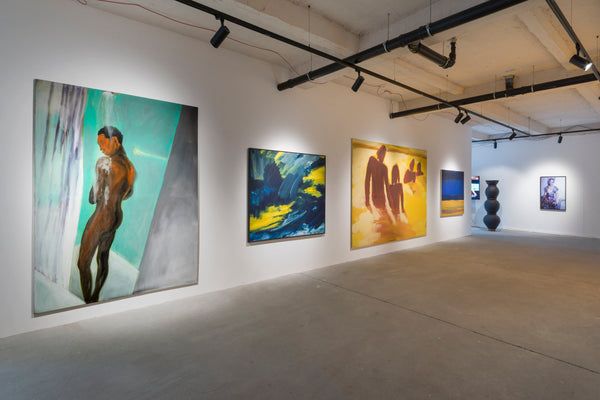
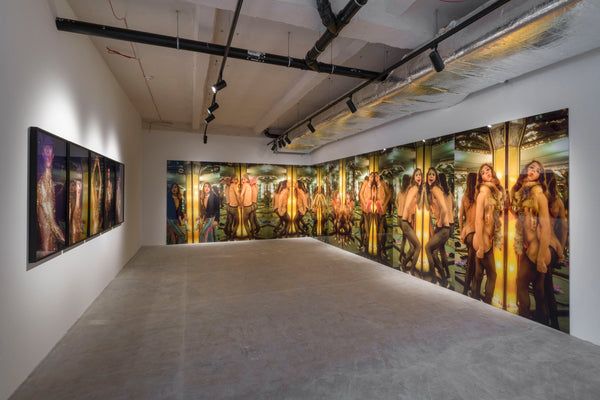
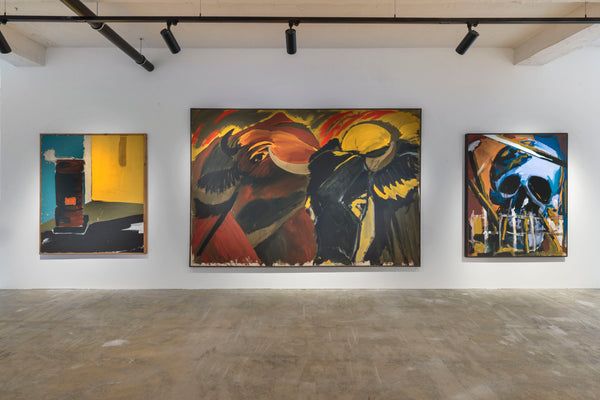
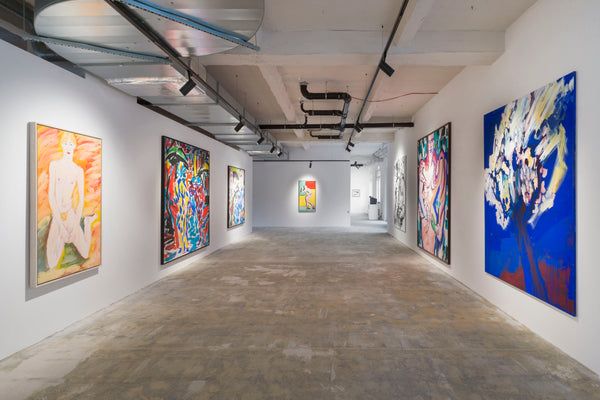
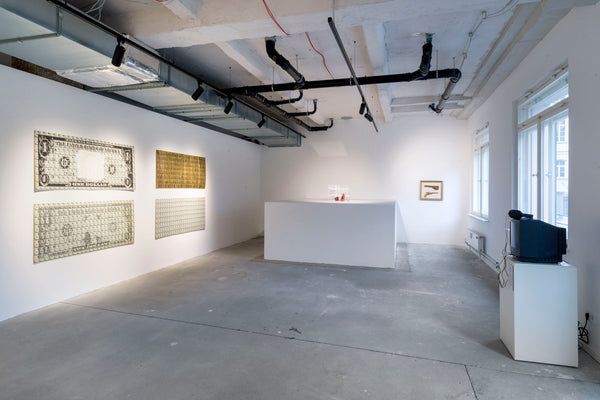
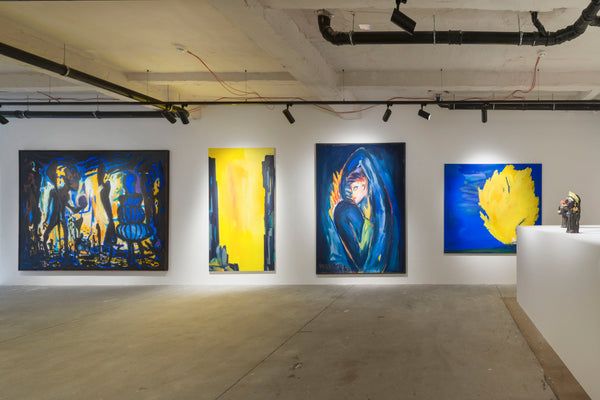
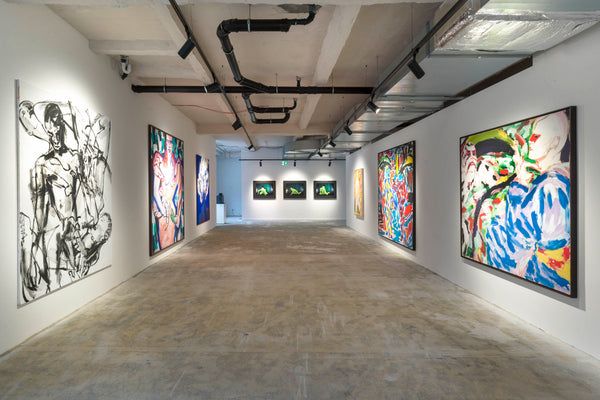
König Telegraphenamt is pleased to present the group show Guten Morgen, Du Schöne. It is the inaugural exhibition for the additional space at the Forum an der Museumsinsel next to the Telegraphenamt. The exhibition evokes an era of vibrant beginnings: In the 1970s, West Berlin became a city of longing for an entire generation. While curfews were being reinstated in other cities, Berlin remained the city that never slept. "Guten Morgen, du Schöne"—a book by Maxie Wander, published in 1977 by Der Morgen Publishing—became one of the most successful novels in the GDR. On the other side of the Wall, the same year saw the birth of the Galerie am Moritzplatz, a collective exhibition space where Anne Jud, Rainer Fetting, Helmut Middendorf, Salomé, and Bernd Zimmer were represented.
Salomé marked the debut of Galerie am Moritzplatz with a bold performance: posing in suspenders on a bed adorned with pink silk and roses. The performance, "Auf dem Rosenbett", placed his body and sexuality at the center of his art.
Rainer Fetting presented his "Mauerbilder" at the Galerie am Moritzplatz debut. His subject matter focused on one of the world's most iconic landmarks: the Berlin Wall, a symbol of the Cold War and a solemn reminder of those who were imprisoned or lost their lives while attempting to escape. For Fetting, the Berlin Wall was not merely an abstract concept but part of daily life—the view from his window at Moritzplatz. The gray concrete wall became, for him, a canvas for exotic and expressive forms of painting.
Helmut Middendorf, like Salomé, was a student of Professor K.H. Hödicke. He arrived in Berlin from the provinces of West Germany in 1971. Middendorf's flat, almost perspective-less painting style reflects the genesis of his motifs: whether from photographs or his imagination, his inspirations stemmed from the nocturnal city, which, shrouded in darkness, revealed only its silhouette.
Above the studio of Anne Jud and Bernd Zimmer in Berlin-Kreuzberg worked painter Bernd Koberling, who introduced Zimmer to dispersion painting. This emulsion-based technique was cheaper than oil and, due to its fast-drying nature, encouraged rapid, gestural brushstrokes—a style that became influential in K.H. Hödicke's class.
While Fetting, Middendorf, Salomé, and Zimmer primarily distinguished themselves through their paintings, Anne Jud was particularly drawn to the performative act as an artistic expression. Born in Switzerland, she studied acting in Zurich and Vienna before relocating to Berlin in 1974.
Luciano Castelli arrived at Moritzplatz in 1978 as a visitor to Salomé's exhibition "Frühling, Sommer, Herbst, Winter". In 1979, Salomé and Castelli collaborated on their first performance together as trapeze birds during a fashion show by Claudia Skoda at the Berlin Congress Hall.
Like her colleagues, Elvira Bach studied at the Hochschule der Künste. Her living she earned in the theater as a props assistant, prompter, and wardrobe assistant. Initially, she struggled with being a painter behind the scenes, and on the other hand the possibility of becoming the center of attention on stage. With her paintings "Immer ich", she ultimately merged both roles on the canvas, from 1978 until today.
Bach’s work centers around the woman, depicted in full-body, three-quarter, or half-portraits. High heels, lipstick, powder boxes, cigarettes, strawberries, long-stemmed red wine glasses, and other objects are elevated as symbols of femininity, becoming the artist’s trademark in her paintings. She creates a prototype of womanhood, which she reinterprets in multiple variations. "Immer ich". In bed, under palm trees, in the bathtub, at the bar. "Immer ich". It is the life of Elvira Bach, where the woman, in all her facets, takes center stage. And ultimately, it was not Fetting, nor Middendorf, nor Zimmer, but Elvira Bach who was selected by Dutch curator Rudi Fuchs in 1982 to participate in "documenta 7", where she presented her work alongside Salomé, the postmodern Italian Transavantgarde, as well as artists from the Mülheimer Freiheit. After a stint as an artist-in-residence in the Dominican Republic, Bach returned early to prepare for her contribution to the exhibition.
The exhibition is curated by art historian and author Franziska Leuthäußer. Until 2018, she worked at the Städel Museum in Frankfurt, where her long-term research project, "Café Deutschland." "Im Gespräch mit der ersten Kunstszene der BRD" was published, an investigation into the West German art scene from the perspective of contemporary witnesses. In 2015, she co-curated the exhibition "Die 80er. Figurative Malerei in der BRD". Most recently, she published an autobiographical narrative by art dealer Franz Dahlems, titled "Am liebsten würde ich Marilyn Monroe sein", released in 2021 by Schirmer/Mosel.
About König Telegraphenamt
KÖNIG GALERIE, founded in 2002, has evolved into a dynamic platform for contemporary art in Berlin and beyond. The gallery specializes in showcasing the work of both emerging and established international artists, with a particular emphasis on younger generations.
More about König Telegraphenamt →