Ended Oct 22
Zach Bruder
Clear Arrears
Sep 14 – Oct 22, 2023
More from Zach Bruder on Gallop
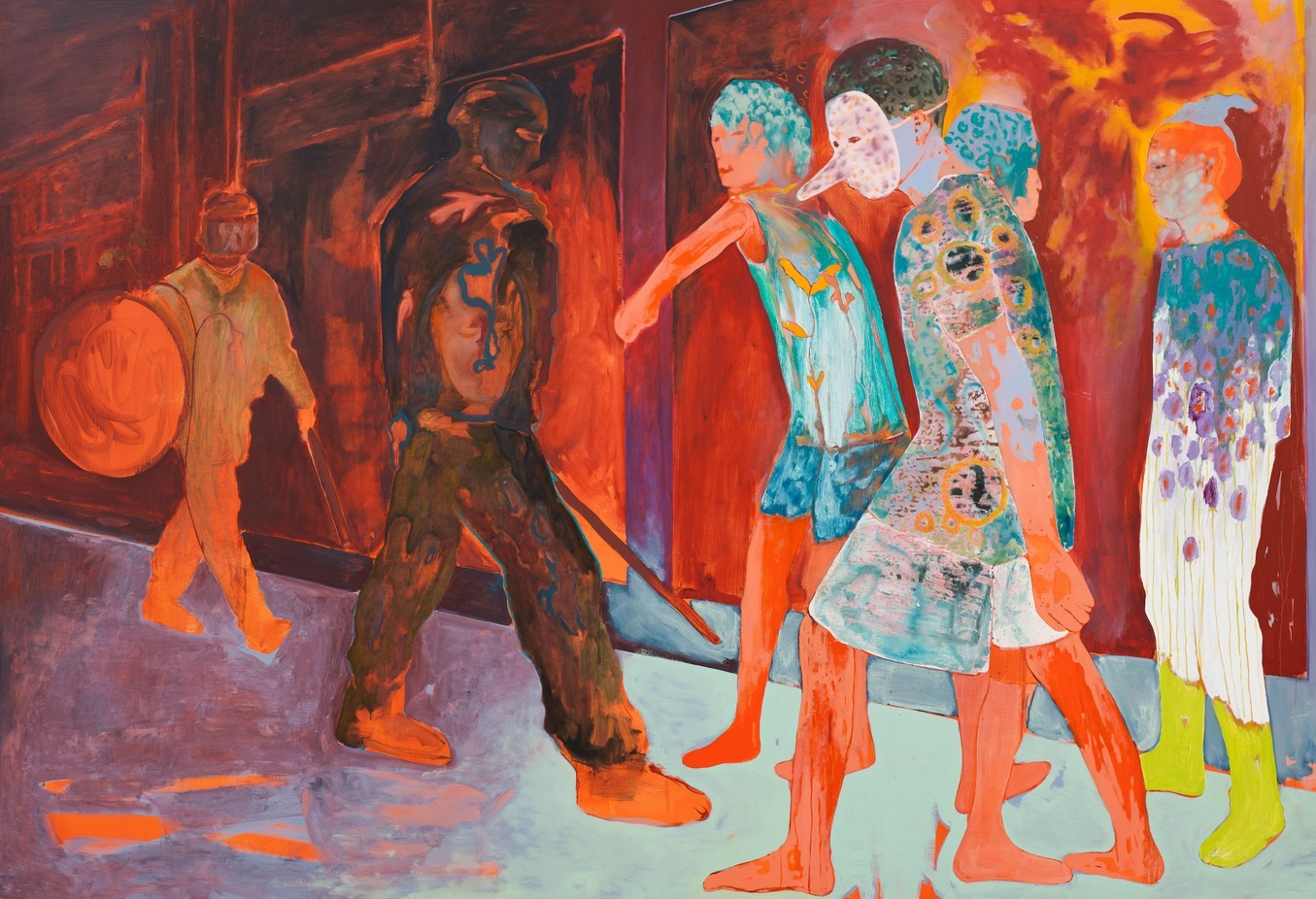
Looking at the paintings that constitute Clear Arrears it is possible to imagine a fictionalized biographical portrait of the artist who painted these works, one that could also potentially mirror your own. For instance, if you grew up in or around Cleveland, like the artist, you might have the following occurrences in childhood: attempting to situate a 19th century patchwork quilt found in your Grandmother’s enclosed patio; or clicking through a hyperlinked picture encyclopedia modeled after the Orbis Pictus; or a tray of significatory cookies are offered to you (Halloween, Christmas, and Easter themed) in a banquet hall whose interior is decidedly Biedermeier. You may encounter in a well-appointed room a heavy mahogany cabinet with an array of industrially produced cup and saucer housed behind glass, they are commemorative, and these are the scenes of a childhood composed by the uniquely American flattening of anything and everything. You think of memory in relation to an object and create a collection of images for repurposing. And after all, arranging signs and proposing their redefinition is similar in spirit to transposing an Alpine setting onto the bucolic terrain of Ohio. Making an emblem of memory while drowning out the noise of The Plain Dealer. Why exactly did families take their children to Sears for staged photography in Tyrolean tracht?
You later learn that the Orbis Pictus was an educational tool where page after page of indices were given that enabled a child to assign language to symbols, to memorize them, and that books of collected emblems, once a popular genre, performed a similar function, you consider their proximity to allegory and melancholy. How form can take the place of memory. A home is a home until it resembles a decorative quilt framing an emptied-out attic with the lights off. A children’s educational game utilizes a badge that has the unwitting look of an emblem you saw years earlier in a library.
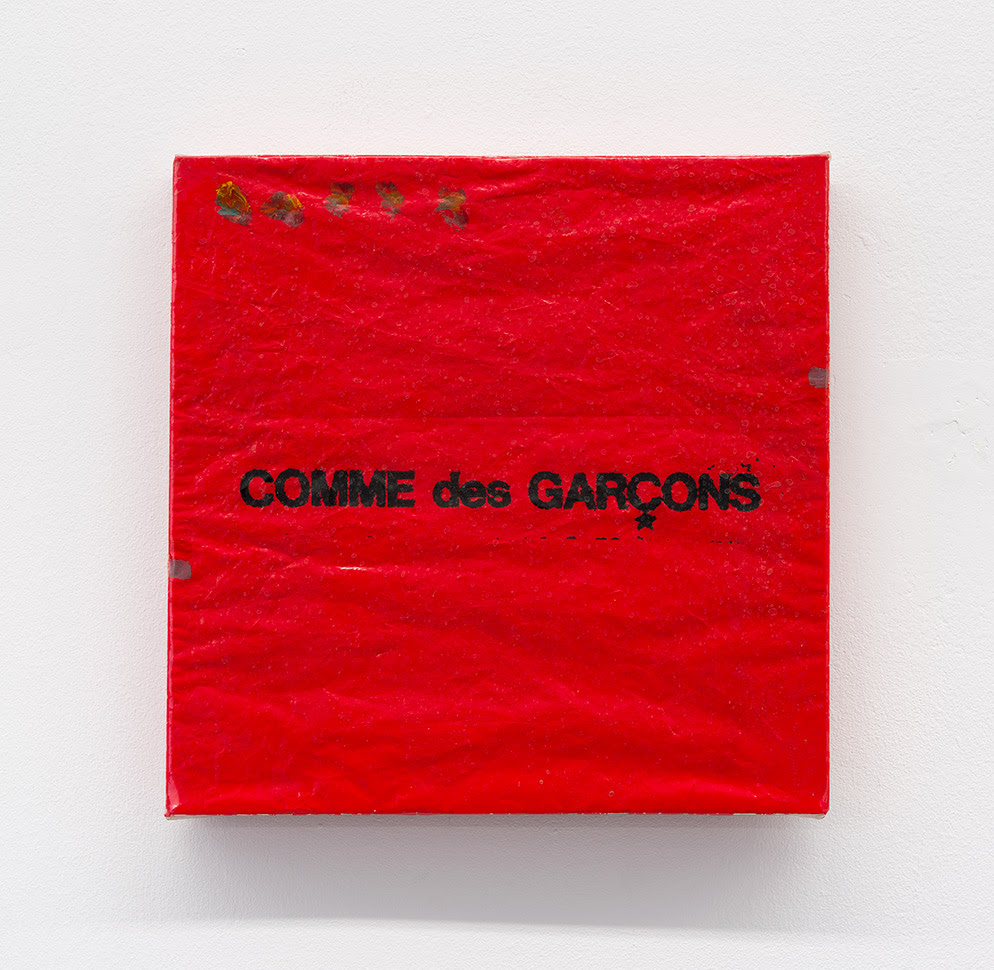
Zach Bruder composes and reconfigures images collected and stored in his archive, he describes it as a process, a clearing of the balance sheet, Clear Arrears. In painting them their seriality becomes for him a practice of hyperlinking, the more accumulation, the more thought, the more definitions. In one instance the figure is in flames, in another, it is fit for the globe in its entirety. Modernist literature contains numerous examples where listing objects in succession quickly becomes an inventory of disarray, outlining the contingency of such a practice. Both the dictionary of Diderot as well as Susan Howe’s Concordance illustrate this tendency toward the entropic. In Bruder’s practice, and just as in the Orbis Pictus, a word such as “world,” in this case, “Course,” indicates a candle, clock, envelope, and shell, sunrise to sunset. The collector of images detaches them from their originating function, and Bruder’s painting becomes the allegorical wager of reconceiving their definition via comparison. Excavating them from the uniforming tendencies of the balance sheet. To Clear Arrears, for Bruder, is a model of painting that attempts to rid the albatross of meaning these signs carry with them through their consistent dispersal via projection, printing, brush, and frottage.
What to make of these images? The exact portrait of the brooding melancholic figure surveying the tools at hand—those collected in notebooks, folders, and hard drives, strewn about the studio and library. The weighing and consideration of these images becomes for Bruder a practice of constructing a series of contemporary emblems, fixing signs momentarily in order to stage “form in place of memory,” as he states. By combining and stitching the already patched imagery, rags, and discarded textiles found in the image culture manifest in his studio, Bruder claims that what has been discarded will sooner be recovered by reconfiguring signs such as an emptied-out wooden attic and the Rijksmuseum Library’s brick wall, all that is missing is the Saturnine sphere and other objects strewn about a sea-side landscape: plane, scale, saw, hourglass, ruler, compass, hammer, ladder, and a bat carrying a banderole unfolding: Melancolia I.
—Ivan Gaytan
Zach Bruder’s (b. 1984, Cleveland, OH) metaphorical approach to painting and long-term interest in image collecting results in inventive compositions in which both pictorial and illusionistic space play a role. Often humorous and allegorical, his paintings involve animals, architecture, and anthropomorphism. His canvases revive and repurpose familiar motifs, referencing folklore while finding new metaphors in simple objects and creatures. The source material—archetypal and drawing from classical and vernacular mythology—is culled from the artist’s extensive archive of historic imagery. Addressing mythologies both cultural and personal, Bruder’s paintings offer multiple interpretations of religious and social narratives and urgent responses to the societal and political moment in which they were produced. Valentina Di Liscia writes, “Faced with one of Bruder’s canvases, the viewer takes an active role, deciphering the intertextuality between the multiple literary, historical, and folkloric references he often cites simultaneously.”
Zach Bruder received his BFA at the University of Wisconsin-Madison in Madison, WI. Bruder presented his first solo show at Magenta Plains in January 2018 in New York, NY followed by Gone to Fair in 2020, and Clear Arrears in 2023. Solo exhibitions have also been held at Harlan Levey, Brussels, BE; galerie l’inlassable, Paris, FR; Gregory Lind Gallery, San Francisco, CA; and LaMaMa Galleria, New York, NY. Bruder has been included in group shows at Peter Freeman, New York, NY; Ratio 3, San Francisco, CA; The Journal Gallery, Brooklyn, NY; Phillip Slein Gallery, St. Louis, MO; and Magenta Plains, New York, NY. The artist lives and works in New York, NY.