

Exhibition · OCD Chinatown
Maya Deren
Transfigured Time
May 17 – Jun 30
About the show
he motion-picture camera, in introducing the dimension of time into photography, opened to exploration the vast province of movement. The treasures here are almost limitless, and I can suggest only a few of them.
—Maya Deren, 1946
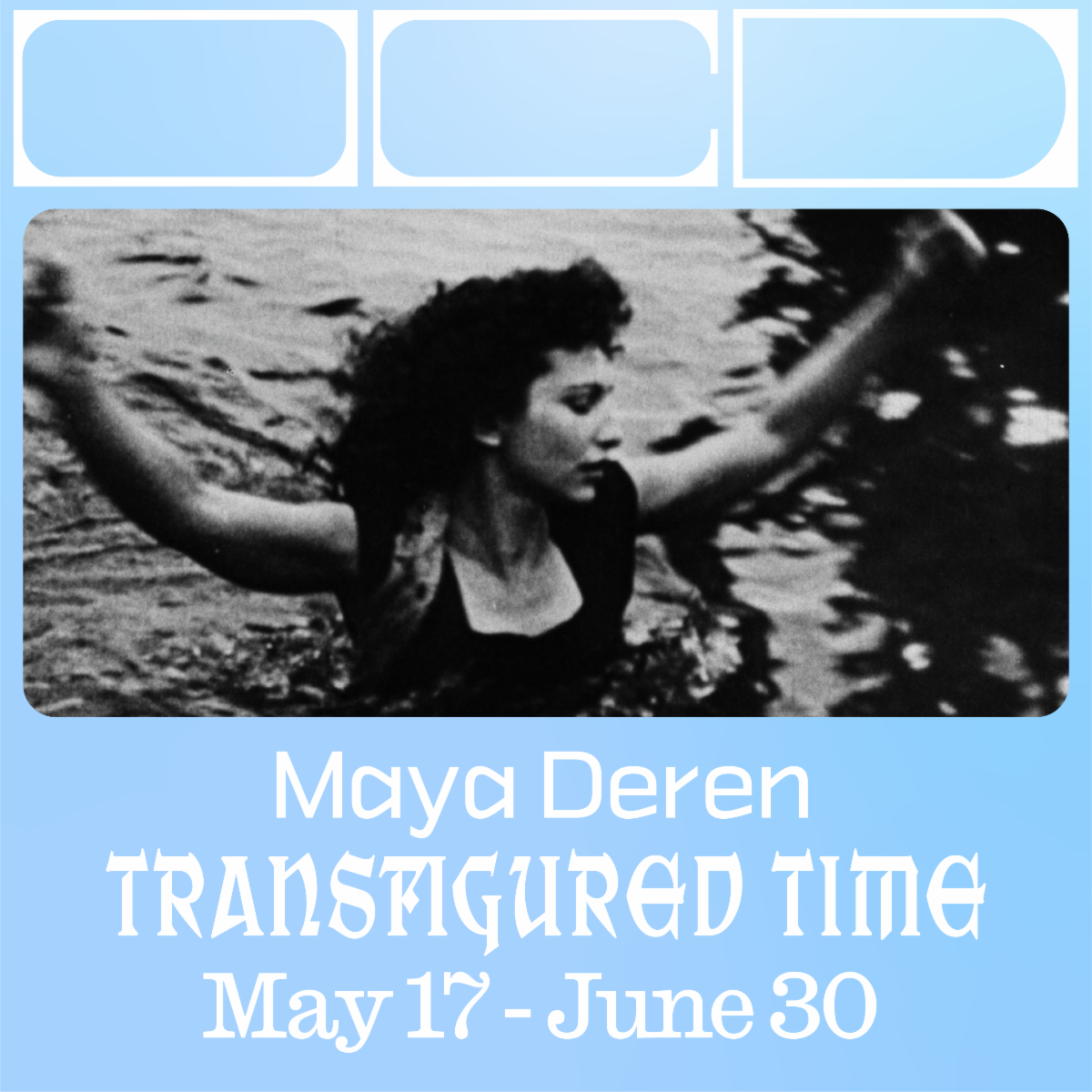
OCDChinatown presents a screening program of five short films by Maya Deren. Born in Kyiv in 1917, Deren and her family soon fled the pogroms, arriving in Syracuse, New York, in 1922. While still at university, Deren moved to New York, where she studied literature and was active in the socialist movement. She wrote poetry and took photographs, but her fascination with dance led her to the choreographer Katherine Dunham. In 1941 and 1942, Deren toured with Dunham’s dance troupe as a personal assistant, traveling through the segregated American South and to Haiti, where she learned about Voudou. A year later, she picked up a film camera for the first time. Meshes of the Afternoon, made on a $275 budget, would become a classic of experimental cinema.
In New York, Deren’s milieu included artists, writers, poets, composers, and choreographers. Many of these friends appear in her films, including Anaïs Nin, John Cage, and Marcel Duchamp. In the 1946 film that lends its title to this exhibition, Ritual in Transfigured Time, Deren literalizes the concept of social choreography, turning a party scene into a kind of dance. Men and women walk across a room, greet each other, turn together, and continue on their ways separately. As Deren has described, “an informal social encounter . . . assumes the solemnity and dimension of ritual.”
Deren plays with time through her use of the medium, incorporating freeze frames, slow motion, and loops. Influenced by the Symbolist and Imagist poets, she also incorporates figurative allusions to the passage of time: the lapping of waves on the sand in At Land (1944); the skein of yarn in Ritual in Transfigured Time (1946), which evokes Penelope’s weaving (and unweaving) as she awaits Odysseus’s return; the spiraling stairs (and multiple Derens) in Meshes of the Afternoon (1943) hark back to Duchamp’s 1913 painting Nude Descending a Staircase, which attempts to capture movement in a still image.
Both a Study in Choreography for Camera (1945) and Meditation on Violence (1947) focus on dance. The former is an exquisite three-minute-long gem, in which Talley Beatty moves seamlessly through a forest, a domestic interior, a museum, and back into the landscape. “The movement of the dancer creates a geography that never was,” explained Deren. “With a turn of the foot, he makes neighbors of distant places.” In Mediation on Violence, Chao-Li Chi performs movements based on Chinese martial arts. To describe Deren’s work, New York Times dance critic John Martin found himself coining a new term: “In her approach we have the beginnings of a virtually new art form of ‘choreocinema’ in which the dance and the camera collaborate on the creation of a single work of art.”
Deren’s interests in time and movement, choreography and anthropology, all come together in the concept of ritual. The artist defined ritual as an “action” that “seeks the realization of its purpose through the exercise of form. . . . In ritual, the form is the meaning.” In other words, to Deren, “ritual is art.”