Exhibition · Nathalie Obadia
Benoît Maire
Miss Rankin
Sep 4 – Oct 22
About the show
Galerie Nathalie Obadia is very pleased to present Miss Rankin, French artist Benoît Maire’s second exhibition, following his first held in 2018, rue du Cloître Saint-Merri.
Benoît Maire’s practice is at the crossroads between philosophy and art, thought and matter: his strength resides in his ability to give body to an idea, by focusing on the sensory qualities of a work. Following a kind of protean approach, which combines painting, installation, furniture and video, the exhibition articulates itself around a group of new canvases from his series Clouds paintings, sculptures and collages that convey the artist’s allegorical universe and his recent progress.
The front page of the New York World Telegram, on the pivotal date of December 8, 1941, indicates: “light rains tonight [...]; tomorrow cloudy followed by clearing, cooler than today,” just above the headline, in bold type: “1500 DEAD IN HAWAII CONGRESS VOTES WAR.”
Using this as a springboard, Benoît Maire began to use silkscreens, last summer, in his series Clouds paintings, begun in 2012, to reproduce various parts of this newspaper page, where current climatic considerations are printed side by side with highly critical decisions. In his resulting, oneiric compositions, the artist distills informative content that reveals the underlying conflict: the moment when the United States entered World War II. Another fragment from this front page displays the face of Miss Rankin, who lends her name to the exhibition: driven by an absolute confidence in the forces of free speech and discussion, Jeannette Rankin was the only congresswoman to seek a peaceful outcome to the conflict. If Cloud Paintings evoke at once the softness of Chinese landscape painting, impressionist recollections or Emil Nolde’s extraordinary skies, these fragments of texts, taken from a newspaper and crudely reproduced, deliver information that gives weight to daydream and anchors it within a historical reality. But these archival inserts also interest the artist as textual elements, with their meaningful matter and formal opportunities. And just like that, his landscapes enter the realm of history painting.
While inscribing itself in the continuity of Renaissance forms, via a classical painting motif, these works also denote the contemporaneity of our relation to facts, the cloud being as much this “globulous mass,” where “everything turns to pleasure,” as described by Gaston Bachelard, as this immense amassing of big data that records information about our personal lives through our online interactions. For Benoît Maire, the cloud is an allegory of painting: “a place of constant formation” and “of the recognition of personal projection,” to borrow his words, but also a concept that is highly topical since it was reinvented in Palo Alto, California. Two types of clouds are then superimposed: the natural cloud and the technological cloud, in a jumble that is translated by the techniques used by the artist: simultaneously traditional, with chromatic, oil-paint gradients; impastos; glacis; palette-knife painting; deep, vaporous and sometimes iridescent hues; and contemporary, with the use of stencils and aerosol cans, silkscreens, drippings and scotch tape.
The exhibition also brings to light a group of recent collages that constitute an experimental terrain for Benoît Maire. Newspaper clippings or parts of sentences, chosen scrupulously, cut and decontextualized, are juxtaposed with photographs of animals or representations of all sorts of natural phenomena. Their minimalism is highlighted by the metonymic presence of a hand with its index pointing toward the sky, borrowed from Rogier van der Weyden’s Saint John the Baptist (left panel in the Braque Family Triptych, 1464, Louvre Museum). This gesture contains a reflection on the notion of “transcendental indexation,” which is at the heart of Benoît Maire’s practice and which signifies “designing what we cannot name.”
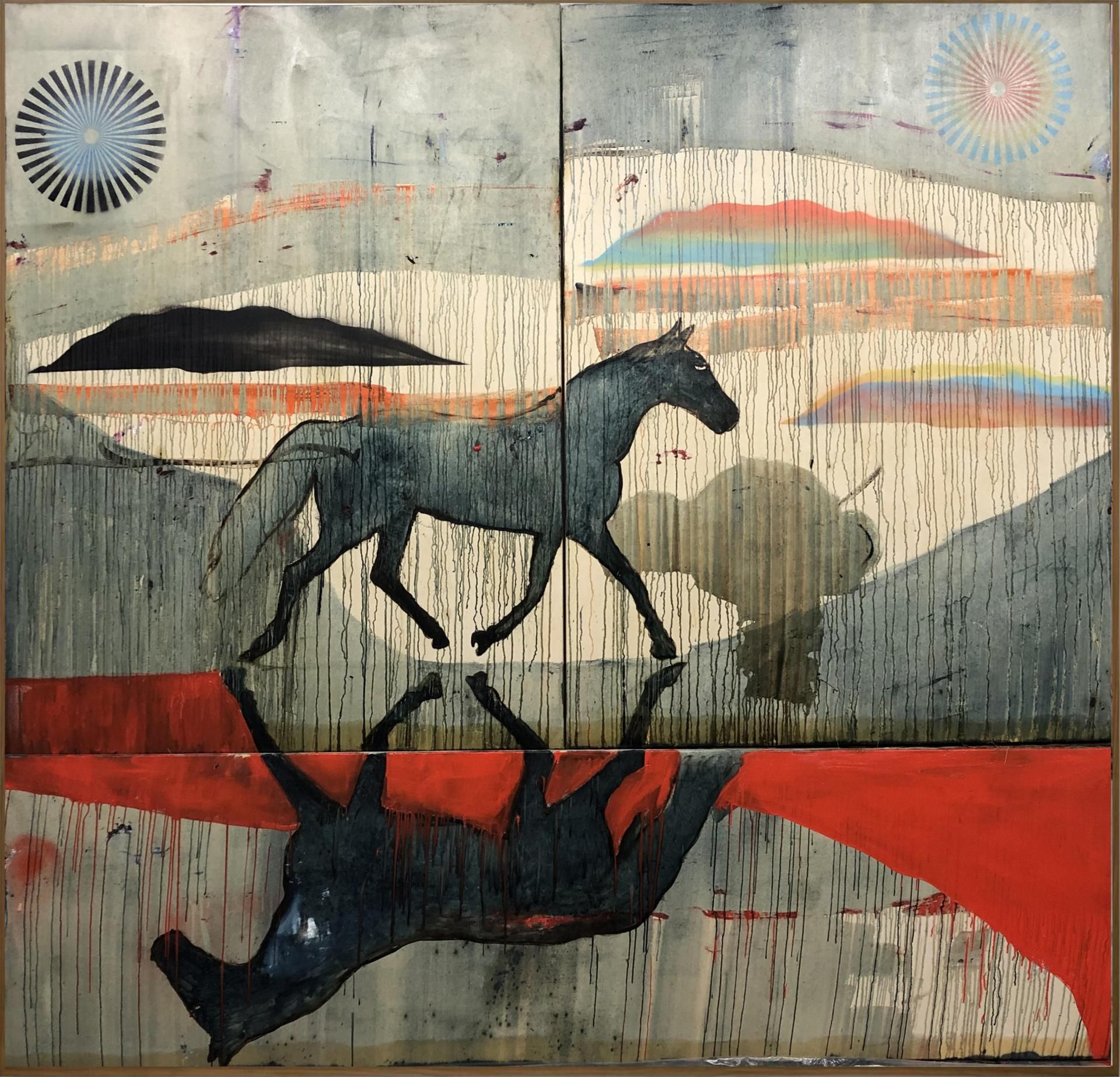
Upon a large stand conceived specifically for the exhibition are nine recent sculptures that prolong the series of Châteaux, begun in 2014, which consists in balancing two opposite objects—one from the mineral world, one manufactured—via a delicate brass architecture or a minimalistic and poetic juxtaposition. Three-dimensional assemblages of disparate elements, associating figures like reason (a bronze arm reproduced on a 7-year-old model holding a cube); an allegory of summer (a headless statue, bearing a scythe in his belt and carrying ears of wheat); and a shimmering, enameled, blown-glass Coca Cola bottle, share the immaculate space. Each sculpture is devised according to a geometric ratio that questions the current living conditions of humans, both physical and emotional. The idea of movement is essential and designates the path around the exhibition: in the paintings that border the large sculpture stand, a horse passes, calmly, and the artist seems to follow it with a slow tracking shot.
Like the dark cloud, the horse also travels around the exhibition and punctuates it with its mysterious and ominous presence. Under a profile silhouette that always remains the same, archetypal, the animal crosses different planes and dimensions. In Benoît Maire’s visual lexicon, this movement represents escape, in the sense used in Shakespeare’s Richard III, where the king wishes to exchange his whole kingdom for one animal: “A horse, a horse! My kingdom for a horse!” Similarly, for the artist, “the figure of a horse serves to prioritize being over having, and in order for this to be effective, the being needs to escape.”
With a sharpened sensitivity, Benoît Maire creates a bridge between substance and structure, concept and history where, like a riddle, enigmas remain. The exhibition thus becomes a space for projection and investigation where each element finds a special place, each work contributes to a general sense of harmony, rich with hidden meanings.
Benoît Maire was born in 1978 in Pessac (France). He lives and works in Bordeaux (France).
Benoît Maire received his DNSEP diploma from Villa Arson, Nice (France, 2003) and a master in philosophy from Paris 1, Pantheon-Sorbonne (France, 2002). He was a resident at the Palais de Tokyo in Paris (France, 2005-2006) and won the MÉCA’s “1% artistique” (a project in the Nouvelle-Aquitaine region) and the Fondation Ricard prize in 2010.
Recently, his work has been the object of major solo exhibitions, in particular at the Musée archéologique Henri Prades in Montpellier with LAICRITURE and at the CAPC musée d’art contemporain with Thèbes (Bordeaux, France, 2018), an exhibition that traveled to Spike Island (Bristol, United Kingdom, 2018). The artist will present a solo exhibition, In Hawaii, at Tanneries (Amilly, France), from October 10, 2020.
His work is in notable public and private collections including the Centre Georges Pompidou - Musée National d’Art Moderne (Paris, France), the MAC/VAL (Vitry- sur-Seine, France), the FNAC Fonds National d’Art Contemporain (Paris, France), the FRAC Ile-de-France (Paris, France), the FRAC Aquitaine (Bordeaux, France), the FRAC Franche-Comté (Besançon, France), the Artothèque de Pessac (France), the CAPC musée d’art contemporain in Bordeaux (France), the Kadist Art Foundation (Paris, France), the David Roberts Foundation (London, United Kingdom), the Nomas Foundation (Rome, Italy), the Fondazione Giuliani (Rome, Italy), the Francès Foundation (Senlis, France), and the Vancouver Art Gallery (Canada).
His book Un cheval, des silex will be published by Macula Editions in September 2020.
About Nathalie Obadia
Since the opening of the first gallery in Paris in 1993, followed by the one in Brussels in 2008 and a second space in Paris in 2013, Nathalie Obadia has exhibited emerging and recognized artists of the international contemporary art scene. In the fall of 2021, Galerie Nathalie Obadia has opened...
More about Nathalie Obadia →