Opens Thursday
Ruth Speer
The Village
Nov 12 – Dec 19, 2026
More from Ruth Speer on Gallop
Ruth Speer (b. 1996, Norwich, UK) is a German-American artist working across painting and sculpture. She lives and works in Oregon, U.S.A. Speer views her work as a series of personal folktales, a combination of odd utility, scene selections and allegories of truth. She paints on wood, drawn to its texture and history as well as its ties to domesticity and sense of utility. She often builds and sources wooden interactive aspects to operate in tandem with the painting, acting as a tool to mirror the physical and tactile nature of life. Speer draws on the visual language of Western painting history and mythology, being the subjects she consumed most fervently during her homeschooled childhood, to look closely at relationships; between people, with ourselves, with our surroundings, and the objects with which we live our lives. Alongside this, Speer touches on themes of the forest, the body, God, theatre, fantasy, art and objects made for children, "let's go play outside," and a personal accord with things that take time.
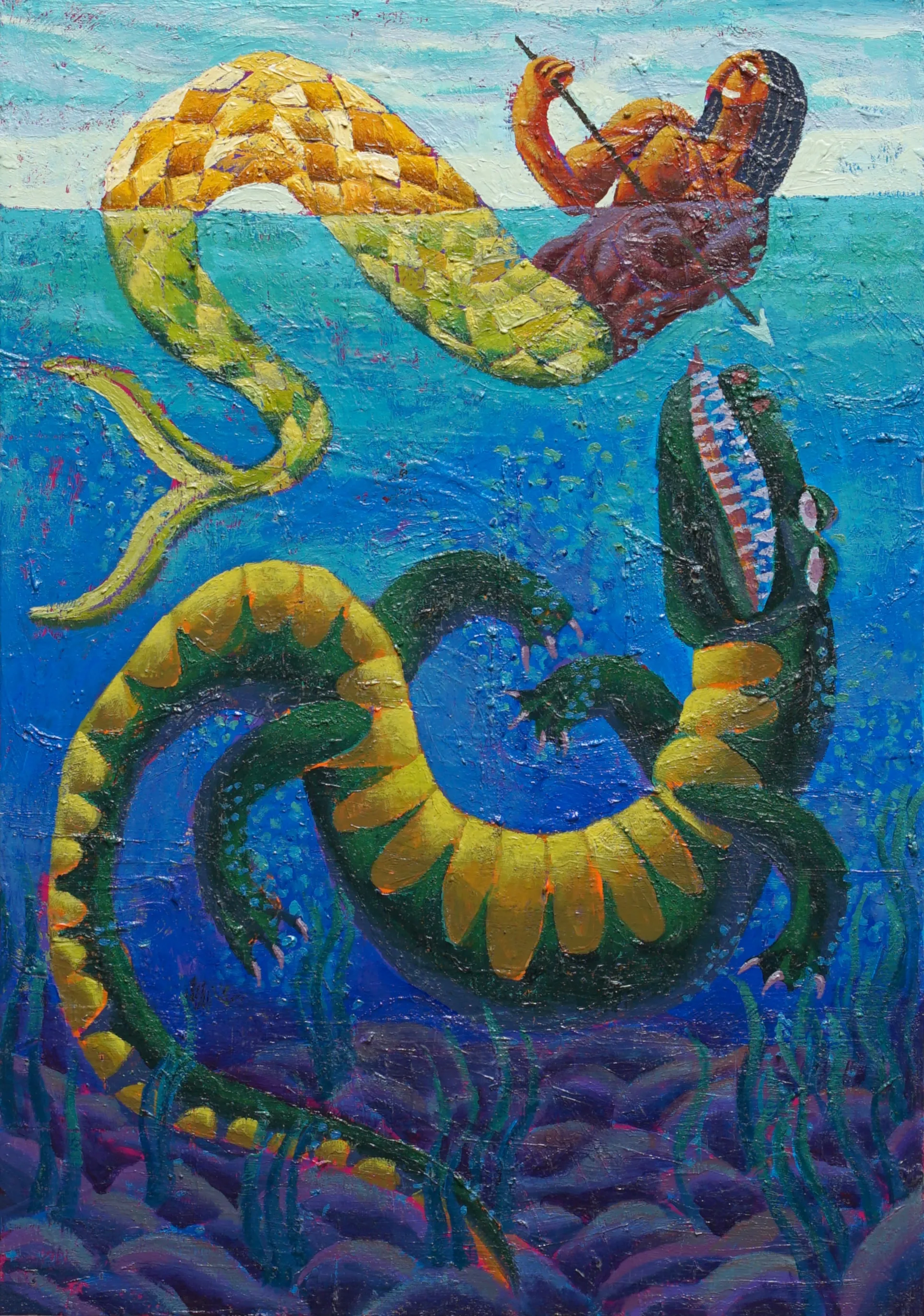
Here is a woman's head inside a dragon's mouth, the sharp points of its teeth hovering above the skin of her neck. She appears to be in mortal danger, yet her expression is not one of fear, but of trust and calm. Her arms are wrapped around the dragon's neck in an embrace. This woman and the dragon are the protagonists of Ruth Speer's folktale The Village which unfolds across a series of paintings and objects in her solo exhibition of the same name at Kristin Hjellegjerde Gallery. In a traditional fairy tale, the woman would be a princess, the dragon a villain and the hero a (male) knight. But there is no knight in Speer's story, and the dragon is not so much a fearsome creature as one with transformative potential, appearing across the works in different forms: as a man, tree and even merging with the woman herself. This is a story about love and the ways in which it challenges and changes us.
The exhibition title comes from the phrase 'it takes a village', meaning an entire community rather than an individual. This resonates both personally and conceptually for Speer, who made many of these works in the early months of motherhood, relying on the support of her loved ones to help her find time in the studio. Alongside this lived experience of collective care, she imagined the works to be part of a historical collection found in a mythical village: artefacts relating to a local folklore, alongside fragments of everyday life, now brought together for display, their original purposes and the stories behind them not entirely known. In this way, she became both artist and archaeologist, creator of images and excavator. The show's central work, Tell it to me again, serves as a kind of map to the folktale, inviting us to piece together its narrative.
Speer is interested in the relationship between the object and image, and in how the materiality and context of an image shape our perception of it. The frames of many of the paintings, for instance, are repurposed antique mirrors. Each work becomes a window not only into Speer's fictional world, but also into the real histories embedded in the objects themselves, where the vestiges of a previous life exist alongside new meanings. Take, for instance, Change be no robbery for the changed case, in which a hand sprouting leaves from its fingertips is painted within an old wooden hand mirror. In How long have you been here?, a repurposed wall cabinet houses a painting of a fruit tree, another central protagonist in the story, around whose trunk curls a hybrid dragon-woman. The cabinet frames the image in a way that is almost devotional, as if it were a shrine.
Other works appear as puzzles or games, inspired by the children's books and toys that have become part of Speer's everyday environment since becoming a mother. The Year of Our Lord functions as a board game where the painted characters are magnetic, allowing them to be moved around and rearranged; in Deciding to Marry, a panel slides back to reveal a hidden image, while hand-painted building blocks and a dragon rocking horse serve as both artworks and toys. The tactility of the works is part of Speer's way of bringing her folktale to life, giving its imagined world a physical presence. Their interactive qualities also invite us to participate in the telling of the story, decoding its images and inventing our own interpretations. There is an implicit intimacy too, in the handling of an object that has been handled by another, an acknowledgment that objects, like stories, accumulate the traces of the lives they pass through.
This idea also finds expression in the paintings that make direct reference to art-historical works: The Lovers (after Chagall) and Breakfast in Bed (after Cassatt). The compositions are Speer's own, but they remind us of the way in which images are reinterpreted over time. They are also the exhibition's most direct depictions of love, even if the woman's companion in Breakfast in Bed is a small goblin eating a piece of cheese rather than the child as in Cassatt's painting. The substitution is humorous, but it also hints at how love can interrupt or unsettle our sense of self. And so we return to the question that runs through Speer's folktale: how do we continue to love one another through all the transformations that shape a life?
Solo exhibitions include (Upcoming) The Village, Kristin Hjellegjerde Gallery, London, UK (2026); Salon, Kristin Hjellegjerde Gallery, West Palm Beach, FL, USA (2025); Godspeed, Slade School of Fine Art, London, UK (MFA Thesis Exhibition) (2024); The Youth Who Set Out to Learn What Fear Was, Minthorne Gallery, Newberg, OR (BA Thesis Exhibition) (2019).