Ended Apr 15
Nazim Ünal Yilmaz
Ball Auf Der Nase
Mar 4 – Apr 15, 2023
More from Nazim Ünal Yilmaz on Gallop
[Please scroll down for German version / Für Deutsch bitte scrollen Sie nach unten]
Scenes reminiscent of Vienna’s urban texture are almost unrecognisable, sinking into chaos; death is nearer than it has ever been, is more entangled to the idea of civilization and progress. Baroque architecture, a certain aesthetic which has stayed relevant and present for centuries, is crumbling down over the heads of rabbits, who rush around rubbles as if it is a playground. It might not be the end of the rabbit thanks to its sharp and quick maneuvers; but the fate of humanity is surely as shaky as the buildings.
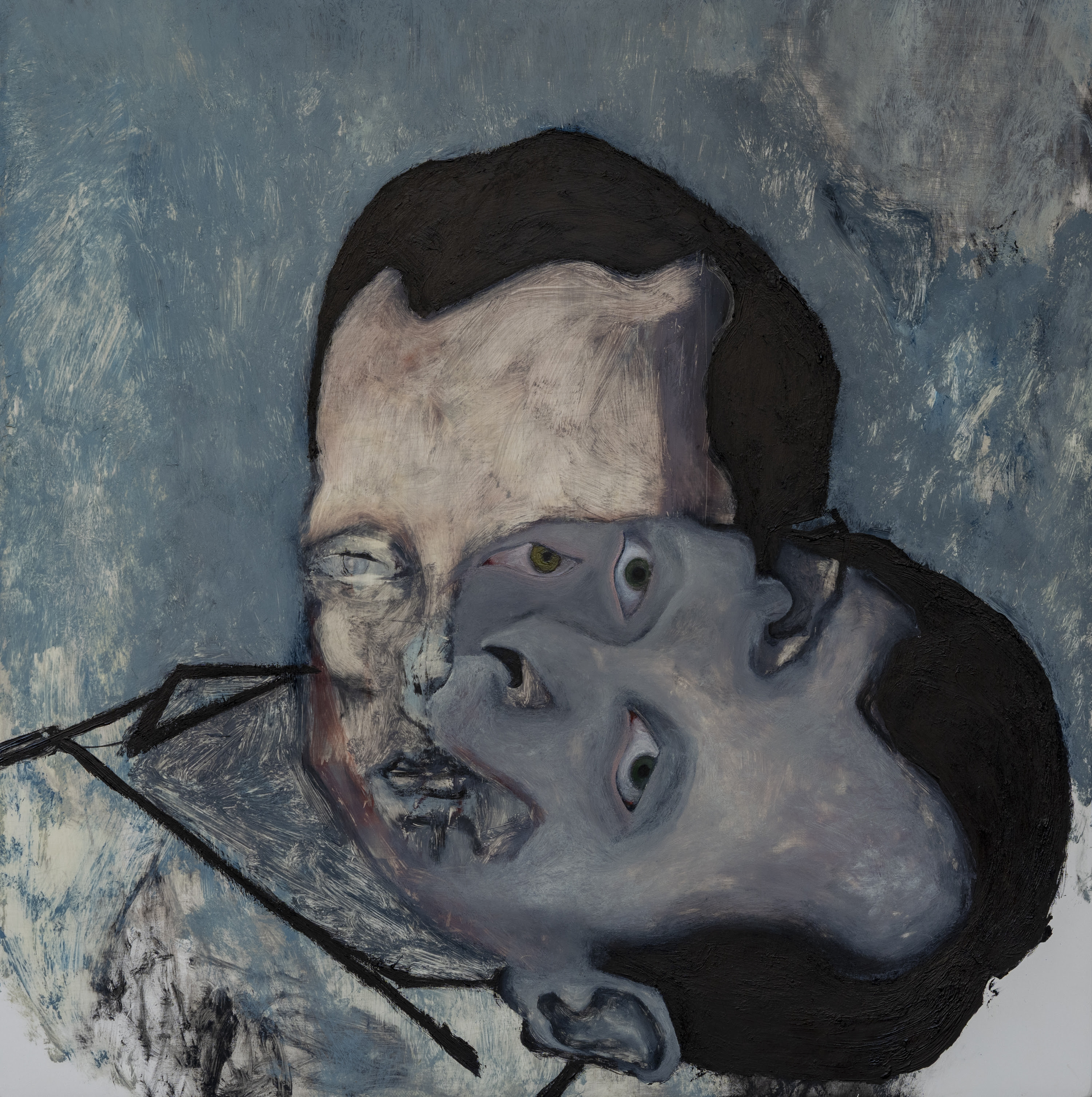
In his second solo show in Berlin, Nazım Ünal Yılmaz brings together paintings, most of which are new works presented for the first time, accompanied by older ones from different eras of his practice. The collection of works at PSM is like an attempt to narrate a science-fiction story, which might not associate itself to the medium of painting immediately, especially if it is a prophecy that is difficult to dismiss as pure fiction. As the catastrophes related to the climate crisis force themselves to an ever-growing proportion of the news, how can they stay out of paintings?
Some of the works are close-up scenes that one easily feels the threat of being swallowed by the canvas. As described above, in White Rabbit!, the animal that gives the name to the work is in a hurry, as if it tries to escape from the surface and break free as baroque ornaments and columns, which erected the imagery of nation-states and identities and we are too close to all that rambles down to ignore. As columns are shattered, one feels the danger thanks to angles Nazım relentlessly deploys in each painting. Yet, humans find a way to avoid the hard questions, even though they might have nowhere left to run, like it is depicted in Polar Activity.
And that avoidance is embodied by snowmen, another recurring figure in Nazım’s practice. Rather than gloriously frozen and hand-crafted by the innocence of children, snowman becomes an archetype that can be considered as the personification of a class that manipulates the discourse around our shared crisis. A class that is not only the main responsible of all the crisis but also who profits from it. One that denies the existence of a crisis as long as it can, and then turns into one that offers cosmetic solutions to it and expects praise for their role. A class that is constantly at odds with what they promise, that hurts the most and heals the least. In Nazım’s image- and world-making, the melting of snowmen is nothing less than joyous.
Nazım does not only go after the hypocrisy of the ruling elite of today; he delves deeper into the history and complicates the first of us who has fallen in love with himself: Narcissus. Leaning upon the water and seeing his face for the first time, Narcissus instantly becomes attracted to the face he sees on the water without knowing who it is. Like him, humanity is in the same track, burning by a desire to discover what they are capable of, how they can come on top in their struggle to rule nature.
Standing on their two feet might have been the curse that doomed humanity from the very start as hinted in Reptile and Two Options for Narcissus. This is also where the figure of a painter in the shape of Nazım comes to the picture; he does not shy away from reflecting on his own image, his own standing up, his positionality, and what his artistic practice would mean given the circumstances of today, both socially and politically.
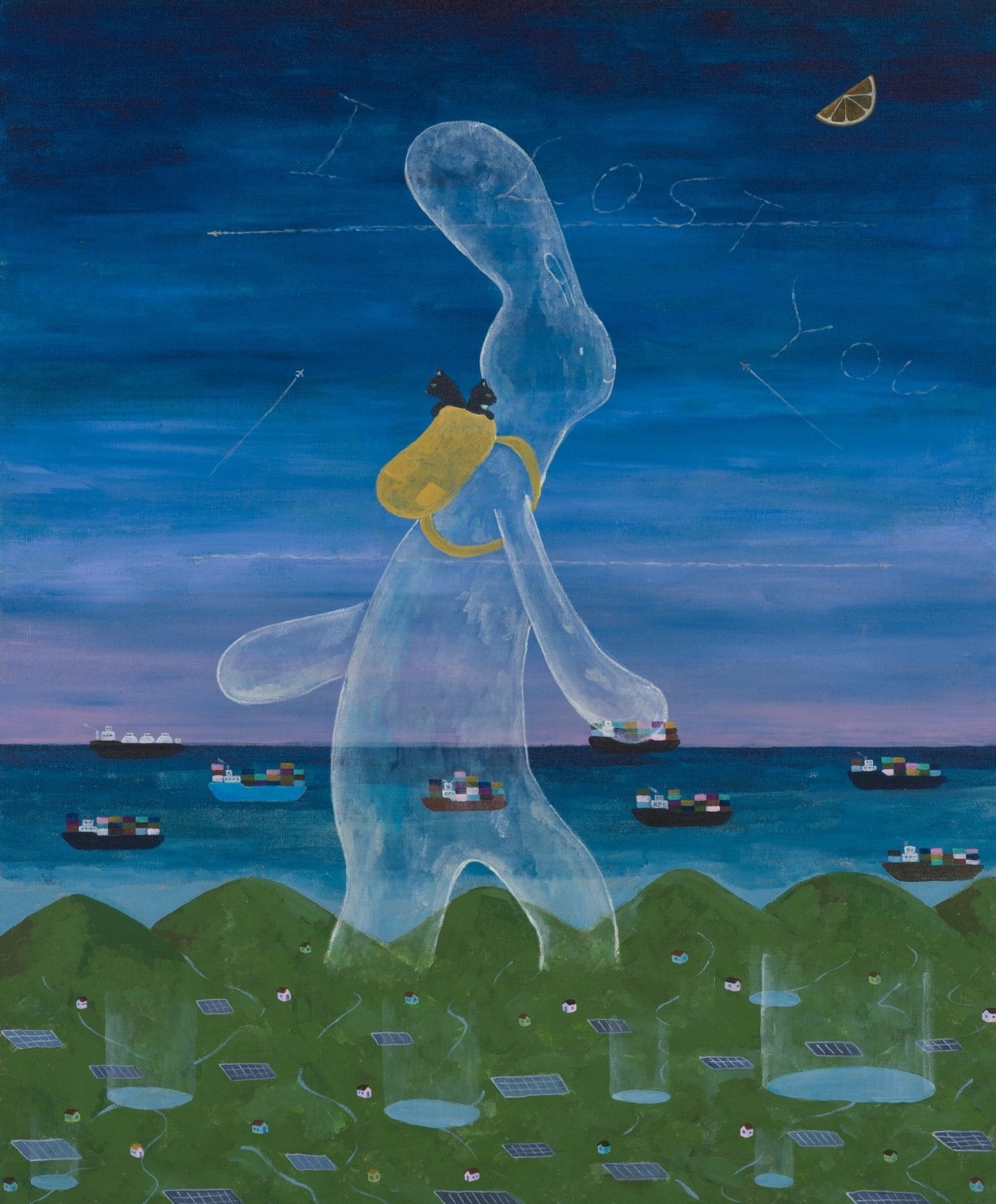
Yet, the reflection does not occur by itself. A source of light is needed; an omnipotent one that can be our ultimate source of life: the sun. The source that can accommodate the conditions for all living things to be born; however, the sun can be just as deadly thanks to each narcissus among us and how we – snowmen the most – mistreat the irreplicable treasure. In Dominating the Sun, a pair of feet are reaching towards the star on what seems to be a summer day, framing the sun as if it is there only to heat and comfort them. The toes are pulling the mouth of the sun to each side of it, stretching it almost to its limits. Does the sun have to smile and join the crowd as if everything is fine? All these figures and their uses, along with others like horses, bring together a personal iconography that Nazım has accumulated, giving us points of reference to reflect on ourselves.
Then again, neither history nor referencing is a one-sided concern for the artist: he also tasks himself with tackling the issue of citing in another way. Trying to label his paintings with a certain style or school is as difficult as it is unnecessary: he paints scenes over scenes, one painting more often than now employing techniques that remind different schools of painting, from abstraction to surrealism and more. Hence it would be a mistake to try to pin him down to one of these in singularity but the paintings are an invitation to recognise the citations, find the playful shifts and transitions from one to the other not only from painting to the other, but also within the same surface.
In a constellation of familiar figures, Ball auf der Nase weaves concepts and styles to urgent questions that are open-ended, rather than posing certain answers. Nazım’s sense of humour still leaves us with some hope, a core feeling spreads across the exhibition. In the end, one cannot help but wonder: will I be able to shower my feet with the sunlight again without thinking about all of this?
—Onur Çimen
*****
Szenen, die an die urbane Struktur Wiens erinnern, sind kaum wiederzuerkennen, versinken im Chaos; der Tod ist näher als je zuvor, ist stärker mit der Idee von Zivilisation und Fortschritt verwoben. Die barocke Architektur, eine Ästhetik, die über Jahrhunderte hinweg relevant und präsent geblieben ist, bricht über den Köpfen der Kaninchen zusammen, die auf den Trümmern herumtollen, als sei es ein Spielplatz. Vielleicht ist es nicht das Ende des Kaninchens, dank seiner scharfen und schnellen Manöver; aber das Schicksal der Menschheit steht sicherlich wie die Gebäude auf wackeligem Boden.
In seiner zweiten Einzelausstellung in Berlin präsentiert Nazim Ünal Yilmaz Gemälde, von denen die meisten neue Werke sind, die zum ersten Mal präsentiert werden, zusammen mit älteren Werken aus verschiedenen Perioden seines Schaffens. Die bei PSM gezeigte Auswahl kann als Versuch betrachtet werden, eine Science- Fiction-Geschichte zu erzählen, die nicht unbedingt mit dem Medium der Malerei verbunden ist, vor allem wenn es sich um eine Prophezeiung handelt, die nicht als reine Fiktion zu erkennen ist. Wie können die mit der Klimakrise verbundenen Katastrophen außerhalb der Bilder bleiben, wenn sie doch einen immer größeren Anteil der globalen Nachrichten ausmachen?
Einige der Werke sind Nahaufnahmen, bei denen man das Gefühl hat, von der Leinwand verschluckt zu werden. Wie zuvor beschrieben, ist das namensgebende Tier in White Rabbit! in Eile, als ob es versucht, von der Oberfläche zu entkommen, aus der Malerei auszubrechen; genauso wie die barocken Ornamente und Säulen, die die Bilder der Nationalstaaten und -identitäten errichtet haben. Wir sind zu nah dran, um zu ignorieren, was jeden Moment herunterzubrechen scheint. Man spürt die Gefahr der einstürzenden Säulen durch die verschiedenen Perspektiven, die Nazim in seinen Gemälden einsetzt. Dennoch finden wir Wege, den schwierigen Fragen auszuweichen, selbst wenn es keinen Ausweg mehr gibt, wie in Polar Activity dargestellt.
Dieses Ausweichen wird durch Schneemänner veranschaulicht, die in Nazims Werken immer wieder auftauchen. Anstatt prachtvoll gefroren und von der Unschuld der Kinder handgefertigt zu sein, wird der Schneemann zu einem Archetyp, zur Personifizierung einer Klasse, die den Diskurs über eine gemeinsame Krise manipuliert. Eine Klasse, die nicht nur für die Krise verantwortlich ist, sondern auch von ihr profitiert. Eine Klasse, die die Existenz einer Krise so lange wie möglich bestreitet und dann nur kosmetische Lösungen anbietet und Lob für ihr Handeln erwartet. Eine Klasse, die ständig im Widerspruch zu dem steht, was sie verspricht, die am meisten schmerzt und am wenigsten heilt. In Nazims Bild- und Weltgestaltung ist das Schmelzen der Schneemänner nichts weniger als eine Freude.
Nazim geht nicht nur der Heuchelei der herrschenden Elite von heute nach, er taucht tiefer in die Geschichte ein und verwickelt den ersten von uns, der sich in sich selbst verliebt hat: Narziss. Als Narziss sich über das Wasser gelehnt hat und sein Gesicht zum ersten Mal sah, fühlte er sich zum Gesicht hingezogen, das er auf der Wasseroberfläche reflektiert sah, ohne zu wissen, wer es war. Wie er, so ist auch die Menschheit von dem Wunsch beseelt, herauszufinden, wozu sie fähig ist und wie sie sich in ihrem Kampf um die Herrschaft über die Natur durchsetzen kann. Auf zwei Beinen zu stehen, könnte der Fluch gewesen sein, der die Menschheit von Anfang an verurteilt hat, wie in Reptile und Two Options for Narciussus angedeutet. Hier kommt auch die Figur des Malers Nazim ins Bild, der nicht davor zurückschreckt, über sein eigenes Bild, sein Auftreten, seine Positionierung, und die Bedeutung seiner künstlerischen Praxis unter den heutigen gesellschaftlichen und politischen Bedingungen nachzudenken.
Die Spiegelung entsteht nicht von selbst. Es bedarf einer Lichtquelle, einer allmächtigen Quelle, die unsere ultimative Lebensquelle sein kann: die Sonne. Sie schafft die Bedingungen für die Geburt aller Lebewesen, kann aber ebenso tödlich sein, dank einer:s jeden Narzissten unter uns und der Art und Weise, wie wir – vor allem die Schneemänner – jede unersetzbare Ressource misshandeln. In Dominating the Sun streckt sich ein Paar Füße dem Stern entgegen und umrahmt die Sonne, als diene sie nur dazu, sie zu wärmen und zu trösten. Die Zehen ziehen den Mund der Sonne zu beiden Seiten hoch, bis an seine Grenzen. Muss die Sonne lächeln und sich der Gesellschaft anschließen, als ob alles in Ordnung wäre? Diese Figuren und andere, wie die Pferde, fügen sich zu Nazims persönlicher malerischen Ikonografie und bieten uns Ansatzpunkte zum Nachdenken an.
Andererseits geht es dem Künstler weder um die Geschichte noch um ihren Bezug: Er macht es sich zur Aufgabe, sich dem Thema des Zitierens auf eine andere Art zu nähern. Der Versuch, seine Gemälde einem bestimmten Stil oder einer bestimmten Schule zuzuordnen, ist ebenso schwierig wie unnötig: Er malt Szenen über Szenen, wobei er bei manchen Gemälden häufiger als bei anderen Techniken verwendet, die an verschiedene Schulen – von der Abstraktion bis zum Surrealismus – der Malerei erinnern. Daher wäre es ein Fehler, ihn auf eine dieser Schulen festzulegen. Dennoch sind die Bilder eine Einladung, die Zitate zu erkennen, die spielerischen Verschiebungen und Übergänge von einer zur anderen zu entdecken, nicht nur von Bild zu Bild, sondern auch innerhalb derselben Leinwand.
Inmitten einer Konstellation vertrauter Figuren verwebt Ball auf der Nase Konzepte und Stile, um offene Fragen zu stellen, anstatt Antworten vorzuschlagen. Nazims Humor gibt uns eine gewisse Hoffnung, ein Grundgefühl, das sich durch die Ausstellung zieht. Am Ende kann man sich nur fragen: Werde ich meine Füße wieder mit dem Sonnenlicht bestrahlen können, ohne dabei an all das zu denken?
—Onur Çimen