Ended
Hither and Thither
Jul 9 – Aug 15, 2025
Marisa Kriangwiwat Holmes
Clémence de La Tour du Pin
Mary Lum
Andrew Ordonez
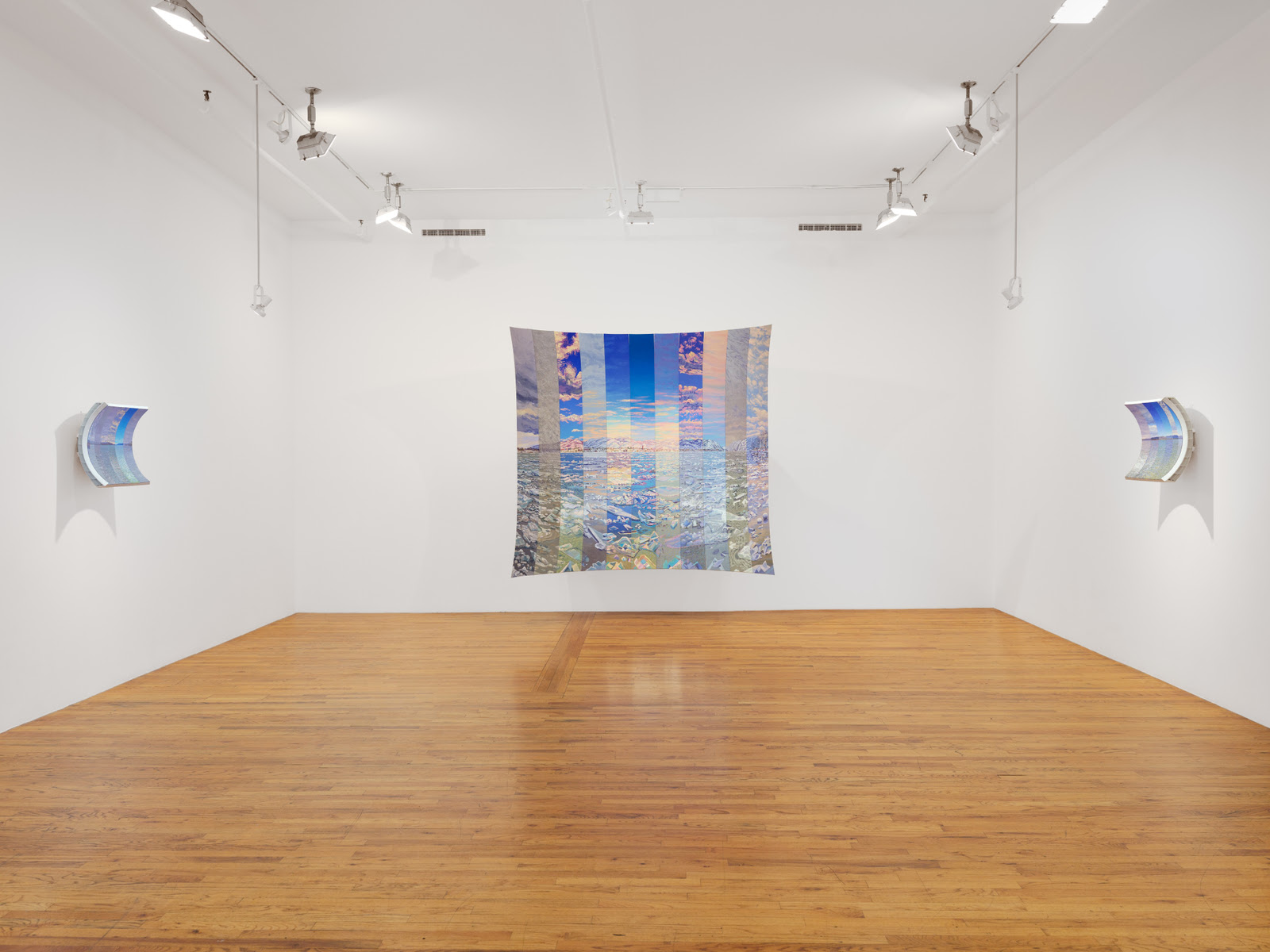
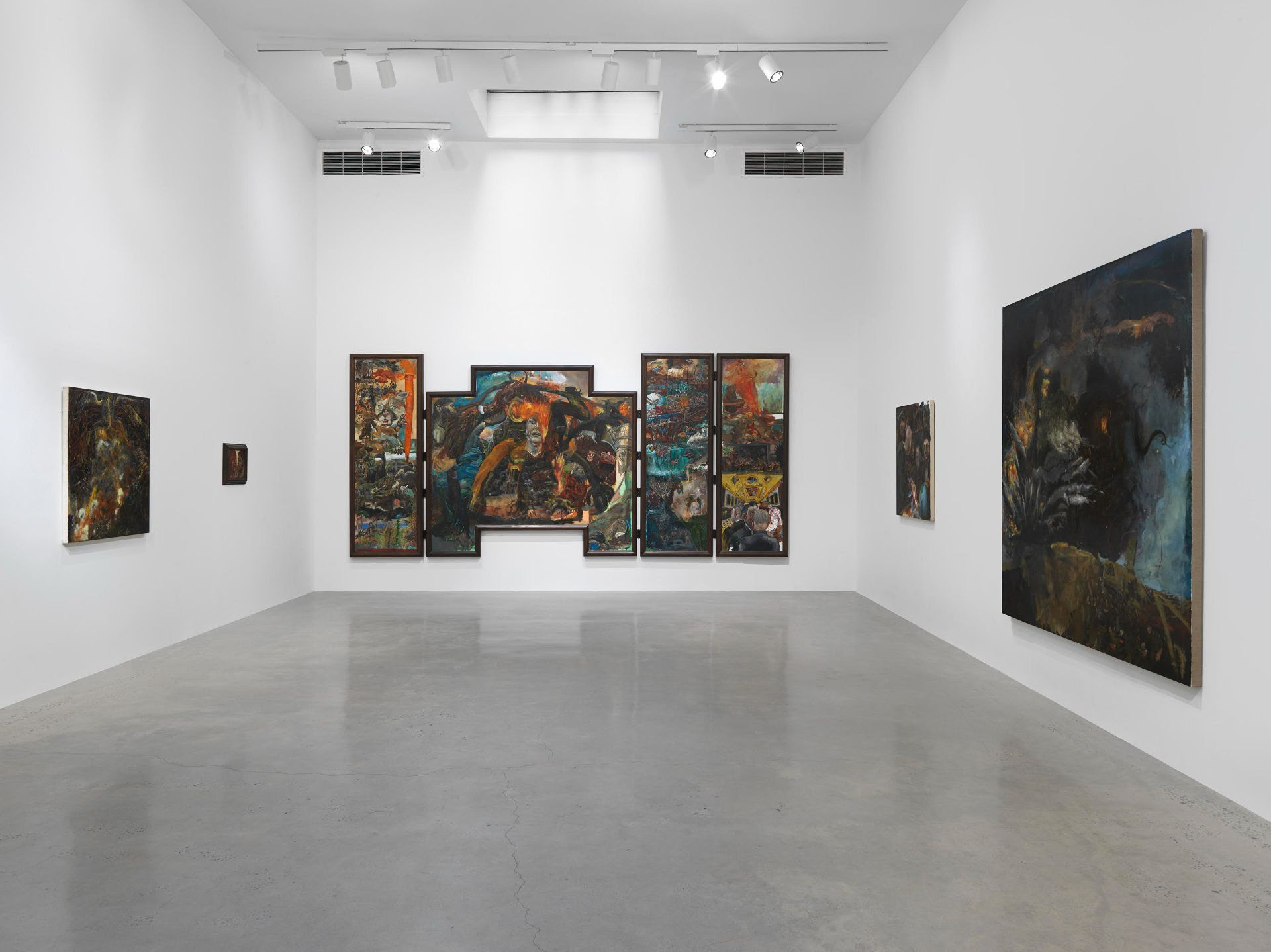
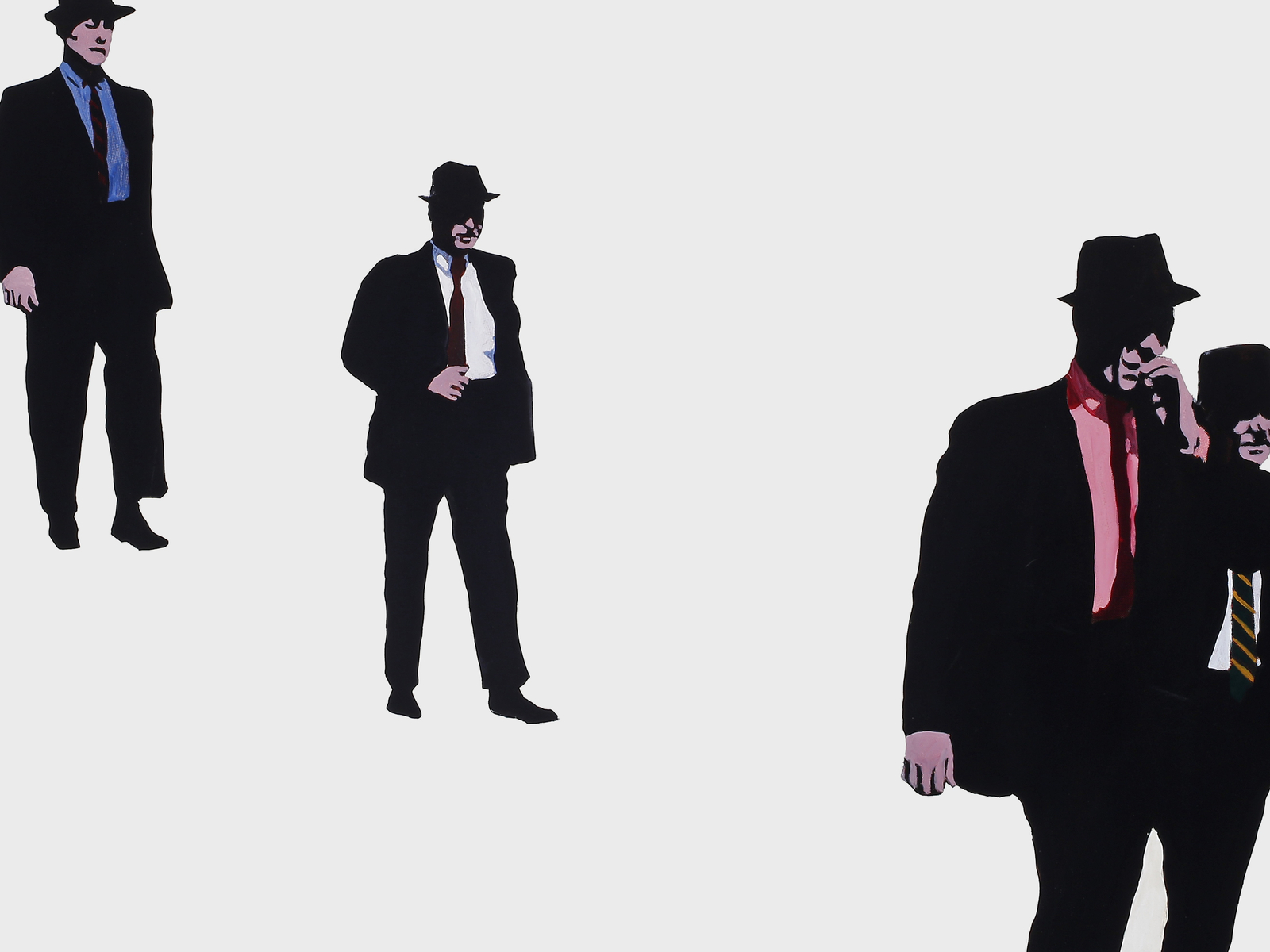
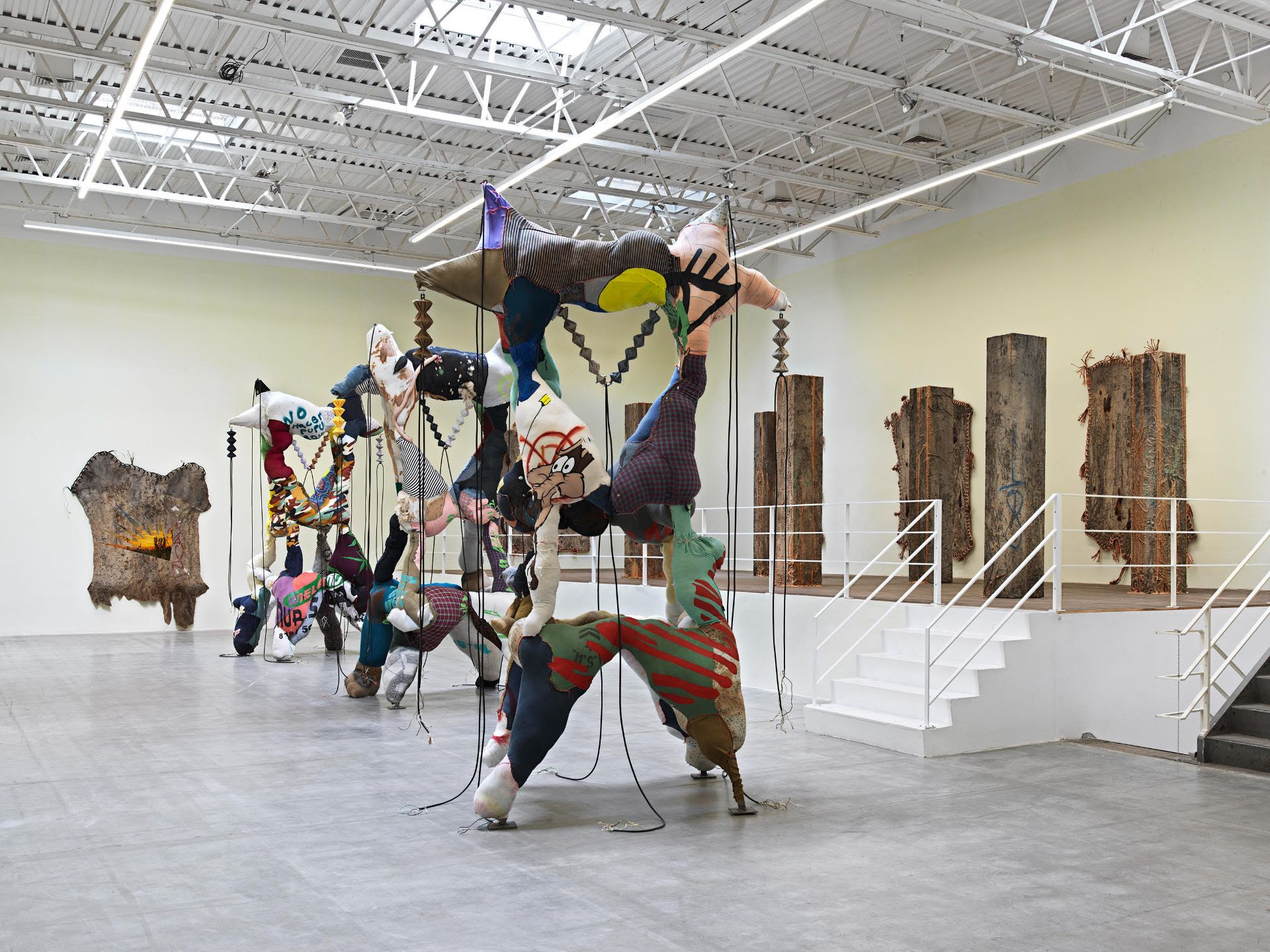
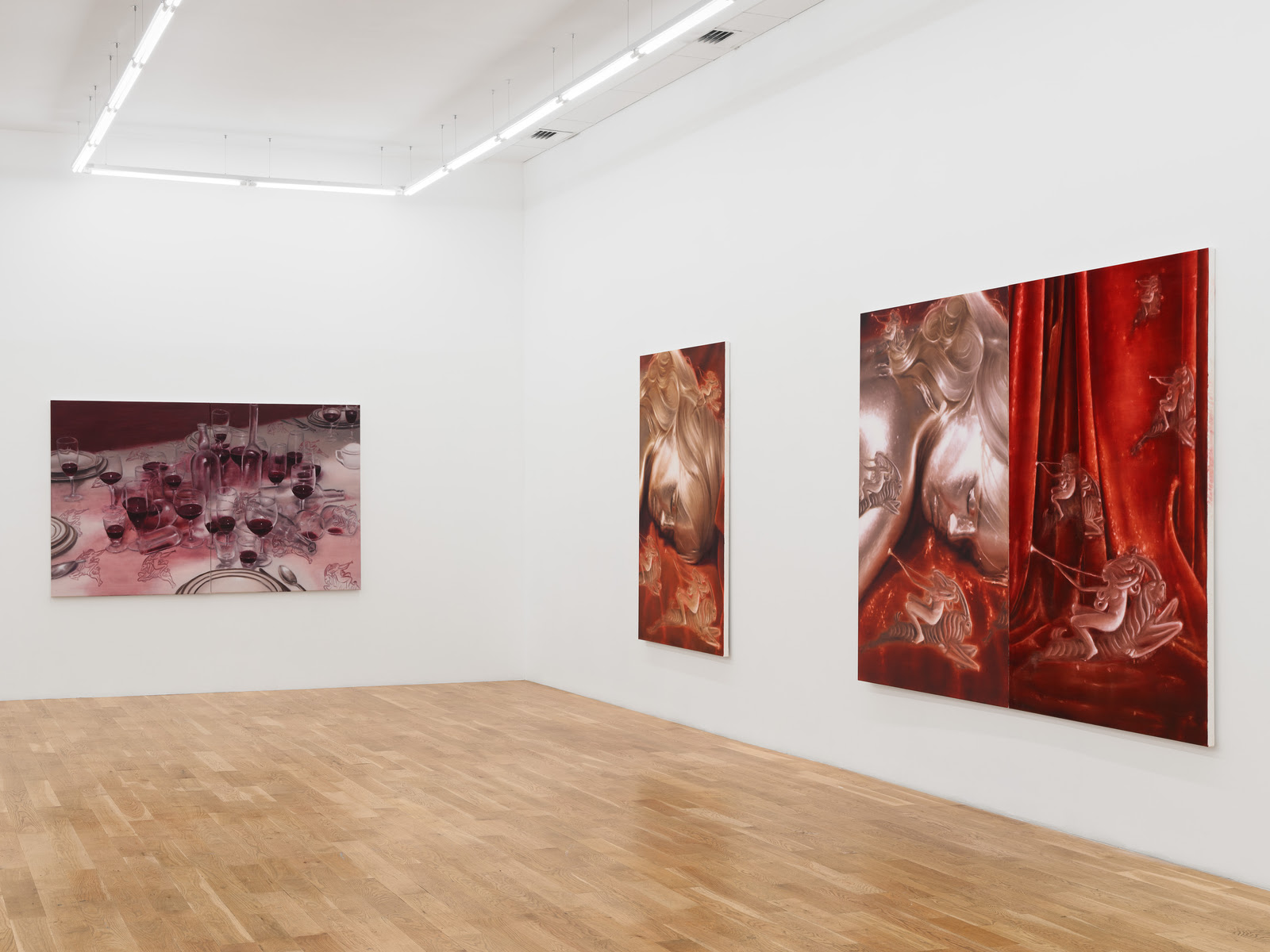
Hither and Thither brings together the work of four artists who are working within the composite mediums of collage and assemblage; layering scraps of everyday images and objects, they create the potential for the works to resonate broadly. Here, amidst the amalgamation of material, substrate is lost, muddied, or obfuscated to create a sense of wear with implications of use and use value. An aesthetic of erosion, or patina, carries both the enigma of what has transpired and veneration for what has sustained, collapsing the distance between both individual and collective resonances, or “the hither and thither,” as referred to by Homi K. Bhaba.[1]
In Ordonez’s orb I & II (2023), a tiered structure crafted of tarnished wood and the tattered remnants of a trampoline sits on the floor, its surface coated with a layer of soil and detritus. Two graphically printed towels fold over the edges, their softness underscoring the potential to absorb and hold. A projection onto the form lends it a monumental shadow and a hazy orb suspends above the silhouette on the wall, shaking in and out of focus. As the illumination changes, the static sculpture appears to shape shift, emanating from its detrital form. The sculpture acts as a pedestal for a floating, levitating memory. This notion of recollection continues in Ordonez’s works post (2024) and post II (2025), which are created by casting the insides of mailboxes with cement and concrete. The resulting shapes echo the originals but there is loss and glitching in the process where the fossilized traces of recognizable objects like a text book, a trampoline spring, and fragments of mail and medical bills peek through the surface. Sitting heavily on the floor, their arched, stone-like constructions are evocative of tombstones, nodding to the near-obsolescence of these symbols of Americana.
Kriangwiwat Holmes’s photo-based works Good Inner Balance (2025) and Feel The Floors Support You (2025) are practices in selective revelation. Drawing from her personal archives of familial images and years as a nightlife and band photographer in Vancouver, Kriangwiwat Holmes contemplates how relationships are represented through images. Round and square passepartouts dot the compositions, creating small pictorial moments–a foot amongst tangled cables, an elderly woman candidly glancing away from the camera, and a small swatch of pink textile dotted with orange and deep brown foliage. Burned edges surround each vignette. The display of images hop between showing and withholding; like life online, where traces of the personal appear but remain confined to the boundaries of what is presented. At the center of each work a sick note emerges distinctly from the other images, with its handdrawn text and doodled images. Words and letters are repeated as the artist emulates her mother’s handwriting to create forged excuses from school, contemplating a youthful practice.
de La Tour du Pin similarly works from personal archives, activating personal and found images to create the collage elements nested within her wall-mounted assemblage, Untitled (star-shaped head) (2023). The imagery is recessed into the depths of a box created from cardboard and the x-shaped metal rib of an umbrella, uniquely framing two portals for mediated viewing of the interior. The rough surface of built up gray paint strewn with hair-like threads appears like eroded stone, evoking an aged mystique. In the corner of the gallery, the small black form of Peculiar Sweet Matter (2023), exudes a subtle fragrance throughout the room. The beeswax cast of a vintage perfume bottle is based on a 1950s brochure for the chemical industry advertising “sweet taste.” Invoking the color and sheen of petrol, the work examines the reverberations of extractive and parasitic practices. The surface of the antique form is uneven, revealing striations in its wax materiality and inducing the reverence of a fragile relic. The scent underscores the olfactory’s potent impact on nostalgia and memory.
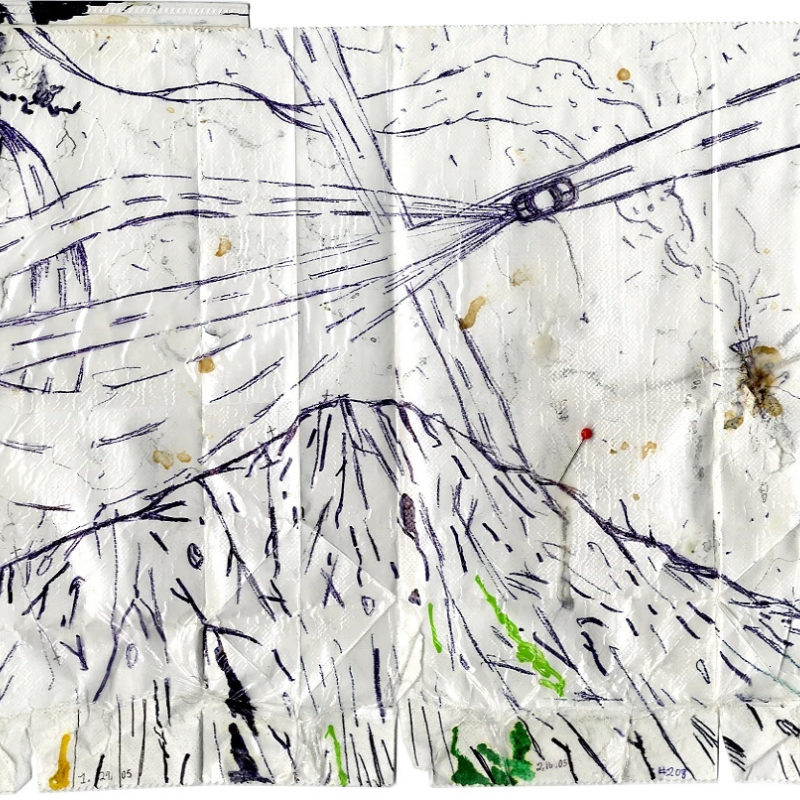
Lum’s practice is rooted in the wandering of urban spaces. Her meandering walks, primarily through New York and North Adams, MA, where she lives, are rooted in the Situationist psychogeographic method of derivé. In these explorations, Lum takes photographs and collects materials that are later incorporated into her collage practice. The resulting works are vibrant abstractions, interlacing painted fields of geometric color with photographic images and the raised, irregular surface of overlapping materials. Her intention is to convey aspects about her wandering that “cannot be easily pictured.” In Curtain (2021), cerulean, mustard, and brown planes jut through the composition with lines converging at the central field where the facture becomes more washy and brushed. There, a triangular cutout of a photograph is affixed, its linear image almost blending in with the painted lines and shapes. The subtle reflection of a car emerges and the titular curtain, with its varying colored pleats, is located. The window, on Rue Jussieu in the 5th Arrondissement of Paris, is a location and image that Lum returns to often, its influence on the outcome of the work dependent on weather, lighting, and mood. It also appears in Surface (2021) and Window (2022), identifiable by its worn but vibrant pink frame and gauzy curtain.
Marisa Kriangwiwat Holmes (b. 1991, Hong Kong) lives and works in New York. Recent solo and two- person exhibitions include Towards, Toronto (2025); april april, Pittsburgh (2025); Unit 17, Vancouver (2022); Project Native Informant, London (2021); Polygon Gallery, North Vancouver (2020); and Calaboose, Montreal (2018). Select group exhibitions include Unit 17, Vancouver (2025); Iowa Projects, Brooklyn (2025); Trapp Projects, Vancouver (2022); Public Art Works, Richmond Art Gallery, Richmond, Canada (2018). In 2022 Holmes was the recipient of the New Generation Photography Award from the National Gallery of Canada. She was the winner of the second annual Lind Prize in 2017. Holmes received her BFA from the Emily Carr University of Art and Design and is currently finishing her MFA at Hunter College in New York.
Clémence de La Tour du Pin (b. 1986, Roanne, France) lives and works in New York. Recent solo exhibitions include Alea, Paris (2025); Derosia, New York (2024); Towards, Toronto (2024); Tonus, Paris (2023); April in Paris, Netherlands (2022); and Smart Objects, Los Angeles (2021). Recent group exhibitions include Catriona Jeffries, Vancouver (2025); Blaffer Art Museum, Houston (2023); CAN - Centre d’Art Neuchâtel (2019); CAC - La Synagogue de Delme (2019); and Musée d’Art Moderne de Paris (2015), among others. Her work is in the permanent collections of CAPC musée d’art contemporain de Bordeaux, France and Frac Grand Large Dunkerque, France.
Mary Lum (b. 1951 St. Cloud, MN) lives and works in Vermont. Mary Lum creates intricate collages, installations, and photographs that use the urban environment to explore geometric abstraction, perspectival space, and color field. She received her BFA from the University of Michigan and her MFA from the Rochester Institute of Technology. Her work has been exhibited in numerous institutions internationally including Mass MoCA, North Adams, MA (2017); deCordova Sculpture Park and Museum (2018); Currier Museum of Art, Manchester, NH (2016); Kunstmuseum fur Geganwartskunst, Basel (2013); Savannah College of Art and Design, Savannah, GA (2011) and The Drawing Center, New York (2000). Lum has been the recipient of numerous awards, including a Guggenheim Fellowship (2010), the Radcliffe Fellowship for Advanced Study (2004-2005), and a McDowell Colony Fellowship (2012), among others. She is a professor of painting and drawing at Bennington College in Vermont, where she has taught since 2005.
Andrew Ordonez (b. 1991, Fort Worth, TX) lives and works in New York City. His multidisciplinary practice—spanning found media, installation, and sculpture—employs analytics of hauntology to explore the tension between erasure and preservation. Ordonez earned his BFA from the Kansas City Art Institute in 2013 and his MFA from the Yale School of Art in 2024. He is a recipient of the 2024 Yale School of Art Dean's Prize. He recently participated in the Casa Lü Parque Artist Residency in Mexico City and completed a three-year Visual Artist Studio Residency at the Charlotte Street Foundation in Kansas City, Missouri. His work has been shown widely across the United States and North America, with recent solo and group exhibitions at 47 Canal, New York (2025); the Nerman Museum of Contemporary Art, Overland, KS (2025); Shrine NYC, New York (2024); the Leedy-Voulkos Art Center, Kansas City, MO (2018); Below Grand NYC, New York (2024); the Charlotte Street Foundation, Kansas City, MO (2022); Monaco STL, St. Louis, MO (2019); and the Mexic-Arte Museum, Austin, TX (2018).
1 - In his 1993 Whitney Biennial essay, Homi K. Bhaba employs the idiom hither and thither to describe the interstitial state of artists who must perform openness in their work to appear culturally translatable. Bhaba writes that it is the contribution of these artists “to enact the dialectic of cultural difference displayed in the ‘interstices,’ the overlappings and interleavings, the hither and thither…”