
Ended
Matthew Watson
Softening Boxes
Sep 12 – Oct 25, 2015
Joe Sheftel Gallery is pleased to present Softening Boxes, Matthew Watson’s second solo exhibition with the gallery.
The house can be read as a sensorium. We furnish our rooms with layers of soft material; including curtains, carpets, paintings, bedding, clothing, and cushions. The softness of human skin is mirrored through the skins of the softening boxes we construct.
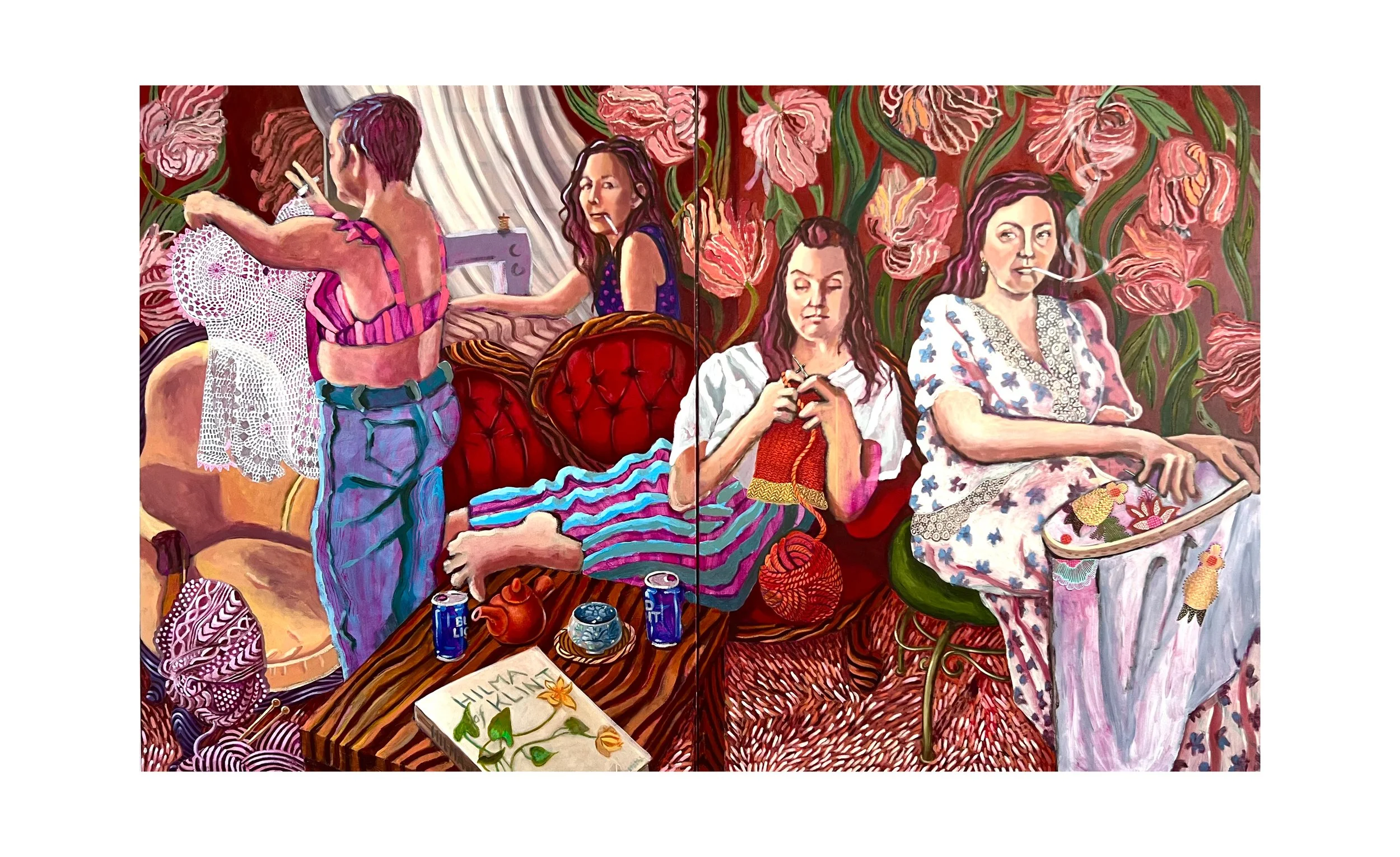
Watson’s recent paintings mark a shift away from depicting the subjects of the painting directly. Represented in the exhibition are two artists, a collector, a dealer, and a critic, yet what is depicted in the paintings are their pets, furnishings, objects, walls, flooring, books, and child. The border between subject and object is softened, a step removed from the humanistic pathos often wrapped up in portraiture.
This is against the myth of Narcissus who gazed into his own mirror image as the primal form of self-relation. Our relation to the world is not rooted in the internal “I”, but instead as the fluid space between subject and environment. Here, the human being proceeds from the social to the individual and not the other way around. It is the social imago that situates our experience of being in the world, where things are not outside of us in some measurable external space. The child psychologist Donald Winnicott provides an antidote to the mirror-stage when he speaks of “transitional” objects, which are the first things a child separates from external reality and appropriates into an ambivalent “zone of experience which is between the thumb and the teddy bear, between oral eroticism and the real object relation.”
Watson’s concern with the social and economic relationships that constitute each of his paintings extends to the accumulation of objects that are depicted in each image. Due to the absence of the person with whom the exchange is being conducted, the relations that bind objects, places, and people are brought to the fore. Louis Althusser would term this the “real abstract,” which he defined as “real relations (as relations they are necessarily abstract) between ‘men’ and their ‘things’, or rather, to give the term its stronger sense, between ‘things’ and their ‘men.’ He aptly claimed that one could not depict social relations in an image positively, but it is possible to depict the determinate absence that governs them, as traces between objects and humans.
For Watson, the technical processes performed by an artist are necessitated by the produced object itself, and not the other way around, which is a refutation of the pure subjectivity of creation. The social and economic relations which accompany the object are sensible, but only in the space between an object, it’s producer, and it’s beholder. Watson inserts himself into this fluid chain of relations, frequently working on commission or by invitation to start a painting, in turn producing objects that relay back into the very flows that led to their construction.
Matthew Watson (b. 1981) lives and works in Brooklyn. He received his MFA from Columbia University and has presented two solo exhibitions at Joe Sheftel Gallery. Group exhibitions include shows at Metro Pictures, New York, NY, Oakland University Art Gallery, Rochester, MI and Shit and Die, organized by Maurizio Cattelan in Turin, Italy, among others. This fall Watson’s work will be included in the Kyiv Biennale in Kyiv, Ukraine.