Ended Jul 18
Keioui Keijaun Thomas
Hands Up, Ass Out
Jun 6 – Jul 18, 2021
More from Keioui Keijaun Thomas on Gallop
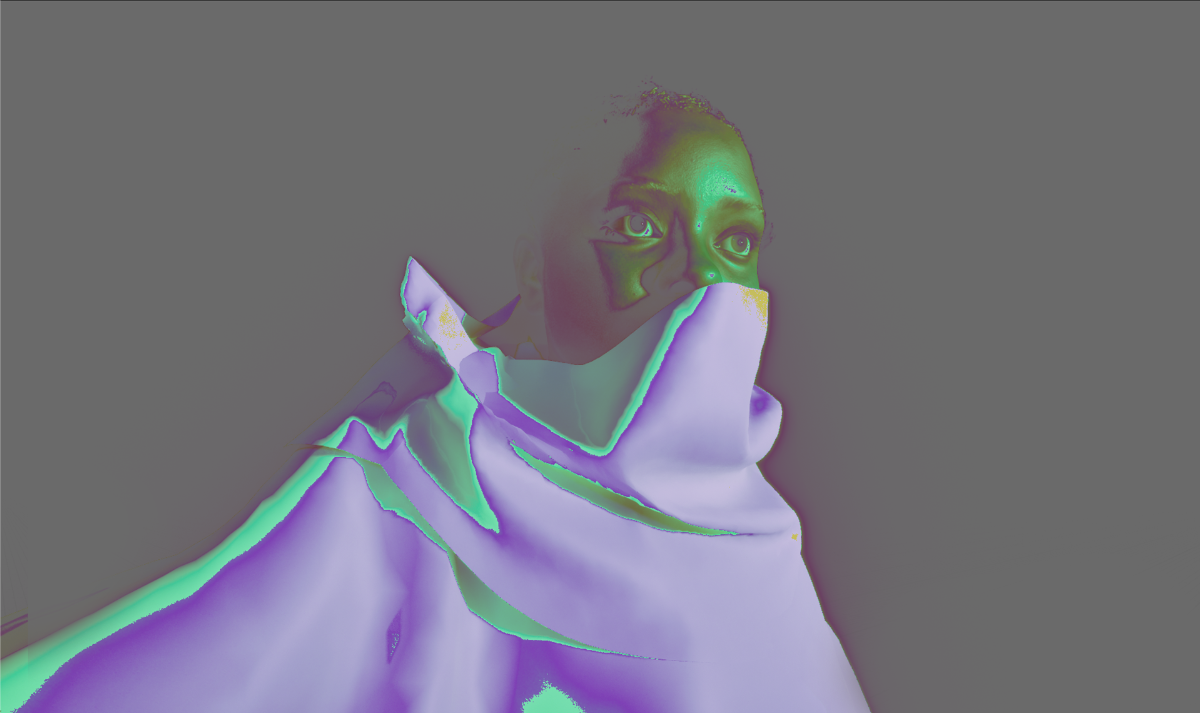
Hands Up, Ass Out is New York-based artist Keioui Keijaun Thomas’ first long-form solo exhibition, representing the culmination of a body of work spanning six years, from 2014–2020. Amassed from iterations of writing, image-making, performances, and choreographies, this exhibition maps Thomas' journey toward self-affirmed transcendence from the tokenization that exploits and oppresses young, talented, and femme black people. Hands Up, Ass Out celebrates this long-term project in its fragmented totality, while manifesting Thomas’ forthcoming body of work, a moment of which will premiere on Participant After Dark on the last day of the exhibition.
The body of work, and this exhibition, is structured into three intersecting successions of partial performance archives:
1. The Poetics of Trespassing. Part 1. Absent Whiteness, Part 2. Looking While Seeing Through, Part 3. Sweet like Honey, Black like Syrup — contemplating a passage without utterance. The body and its voice are consumed in and by labor. It’s working for you.
2. Distance is Not Separation. Section 1. Selective Seeing: Corners, You, Section 2: Painted Images, Colored Symbols: SHE’S HARD, SHE Q — the body appears in sports; the body is a cheerleader. It’s twerking for you, and finding its voice.
3. My Last American Dollar. Round 1. Tricking and Flipping Coins: Making Dollars Hit, Round 2. Black Angels in the Infield: Dripping Faggot Sweat, Round 3. Whatchu Gonna Do: Marvelous like Marva — she’s ready. She’s found her voice, in all its capacity. Can you hear her? Her body is serving. Will you catch her when she falls? An evolution toward making and holding space for the people Thomas is making her work for. This is for us.
Thomas’ multidisciplinary practice is rooted in her writing, which spawned the images, videos, sounds, sculptures, performance iterations, choreographies, ephemera and archival material in this exhibition. Assembled on-site and including location-specific materials, like used coffee filters and envelopes from their exhibition venue, Thomas’ installations and sculptures serve as archives of the bureaucracy surrounding the staging of her performances.
From parts, to sections, to rounds — subjugation to emancipation — flour turns to confetti: shiny, metal shields of reflective color; silence into self-congratulating cheers; absence into agency, and presence. By simultaneously embodying the young, black body; the young, black, and gifted body; and the young, black, gifted, and femme body, Thomas’ passage, throughout this exhibition, invites the possibility for an eventual, collective release even if for a short moment.
Final Note: As a gesture of self-preservation and ownership, and to maintain agency over the consumption and historicization of her work and body, Thomas doesn't have a website of her own. Her work and archive are held by the artist, only shared with those she trusts who personally approach her for access. Fragments of Thomas’ work exist online, accessible to the public as documentation on the websites of the various art institutions and festivals that have hosted Thomas and her performances. The work’s legacy lives with the people it has touched and who have lived/will live to witness it. Limiting access to her work and archive is a gesture of self-preservation and ownership.
Keioui Keijaun Thomas (b. 1989, based in Brooklyn, New York) creates live performance and multimedia installations that address blackness outside of a codependent, binary structure of existence. Her work investigates the histories, symbols, and images that construct notions of Black identity within black personhood. The materials employed by Thomas function as tools, objects, and structures to compose a visual language that can be read, observed, and repeated within spatial, temporal, and sensorial environments. Through movement and matter, Thomas deconstructs, and reconstructs notions of visibility, hyper-visibility, passing, trespassing, eroticized, and marginalized representations of black bodies in relation to disposable labor, domestic service, and notions of thingness. Her performances combine rhapsodic layers of live and recorded voice, reciting her own poetry and slipping between various modes of address, to explore the pleasures and pressures of dependency, care, and support. Thomas underscores the endurance and intimacy that care work demands from those expected to perform it — predominantly black women, black femmes, and people of color. By centering self and communal care in real-time, Thomas’ practice aims to build bridges of understanding, and community, to create safer spaces for black people and people of color.
Thomas is the inaugural winner of the Queer|Art 2020 Illuminations Grant for Black Trans Women Visual Artists and the Franklin Furnace Fund Recipient for 2018. She earned her Masters degree from the School of the Art Institute of Chicago and her BFA with Honors from the School of Visual Arts in New York City. Thomas has presented work nationally and internationally at Anti - Contemporary Art Festival, Kuopio, Finland (2019); Fierce Festival, Birmingham, Uk (2019); Skopje Pride Queer Arts Festival, Skopje, Macedonia (2020); The Rhubarb Festival, Toronto, Canada (2020); Time Based Arts Festival, Portland, Oregon (2016); Dweller Festival, Brooklyn, NY (2020); Rapid Pulse Performance Art Festival, Chicago, IL (2016); SPILL Festival of Performance, Ipswich, UK (2014); Out of Site Festival, Chicago, IL (2014). Solo Performances at Housing NY, Brooklyn, NY (2016); The Knockdown Center, New York, NY (2018), Performance Space UK, Folkestone, UK (2016); Human Resources, Los Angeles, CA (2015). Selected group exhibitions held at Broad Museum, Los Angeles, CA ( 2017); Station Museum of Contemporary Art, Houston, TX (2018); New Museum of Contemporary Art, New York, NY (2018); Human Resources, Los Angeles, CA (2018); Arnolfini, Bristol, UK (2019); Performance Space, New York, NY (2019); Wrightwood 659, Chicago, IL (2019); Artist Space, New York, NY (2018); EXPO Chicago, Chicago, IL, (2015); Links Hall, Chicago, IL (2014); Montréal, arts interculturels (MAI), Montreal, Quebec (2019); The Knockdown Center, New York, NY (2017); Théâtre de la Ville, Paris, France (2015); Catinca Tabacaru Gallery, New York, NY (2018); Defibrillator Performance Gallery, Chicago, IL (2013); Stanford University, Palo Alto, CA (2018); Harvard University, Cambridge, MA, 2018; Issue Project Room, New York, NY (2018), Performatorium 5, Saskatchewan, Regina, Canada (2016); New Normal, Istanbul, Turkey & Beirut, Lebanon (2017); Encuentro 2016, Santiago, Chile (2016); and Centro Cultural del México Contemporaneo, México City (2016).
Shehab (Isis) Awad is a curator and writer from Cairo, Egypt currently based in New York City. He/she is Founding Director of Executive Care, an all-encompassing self-as- agency at the service of artists. Awad’s interests include artists’ books, cuteness, banality, hedonism, and the liberating potential of nightlife, sleep, recreational drugs, and chronic conditions. As a freelance curator, Awad’s projects highlight queer, marginalized, and undervalued practices. Recent projects include Bard’s MFA 2021 Graduate Exhibition (forthcoming); Happy tears (2020), a two-person exhibition showcasing the sinister aspect of cuteness at 17Essex Gallery, NY with artworks by Ian Faden and Wayne Bruce Dean; A Body of Work (2019), exploring the body through textile at Jane Lombard Gallery, NY; Publishing Process (2018), a symposium about artists’ books and experimental publishing practices from the global south at Institute of Arab and Islamic Art, NY; and When the whites of the eyes are red (2017), exploring the conflation of sleep and death at Hessel Museum of Art; NY. Publications include A Tardigrade’s Dream (2016), an illustrated short story book about a batch of frozen tardigrades sent to outer space published by Nile Sunset Annex, EG; The Symbol That Must Not Be Named about Egypt’s Raba’a Square Massacre in Branded Protest (X-Site: 2020); and The People Who Hold The Wall the history of pajamas, and laziness as political resistance in Sara Enrico: The Jumpsuit Theme (Nero: 2021). Awad’s writing also appears in periodicals such as The Brooklyn Rail, ArtAsiaPacific, Art Papers, and Madamasr—Egypt’s leading independent news source. Awad has held curatorial positions at Townhouse, Cairo; Institute of Arab and Islamic Art, NY; and Participant Inc, NY. He/she holds an MA from the Center for Curatorial Studies, Bard College.