
Ended
Emil Michael Klein
Paintings & Sculptures
Sep 11 – Nov 2, 2024
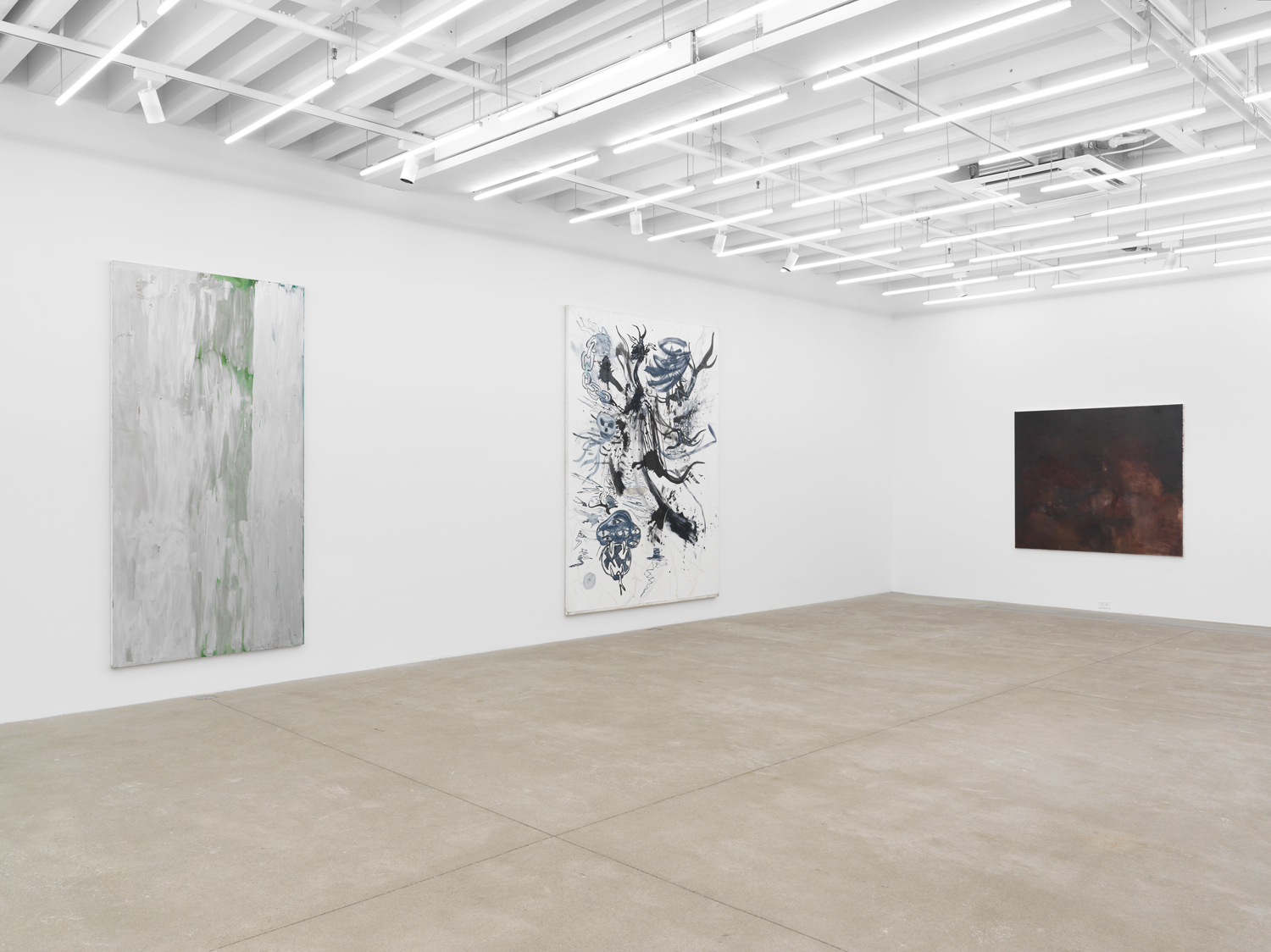
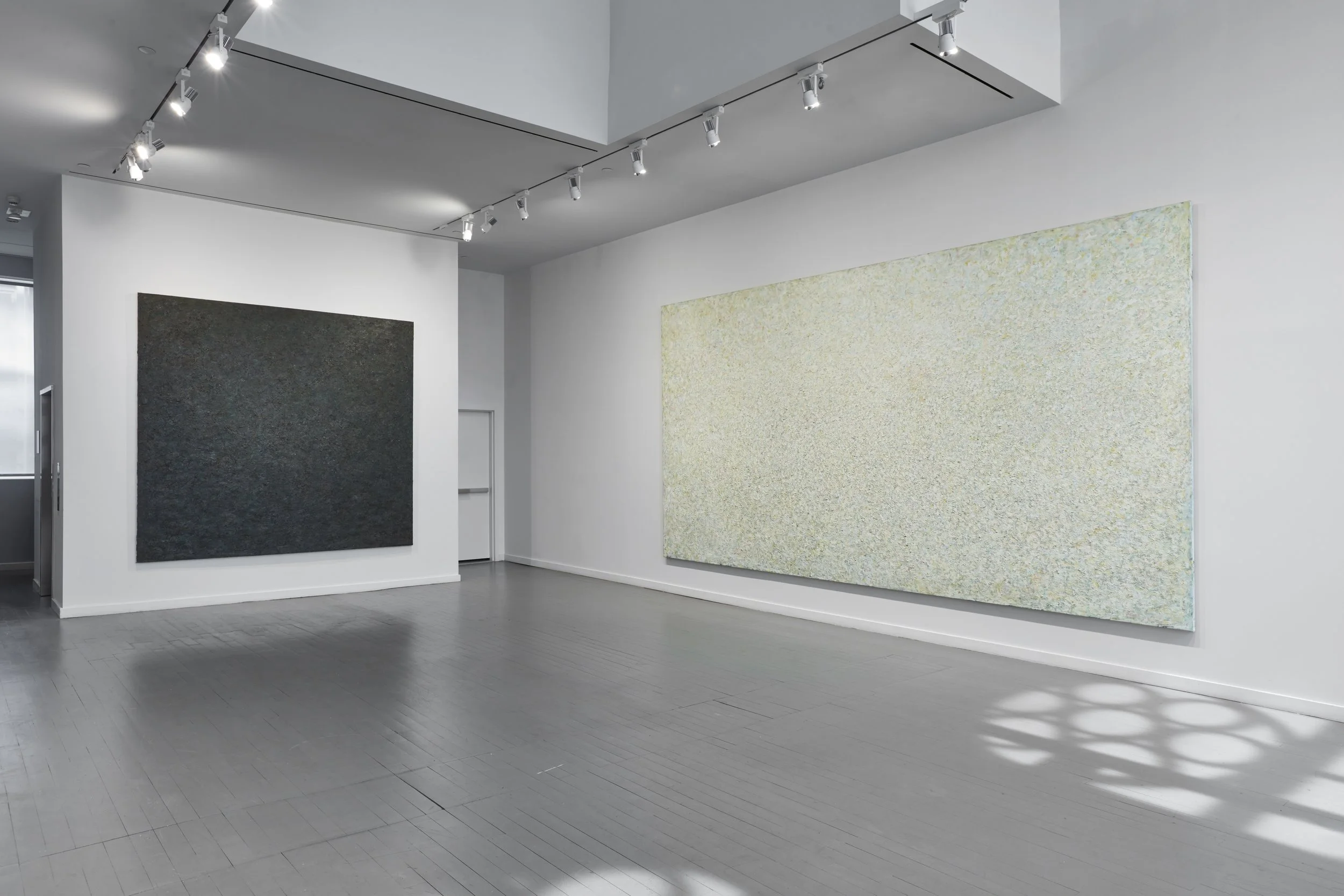
Bridget Donahue presents Paintings & Sculptures, a solo exhibition by Swiss artist Emil Michael Klein, his first in the United States. Klein’s approach accretes brushstrokes while simultaneously negating them, resulting in abstract paintings that register a careful deliberation of minimalist forms. Trained in classical wood sculpture, Klein is deeply engaged with pushing the boundaries of what constitutes a painting. Artist Peter Fischli said of his work, “Some of his lines seem to leave the canvas, become invisible for us, and travel to a parallel universe where the distorted echo of the question Why painting? is still audible. But space-time curvature reshapes the lines and sends them back to the terrestrial canvas, where they become paintings that can do everything.” [1]
On occasion of this exhibition, Klein speaks to two friends: New York based painters Greg Parma Smith and Giangiacomo Rossetti. These artists have responded to one another’s work over the past 10 years. Reflecting on their shared medium, they offer a conversational introduction to Klein’s work today.
Greg Parma Smith: Does dealing with “abstract painting” as a monolithic term figure in your project or symbolize anything to you? Does it have a presence in the studio or in your mind? I’ve always found your work so fresh in the way that it relates—or maybe doesn’t relate to—this big art historical specter. Your paintings can be monumental, yet their formal qualities seem to emphasize the idea of detail, these subtle or even minor changes of direction, as teasing out the subject in itself.
Emil Michael Klein: My education in wood carving takes its subjects from folklore, but then I started to paint. There wasn’t one moment or decision to make abstract paintings. It’s not something I’m thinking about more than I think about art in general. However, my sister and father are abstract painters, so it’s something I do relate to.
Giangiacomo Rossetti: Your work keeps moving and returning to points that are stable. The lines are anchors that hold space but they also move ideas further, separate them or hinder them; The brush strokes, layers, and other physical aspects in the painting are also stable. I remember when these forms were perhaps imitating structures in nature in a quasi-graphic alien way with more emphasis towards mimesis. The paintings were very flat. Now the works have grown into something that is very truthful or real and also quite muscular. I think this has something to do with mastering a form until it is emptied out of its conceptual intention and becomes something of its own. What are your thoughts on that? And what are your concerns when you decide to rework something from the past?
Emil Michael Klein: When time passes by the perspective on things changes. It is then easy to say goodbye to something while you’re working on it again. For some things or aspects, acceptance grows over time. I'm happy with the colors for New York. After years of painting out of the bucket, I'm working from the palette now. I want to build off the recent color range of the works in this show; I guess this work is about getting in the mood for a new color range—or getting back to the old one. Toward that, I’m busy every day doing tryouts and preparations.
Greg Parma Smith: Although the three of us have focused our practices on different sorts of painting, we come out of a context that was rigorous in demanding self-reflexivity in painting—internally addressing the social or material circumstances of its reception. It all stems from the recognition that an ahistorical or unmediated experience of a painting is impossible. While we have each internalized that reality in our work, we also, as so many others do, seek a path that revitalizes some traditional aspect of painting. In my case, it is its metaphysical aspirations while for Giangiacomo it is realism. Emil, you make an active case for the ongoing narrative between forms.
Giangiacomo Rossetti: I have been questioning where —and if—there is an end of the pictorial plane, and the metaphysical implications within it. Although I have recently been attempting to depict reality I find that the mediation process often deters that aim; By approaching each work as a singular project, things can take a direction beyond my control since the space in which the image exists is yet unknown. The picture that results might just live within its frame; a finite, contingent space. I often work on panel because it is a surface that has a certain weight. I think the physicality of it helps me in some way. The same applies for natural pigments, made from earth and minerals. There is care taken for a work to be in the world but if, in your case, the pictorial plane is continuous, what happens when the work is released? Is the painting itself gone? I mean the difference between the actualization of something purely as an idea and the physical thing: Do the forms come back? And what about the signature? Is that a marker within this plane?
Emil Michael Klein: Since my education is in sculpture, I don’t know where pictures end—probably where the canvas bends around the stretcher and is folded back. Years ago, I used to paint on the fabric first and then stretch it afterwards. That, too, was a moment of losing control as the edges of the painting got cut off, so stretching came to play a role as well. With my recent paintings it's different. They are made on canvas after being stretched and prepared. The signature is an obligation. With the monochromes I did them first, then the painting. It can be very different if the signature is on the front of the painting, then it becomes a compositional element.
Greg Parma Smith: Painting is a world without end. The weight of our expectations allows it to have this special simultaneity of intellect and sense, image and material, intention and accident, universality and contingency. People assign qualities like smart or stupid, or some version of that. I readily admit to thinking through these extreme polarities. At 41, I can recognize my own psychically imprinted fixations (edges, color, style), but as an observer of my own work, have seen and felt the “correct“ balance of those dialectical opposites moving and pitching—in cycles, not towards any end point. Skill and sensitivity can improve, but I don’t know whether I believe in artistic progress. Sometimes the balance you strike finds a true resonance with what can be called a contingently visible image of the universal. Then maybe it slips out of view, out of its own immediacy when circumstances are updated, polluted, or purified.
Emil Michael Klein: Indeed, it depends so much on circumstances, and how it’s possible to find a balance of—let’s say—hand and eye. Realism is recognizable in both of your work, at least when the oeuvre is considered as a whole. Likewise there are metaphysical aspirations in Giangiacomo’s paintings.
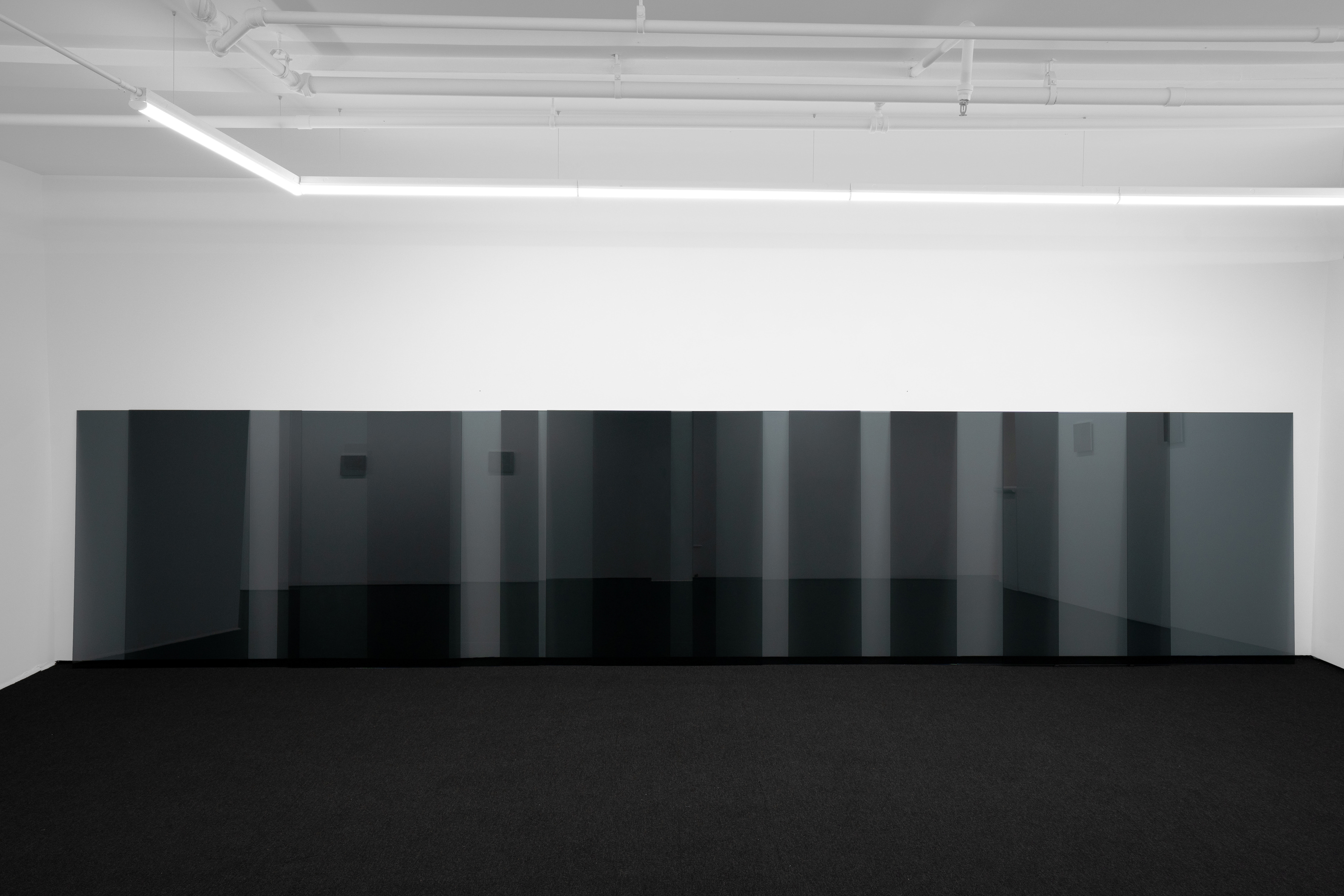
Greg Parma Smith: Emil, with your sculptures and the curtains you also represent the paradox of image and material, or the limit of the picture plane. With the curtains it’s “dramatized,” isn’t it? At the risk of over-explaining, I’ll say the implication is of a promised but inaccessible scene waiting behind the curtain. But then it’s also just the blank face of the curtain itself: a vertical, rectangular, recognizable device constructed for a specified purpose from some beguiling fabric—i.e., also a painting. Nothing is actually behind this big veil, physically or metaphysically. Whereas in the sculptures the “picture plane” continues around the form. You’ve also worked on walls, ceilings, and on ceramics. It seems like these extensions of your practice offer layers of philosophical clarity.
Giangiacomo Rossetti: There are two things I want to ask. First— I was looking at Rauschenberg’s Jammers (1975–76) and wondered if in some way that work had an impact on thinking about the curtains and from there I thought, in general, what is your relation to American art? It might be too open of a question but I feel like your work is linked to some experiences of American abstraction and I can imagine this makes it exciting to be shown in NYC where your work is relatively new in comparison to the European context.
Emil Michael Klein: Of course, I relate to American artists from that generation, and I see the kinship between the Jammers and my own curtains—the aspect of covering surfaces in sculpture versus painting. I'm always trying to explain how it came to be that I make curtains, although, I suspect it's probably more interesting just to see one of them hanging.
Giangiacomo Rossetti: Second—and this can also be a simple idea applied to any sort of sinuous line connected to a vertical plane — Sometimes I think about mountains and rivers when I see your paintings, but maybe it’s more because I fantasize about where you grew up. I could see those very same mountains from where I grew up myself. However, I don’t tend to read your work in such a clear way but still the question remains: how much does reality relate to your forms in abstraction?
Emil Michael Klein: Yes, I grew up in an isolated valley in the Alps, but there was a pass you could cross to reach the southern side of the mountains. Those valleys, rivers, lakes, and Italian towns have always been important to me. However, the question of reality versus abstraction doesn’t concern me much. With painting it's mostly about what a form evokes and to what extent it does. If someone suddenly comes along and says, “I see a table,” well, that’s fine if the composition is good.
Edited by Miciah Hussey
1 - ”The Artists’ Artists: Best of 2015 (Peter Fischli), Artforum 2015
Emil Michael Klein (b. 1982, Munich, Germany) lives and works in Zürich. He has had solo exhibitions at Kunsthalle Zürich; the Museum Bellpark, Kriens; and Museum für Gegenwartskunst, Basel. Selected group exhibitions include Kölnischer Kunstverein; Nicoletta Fiorucci Collection, Monte Carlo; Fondazione Prada, Milan; the Contemporary Art Center, Riga; Kunsthaus Hamburg; Astrup Fearnley Museet, Oslo; Fri Art, Fribourg (2013); and Magasin CNAC, Grenoble. His work is in the collection of the Museum Im Bellpark, Kriens; Kunstmuseum Bern; Bechtler Siftung, Uster, and Cnap, Paris.
Giangiacomo Rossetti (b. 1989, Milan, Italy) lives and works in New York. Recent solo exhibitions include Greene Naftali, New York (2024, 2020); The Power Station, Dallas (2023); Mendes Wood DM, São Paulo (2022); Galleria Federico Vavassori, Milan (2021, 2017); Fiorucci Art Trust, London (2021); Riverside, Bern (2018).
Greg Parma Smith (b. 1982, Cambridge, Massachusetts). He lives and works in New York. Recent solo exhibitions include David Lewis Gallery, New York (2024), Francesca Pia Gallery (2020), Galleria Federico Vavassori (2018) MAMCO, Geneva (2017). His work in currently on view in a 2-person show at François Ghebaly, New York.