Opens tonight
Larry Poons
Bo Jangles
Nov 11, 2026 – Jan 16, 2027
Closes Jan 16. Get a reminder before it closes.
 or scan for the iPhone app
More from Larry Poons on Gallop
1.
“Another word for creativity is courage.”
—Matisse
Ang Lee said the greatest creative gift an artist can have is indecision.
An artist lives in limbo, floating offshore. In sight is a ledge, dry and stable where other artists gather to have martinis, smoke cigarettes, flirt or kill time with chatter. A seductive community resort, it is always within reach should the artist want reprieve from indecision. This place has a name. It is called “style."
Style is a cloak behind which one removes the chance of slipping up, exposing a more interior dialogue. Oscar Wilde said that the trouble with being understood is that they find you out. Style is the intercessor that keeps the prying from your privates. It is imperious silence draped in aesthetics.
“Silence is the lid on the garbage can.”
—Gilbert Sorrentino
The costuming of style is unknown to Larry Poons. His work is ruthlessly, embarrassingly, honest. It pleads for admission only to be faced with a jury that can’t process its integrity. He is amazingly prolific. Poons’ paintings embody what Francis Bacon, referring to Picasso, called, “the brutality of fact."
A clutch of academic idiots who codify stuff want footnotes. Precedent. Artist’s statements. Parroting a meagre diet of sanctioned recipes, they insist that a validating link will weld evolutionary provenance to an artwork. In timidity and arrogance contextualization is subpoenaed so that the art at which they must look bears proof of its fitness for consideration. Aesthetic narcolepsy has created a demand for meaningless spectacle whose confections serve fealty to selected paradigms. But the shame of an unadulterated approach to image humiliates the narcissism of the college trained viewer. Because... in their honor-hungry cupidity, they might, God forbid... be wrong.
“If your art looks like art it must be someone else’s art.”
—Chuck Close
Avoiding curtsies to the qualifying niceties indulged by most painters, Larry Poons’ work doesn‘t absorb comfortably. To how much Jungian surrender must we succumb? Come, enter the conversation.
2.
Balthus famously had an artist’s statement that he released when asked for one. After a while, as word got out, publishers stopped asking him for it. Here it is:
“Balthus is a painter about whom nothing is known. Now, look at the paintings.”
When Niels Bohr repeatedly asked Einstein from what existing theories he extrapolated relativity Einstein replied, “I simply chose to ignore an axiom."
The notion of axiom is anathema to Poons.
I met Larry Poons in 1966 in his class at the Art Students League. He is generous, energetic and direct. From 1966 to 1970, I served as his studio assistant with classmate and close friend, the painter Kikuo Saito. In 1972, two weeks before my marriage to Maria, we were at King/Ghost Motorcycles and Larry suggested that I buy this 750 cc Triumph. Maria said: “if you buy that, the wedding is off.” Then Larry raced us, in my pedal-floored GTO on the Belt Parkway, zooming out of sight within seconds.
“Heidegger described human existence as Dasein, literally ‘being there.’ We find ourself thrust into a world already under way, surrounded by objects and people, carried irreversibly through time toward death. The danger was surrendering to convention and commonplace opinion, becoming what others expected. “Everyone is the other, and no one is himself,’ Heidegger wrote. Authentic existence required confronting one’s own death without evasion.”
—David Denby
According to David Douglas Duncan, Picasso imagined himself under the watch of an immense audience as the bull in the toreador’s arena facing the sword, surviving - or not. Larry has, throughout his lifetime, succeeded in avoiding a collision with death in the studio. If this sounds too romantic to be serious, then you can stop reading now.
Guston said that a masterwork must be a ruin, rife with defect. He said that there’s something death-like in constructing an artwork that is a readily consumed package as it provides an unflawed dead-end. This warning grants Poons release from guiderails. It is incentive for the continuance of attack. There is an optimism for which Poons is generationally apt. Robert Creeley ended all his correspondence with “Onward.”
Larry Poons is a championship-level motorcycle racer. He has been since I’ve known him. It is common parlance among medical professionals to call motorcycles “organ donor machines.” Each ride taunts the lethal. Poons craves an immense diet of risk.
I once watched him drink ounces of Tabasco from a glass and pour an entire container of red pepper flakes on his scrambled eggs. No kidding, Poons abides the consequences of risk.
Rumor has it that a verbal spat caused Kenneth Noland to tell Larry that he took all his chances on the track and not on the canvas. Noland’s defensiveness was a response to his own incomprehension of Poons’ achievement. Poons is haunted by his own mortality. His urgency is tangible. He has chosen this “profession," as Newman called it, and has sunk everything he has into pursuing it through the darkness.
Almost alone in recognizing this, in his insightful essay, “Mr. Natural: Larry Poons," Frank Stella has wistfully and graciously acknowledged Larry’s place among the greatest artists of his generation.
Poons is inside painting, not viewing it. He is within the construct. As in motorcycle racing, Poons references “the feel of it when it’s actually happening.” He says, “sometimes you get lucky and sometimes you fall down,” blithely equating chancing death on the road with making a counterproductive move in a painting. We are privy to a frantic focus, gasping for one last lunge into discovery as if the vision of an immediate nightfall lurked in peripheral terror.
“I have a very dear friend, a great painter called me up very upset, the work wasn’t going well… he asked me to come to his studio – which I did – I looked around at the work, saw some sketches, drawings, large pictures, and I was very close to his work, intensely involved with his work, and he asked me, ‘what’s wrong?,’ and I said “simply - a loss of nerve.” And he was so relieved, he said, is that all?
So don’t talk to me about systems, don’t talk to me about aesthetics, don’t talk to me about life, in fact don’t even talk to me about art, and let’s end it with this thought: That it all has to do with nerve, nothing else, that’s what it’s all about; so in a sense, it’s a character problem.”
—Morton Feldman
3.
Without a net, Poons was doing something that Stella couldn’t do. Stella’s denial that his great stripe paintings were anything other than what we encountered (“what you see is what you see”) didn’t keep those paintings from being absorbed as descendants of the religion-circling squares of Malevich or the sage authority of the Russian icons that preceded them. This subliminal reference is critically ignored but imperative to the experience of viewing those great early Stella paintings. A trained logician, finding systems necessary, Stella’s later movements were precipitated by chaotic restructurings within confines of a formalism.
Poons was ostensibly presenting paint as paint. The power and pleasure of these works do not derive from their intent but their ability to have the viewer apprehend a subjective attraction, fabricated irrationally from wisps of association. That’s a tall order. This is not the next step of an historical trajectory. This is nothing short of magic for those who could dwell in his paintings.
The difference is most painters want you to know something and Poons wants you to feel something.
It is necessary to extricate the work of Larry Poons from the clan into which he is clumped. He is not, and never was, a Color Field painter. His work belongs in a class that is removed from many facets of Clement Greenberg’s tenets. The practitioners of this other-smaller-group into which I place Poons have little to do with Greenberg’s classifications. Historically, these painters, in whose company Poons is fit to join, hover far from those racks convenient to categorization. These are not practitioners. They are not dutiful but are wildly individualistic isolatos who cleave to their work with a desperate life-saving devotion bordering on the fanatic.
Painters can be distinguished by their routes of ambition. By a large margin, the more available types are the painters who want you to recognize something on which they have purchase and hope you will deem them skilled or intelligent. They want to be, if not admired then, acknowledged. Who can blame them? Their narrative is marinated in communal parlance and employs signals that viewers can grasp. An agreement is reached between viewer and painter. Viewers are relieved, stopping at the threshold of investigation, and comforted, self-congratulatorily satisfied, that their intellect is up to snuff as they can locate softball cues sent by the artist that parallel their own limited knowledge. They have identified the messaged tropes and approve of their stance. They can pocket this agreement both as respect for the artist and as a personal head pat. Proudly. The artist and viewer have a deal. The painting is the go-between. This is the goal of the typical artist.
The second type of artist is a rare bird. These artists want you to experience that to which they have been given access. What they feel. Not what they know. Their narrative can seem insular and unenterable if one is solely utilizing tools of the discourse.
Critic Karen Wilkin tethers Poons’ more recent work to Bonnard. I agree, not only in look but in sincerity. Poons’ paintings are copiously loaded to the point of charity. These paintings give rest and provide nutrition.
Vuillard and Bonnard are seen as having parallel purpose. A recent Vuillard show at Skarstedt and an earlier Bonnard show at Aquavella made their differences clear. Vuillard, for all his intimism, hurls insecure stage whispers from his paintings, wanting to reveal that he knows something: a bright color accent in the tonality, a balancing highlight here, an announced palette, a symmetrically divided composition there. He has ideas. The viewer catches them. From a distance, the viewer nods in accord, intellect vindicated, and rewards the artist with accolade.
“I see you have ideas of your own.”
—Arshile Gorky to (a dismayed) Willem de Kooning
Oddly, despite bombastic color, Bonnard isn’t interested in showing off. He wants to distribute sustenance and articulate gratitude, even affection in his freely dispensed dazzle. He wants you to FEEL something. The entire atmosphere, in which there may or may not be human participants, is a situation - and that situation is the story into which the viewer embeds.
“Painting has nothing to do with knowing, it has to do with giving.”
—Franz Kline
When his work is sequestered from that of his named colleagues it is apparent that Poons is doing something else. Something other.
“Poetry is a machine for the manufacture of love. All of its other properties are lost on me.”
—Jean Cocteau
Many of the Color Field painters provide a trail of breadcrumbs tied to the arc of discussable context. Of association. Of knowledge. They are pictorial. They are aesthetic.
But Poons shares some approach with Morris Louis if not Jackson Pollock. Poons makes work about which you can’t talk. His paintings provide knittings of dynamic clots extruding a purely visual intellect. It is non-referential. His paintings stare dumbly back and what they offer is clearly adamant but accessible only if catalyzed with enzymes of humility. They are metaphysical. There is no intimidation in the work. It is uncooked, free of pretense. It is. If guileless entry is attempted, these paintings will explode with grace. They pulse, hinting a family lineage indelibly erased, teasing a mystery we strive to untie. We can’t. We try. We want to. And that keeps us looking.
"Before the grass is out the people are out
and bare twigs still whip the wind—
when there is nothing, in the pause between
snow and grass in the parks and at the street ends
—Say it, no ideas but in things—
nothing but the blank faces of the houses
and cylindrical trees
bent, forked by preconception and accident
split, furrowed, creased, mottled, stained
secret—into the body of the light—"
_William Carlos Williams
“Say it, no ideas but in things… into the body of light (…). Poons posits “Painting is a controlled moment of light.”
4.
I was dear friends with Jules Olitski and held him and his work in serious esteem… but... Olitski’s stripe is a standard bracing device keeping his work within historical familiarities as it pinpoints the limit of its dimensions. It conforms to how we are trained to decipher a painting’s architecture. Tobey, Joan Mitchell and almost all landscape painters use reinforcers like these Alberti-birthed bumpers as regards the confines of the stretcher. Old school. As Olitski’s work gets gloppy, it relates to his early 50s love of Fautrier’s Tachism and it parallels contemporary work by Tal-Coat.
In Olitski’s work, the viewer faces an actual occurrence rather than a pictorialization. Good. Now every inch of area is accountable to itself. Good. But, even in his last works, it still calls into service this die-cut, edge-smudge of compositional endorsement, regardless of how inconspicuous, just-for-good-measure, separating it from Pollock’s accomplishment.
Picasso said that most painters finish their paintings the way the commandant finishes the execution. With a coup de grace bullet to the head.
This is a site familiar to and rejected by Poons, who, avoiding pitfalls, has been monitoring this geography for a while. Poons’ feat of all-over accountability is supported by:
“There’s no such thing as the figure/ground relationship – it’s all figure.”
—Malcolm Morley
Malcolm was after “sensation without memory.” I countered to him that secreted memory, unasked-for and skewed, triggers an inarticulate recall. Sensation cannot be conceived apart from perception although not necessarily enhancing comprehension. It’s annoying but tantalizing. We make it up. That fuzz of optical tinder ignites our interest in a painting as we scrap to formulate any identity that would grant us a relationship. Malcolm had Poundian notions of the artist’s obligation to be an on-site journalist simultaneously recording a response that, for him, was simply notated as visual consumption. But he fidgeted, claiming it was devoid of it.
“A painter must always uphold a purely optical sensation: It is for the comprehension of the eye as music is for the ear. The eye is the soul of the painter; our emotions are connected through him... each gesture of the same merit, whether one is in the process of combing one’s hair in front of a mirror or strangling someone. In painting everything should be treated equally – individuals or a floor, it is the same thing. The painting must be the most powerful rendering possible of a precise moment.
(…) It is much more difficult to make an abstract painting that is real than an abstract painting that is abstract.”
—Malcolm Morley
But even music isn’t simply aural. Paul McCartney said it can make us cry and we don’t know why. There is emotion in sensation that is indexed in memory.
I think of Larry doing work that parallels that of pianist/composer Cecil Taylor in that Taylor’s work is linked by scholars of such stuff with avant-gardists John Coltrane and Ornette Coleman, both of whose musics can traced to questions raised by “jazz." Taylor’s music nods to Ellington and then it spins off into a space for which no one inside that circumference has a key. Larry cites Mondrian as his North Star. (Poons is the only painter I know who took notice of Mondrian’s counter-intuitive cream cheese paint handling and trawled it out for future permissions). Cecil’s music is not connected to the official histories of jazz, it veers into God knows what orbit. In that sense, similarly, Poons’ work should not be attached to the Greenbergian juggernaut that is spliced to France. Poons’ concerns ignore analysis and insist on, rather than invite, the unconditioned recoil. He trusts.
"For it is hard to discover
the winged vertebrates of prehistory
embedded in tablets of slate.
But if I see before me
The nervature of past life
in one image, I always think
that this has something to do
with truth. Our brains, after all,
are always at work on some quivers
of self-organization, however faint
and it is from this that an order
arises, in places beautiful
and comforting, though more cruel, too,
than the previous state of ignorance."
—W.G. Sebald
Like Taylor’s output, Poons’ paintings elicit untried but not random compilations and as such can only be ingested by the viewer who dismisses precluding expectations, appreciating what can be extracted from unqualified reaction. Poons offers a solace in mystery, a challenge of self-acceptance. It is non-temporal work, a different stratum, more capable of bestowing consolation from the provided back-and-forth than can be snatched from issues of topical declaration. His paintings become household presences rather than didactic schematics.
“The Princess: … Young girls, old women, all of us receiving orders.
Orphee: What if you disobeyed those orders?... Where do these orders come from?
The Princess: They are transmitted by so many sentinels that they are the tom-tom of your African tribes, the echo of your mountains, the wind in the leaves of your forests.”
—Jean Cocteau
5.
Most viewers don’t relish allowing their imaginations free-range when confronted with a painting. It may lead to trails of self-analysis that prove discomfiting. Who wants to hang a late Goya in their breakfast nook? What would that indicate? What would that perpetrate?
These questions of how we monitor our internal psychology and what is socially broadcast to a collector’s friends weigh heavily on whether fervent conversation on the content of a painting is accommodating to the collector or the curator. There are few answers to what is ‘“a Poons” about?”
6.
Artistic tradition maintains the division of intent. One faction displays technical and/or intellectual prowess. Their narrative is apparent and could be exemplified by Raphael. The second group has Michelangelo. Raphael’s drawing is taught as an academy model but aside from Rilke’s praise (“Of One Who Listened To The Stones”). I’ve never read much that is meaningful about the work of Michelangelo. It is pure visual persuasion.
“When you are in touch with the ineffable, don’t talk.”
—Joseph Campbell
Clement Greenberg was obsessed with a fairly jejeune interpretation of “drawing." He and a group of Color Field painters would meet to sketch from the model, recertifying themselves as artists. In Frankenthaler, Noland and Olitski the paint indicators often clamp the sides of the stretcher, framing the interior and supporting a traditional, diagrammatical version of “drawing." Analytically the paintings qualify. Not that I don’t respect their work, but this is what often holds their paintings together: compression from the outside inward.
Pollock was trained in Benton’s Michelangelesque approach, believing that the narrative should be placed centrally, radiating outward, expanding from the middle. Similarly and almost uniquely, when Poons cropped his paintings from larger rolls, what was selected was the actual meat, the subject of the painting. The interior was the story and the painting ended when the color ceased being the dominant voice. The structure of the painting was decided by the importance of the interior’s meaning and not sanitized into relevance by assuming the French/Italian couture of neat presentation. Historically, this response of Poons’ is not uncommon. Thomas Hart Benton, like Flemish Mannerists Pieter Coecke van Aelst and Herri met de Bles, used swirling diagonals to structure their works. Their student, Pieter Bruegel the Elder, reacted with field compositions - as did Benton’s student, Jackson Pollock. Poons saw the bottleneck in placing arrangement over the truth of a content that the viewer’s participation completes.
In the same vein, Zero Mostel said that he could spend hours in conversation with Rembrandt paintings. This is about the ability to feel and communicate love where diction is replaced with message. This is not explainable. The shield of “smarts” is dropped, allowing an embrace. One either accepts engaging the opening or not. This is about the necessity of belief, which is painting’s genesis and its only DNA.
Poons’ work falls to the ineffable, its value unavailable to docents. His paintings, rich with avenues of self-examination, fall outside of approaches that can be taught.
“It is difficult
to get the news from poems
yet men die miserably every day
for lack
of what is found there.”
—William Carlos Williams
Poons’ lyric is intoned deeply. His syntax is alien to all but those whose intake isn’t roadblocked by an ideology that constrains agency. His profile, not buffed to a luster, beams, clenched, radiating.
On a panel, Ad Reinhardt bloviated on about all the things that the artist is and isn’t. He read off quite a list. The panel was beaten to muteness after being so harangued. Finally, the moderator, Tom Hess, asked Philip Guston to break the silence and take the mic. Guston looked at Reinhardt and said: “the artist should not want to be right.”
“I can tell you that I loathe the word success. My dear, good friend, Josephine Herbst, is inveighing against fame when she asserts that Bartram searched for the source of streams, gathered seeds, walked through unknown fens, scrutinized the leaves of the alder and the scrub oak, not to be renowned, but because he had an overpowering love within himself that he wanted to give to others.”
—Edward Dahlberg
Poons has a consecrated paternity. He was mentored by Barnett Newman. Newman’s abstraction places the viewer as witness in a way that, excepting his very last paintings, Rothko’s faux-mysticism could never do.
Newman was a close friend in Pollock’s last years. Tony Smith and Alfonso Ossorio were planning to build a church on the East End. Pollock was reading Krishnamurti and Smith was about to convince him to convert to Catholicism. I believe – and this is conjecture – that Pollock’s black-and-white paintings may have been studies or actual murals for that intended church.
There is an uncomfortable overlap between asceticism and faith. Poons isn’t the snarkily iconoclastic, laser-pointing George Carlin. He is more the overturning, searching Bob Dylan. Jackson Pollock’s retort to Hans Hoffmann, “I am nature," bobbles up when examining Poons’ work. Poons comes out of an Emersonian respect that necessarily dawdles with a belief system that reveres nature as narrative.
Examining Transcendentalism, one can illustrate Newman as Emerson and Poons as Thoreau. It is consonant with the beatnik values of his times: resisting conformity, nature’s divinity, the primacy of conscience, the supremacy of intuition, integrity against compliance, the value of self-reliance, the spiritual over the material and living with meaningful, ethical work - producing the “visceral palimpsest of earthly retort.”
This informs the introspective subjectivity of a Bocklin, Friedrich, Morandi or de Chirico but not, say, of Frederick Church whose work is propagandistically communal. Poons is the inheritor of an oxymoronic condition that could be described as metaphorical non-objectivity.
7.
Paintings, if they are any good at all, are devotional objects. That’s why people go to museums, where concentration activates, in public, a private intimacy. It is an undecipherable exchange. It is a cleansing extrication and a verifier. Satisfying. One leaves a museum “full."
The failure of a painting’s devotional capacity leaves them as uninvested spurts of ego, serving no function other than as wall space placeholders.
A painting’s purpose is to form a conduit, allowing us tunneled assurances, secret sustenances tapped from their apparent muteness. Are Goya’s Disasters, Monet’s troweled sunlights, Miro’s concretized mirths to be debased by aesthetic analysis?
My job is to place Poons’ ambition and accomplishment on an unaccustomed plane. His work rests on a horizon of endeavor that eschews strategy, removed from the presumption that seeks anointment as the next tile matching an extended trail of dominos.
Barnett Newman was asked if he was concerned with his work being compared with that of Mondrian’s. He said: “My argument isn’t with Mondrian. My argument is with Michelangelo.”
Poons just wants to make the best paintings he can and his advances can’t be decoded by the critique cooked up in the market’s murk.
It can be noted that revered musicians, Elvin Jones and McCoy Tyner, with disgust and confusion, left the band of the justly beatified John Coltrane as his forthcoming orchestra was inevitably planned to consist of 25 Nigerian drummers and only himself and Yusef Lateef on horns. School-aged percussionists, kids, were on stage with him at his last, sparsely attended, New York Village Theatre concert. Half the audience walked out. Not everyone can eat stuff that doesn’t adhere to at least some snip of expectations. Trane lost his following (which is now denied). Who was Coltrane playing for? In the mix lives the element of morality, an obligation for an honest report, bypassing skill or conversational intellect. Who is witnessing this sacrifice of your ability to be perceived favorably?
I contend that Poons also, with sparse company, has long lived on this island.
Cezanne at least had the excuse of his piety to paint rocks and enter into what Will Eisner coined “A Contract With God.” Who monitors Poons’ integrity to which he submits at the expense of a greater visibility?
8.
Poons’ paintings are fact. Not necessarily brutal as Bacon preferred but uncostumed. This is probably what Frank Stella most admired in his work.
Music. In Boston, Larry was an occasional rhythm guitarist for the pioneering Lilly Brothers bluegrass band. One night, Larry engaged me to conduct along with him to a spinning LP from a musical score of Glinka’s. On another evening, a group sat in his loft for a Lamont Young concert where the sound of one note was played for hours. For a while, T-Bone Burnett was a near-constant presence at his house. Dancers, novelists, filmmakers, sculptors, critics, actors, musicians, poets, rock stars of the highest magnitude, drunks, goofy people, professors, groupies, tourists – all trudged through Poons’ studio with a telling equanimity. Poons’ appetites are innocent, brilliant and enormous. He is roped to a mast of a malleable guidance, helpless to disobey. He is locomotive. There is something parallel to a religious imperative in the propulsion of his lifelong output.
“Rabbi Tarfon said: the day is short, and the work is plentiful, and the laborers are indolent, and the reward is great, and the master of the house is insistent. He used to say: It is not your duty to finish the work, but neither are you at liberty to neglect it.”
Not that Poons is averse to recognition. He is, of course, “famous." But the climate has become autocratic, inflexible to further admission of the unregulated. Poons’ work is deserving but his freedoms remain too heady for academic consumption.
"The Mountain
My students look at me expectantly.
I explain to them that the life of art is a life
of endless labor. Their expressions
hardly change; they need to know
a little more about endless labor.
So I tell them the story of Sisyphus,
how he was doomed to push
a rock up a mountain, knowing nothing
would come of this effort
but that he would repeat it
indefinitely. I tell them
there is joy in this, in the artist's life,
that one eludes
judgement, and as I speak
I am secretly pushing a rock myself,
slyly pushing it up the steep
face of a mountain. Why do I lie
to these children? They aren't listening,
they aren't deceived, their fingers
tapping at the wooden desks--
So I retract
the myth; I tell them it occurs
in hell, and that the artist lies
because he is obsessed with attainment,
that he perceives as the summit
at that place where he will live forever,
a place about to be
transformed by his burden: with every breath,
I am standing at the top of the mountain.
Both my hands are free. And the rock has added
height to the mountain."
—Louise Gluck
Julian Schnabel told Charlie Rose that “even a famous painter isn’t famous.”
9.
The transcendent that Poons proffers suctions enlistment of the viewer’s imagination. Art is an illusion. Paintings are dirt on a surface. What we see is up to us. To contradict the supportive Frank Stella, what you see is Not what you see. We subjectively pair matchings of recall with our perceptions of illustration without appointing chagrin to this simplistic mechanism of transfer, never assuming that it is this magic we perform. It is hardwired into our DNA to translate something designated as art to be given meaning. In Poons’ work we gnaw, ingesting chunks of invading associations from these coyly mute oracles of vibrant color and mass - chewing, tasting them, in the totality of their matrix, as nutrition.
“Memory, in practice inseparable from perception, imports the past in the present and contracts many moments into a single intuition.”
—Henri Bergson
As students of Russian icons surmise, we don’t pray to icons but through them. Many Color Field artists raise their hands up in a “stop” gesture, warning you to recognize the incontrovertibility of their hard symbols as manifest, guiding you to pray To their paintings. In Morris Louis, Jackson Pollock and Larry Poons one encounters an opening tucked into the field which then allows praying Through the work. You can stroll back and forth. Their paintings are intercessors. A sagacious stillness exuding wisdom and acceptance. A filet of essence. The glory of that.
“For you who will read these meditations it is important to gaze at the icons with complete attention and to pray with them. Gazing is probably the best word to touch the core of Eastern spirituality. (...) Then these icons will have become yours and they can guide you by day and by night, in good times and in bad when you feel sad and when you feel joyful. They will begin to speak of the unique way in which God has chosen to love you.”
—Henri J.M. Nouwen
10.
From Poons’ earliest work we are asked to partake in our unadorned humanity. Even in the early Green Gallery dot paintings and ying yang curve drawings I recall Fielding Dawson’s reminiscence of Franz Kline’s grief over Pollock’s death, Kline saying “he rearranged the stars and even the birds are appointed.” Poons’ dots are “appointed." There has never been anything in his work to “admire." Only an amateur “admires” Rembrandt – it misses the point. We hug, swallow and incorporate the work. Poons’ work is bereft of received language. It is not an artisanal artifact he presents but a situation. It is not so much an image as a thing, raising Poons’ work to the level of eminently original painters, oblivious of debatable concerns and who, unnoticing, stride past shibboleths.
To attain situation pedantry is banished, replaced with entrance. The sophistic dissolves leaving instinct, flecked with specks of roving emotion as residue. The reflex, to want to know something, disintegrates into a passive absorption of the embraced. The painting provides. The mystic aspects that are the armature of his work are as ineffable as the music in Poons’ soul. Kandinsky wanted to paint music. Poons’ paintings are music.
An incitement for the viewer’s investigative ignition is the apparent vulnerability of his paintings’ clumsy earnestness. An unmodern abduction attempt of ocular, tactile, experiential, or stateable substitutions makes an incomplete play for interfering with the digestion of the paintings’ totality. It fails. The value of, or access to, Poons’ paintings ultimately rests in a viewer’s scouring a pathway to their own subjectivity. Against the reams of theory and faux-historical rhetoric slathered onto the Greenbergian legacy, this squirmworthy test is proof that Poons’ work does not belong to the categories into which it’s been placed.
At the time, Clement Greenberg qualified Color Field painting as optical illusion, which it rarely was. It was more often a decorated formalism. Poons’ work was unthinkingly and illfittingly clumped into this perception. Michael Fried avoided finishing the equation in Poons’ work, being satisfied to relegate it to object. However that’s not enough. Object itself has no inherent interest. Such an identification understandably avoided the stink of Abex‘s sententious posing that drove artists and critics from conceding that paintings could elicit feelings. Simply as object it lacks placement.
Poons was not in dialog with the prevailing Donald Judd dictums across the tracks, but in spirit, shared something more illogical with Dan Flavin or Eva Hesse. Against intention his work is deeply romantic while being devoid of sentiment. Poons’ work has memory but whose memory was up for grabs. Delacroix said “sacrifice everything for effect.”
I know this – that Larry Poons was never in the grip of Greenberg’s pronouncements but was coddled by that group to add mass to their ranks. I was 17. I had done some very long canvases in a Frankenthaler/Pollock mashup that Larry invited me to unroll in his studio. Supportively, he asked the sculptor Michael Steiner, whose work I thought was terrific, to come over and look. Steiner was very critical asking, “so where will you crop them?," referring to their relationship to the edge of a hypothetical stretcher. I was hurt and had no notion as to what he meant. Michael ferociously doubled down, attacking my lack of compositional savvy at which point Larry became furious and defended the paintings, yelling, “That’s Clem bullshit!” Larry, he knew. He always knew.
11.
The lively command of the dot paintings’ notation, the impactful color streaming from the lozenges, the wearied sagacity of the “elephant skins," the pours, throws, drips, flow-diverted clots from hysterically curious imbedded objects, the richly populated, frenzied, glowing brush and handworks evolving to scenarios – all of these chapters, under their particular exhausts, coagulated clumps of straggling painters traipsing behind, collecting meagre gleanings from Poons’ intrepid ground clearings.
The great white shark, to extract oxygen, must never stop moving. Like no other painter of our time, in search of a pressing continuance, Poons requires uninterrupted swerves of responsive invention to survive. It is a physical necessity.
A striation-streaked sky, a downtown parade, a marred cave wall, a gaggle of organisms, a dank obstacle, a Klimt forest could all appear uninvited and irrelevant to the painting’s claim of neutrality. But these trespassing strangers, these impudent associations, anchor the eye with an unasked-for seed of familiarity. We germinate in the richness of what appeared infertile.
Newman insists we inhabit a stationary position encountering his work, the recognition of whose importance is promoted by its austerity. Newman’s viewer observes a location from a location, inhaling an implicit scene. In Poons, we confront a natural environment of color, gravity, time, texture. The extant human interventions seem archeologically natural, predating the earliest cave paintings. We move but still fixate. These paintings stand firm as igneous intrusions in the accountable landscape. Psychologically, they read to us as ever-present as dinosaur footprints. What we witness in Poons’ work we translate as phenomena.
It is paint.
There appears to be no illusion. It is just paint. The absence of pretense is seductive. But a painting, as a thing, subconsciously demands extracting a map of entrance. This demand for passport is unconscious, immediate and endemic to our brain, a factory-issue reflex in human culture. We are born with the necessity to deduce the inherent chronicles hidden within something ordained to communicate visual messaging. It is animal curiosity. If needs be we can make it up. Durer hides faces in mountainsides. We are either cognizant of what the image represents or, striking us unawares, we conjure an entry: a memory, smell, sound, feeling. The subject in all Vermeer is the light which memory makes personal. Poons’ work is oddly capable of having us retrieve caloric transmissions. We are not aware of, can’t articulate, what we recognize. But we answer the door. We know this. We do. The hum of association almost unwillingly refills itself on each viewing. It is a stoic relief.
“(Paula Igliori): So do you mean to say that the brain naturally always strives for harmony, for finding the connection?
(Dr. Joe Gross, friend of Harry Smith): Absolutely. That’s what it does. We see things as having form and pattern and relatedness and that occurs not only in terms of individual perceived objects, but in terms of all existence, the universe, time; everything has a pattern that we, I would have to say, impose on it. But that gets into all kinds of esoteric things.”
12.
Larry Poons hit the ground running. From the first there was never a dilettantish move. Absolute engagement can be hewed from every Poons work with no time to dawdle in the realm of approval questing. All of the outtakes are for all the marbles.
Years ago, I read an interview with Andrew Wyeth where he said that he wanted to create time, activity and narrative without movement. I was interested in that illogicality. Soon after, I saw that there was a Madison Avenue apartment gallery show of Wyeth drawings that I was curious to see. Keeping in mind what I had read, I saw the gallery filled with close-up drawings of the bark on trees.
A sculptor once asked me who I liked and I said Rodin. He said that was a typical painter’s answer because Rodin is all surface and that he preferred Maillol because you could feel the solidity of the figure, the depth, substance, below the skin. This exchange verified for me that belief in painting resides in its ability, if not its charge, to transform a 2D organization of color to a believed 3rd and 4th dimensional existence. It’s a magic that we unconsciously take for granted. Do we question when biting into a painting that colored grease smeared on a fabric or wall becomes Abraham Lincoln, a landscape or God?
Poons’ gravity paintings are surface, a gargantuan slice of mineral and yet Poons’ painting remains on top where one is free to shrink down, wander and dwell as inhabitants of this Flatland. But somehow, as in Maillol, we also feel a permanence, a solidity, that recedes beyond, into the surface. To a depth. A quicksand depth of time if not space. It is real. Not just paint but a portal to a continuance. The doors have closed shut on the Pied Piper’s Mountain but there are children locked inside.
The ancients believed that the night sky was a dark sheet through which tiny holes were poked permitting us filtered spots of the Divine light, a foretaste of the world to come. These were the stars. Poons’ early gridded, candle flicker dots pinpoint the cross-hair notes in Mondrian’s hectic rhythms, scored onto staff paper, a planetarium ceiling of astrology, beating as a heart, with all the solemnity of an Agnes Martin cadence.
The early 80s insertions of foam and sponge rubber bits built up flow-damming blockages that flaunted Greenberg’s demand for flatness. This innovation influenced painters whose later insertions were even similar in shape to Poons’ awkward baubles. His was an action as unforeseen as Georges Braque’s pouring sand into the mix of his oils to reinforce the “thereness” of the surface. Asking, what is this paint stuff, this icky rainbowed substance that we squish, apply and at which we stare? As Siqueiros showed Pollock, exploring just paint, as not only the vehicle but the point of painting, is renegade imagination.
In his cross-sector discard of deedholder claims, he excavates into whatever constitutes memorable recall. When Poons added more articulated, divided shapes, barriers and pastel colors his compositions uncannily nudged the demarcated vistas of Stuart Davis. Precedent for Poons’ clunky inclusions lies tangential to Pollock’s embedded nails and cigarette butts or Alfonso Ossorio’s planes of glued junk.
Poons joins Braque’s company in his mutiny for materiality. A contemporary review (yes, there were published art reviews) of Rembrandt’s late work, from a critic who liked mirrored surfaces, mocks the master, quipping that if one were foolish enough to purchase a painting from Rembrandt’s studio one needn’t carry it home by the hanging wire but by the impasto on the nose.
Like Braque, the eye never settles in Poons’ life-long output as he constructs either monumental symphonies or chamber music. The paintings bustle internally as leitmotifs fall into bits of sustained melody, recede, collapse, and surge into a mixmaster of revolving employment. His paintings are always in movement. Sometimes these paintings are staggeringly, unreasonably, enormous. They are witness to their own evolution. They live.
17
“But this spiritual association with paper is insufficient on its own to explain the continuing allure of the technique of suminagashi. Another equally important explanation comes from its ability to mimic natural phenomena, a characteristic which is seen repeatedly in other Japanese art forms... Furthermore, it is in the nature of the Japanese artist not to impose himself on his art, with the result that he is considered a separate force in the universe.”
—Anne Chambers
Early on, Larry had advised his students to “let the paint do some of the work.”
Poons is consonant with his American generation, paralleling the Beats and having little in common with the university alliances of the Color Field painters with whom he has been deposited. He is an American individualist, distant and naturally repelled by encouragements to parry arguments or stake purchase in gentlemanly one-upsmanships. He is immune to the contests of painting’s “progress” - a hubbub which goes on outside. Although counted as being in attendance, Poons’ work shuffled uneasily in the exclusionary clique that was stationed on the flip side of Emmerich’s velvet rope.
13.
Ross Feld and Philip Guston would argue about whether Philip’s contention, that his work was allegorical, was accurate. Philip based his assertion on his reading of Walter Benjamin’s “Illuminations." Ross’ disagreement was about Ross’ literal interpretation of “allegory”, while Philip clung to skooching any conceivable narrative content under the wire as allegorical. Benjamin posits that as subject matter was dispensed with, because it got in the way, so the emphasis was put on reductive means, which become the replacement enjoyment or the offering of a substitute nutrient which Benjamin termed “a false sense of unity.”
So, for instance, I propose that in Frans Hals we are offered the aesthetics of his fabulous paint handling so that we can bypass a call for exercising any incursions to find a reason for the work. We are satiated with the performance, omitting the necessity for relatable accountability. “A false sense of unity” is delivered. But in Rembrandt, we care about what is presented. We engage, first person, with the content or “allegory." Benjamin says the importance of content, “allegory," is that it is a “necessary corrective to “art." The significance of this distinction is that story inserts an imported discontinuity, a “why?," that brings no shutting-down catch phrase of explanation, inviting revisiting.
The modernist’s “what you see is what you see” leaves work ostensibly devoid of content in its exclusive adherence to aesthetic gang rules. It is a self-sealing pouch containing no access to breath.
In Poons’ case, I am inferring some convoluted thinking, probably contrary to Larry’s intentions.
Without Benjamin’s “necessary corrective to art," of subject, where “just paint” may transform to a recognition of sensation that may or may not inhabit a crevice of welcome, we have a “false appearance of unity” – a homiletic rather than a narrative presentation. This discursive shim would ordinarily offer an invited logic, satisfying as intellectual glazing, a sugar-rush, quelling the appetite for meaning, the glare of its heraldry dispensing with cross-examination.
But Poons’ work doesn’t court received aesthetics, depriving his paintings of membership in the club of non-narrative abstraction. His lack of familiarity and instinctive repugnance towards such structures and techniques precludes his work from being sterile. He is not capable of sneaking into the safe room of appreciated solutions. He has said: “I never saw a bad painting that wasn’t well painted.” The helicopter finally locates the maverick Poons, stranded off-site.
The raw insistence of Poons’ artifact contradicts the “false appearance of unity” that philosophical illustration affords with its verbal, not visual, explication. Poons doesn’t concede the entrance of an alternative text, as Greenberg had quarantined such stuff as kitsch, but the quiddity of his orphan walls of paint, without even a Tachiste relationship, stand secure and confident. Still, pushing against an enveloped tension, they secrete a scream, asking consent to be born, begging, the acknowledgement of a meaning that would kidnap imagination and meditation off the street and press them into service. There is no education, no instruction, only contact.
Why has this object, this being, been selected for my attention? What has been chosen for me to initialize rapport with this independent stack propped before me? There is no question - this slab has intention. Which unutilized language must I grab to converse? The mind rushes to fill in, providing. There is a sentient presence in front of me, not mute but whose broadcasts, evidently substantive, are quizzically faint. I can feel their throb, but strain to decode. Listen. This is the voice of the painting. To my eye, this qualifies as providing narrative, making it allegory – Benjamin’s “necessary corrective to art.”
Stella’s “what you see is what you see” only Seems more present in Poons’ work. Malcolm Morley told me he inevitably desired “sensation without memory," a fitting stance in those times but to my thinking, not possible. Malcolm’s wrecked buildings and model Spitfires point directly to his living as a child under London’s blitzkrieg of V-2 barrages.
More to my liking, is Guston’s saying “what you see is NOT what you see.” The conjunction linking these opposing declarations weighs on the integrity of narrative intent:
“Nothing matters but the quality/ of the affection—/in the end—that has carved the trace in the mind dove sta memoria.”
—Ezra Pound
14.
There is a conflict between detection of narrative versus appreciation of the technical application and compositional consideration. Historically, the latter has been bested by an insistence on the primacy of subject/situation, despite what art schools teach. They teach you can satisfy both.
You can’t. Poons claims that his, or all of paintings’ subject, is the elastic term “color ," which by itself offers narrative potential. Wittgenstein, Goethe, William H. Gass, are among many who describe varied themes and personalities of color.
“There are not more than five primary colors (blue, yellow, red, white and black), yet in combination they produce more hues than has ever been seen.”
—Sun Tzu
Poons means the interactions, the stories of color, while Greenberg meant the presence and recognition of color as an entity vehemently sectioned off from its psychological potential. Of course, this is impossible - a pompously disguised and confused Marxist sleight of hand. In their aims, the maintenance of these distinctions that posit whether there is a purchasable subject, separates Rembrandt from Hals, Guston from current figuration and Poons from the academics of post-Abex abstraction.
Color: Matisse, wanting to create a peaceful mood, initially painted “the red room” green, feeling that it was the color of grass and was therefore soothing. But it was shocking. He painted a blue version and a black version hoping that the color would advertise a calmness but they also failed. In desperation he painted the room red and that produced the peace he was seeking. Go figure.
In Poons’ painting the residue, surviving on the canvas, transmits its inability to be extricated or moved. It is set as testimony. It is a human record, as readable as Lascaux or the Bayeux tapestry. Poons’ paintings evolve until they are witness to their own inevitability. At the end, a film forms in stasis, gelling the record of engagement. A frozen Zapruder film frame documenting the report of extended effort. Articulate as hell. Radiating the moment of completion and locked in time. When asked how does he know a painting is done Picasso answered, “How do you know when you’re finished making love?” It’s all there.
The cliché goes that the amateur paints until everything is right and the master paints until nothing can go wrong.
15.
Larry Poons navigates horizontal rather than vertical desires. This strategy is innate and has made his career is a conveyer belt of titanic engagement. His ability to pivot is a strength minus hubris. Vertical ambition (style) is ideologically calcified and threatens congestion as it has imposed on itself no-exit boundaries against which inevitable collisions, or even pauses, cause immobility.
Poons moves horizontally as if on a checkerboard allowing himself an instinctive freedom of multi-directional choice. He is not an artist who changes fashions from frustration. In retrospect, he is methodical. He enters a mode of investigation, mines it for various riches and when depleted, transports the burbling starter yeast, whose ferment concocts the next invention.
He never falls back on expired procedures. Bob Dylan has said that he couldn’t now write the songs of his youth, he’s “moved on."
Guston said that he had to transform as he didn’t want to die like Clyfford Still, churning out a string of souvenirs that self-applaud his discovery.
Making paintings that “look good” is offered as a respite to artists who have exhausted their siloed stock, emptied after having catalyzed some achievement. Receding to more grazed pastures or tweaking some hangnail in their previous work, many painters fall off the screen. Mosquitos in a zapper. Natively forewarned, Poons has never considered crossing that shoddy welcome mat. He is sleepless.
Larry Poons’ paintings are not scholastically available pictures and shouldn’t be equated as having commonality within the larger art-parsing discussions. They are the afterglow embers of a process made without the menu of finish lines that almost all abstractions invoke. While indelibly positioned, they march in place, relentless, exhibiting the veteran’s earned fatigue of a mission completed and paradoxically jumping with youthful vibrancy. His work engenders notice of the grateful self-knowing that welcomes its own mercurial summarization. It is different each time. They reside, generously recounting and transmitting the story of their journey and as such give witness to a resolution that eliminates the painter’s interference in favor of the painting’s autonomy. The paintings share their tale. One doesn’t get tired of hearing their story.
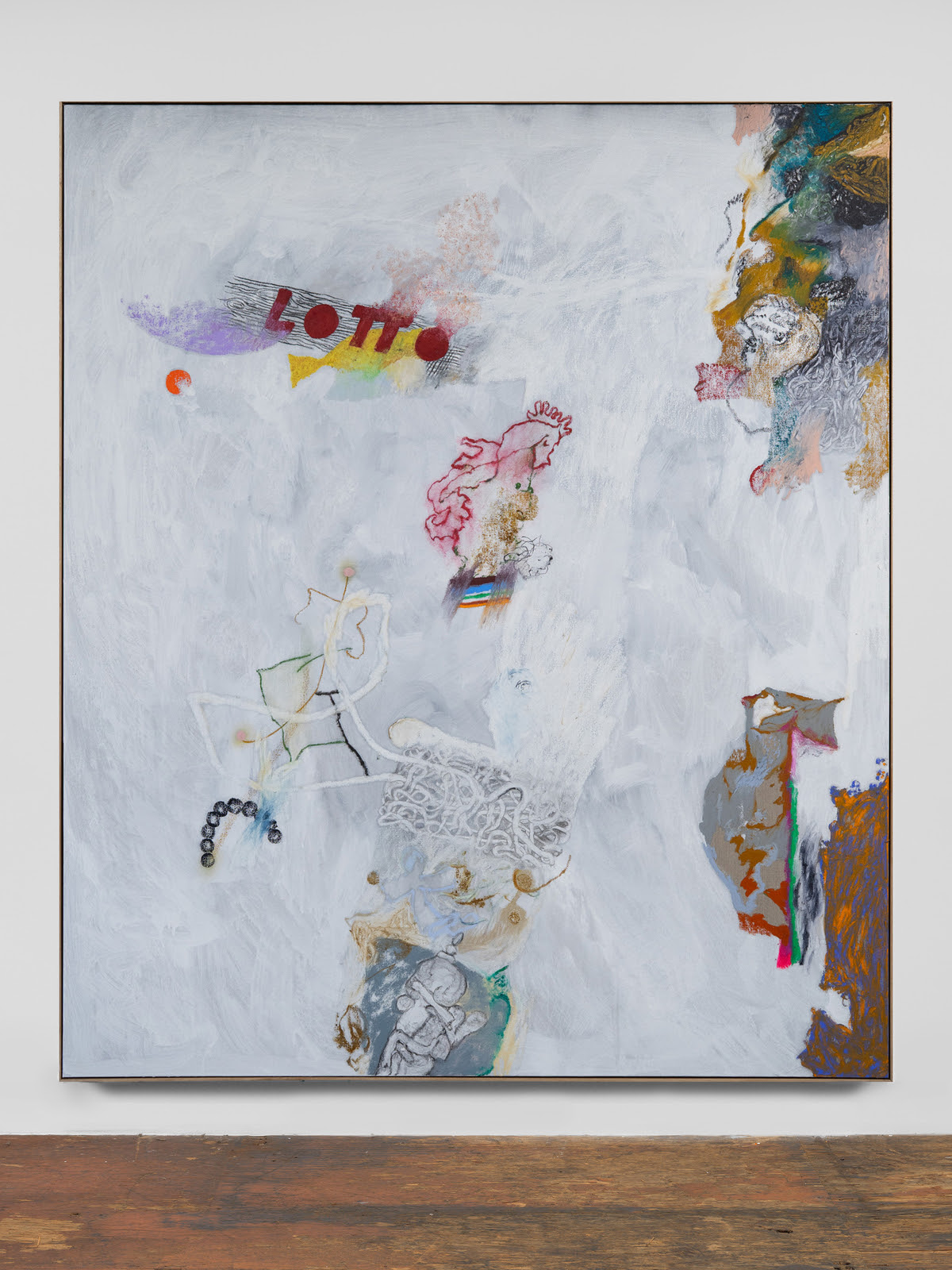
In some of Poons’ recent work, the oversized scale in its insolent enormity testifies to an uncapped vision of engagement. An ode is being written that has no constraints other than to finalize some story in all of its intricacies and detours.
They are sagas, inviting intimate absorption and prayer-like introspection from the viewer rather than fomenting surprise at their proclamatory dimensions. In one patch a colony of tightly wound brushstrokes may act as capillaries in an expanding organism that is then coupled with a cartoon explosion next to a snapshot of the lushest foliage. “By any means necessary” has leached its way into the global creative consciousness.
As de Kooning, in brotherly support, said to Guston after the disastrous 1970 Marlborough opening, “it’s about freedom.”
When Rauschenberg makes a very long work that continues for the length of a gallery, we marvel at the imagination and energy of its engineering. We are looking at the construction of say, a colossal architecture, and in the display of its imagination and cleverness it is very impressive. But the narrative is self-reflexive. It says, “look at what I’ve built." It is commendable in an Ozymandias type way. In Rauschenberg’s efforts, we are gazing at the George Washington Bridge.
With Poons, we are flown elsewhere, trapped beyond time. We are in Yosemite. A different kind of magnificence. Dutifully generous in the charity of a complete accounting. The plastic verities, breathing, encased in his paintings, hum. There is sound. It says, “look at what the paint did.” There is rhythm in Poons’ paintings which one could swear was audible. Confronting his paintings recalls Ira Gitler’s calling John Coltrane’s work, “sheets of sound." When Poons’ majestic, extended works go on for impossible lengths, we trample through marsh, gaze at trees and sky, get marinated in the colors of grass and sunsets and can revisit, and sidle up to the offering, selecting perennial locations of excitement and relaxation. An endless mountain ballad with endless verses. So rich. Only the work remains to tell the truth of the hero’s journey. The paint’s story. The story.
In Rauschenberg, there is a collective sigh of admiration for the labor’s non-stop shiny hysteria. It is declarative. This is true. In Poons, there is attestation, shot directly to the personal, of victory over reluctance for lifetime use as keepsake inspiration. It is cherishable counsel. We are grateful and remember the example of the painting’s encouragement long after we have gotten over the immediate goosebump of sighting Rauschenberg’s JFK-Dada juggles.
When we read the Odyssey we think Odysseus. We are engaged in story, we don’t think Homer. Poons absents himself – we engage. Only an aroma of his visual articulation, his egalitarian care, his sophistication in assessing moments, wafts to us. He is an artist of abject humility.
“John Cage (...) once told me, ‘When you start working everybody is in your studio – the past, your friends, enemies, the art world, and above all, your own ideas – all are there. But as you continue painting, they start leaving, one by one, and you are left completely alone. Then, if you are lucky, even you leave.”
—Philip Guston
Poons early on, unnoticed by critics, who saw him tied to Greenbergian pronouncements, fled the corral of structural obeisance. The rest of that Color Field cohort was art-school-trained and to varying degrees were annealed to repeating tenets of Western art making. This caused most of them to wrap themselves in name-badge mannerisms which verified their fealty to what a painting should offer to be aesthetically viable. Even Olitski’s most ambitious works consider, however lightly, the paint’s relationship to the edges of the stretcher.
Meyer Schapiro, in his analysis of Cezanne, makes the distinction between object matter and subject matter. Olitski’s reversion towards his younger Tachiste affections deny him entrance to a transformed narrative having him present the acrylic gook as object rather than subject. I refer back to Walter Benjamin on this one. We all knew that Jules’ great spray paintings looked like luscious late day skies but Greenberg wouldn’t allow us to say it. It is no surprise that in his last years Olitski painted watercolors of sunset over the sea in atonement for his previous disallowment, his evasion of story.
In this regard, Poons has some things more in common with Pollock in that he is fully aware that the activity on the canvas is the only thing that matters and its relationship to compositional expectations would be enervating rather than supportive of the painting.
Some artists have had to amputate their infected learning to achieve freedom of expression. Georgia O’Keeffe was the monitor of John Vanderpoel’s class in Chicago, making her one of the country’s greatest figurative draughtspersons. It is a training she had to repudiate and a skill she had to abandon to gain access to expression.
But Larry was a musician and composer and like Kandinsky, who was an economist, or Matisse, who was almost a solicitor, didn’t have that hurdle to jump, putting him in a different, more advantageous league than other concurrently positioned painters.
After quitting music studies, Poons also left art school. His contemporaries were dealing with obliging leftover to-do lists, insisting that they include nods and bows to what they were taught art demanded. Knee-jerks from muscle memory. The ruler rapping their young knuckles kept them in tow.
Poons’ approach has a dearth of admonitions or allegiances. This gives him a rare clean slate. Stella told him, “you had something before you met Greenberg. The others didn’t.” Poons has said: “You can throw composition out the window because everything is composed within four right angles... so it leaves color free to do whatever it can do inside there – so you have color making its own composition.”
“If the music is true – the form takes care of itself.”
—Cecil Taylor
Poons’ triumph is his lack of any contrition for his ignorance of these suffocating art school exercises. He implicitly understood the cultural hazing he was avoiding and replaced it with his voracious wonder as to what painting could do. With a desperate, omnivorous appetite, he set on a path whose every stop offered unused choices from a buffet’s potentials of investigation. Ensuring its own sustenance this ravenousness has never been sated. The compensatory salvation of his remarkable visual intelligence buried exposure to those infectious instructional hazards. His strategy purposefully neglected that soured tutoring. The vastness of his encompassing perspectives, annealed to a reckless mastery of technical possibilities, act to mutually bolster themselves. His unheralded sophistication in comprehending a painting’s function is blatant. Poons willfully ignores the charade of gossip as discourse, leaving his contemporaries fiddling with Duncean precepts.
Long ago, his work left an insulted artsy gabfest befuddled, without recourse or agency, to infiltrate his adversarial hideout. Poons said: “painting appeals to our nervous system." How can there be a structured argument against that? Meanwhile, his work has been evaluated by the very system of PhD. dictates from which he has self-exiled. After stating, “It’s all visual, it’s not oral,” one can empathize with Stella’s awe at this feral Alexander slicing the Gordian knot of strangulating art quibble.
Duke Ellington said: “There’s two kinds of music. Good music and the other kind.” Go ahead. Try to put that equation into a lockstep curriculum.
16.
Poons is a guzzler of life on the edge. Mozart thought that this kid Beethoven’s compositions were pedestrian but he was deeply impressed by Beethoven’s improvisational creativity and skill. 1960s-70s abstract painting was big on planning and exhibiting the required proofs of their time, which lacking the blood of a cage fight doesn’t age well. The products of those art-making blueprints sit, yellowed, indexed and dusty on their appropriate recent-history shelf. Rearing the head of a deposed Abex mantra Poons has remarked, “If you can’t improvise, how are you going to compose?”... or... ”If you can’t visualize your goal, then maybe there’s a hope.”
Inhaling Poons’ oxygen filters complacency from invention, convention from adventure. “Isn’t blue as real as a shoe?” he asks. In this mercantile panopticon Poons perseveres unruffled. How do you respond to the obviousness of such a statement?
“In the Tabernacle of Music
We come in, we put on our straps, we take out our horns, we begin to hear our note, we concentrate upon our note, and only when we find ourselves communicating through various musical instruments which will occur simultaneously and in harmony with another sound from another horn do we become aware that there is another’s activity present within our range of hearing. Then we let pure music take over and allow the higher more perfect language of creation to lead us into further avenues of harmony with those around us who do the same passive act of musical execution.”
—Sonny Rollins
In the recent work, hand usage with brushes are not a novelty or technique but an embrace, an eroticism that is chaste and meaningful. Some of these paintings stretch out the unmeasured distance of an interminable Ashbery poem with radiant nuggets at every turn. The interface, the action, shows a loving reciprocity of desire, Poons and the painting witnessing the care for each other, an open display of what will be publicly posted affection. Each painting is an affair of the heart. Egging each other on - the painting is corporeal, reacting to, and receptive of, Poons’ advances. The painting snorts, kicks, acquiesces, protests and concedes. What remains, the detritus of this exchange is a tableau of naked purity. There is a Byronic, mythic self-reliance that emits from Poons’ approach, out of sync with these polluted times, that a society, morphed to a prescribed numbness by over a half century of cynicism, can’t swallow.
“Onward,” says Creeley.