Ended Jun 15
Catalina Ouyang
Trick
May 10 – Jun 15, 2024
More from Catalina Ouyang on Gallop
Lyles & King is pleased to present Trick, a solo exhibition by Catalina Ouyang. This is the artist’s third solo exhibition with the gallery.
Trick comes ferociously, longingly. Ouyang writes, i have never felt guilt, but i have felt the suffering of others. Responsively i shake with my dog's recently removed spleen, severed chords and battle gauze, i feel every scythe in my lung as i try harder and harden to cum.
A worn bed sheet becomes the ground of a large canvas; old lovers’ t-shirts are repurposed into soft pods for a hanging mobile and sewn into a training bra for a papier-mâché child. High heels and animal parts interrupt and erode furniture, perverting assumptions of the built environment. A writhing figure reminiscent of Pompeii’s frozen bodies attacks the industrial support on which it lies and serves as witness to this social restructuring. Artifacts from Ouyang’s life as an artist, laborer, and lover merge with hand-formed objects to constitute the sculptural works in Trick.
In the gallery's outdoor courtyard stands the monumental steel sculpture Brank. It takes the form of a scold’s bridle, an instrument of public humiliation and punishment for speaking out of turn. A spiked bridle-bit was forced into the captive’s mouth so that any attempt to speak would inflict injury. At fifteen feet tall, this sadomasochistic arena shifts the out-of-turn to the turn on where amplification tests the confines of judgment. Brank holds as it haunts, and serves as a stage for performances and readings during the run of the exhibition, reinstating voice in the once-muted space.
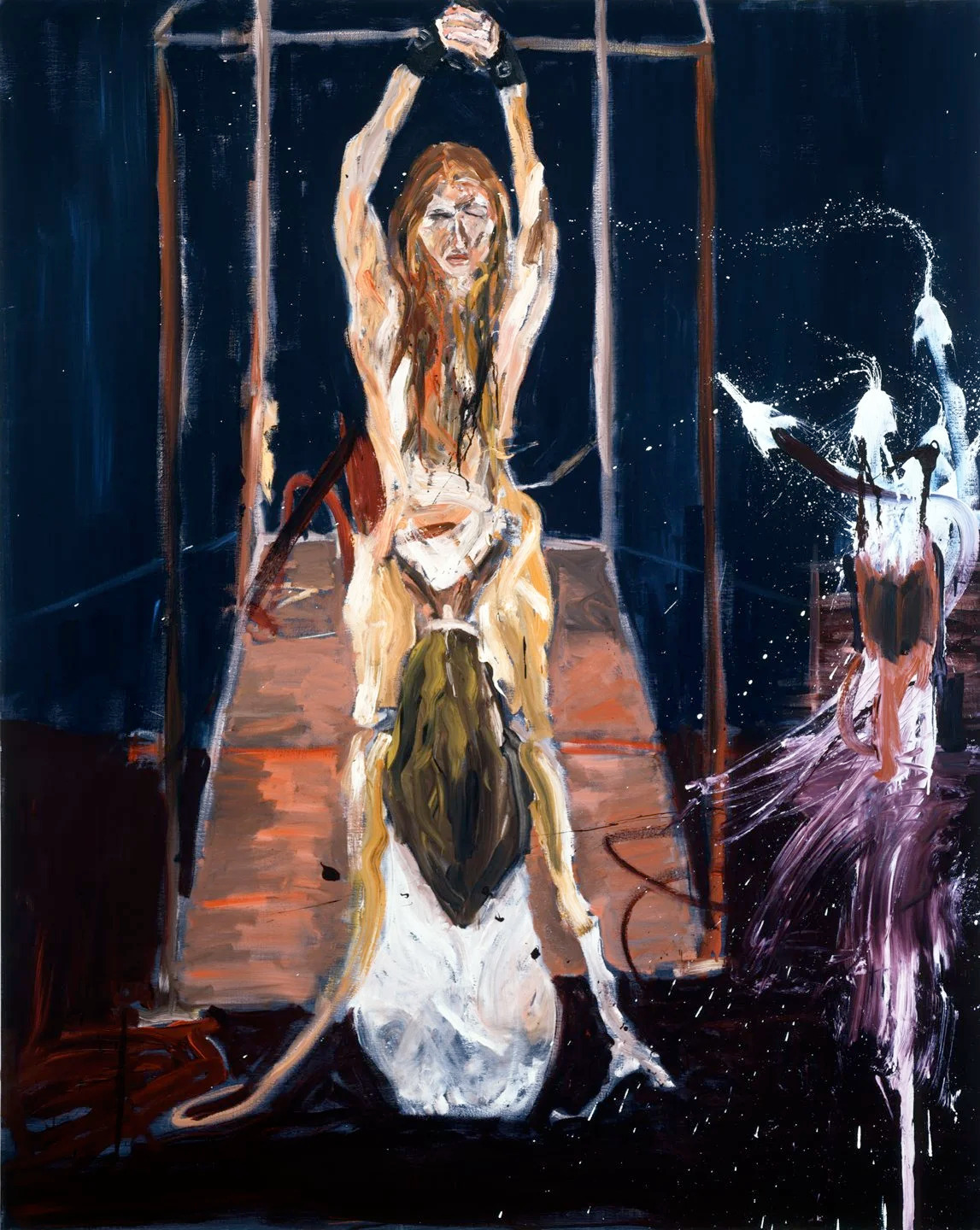
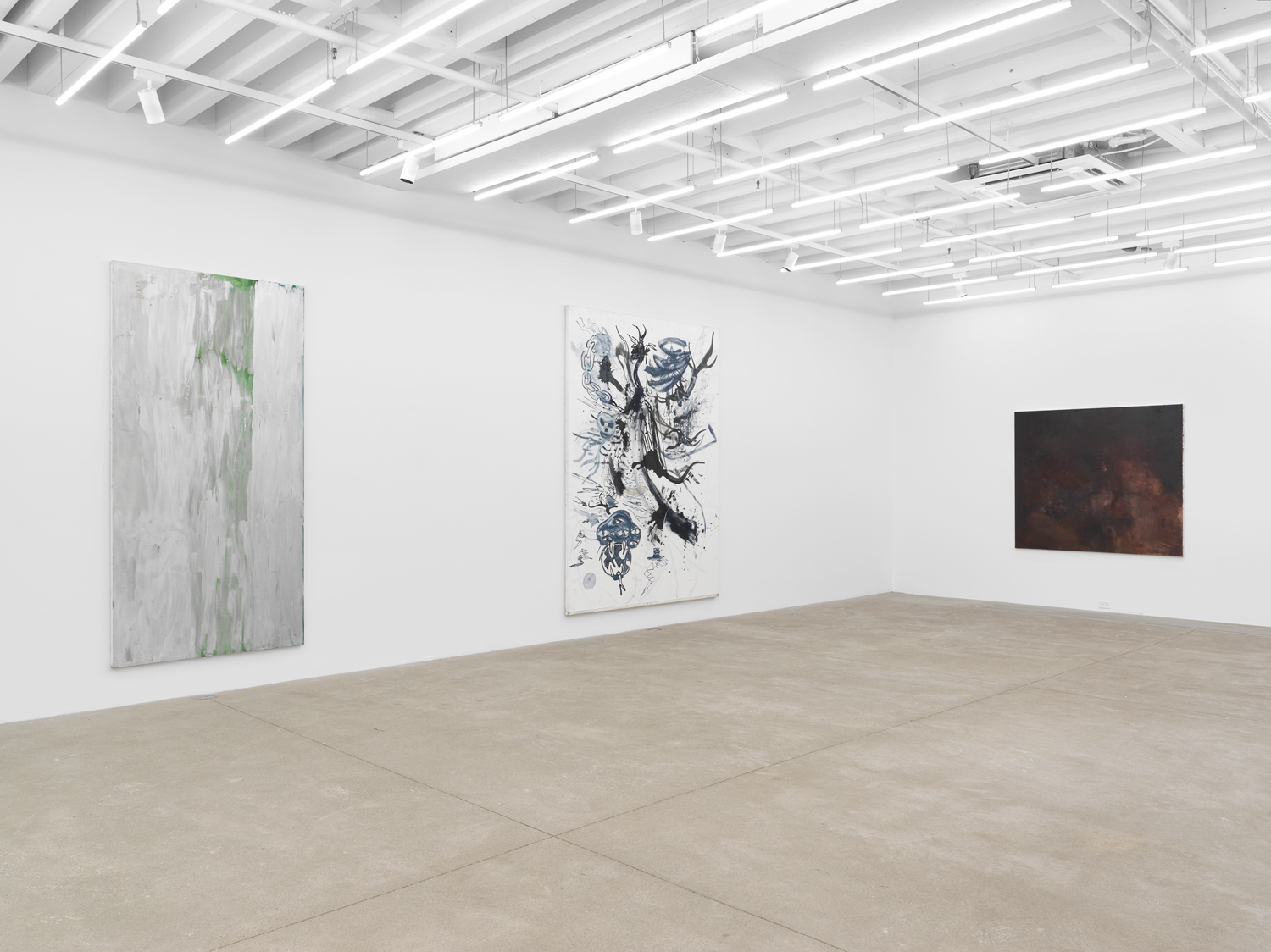
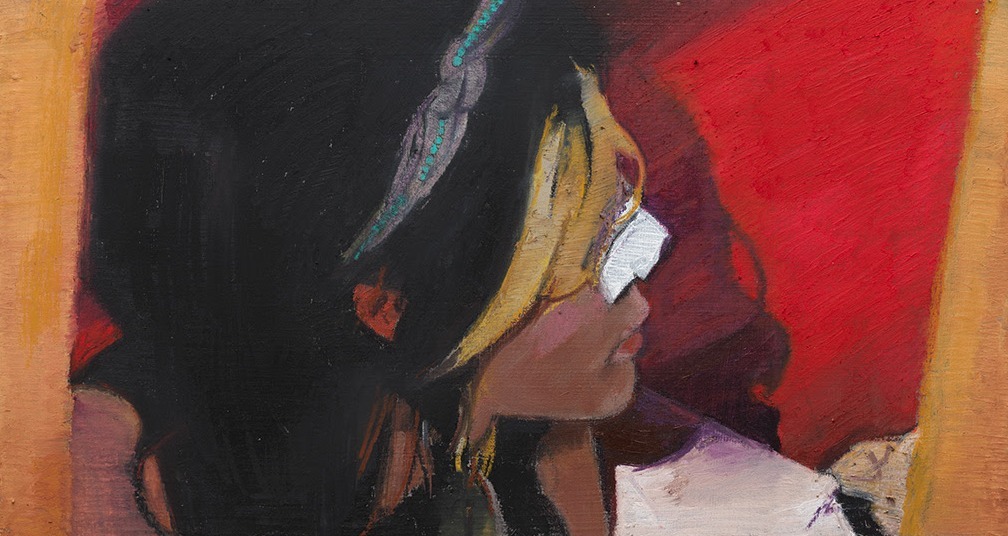
A series of paintings evokes figures that embody seduction and masochism, including close ups of a wooden sculpture of Christ’s foot; two oversized studies of Sarah Bernhardt’s 1880 self portrait as a sphinx; and a figure violated with a pitchfork while she sleeps, based on stills taken from Catherine Breillat’s erotic drama Anatomy of Hell (2004). The renderings, like rotten leftovers, corrode their originary referent. In a recent text message, Ouyang blithely reports: last night i came so hard i threw up in my mouth. In this image i sift through memories—a loose sheen of adolescent bile crusting a countertop at dawn.
A cage-like structure made of metal and wood, eponymously titled Trick, illuminates one corner of the gallery. Large, bone-like forms are carved out of repurposed pine lumber and fitted like puzzle pieces with apple wood and steel parts. Two plywood carts, pitifully motorized, cast light onto a scrim made of the expanded steel grating most often used in flooring. Through repetitive motion, the work circumscribes an inchoate space rife with interruption; i find my body lean into the veiled sequence. Closer to tripping, Trick is neither trap nor enclosure but invites, via the persistent reminders of rhythm, light, and somatic encounter, the act of getting in.
What is a trick? What does it mean to trick? What’s the intersection between the artist and the courtesan? How do they use seduction, cunning, or deception? The artwork and trick share sensibilities; a sexual act, promiscuous girl, a customer, defective, liable to fail. For Sphinx Study (Profile) and Sphinx Study (Rear), Ouyang reprises a long-abandoned painting practice to pay homage to the actor, courtesan, and prolific artist Sarah Bernhardt. Bernhardt, arguably modernity’s first celebrity, sculpted her self-portrait as a bronze inkwell in the shape of a sphinx. In doing so, Bernhardt reimagined her own use value by shaping her likeness as a liquid agent of communication necessarily contingent on reception: to be seen, read, and touched by others. Ouyang notes that Bernhardt gifted several editions of the inkwell to her most loyal benefactors. Like Bernhardt, Ouyang traffics their want, shameless in the demand to be handled, groomed, and drooled on. Ouyang meets Bernhardt’s need with large-scale copies, unapologetically recording their own history of violation, extraction, and full bodied pleasure.
In this collapsed world, counterfeit becomes authentic capital. Ouyang asks, what does it mean to paint images of money, to know your worth, to want more? The coins Ouyang paints are images of silphium, a plant used in ancient Greece as a contraceptive, aphrodisiac, and cure-all aid in revelry. The plant was so coveted that it was enshrined as a local currency; later, the Romans’ prodigious appetites drove the plant into extinction. It makes sense that the end result of any money might take the form of a painting—a newly grafted being, enraptured and unknowing of its own commodity status. Here, silphium returns crusty and desirous for further exchange. Two additional wall works titled Plots present as paintings, made from gauze stretched over animal traps rusted with wounds and stained with pain both real and imagined. Something is being altered beyond recognition. At each new turn i fall farther into begging, and Ouyang asks: Is transformation extinction?
The figures in Ouyang’s work elude taxonomy. Their plasticity is as much about alienation and holes as their longing to be pet and appreciated. Ouyang muses that the dog is the wolf that was raped into deformity and codependence and wisely states that both humility and narcissism are born from aspiration. Like the roughed up wood and bone, Ouyang exerts wanton force upon the materials. Skill exhausts its own capacity, as the artwork or trick continually transgresses limits. Fingers slick with slap hold us firmly in their grasp, forcing the impossible over and over. Perhaps in response to the beautiless thrum of a suburban childhood, the artist desperately works and fails to train a twenty-five-foot drywall log—painstakingly and illogically laminated, layer by layer—along the wrong axis. Inside a mid-century modern display case, the beheaded handles of seven scythes pile together like a nest of snakes; Medusa's hair, ancient harbinger of death, straightens desolately into a tool of agrarian accumulation. In Pitch, the skull of a dog with a perfect human eye, hand-painted by the artist and half hidden by a slice of sow’s bladder, teeters on the rim of a chair-like being. Although i am unsure of the species i want to be, i am sure of my shame in being human.
Ouyang brings us to the edge of skin, want, labor, and love. Here a trap becomes a surface that corrupts value to beg for the right to live and coexist with memory. This charged, lit up love affair is born from the exchange and betrayal inherent in every trick, tic, tickle and turn on. At the end of any given day, the trick is just a job.
—Cara Benedetto
Catalina Ouyang has presented solo exhibitions at Lyles & King, New York; Night Gallery, Los Angeles; Make Room, Los Angeles; No Place Gallery, Columbus; Real Art Ways, Hartford; and Knockdown Center, Queens; among others. Their work has been exhibited in group exhibitions at Nasher Sculpture Center, Dallas; Columbus Museum of Art, Columbus; Aldrich Contemporary Art Museum, Ridgefield; Kimball Art Center, Park City; Institute of Contemporary Art at MECA&D, Portland; Jeffrey Deitch, New York and Los Angeles; James Fuentes, New York; Galerie Kandlhofer, Vienna; Simon Lee Gallery, London and Hong Kong; Micki Meng, San Francisco; and Murmurs, Los Angeles; among others. Ouyang is the recipient of numerous awards and grants including Fountainhead Artist in Residence (2024); Foundwork Artist Prize Short List (2023); Smack Mellon Artist in Residence (2020-21); among others. Their work has been written about in publications including The New York Times, Artforum, Flash Art, Frieze, The Cut, Flaunt Magazine, and Momus. Their work is held in the public collections of Brooklyn Museum, New York; Pérez Art Museum Miami, Miami; High Museum, Atlanta; Cantor Arts Center, Stanford; Kadist Foundation, San Francisco; Nasher Sculpture Center, Dallas, Columbus Museum of Art, Columbus; and Faurschou Foundation, New York. Ouyang received an MFA from Yale University and is based in New York. They are represented by Lyles & King, New York and Night Gallery, Los Angeles.