
Ended
Gian Maria Tosatti
History of Night and Destiny of Comets (Storia della Notte e Destino delle Comete)
Apr 14 – Nov 27, 2022
History of Night and Destiny of Comets (Storia della Notte e Destino delle Comete) is the title of the exhibition project of the Italian Pavilion at the 59th International Art Exhibition - La Biennale di Venezia, promoted by theDirectorate-General for Contemporary Creativity - Ministry of Culture. Curated by Eugenio Viola, the exhibition presents the work of a single artist for the first time in the history of the Italian Pavilion: Gian Maria Tosatti. The curator chose a project that would act as a powerful statement of contemporaneity, capable of restoring a bold reading of the present and giving Italy a unique voice.
«A fascinating exhibition project ranging over different artistic languages and exploring the contradictions of contemporarity, as well as the relationship between man and nature. It will be a Pavilion driven by creativity and innovation» stated Dario Franceschini, Minister of Culture.
«As a former man involved in the film industry, I would have liked to produce a film called History of Night and Destiny of Comets. It promises mystery, discovery, and the thrill of an extraordinary journey. Gian Maria Tosatti refers more to theatrical than cinematographic tradition. He knows the importance of the narrative, which will be the raw material of the Italian Pavilion. He also knows the importance of the "continuous forum", a formula that the entire Biennale (in the sense of all the arts it represents) wants to make more and more use of, to redeem the creative action from the transience of a limited time to the duration of its exhibition in the show.» Thus Roberto Cicutto, President of La Biennale di Venezia.
«It is with great conviction that we have welcomed Eugenio Viola's project, which sees Gian Maria Tosatti as the only artist in the Italian Pavilion at the Biennale Arte 2022,» says Onofrio Cutaia, Director-General for Contemporary Creativity of the Minister of Culture and Commissioner of the Italian Pavilion. « It is an ambitious, immersive project that deals in an original way with the relationship between man and nature, between sustainable development and the territory, metaphorically interpreting the Italian industrial dream. »
Eugenio Viola explains, «There are many points of contact between my curatorial research and the artistic investigation of Gian Maria Tosatti. For both, our work consists first and foremost in dialectically engaging with the cracks and contradictions of the present, that is, in assuming a critical responsibility towards our uncertain historical present. For both, a project must necessarily express an ethical-political tension, conceived as a distinct visual essay that is part of a broader narrative built through images in constant evolution. Story of Night and Destiny of Comets is, for both of us, the most important chapter of this narrative so far, in which our stories intertwine and confront each other once again. »
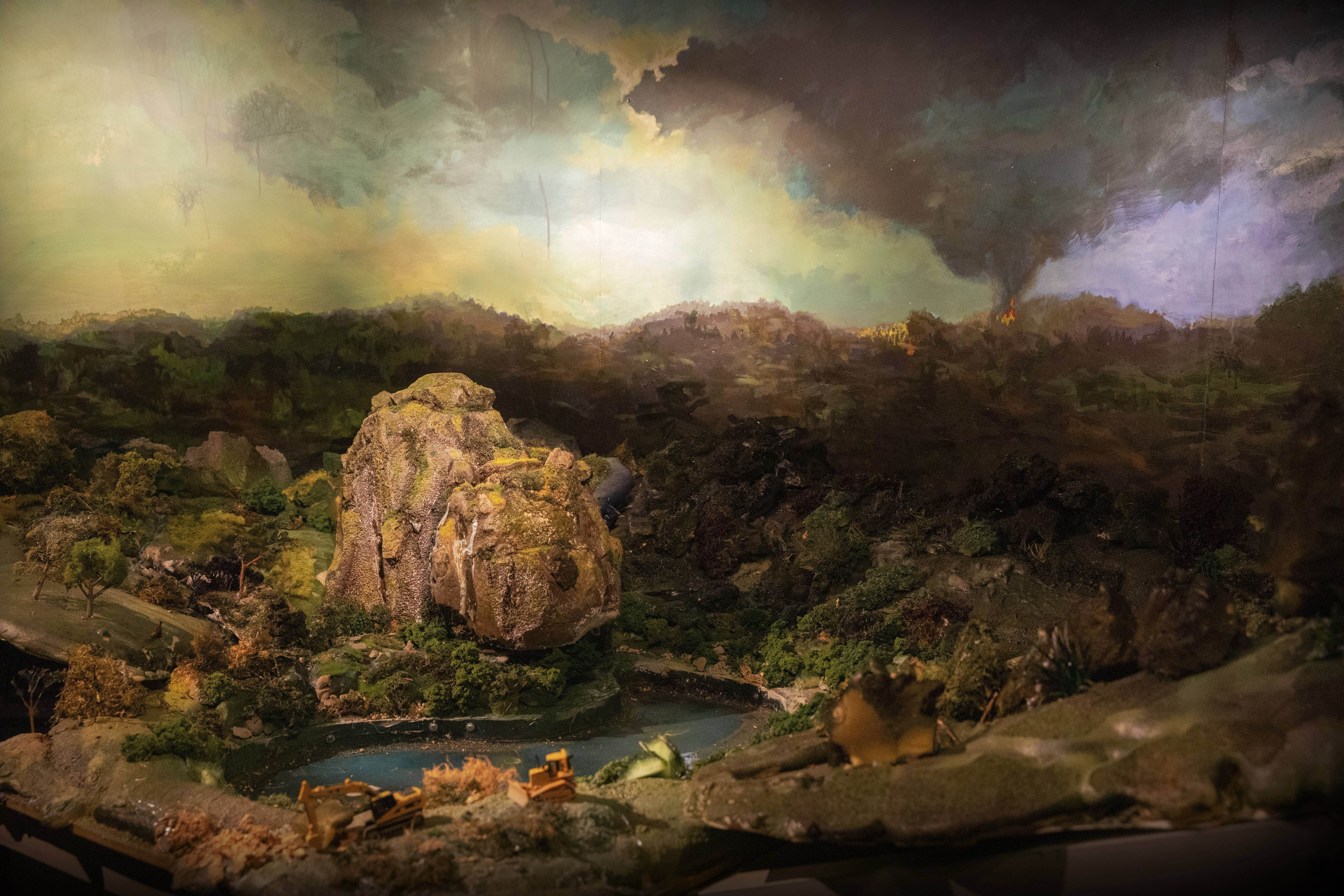
History of Night and Destiny of Comets is conceived as a vast environmental site- specific installation that occupies the whole space of the Tese delle Vergini. It proposes a vision of the current state of humanity and its future prospects. The work is conceived as an intermediary device that contains and mixes a variety of languages, as usual in Tosatti's research, which integrates literary references and visual art, with stimuli from theatre, music, and performance. A complex, experiential narrative machine that leads the visitor along a sensitive, sometimes familiar and sometimes unsettling path, with the aim of creating a new awareness and concrete reflections on the possible destiny of human civilisation, which fluctuates between the dreams and errors of the past and the promises of a future that has yet to be written in part.
History of Night and Destiny of Comets tells of the difficult balance between man and nature, between sustainable development and territory, between ethics and profit, proposing an aesthetic reading of this scenario and offering an unprecedented platform to develop a comprehensive and profound debate on these issues. The exhibition is envisioned according to a theatrical ratio that articulates the narrative into a prologue and two acts: History of Night and Destiny of Comets.
Italy, with its particular historical background as a young nation recovering from two world wars and affected by an extraordinary economic growth, the so-called "Italian miracle", provides the scenario for this exhibition. The space of the first room is a journey into the ‘Bel Paese’ and coincides with the Story of Night or rather the symbolic story of the rise and fall of the Italian industrial dream. A sequence of disturbing scenarios prepares for a final vision in which the imagination is overturned in a true epiphany.
A series of different scenario recall La Dismissione (The Dismissal) by Ermanno Rea (Feltrinelli, 2002) and the expanse of warehouses that stretch across the landscape between Ragusa and Cremona, the only paradoxically homogeneous panorama of a hypothetical provincial Italian journey.
The Destiny of Comets is the final vision, which reminds us that indignant nature has not forgiven man since the time of the Flood. Through this image emerges a powerful and unsettling epilogue, an inverted disturbing element, the sign of a possible peace. Therefore the exhibition ends with a message of hope about the destiny awaiting this humanity that, like a comet, has crossed the universe with a great luminous trail.
«I would give the whole of Montedison for a firefly», writes Pier Paolo Pasolini at the end of a famous article "The Vacuum of Power" (Corriere della Sera, 1 February 1975) about an epochal passage told through the metaphor of the disappearance of fireflies, understood as the final and heinous crime of the new fascism: neo-capitalism.
The Italian Pavilion will be a continuous forum throughout the exhibition - in person and online - thanks to a calendar of scientific-informative meetings that will bring together professionals and experts from the eco-ecological field and protagonists from the world of culture on the themes of the exhibition. The conference programme will extend from Venice to the rest of the world, thanks to a number of international institutions that will organise debates on the themes addressed by the Pavilion, real embassies of the History of Night and Destiny of Comets abroad. All the themes dealt with, the ideas generated and the reflections developed will be collected on a website available to anyone wishing to deepen their research into alternative models of life and development. In parallel, an extensive corpus of audiovisual documents of the work will be created, from its creation to its presentation to the public.
History of Night and Destiny of Comets explicitly refers to the United Nations 2030 Agenda for Sustainable Development (signed by 193 member countries in September 2015 UN) by stimulating a public debate about the environment, the urban landscape, and sustainable ecologies. The project touches the whole themes explained in the 17 goals signed by the United Nations, related to the health and education of future generations, the protection of nature, sustainable development in terms of territory and rethinking ethical models of production, consumption and profit.
The Italian pavilion has also been realized thanks to the support of Sanlorenzo and Valentino, the main sponsors of the exhibition. Thanks also to the sponsor Xiaomi and the technical sponsors Bonotto, Folio, Fondazione Morra, Italstage, Laterlite, Marcegaglia and Mosaico Studio. Special thanks also to all the donors whose names appear in the colophon who have made a fundamental contribution to this project.
Commissioner: Onofrio Cutaia, Direzione Generale Creatività Contemporanea, Ministero della Cultura
Curator: Eugenio Viola