
Ended
Joel Shapiro
Oct 28 – Dec 22, 2016
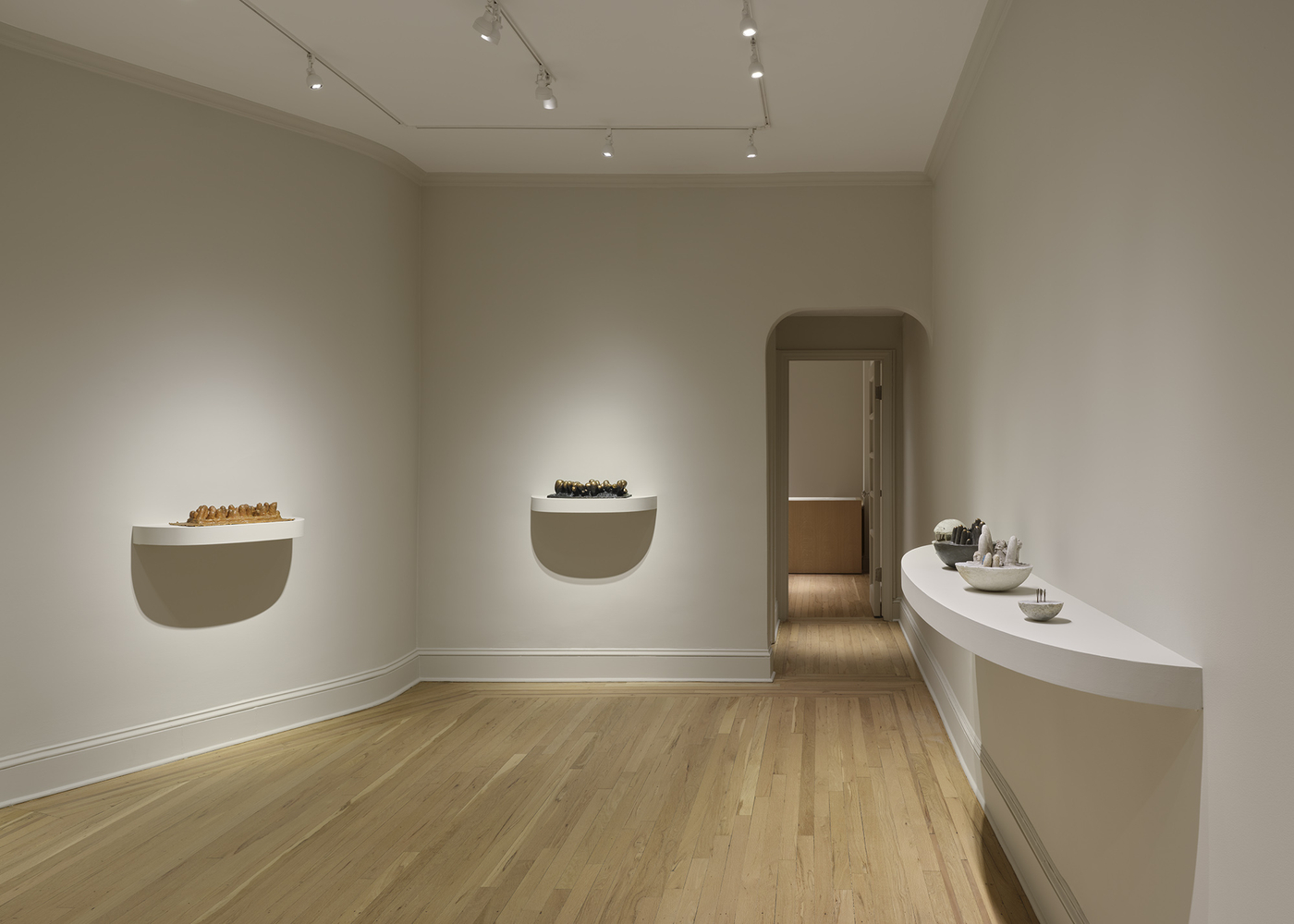
Dominique Lévy is pleased to present the first survey of early wood reliefs by the American sculptor Joel Shapiro, organized with Olivier Renaud-Clément. These works, created between 1978 and 1980, will be on view alongside a new site- specific installation. The exhibition will foreground work from the late 1970s, demonstrating the trajectory of Shapiro’s career, over the course of which the artist has continually pursued ideas of color and mass, culminating in a recent body of room-size sculptural installations. Dominique Lévy will publish a monograph in conjunction with the exhibition featuring texts by David Raskin and Phyllida Barlow and poems by Peter Cole and Ange Mlinko, as well as full documentation of the wood reliefs. This marks the first time the series will be comprehensively surveyed.
Shapiro has worked with the idea of form collapsing since 2002; he views his work until this point as building up to this “moment of discovery that I can get the work off the floor and be more playful in the air.” [1] He describes these large-scale installations as being “the projection of thought into space without the constraint of architecture.” Shapiro will create a new site-specific installation for the exhibition, which will occupy the second floor of Dominique Lévy Gallery. This sculpture is part of this recent body of work concerned with the articulation of form in architectural space; the artist suspends painted wood elements in air by means of fishing line connecting them to the gallery floors and ceiling. To create these installations, Shapiro cuts wood elements and paints them with hypersaturated dry pigment in casein emulsion. The composition formed in space appears pregnant with motion: the string is pulled taut, hence creating a sense of “torque and twist... So it feels like it’s going to rip away.” Shapiro has spoken of these installations as being “expansive” and “joyful” in their refusal to be “limited by architecture and by the ground and the wall and right angles.” [2] Decisions regarding the configuration of the wooden elements and their coloration will be made intuitively and spontaneously as Shapiro is installing the work; thus, this new installation presents an intense engagement with the gallery space, implicating both architecture and viewer’s bodies in the work. Of this, Shapiro notes, “In a piece like this, as you walk through it, it reconfigures, which is some
essential aspect of sculpture.... It unfolds in time and space.” [3]
Shapiro’s early work, including the wood reliefs on view at Dominique Lévy, was created in part as a response to Minimalism’s “specific objects,” wherein color, texture, weight, shape, and the dynamic relationship between object and space are prioritized. However, Shapiro’s reliefs, like his iconic bronze and plaster floor sculptures, also on view in the exhibition, question Minimalism’s insistence on non- referentiality, introducing again into the art object ambiguous states of psychological and affectual intensity. Against outright representation, in Shapiro’s work, the referential quality is never explicit: the sculptures appear simultaneously abstract and figurative. Of this, Shapiro has said, “My problem was to describe an emotional state, my own longing or desire... The work is about my experience, and if you care to
participate, to look, then you bring your own history to the situation.” [4]
In the reliefs, traces of the artist’s hand interrupt the neutral geometric vocabulary of Minimalism. The sculptures are made of simple shapes and angular cutouts, built up in stratified layers of distinct wood elements. This mode of fabrication, coupled with unconcealed saw marks, makes Shapiro’s process visible and rewards close viewing. Shapiro often coats the reliefs in a light, uniform coat of color, allowing the underlying wood to remain partially visible. In painting the works a single color, the artist binds the forms together under a cohesive rubric, creating volumetrically dense structures. For Shapiro, painting his sculptures presents several opportunities: It can render a work more abstract, or the resulting smoothness can negate the surface texture of planes. Color affects our perception of structure; while monochromatic works are legible as compact, self-contained forms, multi-colored works appear as complex dimensional stratifications. Color also adds an affectual component: according to the artist, it has “an intrinsic metaphorical quality. It is not only perceptual but can have
cultural connotations as well.” [5]
1 - Joel Shapiro quoted in Richard Shiff, Joel Shapiro: Untitled, Houston, Rice University Art Gallery (2012).
2 - Joel Shapiro interviewed by Michèle Gerber Klein, BOMB Magazine, Fall 2009 (109).
3 - Joel Shapiro quoted in Richard Shiff, Joel Shapiro: Untitled, Houston, Rice University Art Gallery (2012).
4 - Joel Shapiro interviewed by Michèle Gerber Klein, BOMB Magazine, Fall 2009 (109).
5 - Joel Shapiro quoted in Michael Brenson, Joel Shapiro: Sculpture and Drawings, New York: PaceWildenstein (1996), p. 84.