Opens Friday
Amitesh Shrivastava
Backyard
Nov 13, 2026 – Jan 16, 2027
More from Amitesh Shrivastava on Gallop
There are art historical references (James Ensor, Cecily Brown) one might reach for to place painter Amitesh Shrivastava’s work. The artist would not. The canon is not sacrosanct at Shrivastava’s studio in Mumbai. The backyard is.
For Shrivastava the backyard is less a place or a memory than a methodology informed by both. The backyard of Shrivastava’s childhood is in Khairagarh, in central India, where mornings come with cows grazing and thick swarms of insects humming, where dusk casts parents and neighbors in long black silhouette, and where the dark bred fears of the unknown. One yard, and no two hours of it alike. The backyard is where the artist learned as a boy that the personal is a falsehood. Whatever we feel is in direct relationship to those around us, our neighbors. Their participation, their reactions and emotions inform our own. We are a hive mind. There is no clean break between us. And therefore there are no hierarchies. A riot outside the window, something crawling across a foot, a hand at your back: three things at once, how can one decide which experience is primary, which comes first? They are all simultaneous. The backyard is the absence of judgement. It is the cacophonous roar of everything together all at once. And it is this unknowingness that the artist seeks. Painting therefore is not an activity about gaining control. Rather it is about perfecting the art of losing it.
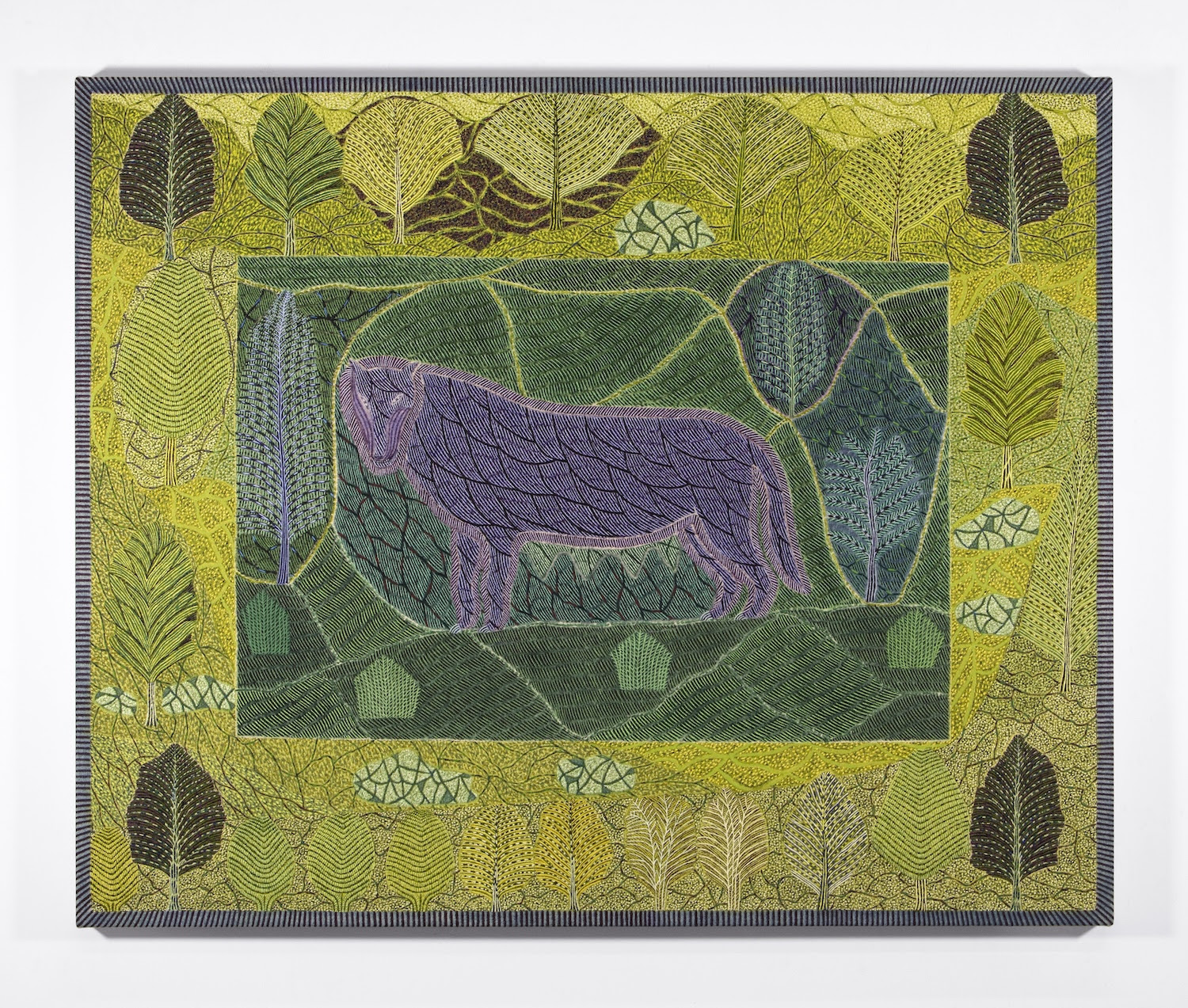
Shrivastava is not, as he puts it, a commander in his own process. And yet he paints nearly every day, often deep into the night. Layers upon layers of release. No research, no poetry, no master to work from. A painting expands until it has reached the intensity he is after. Sometimes another canvas is set beside the first, and if that is not it, another. The decision takes a few hours; the painting then takes thirty or forty days, sometimes demolished and begun again. This is how Shrivastava arrives at his signature diptychs and triptychs, compositions that evoke famous narrative cycles of paintings yet are made completely the opposite way, with no plot and no climax. They don’t prescribe the possibilities they hold.
Each time one looks at Shrivastava’s painting, it seems renewed. An unfamiliar passage emerges that you didn’t notice before. A certain light draws out what previously looked like a splotch and now is a distinct figure. What survives between takes is the fluctuation and the questioning, which Shrivastava will tell you is the most important part of the work. He calls it: surrealistic abstraction. Whatever it is, it only grows in the backyard.
—Kat Herriman
Amitesh Shrivastava (b. 1975, Khairagarh, India) lives and works in Mumbai. Shrivastava is a painter who channels sensory experience through an emotional understanding of his natural and artificial surroundings. The first 24 years of his life are characterized by a persistent immersion in the forests and rural life of the Chhattisgarh region where he was born. Shrivastava embraces the fragmented nature of the past and memory. The artist does not want to illustrate his experiences, his painterly visions come to life through a subconscious unrestrained flow. A state of catharsis, which blends fiction and reality. "When I recall my memory or my nostalgia it appears with a different light, different breeze, different kind of warmth". To recall memory and nostalgia is a way of reinventing it as well.