Ended Mar 19
Victoria Morton
Pedal Point
Feb 12 – Mar 19, 2021
More from Victoria Morton on Gallop
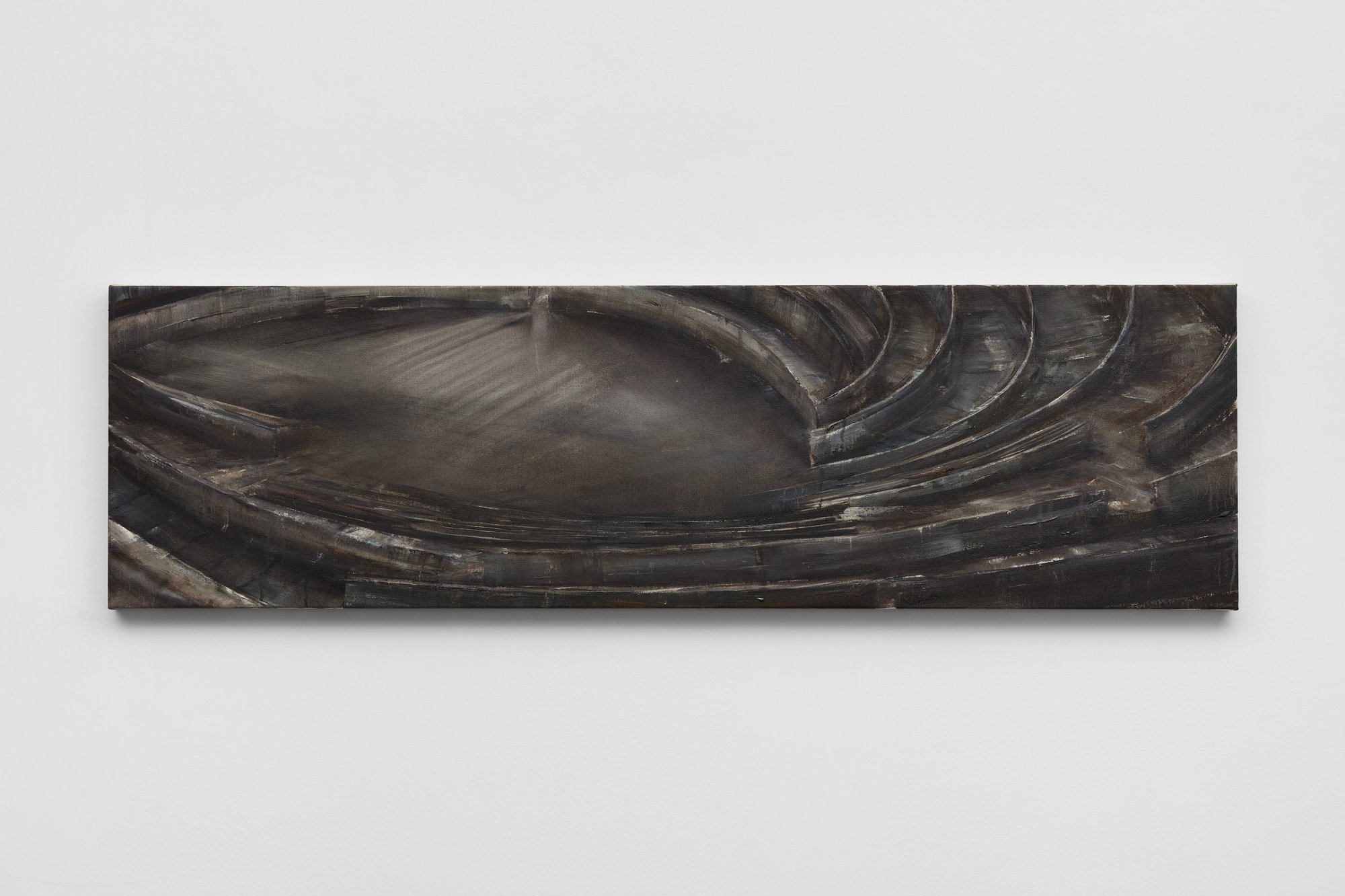
Victoria Morton’s solo exhibition, Pedal Point, comprises a new body of work on canvas in which she distils her multi- layered and analytic approach to painting. Referencing the musical notion of the ‘pedal point’ – a sustained note, during which the harmony and dissonance above it evolve – these recent compositions synthesise rational structure with intuitive expression.
Across large and small-scale formats, the canvasses extend the conscious explorations central to Morton’s physical, performative process, counterbalanced with psychological expression. Through this approach, pictorial planes are mapped and contoured through aggregates of freely formed pools of colour, interwoven with linear structures and accumulations of near-pointillist brushstrokes. Shifting between the fluid and the concrete, these abstracted landscapes teem with kinetic tension and desire, simultaneously conjuring, and eluding, literal interpretation.
In places Morton engages a loosely defined schemata, examining notions of organic form through the material process of painting itself. Developing techniques that evolved in connection with a recent commission by
The Stem Cell Institute in Cambridge, the artist allows pools of oil paint to naturally amass, swell and evaporate across the canvas surface, creating a suspended image parallel to that of a developing photograph. The emergent cellular formations evolve as cosmic landscapes, in which space dilates, shifts, recedes and contracts. Elsewhere improvised ‘automatic’ markings, inspired by musical notations, are reconfigured by networks of diagrammatic or clustered brushstrokes, interpolating the abstract scenery with a spatial rationale of dance-like movement.
Morton consciously references a painting lineage that extends from American action painting, biomorphic abstraction, Russian Constructivism and the geometric De Stijl aesthetic of Mondrian. Morton’s practice extends to textiles, music and sound, and sculptural construction. Last year she completed an environmental installation for the Royal College of Music in London. She therefore specifically identifies with artists for whom historically painting was at the centre of a multidisciplinary practice: Natalia Goncharova, Annie Albers, Paule Vézelay and Popova among them.
Especially striking in this new group of paintings, Morton invites sensory interpretation through colour as potent stimulus. Luminous overlapping hues – jewel-like oranges, violets, pinks, acid greens, and cool blues – evoke the chromatic experimentations of Sonia Delaunay, in which the relationship of colour and form alone channel multiple experiential realities.
Throughout, Morton foregrounds painting as both medium and subject, exploring the potentials for expression through constructed composition and reference points from art history. Central to this process is the discourse between spatial articulation of the canvas and its relation to the body, and subsequently the evocation of sensory narrative. In the large-scale paintings, Morton has perceived the canvas as an expansive field to encompass the human body: both her own, through the act of painting, and the viewer’s, through the act of looking. She has stated that both the ‘movement of the eyes and physical movement are essential’, perceiving the experience of the paintings a kind of ‘mind wandering’.
Victoria Morton (b. 1971, Glasgow, UK) obtained an MFA from Glasgow School of Art (1995), following her BA in Fine Art Painting. Playing with the nature of image construction and the physicality of perception, Morton constructs a “narrative of sensations” in which personal and historical references intersect. Her paintings teeter on the verge of a readable image, while never crystallising into graspable figuration. Accordingly, the works are full of internal thresholds – floating diagonals, fragile gridlines – running between translucent pools and denser blocks of colour. Veils accumulate on the canvas implying recessive space: a windowed interior or a mountainous vista, ambiguous zones inhabited by almost perceptible body parts. Morton lectures in drawing & Painting at Duncan of Jordanstone College of Art in Dundee, UK.