Ended Jun 18
Uwe Wittwer
Im Widerschein – Scherben
Apr 30 – Jun 18, 2016
More from Uwe Wittwer on Gallop
During the Second World War, numerous cultural assets were either displaced or destroyed. Many art treasures remain lost today. Swiss artist Uwe Wittwer takes up this still incomplete chapter of recent history in the framework of his fourth solo show at Galerie Judin, showing around 100 new works.
The series Im Widerschein—Scherben brings together the thematic concerns that have shaped Wittwer’s work over the past 25 years, linking his interrogation of the canon of art history to an interest in fugacity, loss, and the fading of memory. Due to his family history—his father and grandparents lived in Germany before and during the Second World War—there is also an element of autobiography involved. Nonetheless, this is not a nostalgic search for traces, but a study of the power of images and the endurance of standards of art history.
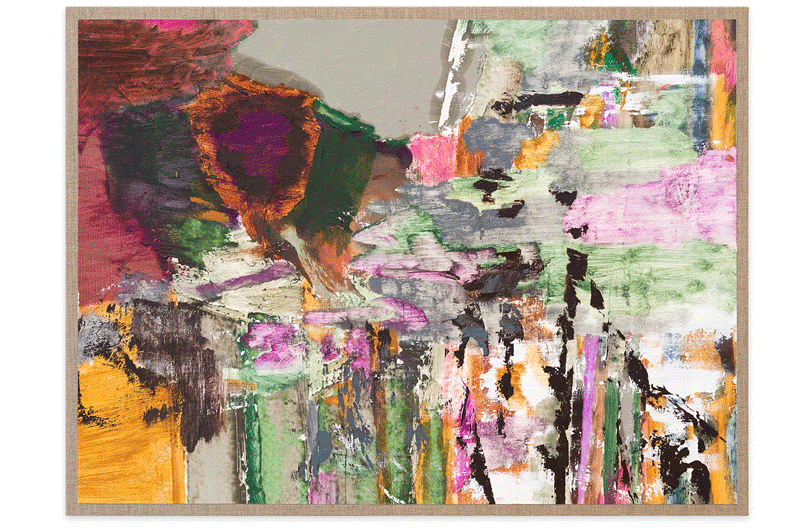
Destroyed, lost, and rescued artworks form the point of departure for these appropriations. The artist thus assembles a whole range of items of European culture that today only exists as memory. Neuschwanstein Castle, which is treated in his oil painting Menetekel, can be considered an emblem of this visual memory. The Nazis stored extensive holdings of their plundered art in this iconic edifice. What was brought together in this location, which Wittwer allows to appear against a dark background, would become a gloomy premonition of Germany’s own cultural losses. Misappropriated art treasures are also reflected in the painting Figurinen negativ, which shows Meissen porcelain figures from a Jewish private collection that were lost after their forced auction. The painting Nike von Samothrake, in contrast, is based on the careful removal of the Louvre’s celebrated marble sculpture, which was lifted out of the museum using ropes and brought to safety. Masterpieces by Nicholas Poussin, which were also saved for subsequent generations, served as the point of departure for the large format oil paintings Bacchanal nach Poussin and Jagd nach Poussin. In a sense, these works form the foundation of this exhibition: with these reflections on art history, Wittwer developed the style of his new series.
The paintings Reiter negativ nach Vivarini and Kleiner Spiegel and the 94 watercolors from the series Im Widerschein are dedicated to the tragic end of a Berlin museum evacuation. They are artistic reflections of the approximately 500 lost paintings from the Kaiser-Friedrich-Museum, a collection that today is on view at Berlin’s Gemäldegalerie and Bode-Museum. In 1941, the museum’s Old Masters were moved from Museum Island to the Flakbunker Friedrichshain, a newly built military complex. In the days after the German capitulation, every trace of the paintings that had remained in the bunker—usually because they were too large to be moved to safety in mineshafts like the rest of the collection—was lost. The holdings, including ten paintings by Rubens and three by Caravaggio, were probably destroyed by fires that broke out in the unguarded bunker. Based on black and white illustrations of this lost museum, Wittwer developed a cycle of watercolors that all use the same colors and compositional effects of de-familiarization. Just as in the artist’s oil paintings, the compositions the works refer to here are varied, over-painted or turned into negatives. In particular, methods of collage are utilized. Wittwer chooses sections of the paintings and combines their various elements. Frequently, elements of the works are simply cut out. By way of interventions such as this, Wittwer’s works reflect the violent excess of the war. In the painting Reiter negativ, based on a photograph that records the arrival of troops on horseback, this artistic scarification is combined with actual wartime destruction. All that attests to the conquered city are the architectural skeletons that remain. And the victors in Wittwer, too, are but spectral shadows of themselves.
With his paintings and watercolors, Wittwer combines the artistic past and present in impressive visual creations. Based on a canon of styles and motifs familiar to us from the pivotal collections of European art, he creates an enduring sense of unsettlement, opening aesthetic and motivic interstices. The artist’s declared goal is to lead the beholder to the space between the familiar and the unfamiliar.