Ended Apr 26
Tae Kim
My Child's Nth Finger
Mar 27 – Apr 26, 2025
Tae Kim (b. 1986) lives and works in Seoul, Korea. In her work, Kim explores online human connection as a deeper relationship than that of the flesh to flesh. Her art is inspired by the imaginations of players met in online battle games and their short mythic episodes. In this way, the resulting artworks investigate emotional experiences as well as mixed culture and history.
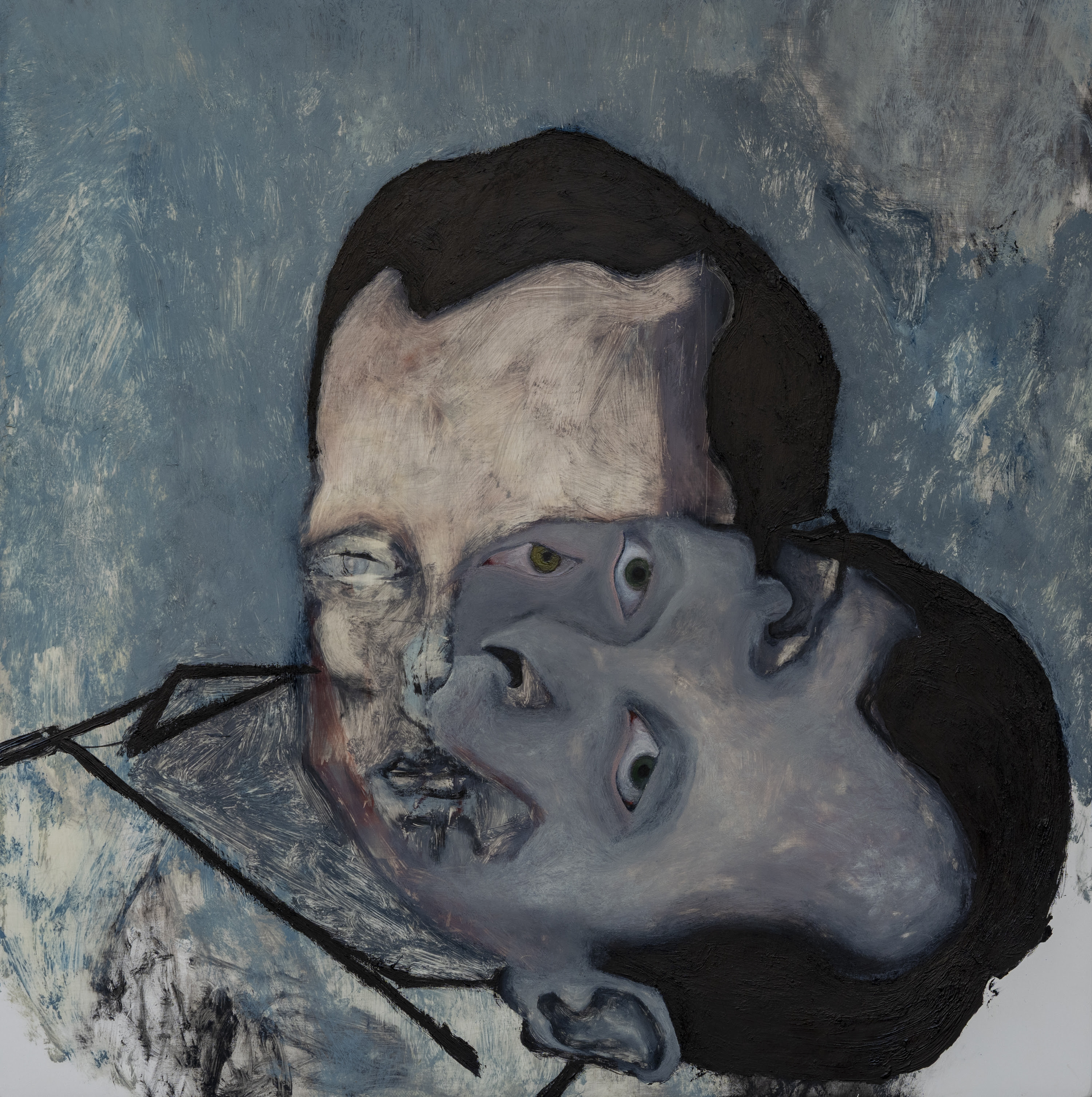
Bearing multiple heads, eyes, and limbs, Tae Kim's willowy, elfin figures appear glitching, caught in a seemingly endless process of transformation that allows them to exist in different forms and states all at once. My Child's Nth Finger, the Korean artist's solo exhibition at Kristin Hjellegjerde Gallery Berlin, expands on her ongoing investigations into hybridity, questioning how we define or quantify humanity in a digital age. As she imagines new and shifting forms of figuration, Kim relates the portrait painting process to giving birth and refers to the characters as her babies. The intimacy and labor of the act of creation is referenced by the show's title which also conveys the idea of an evolving process or an unknowable future, which has the potential to be transformative as well as monstrous.
To create this latest series of paintings Kim not only looked to the aesthetics of online avatars and gaming but also to mythological stories and creatures, specifically the nine-tailed fox that appears in Eastern Asian folklore and is known for its ability to shapeshift. In Dysfunctional Night, the fox appears as the figure's spirit or accomplice, its multifarious body creating a swirl of color and movement, emblematic of a volatile or changeable state. The figure at the center meanwhile appears morphing between various human, animal, and cyborgian forms. Like all of Kim's characters, they are androgynous and translucent-skinned, suggesting an existence beyond the confines of gender and race while the sketched outline of the spinal bone structure retains the idea of human physicality and imperfection or frailty.
This sense of precarity is also evoked through the soft, blushing color tones of the characters' skin as well as their bareness; though we might understand them to be 'adult', they also appear fragile and awkward, like a foal that has been recently born and is still learning the use of its limbs. We see this most clearly in works such as Support and Support-not, where the figures are barely visible against the white-painted silk backgrounds. In Support, the figure's tilted head is held upright by a palm beneath their chin—whether this is their own arm or that of another's is unclear—while in Support-not the figure's supine pose recalls the curves and fleshiness of Renaissance nudes while appearing simultaneously spectral, barely there.
This corporeal and material softness is a recent development in Kim's work that reveals her empathy—or love—for the figures she creates while also reflecting on the ways in which the body itself is becoming increasingly more permeable and fluid. We see this visualized through depictions of melting substances, clouds of smoke, and pools of water as well as through areas of diffusing pigments. In Ninefacedfox-gravity the character appears like an Oceanic deity, caught up in a feathery white spray and dripping an icy-looking liquid, while undulating turquoise trails of incense surround the two-headed figure in Poison Spring.
In Korean culture, incense is associated with the idea of transportation between life and death and is used in memorial services to conjure the spirits of those who have passed. For Kim, it becomes a memento mori, a reminder of her own mortality in contrast to the immortality of her digital persona and her art.
Alongside her paintings, Kim presents a series of paper masks that further explore ideas of intimacy, connection, and possession while also acknowledging the freedom that comes with embracing more fluid approaches to identity and reflecting, on a personal level for Kim, a newfound feeling of creative expansiveness. 'While before I felt as if I were observing and documenting my online experiences and the avatars that I encountered, I am now creating my own stories and leaning into this world of fantasy as a source of endless potential,' she says.
In this way, Kim's work invites us into a realm where transformation is both a necessity and a game, a delicate negotiation between the virtual and the corporeal. Her figures, suspended between states, remind us that identity—like the act of creation itself—is never fixed but always in flux, a continuous unfolding of possibility.