Ended Jan 14
Dineo Seshee Bopape
sa ____ ke lerole, (sa lerole ke ___)
Nov 18, 2016 – Jan 14, 2017
More from Dineo Seshee Bopape on Gallop
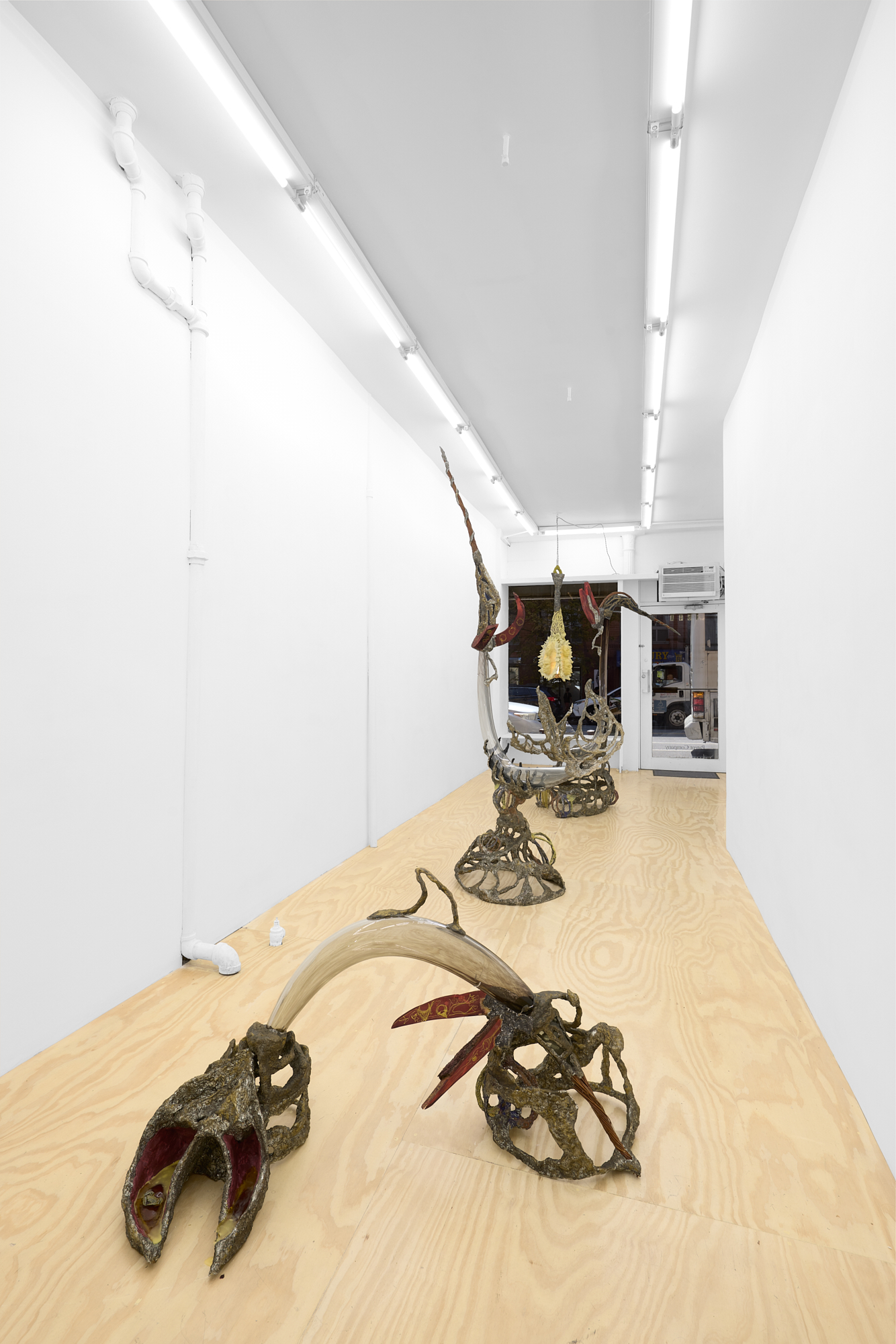
Dineo Seshee Bopape is known for a practice that combines a digital and analog aesthetic, as well as natural and synthetic elements such as plants, wood, mirrors, and video monitors. In sa ____ ke lerole, (sa lerole ke ___) which is partly inspired by her recent project for the 32nd Bienal de São Paulo, Bopape explores the complex sets of relationships and tensions that arise when considering land from the varied perspectives of gender and maternity, history and the politics of place, memory and the metaphysics of self and presence.
In this new commission, uterus forms, soil, clay, charcoal, flowers, herbs, crystals and ash alongside projected images of her hands holding or squeezing lumps of clay, bring forth a range of associations, from the extraction from the earth of minerals and other substances, to the larger topic of the Anthropocene, to what the land signifies beyond its sheer materiality. The idea of sovereignty resonates through references to the self, (female) body and land, and the subject of land ownership, occupation, absence and reclamation.
Bopape sees the land as both a container of memories and histories, and a host for life and death. Her recent work questions what memories are embedded in the land, what ‘presences’ it holds, and how these might be communicated or sensed. Bopape experiments further with these ideas in this commission, using the soil as a conduit for sound to soothe the soil/compressed dust.
Bopape’s frequent use of holes in the soil works is significant, as she views the hole both as a void—a disruption of surface, continuity, and memory—and as a container. Here, there are also formal references to the games Morabaraba and Diketo that make use of rocks and holes, with rocks shifting in and out of holes, depressions and pits. In this respect, Bopape’s working process is not linear, but rather oscillates across a spectrum of concerns. “What is remembered and what is forgotten? What matters and what does not? What is visible and what is invisible?” These concerns are consistent with her approach to matter itself: she describes the clay she works with as something that can be formed into an object, but that can also disintegrate back to dust and a kind of nothingness, echoing the SePedi title which can be translated literally as that which is of ___is dust, (that which is of dust is____).
Curated by Anne Barlow