
Ended
Jay Carrier
Other Side of the River
Jan 9 – Feb 15, 2025
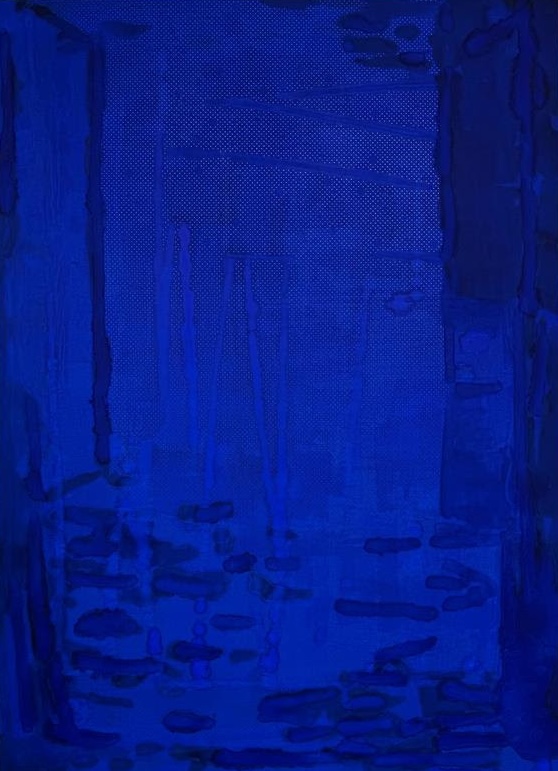
47 Canal is pleased to present Other Side of the River, a solo exhibition of the artist Jay Carrier (Onondaga/Tuscarora Nations, Wolf Clan; b. 1963, Six Nations reservation in Ontario, Canada). Featuring paintings from the mid-2000s onward, Other Side of the River spotlights Carrier's affinities with his hometown of Niagara Falls, New York, where he lives and works. The artist's long trajectory in the Western New York region is encapsulated in his abstract imagery, which captures the colors, landscapes, histories, and indelible aura of the area's natural and urban environs. This is Carrier's first solo exhibition in New York City since 2006, when he showed at the American Indian Community House Gallery, and his work was featured in 47 Canal's 2024 group presentation Summer with Friends and Family, curated by G. Peter Jemison (Seneca, Heron Clan).
The exhibition title Other Side of the River alludes to the Niagara and Grand Rivers. Used to demarcate an official transnational border between the United States of America and Canada, the confluence of the two rivers has long symbolized for the Haudenosaunee people a fluid topographical feature that marks a crossing, rather than a fixed juncture. Born on the Six Nations on the Grand River reserve in Canada, Carrier himself crossed over to Niagara Falls, New York, with his family in early childhood. The bodies of water that feature prominently in the artist's life—the rivers, the waterfalls, the gorge—are omnipresent throughout his oeuvre. In his work, Carrier emphasizes their importance in this once mighty industrial region, and their simultaneous beauty and terror.
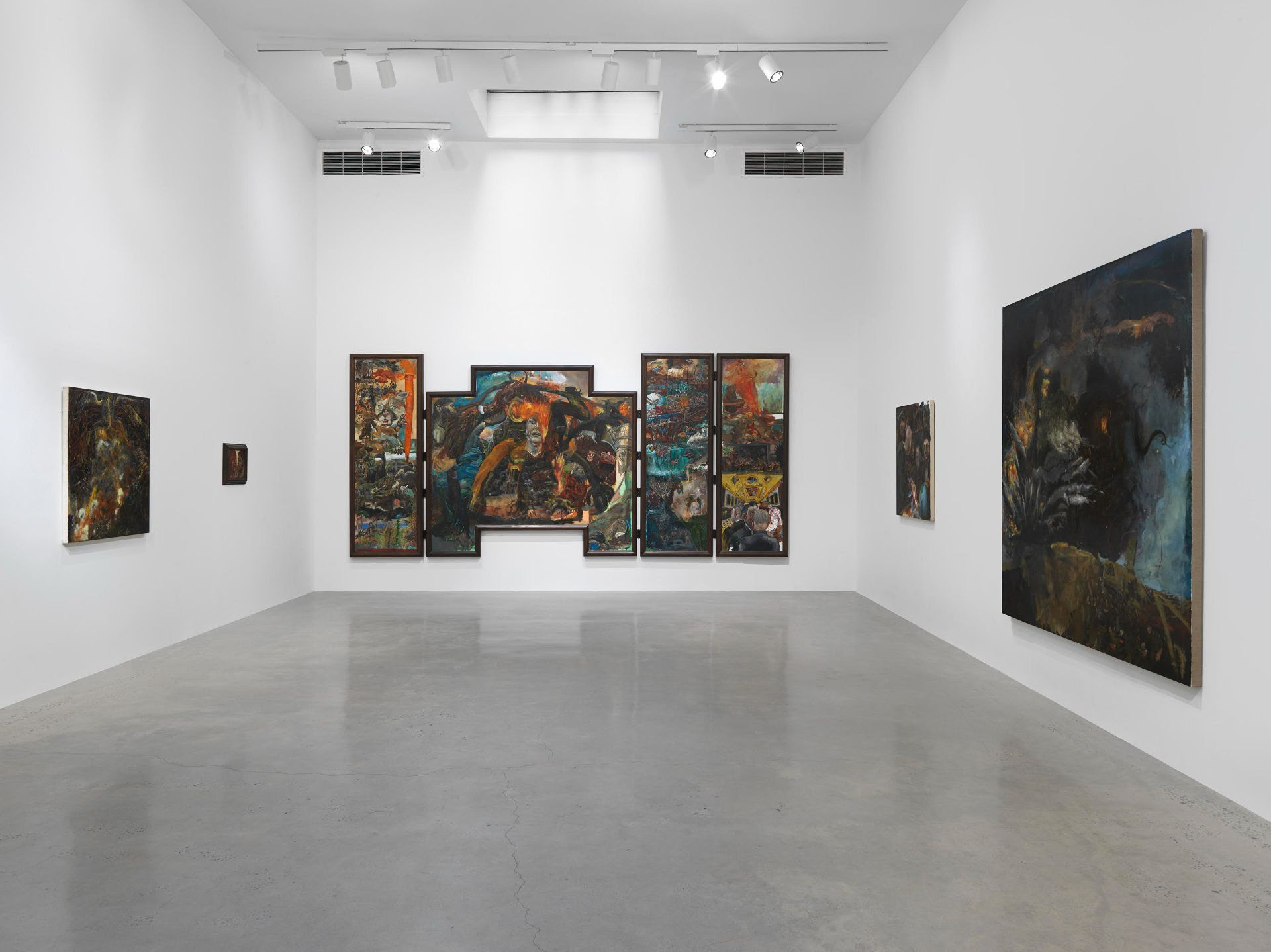
In the new and recent work exhibited in Other Side of the River, Carrier remains dedicated to an abstraction that encompasses cultural, political, emotional, and spiritual concerns alongside stylistic experimentations and whims. Embracing contradictions and complexities, his non-representational modes are syncretic and collagistic. The resulting compositions conjure reflections on contemporary life as a Native American man, as well as the accompanying lore and tragedies of Niagara Falls that have passed over centuries. Carrier incorporates a wide range of media, including organic materials and found objects he has collected from these local sites, into his paintings. Recycled wood panels, corkboard, and chalkboard become supports for his works. Leaves are gathered from the dense forest trails that surround the Falls, where the artist takes morning strolls. Rust and ash speak to the postindustrial area's socioeconomic downturn. Shells, pebbles, and shards of ceramics and debris are trawled from the muddy banks of the Niagara Gorge. Carrier occasionally mixes some materials directly onto his surfaces with acrylic, oil, spray paint, pencil, and chalk, eschewing the specificity of any medium and pictorial hierarchy. For him, abstraction gives way to moments of figuration and inscriptions of text that recontextualize the act of markmaking. Out of respect for matrilineal longhouse traditions of the Haudenosaunee, in his paintings Carrier elides specific details and weaves in others to capture a sense of the spiritual transformation that takes place in ceremony—much like what happens in the presentation of artwork.
The tension generated on the surface of Carrier's works further evinces the embodiment of the real, the dreamlike, and the sacred. Two Trees (2008) is an homage to the artist's sister who passed away during delivery before Carrier was born. The two-panel work joins together a multitude of objects. On the right, Carrier mixes white pine needles and birch bark into pigment directly, creating a kind of vigorous explosion that cascades all over the surface; on the left, he places in the center of the panel a stereotypical image of a Native American girl, surrounding her with a broken fishing net and shattered pink tiles, pieces of broken glass bottles, and shells. In this diptych, he honors his sister and her fallen spirit, which Carrier imagines as a constant protective presence in his own life. As in Two Trees, the artist integrates such miscellany in Devil's Hole Mythology (2015), a painting that refers to the Battle of Devil's Hole in 1763, when 300 Seneca warriors fought and killed 81 British soldiers and threw their bodies into the Niagara Gorge. Devil's Hole, once an important portage site for the Seneca people, is a place where Carrier often fishes in the spring and summer months and gathers material for his art. The gravel and debris that he collects is blended into the painting's surface, literally comprising the ground into which figures seemingly emerge and recede.
Part of a new body of work, Undercurrents (2022–23) is a large gestural abstraction that spans across three panels. The paintings in this loose series each possess distinct psychic landscapes, ones in which the artist, the viewer, and community reckon with the ghosts of the past and present. Intuition ultimately drives Carrier's process—an idea that art is an extension and expression of everything else.
Carrier's participation in the local artistic community began in the 1980s, when he worked as a server at the adjoining restaurant of the Native American Center for the Living Arts on the New York side of Niagara Falls, also known as the Turtle for its characteristic architecture that reflects the Haudenosaunee creation myth. The Turtle's dynamic program epitomized a golden age of Indigenous arts production and profound kinship among participants. There, Carrier encountered such luminaries as the actor and musician Gary Dale Farmer (Cayuga), and met artists G. Peter Jemison (Seneca, Heron Clan), Norval Morrisseau (Anishnaabe), Oren Lyons (Onondaga/Seneca), and Duffy Wilson (Tuscarora/Cayuga), among many others. These encounters inspired Carrier to enroll in a program at the College of Santa Fe in New Mexico, which shared the same campus as the Institute of American Indian Arts in Santa Fe, New Mexico. He went on to complete his undergraduate and graduate studies at University of Illinois, Urbana-Champaign, where he befriended Olen Perkins (Akimel O'odham) and further developed his personal philosophy on painting. After returning to Niagara Falls in the 1990s, Carrier maintained his creative practice daily while working full-time at a local chemical plant, a position from which he retired this year.