Ended Jul 26
David Huffman
Children of the Sun
Apr 29 – Jul 26, 2024
More from David Huffman on Gallop
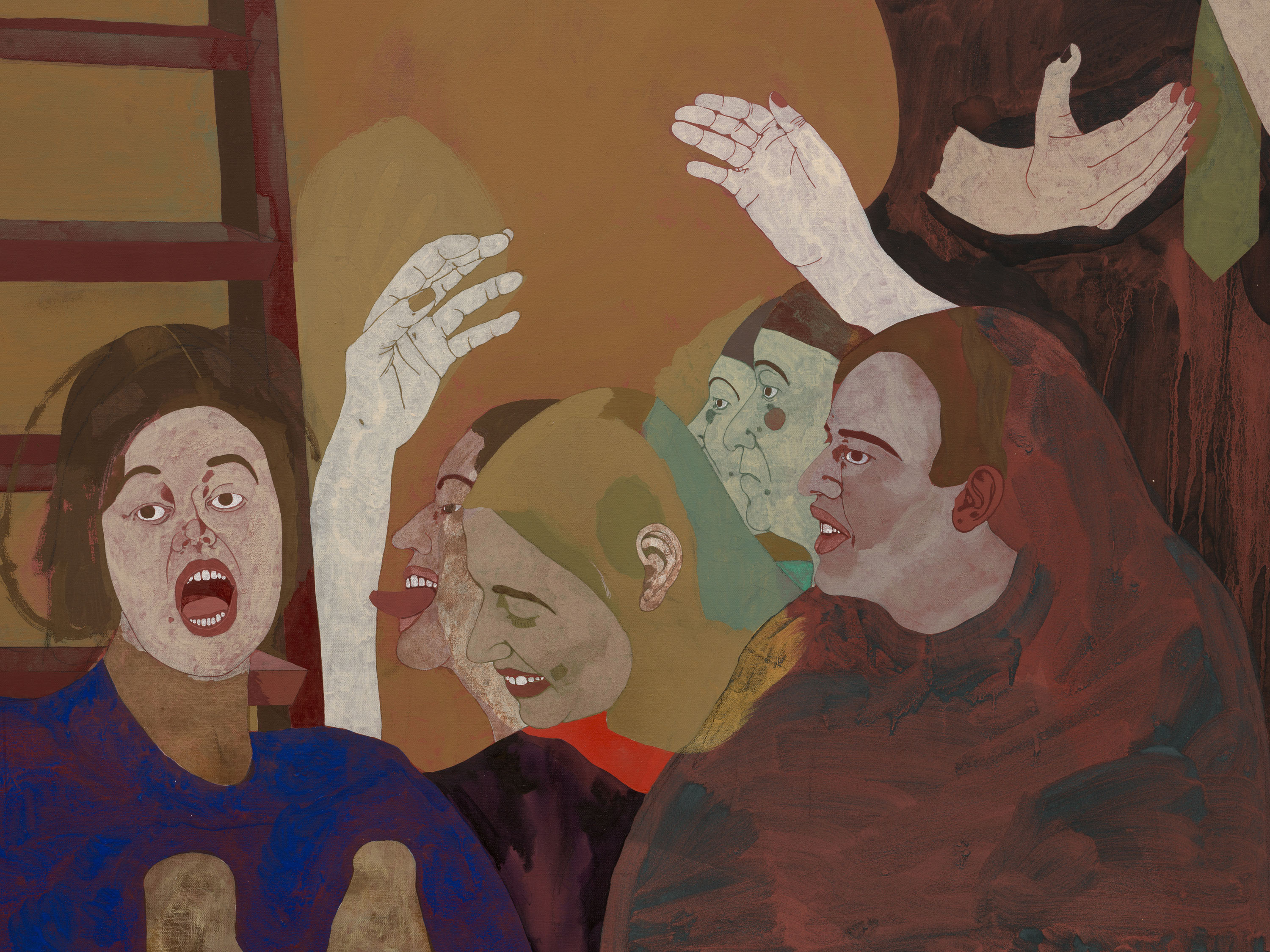
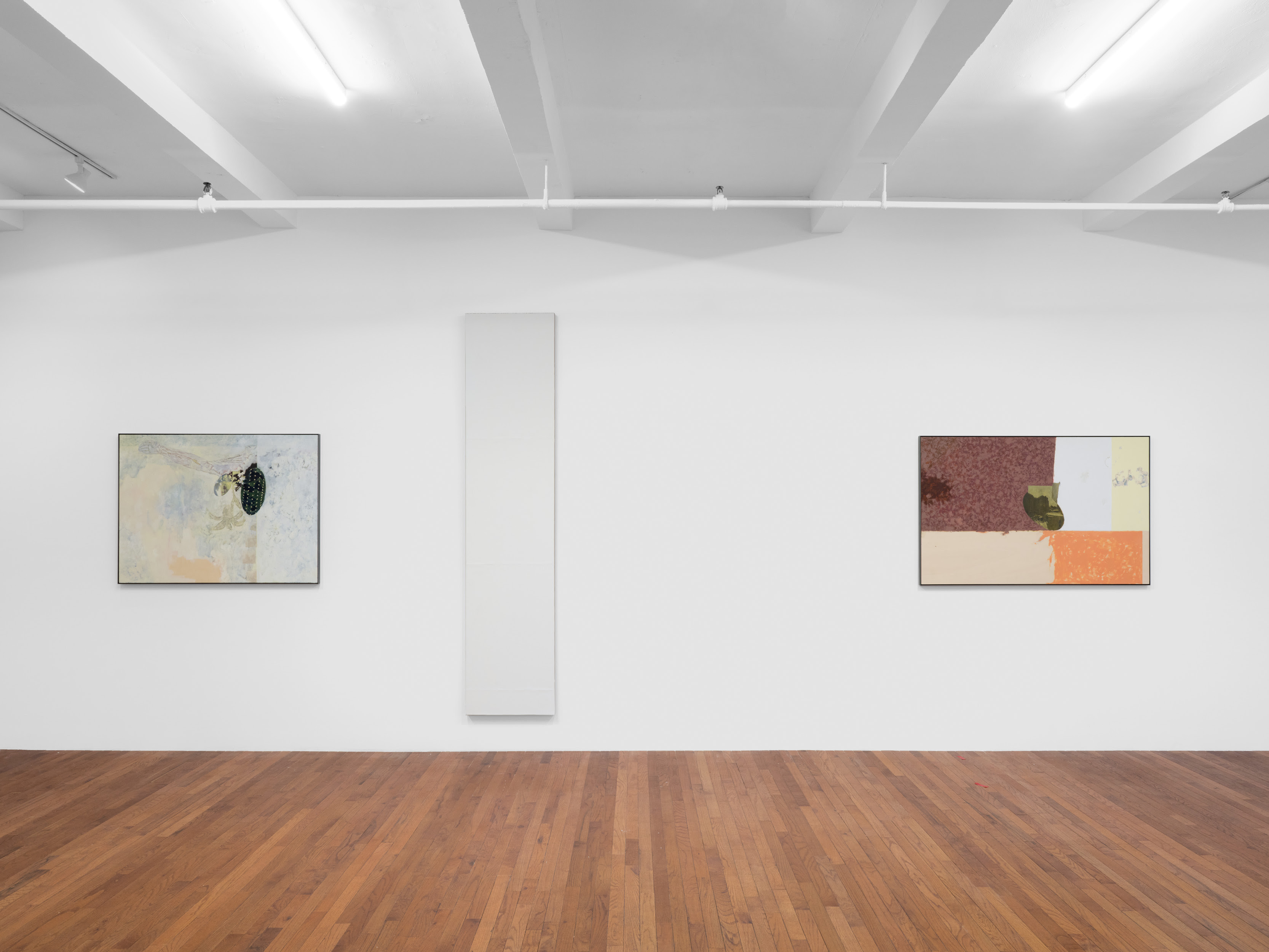
David Huffman’s (b. 1963, Berkeley, CA) inaugural exhibition with Casey Kaplan, Children of the Sun, presents a new group of paintings known as “social abstractions” that combine socio-political themes, personal history, and abstract mark-making. Large-scale, densely layered paintings become sites for the artist’s play— swathes of African textiles, spray-painted basketball nets, loose brushstrokes, and collaged imagery merge as a way of storytelling. Huffman activates these planes with memories of his family’s experience in Berkeley, California at the height of the radical Black Power movement in the 1960s and 1970s, combining material evocative of the quest for self and Black liberation.
Huffman found himself at the epicenter of revolution at a young age in the charged Berkeley environment. Swelled by the birth of hippie culture, the Black Power movement, and the Space Race, Huffman, by the age of five, experienced most of what would later inform his life and work. His mother, Dolores Davis, was at the crux of his upbringing, exposing him to the machinations of the Black Panther Party, ultimately designing the iconic "Free Huey [Newton]" flag and the crawling panther in the party's logo in 1968. Inextricably bound by meaning and form, Huffman’s works integrate his mother’s illustrations, serving as symbols of his childhood and a future his community collectively longed for. At the center of Eucalyptus (2024), Huffman collages a photograph of Bobby Seale, the co-founder of the Black Panthers, embracing him and his brother at Berkeley’s Provo Park festival. They are positioned at the base of a painted tree, miniature, but focal— the two young boys stand next to a stoic Seale, their trio laden with the heft of the past, present, and future. Within Huffman’s swirls of activity and gesture, they are engulfed by the material remnants of a long-served memory.
Three eight-foot panel paintings anchor Children of the Sun— their monumental scale juxtapose smaller format works, each combining imagery and diverse material steeped in personal narrative. With weighted balance, Huffman’s material decisions imply equity in form and content: African fabrics are layered against hard-edge abstract lines and expressionist brushstrokes, while spray-painted sections of basketball netting overlay floral patterns and structured, high frequency stamped words. The abstraction of these elements, along with glittered text like “mental health,” “homeless,” and “payday loans" act as social agents— they are significant to the Black experience and serve as motivators for societal change.
In his most recent series, Huffman updates his palette— floral patterns and pastel hues recall a sense of awakening. Rebirth, bloom, and a return to nature are at the forefront; specifically, Huffman accentuates the symbiotic relationship between children and nature, perpetually young, free, and full of hope. The multi-racial children of the “New Frontier” (a promise for domestic social reform by John F. Kennedy in 1960) are Huffman’s “Children of the Sun”: together they are reflected by the vibrant color and synergy of Huffman’s expression. Within the residue of his memory, Huffman recalls the rare breaking of cultural bounds, where for a moment in his childhood, there was reciprocity between racial, social, and economic status. If the seeds of change stem from the place cultures collide, Huffman aims to find this elusive middle ground.
The fecundity of nature is balanced by a celestial world that spans planetary orbs and moons, reflecting the expanse of the universe and the search for the supernatural. Huffman integrates a sphinx head across multiple paintings and merges the profile of his mother as a nod to her commitment to Egyptian mysticism and psychic teachings. These spiritual inclinations were integrated with the lessons of Sun Ra, Black American writers like Octavia Butler, Jimi Hendrix, and Star Trek, paving the path for Huffman as a progenitor of the visual Afrofuturist movement. Huffman’s translation of this genre into the visual arts introduced a world of fantasy to a community typically rejected from the category until then. His acclaimed series of “traumanauts” from the late 1990s depicted a group of Black astronauts inhabiting surrealist landscapes, collectively in search of an elusive “home.” By expressing notions of Black agency, social and creative freedoms, and activism as a means for Black liberation, Huffman’s abstractions serve as a response to a displaced world in need of repair. As the sphinx head in Huffman’s work gazes up towards the sky, it signals the potential of a brighter future and acts as a reminder for humility within a boundless ecosystem.
David Huffman (b. 1963, Berkeley, CA) lives and works in Oakland, CA. He studied at the New York Studio School and received his MFA at the California College of the Arts & Crafts, San Francisco, where he has taught for over 20 years. Recent solo exhibitions include: Terra Incognita at the Museum of the African Diaspora, San Francisco, CA (2022) and Afro Hippie at the Berkeley Art Center, CA (2021). Huffman has participated in group presentations at the following institutions: the de Young Museum, San Francisco, CA (2023); Berkeley Art Museum & Pacific Film Archive, Berkeley, CA (2023); Everson Museum of Art, Syracuse, NY (2023); San José Museum of Art, CA (2023); San Francisco Museum of Modern Art, CA (2022); the Birmingham Museum of Art, AL (2022); and the Oakland Museum of California, CA (2021). Huffman completed permanent commissions in Oakland and San Francisco at the Chase Center in collaboration with SFMOMA in 2019 and has been the recipient of numerous awards and residencies, including the Eureka Fellowship, Artadia San Francisco, and the Palo Alto Public Arts Commission. Huffman’s work is included in the collections of SFMoMA, San Francisco, CA; LACMA, Los Angeles, CA; Berkeley Art Museum, CA; Studio Museum, Harlem, NY; Minneapolis Institute of Art, MN; Oakland Museum of California; Crocker Art Museum, Sacramento, CA; San José Museum of Art, CA; Palo Alto Art Center, CA; Birmingham Museum of Art, AL; ASU Art Museum, Tempe, AZ; and the Embassy of the United States of America, Dakar, Senegal, among others.