
Exhibition · Off Paradise
Through
Sep 17 – Nov 17
4 images · swipe
About the show
Greg Bogin James Rosenquist Jane Reynolds Maximilian Schubert Kristin Walsh
Off Paradise is pleased to present Through, an exhibition featuring new and historical works by five artists.
“Sometimes ideas come through the window, floating in from somewhere. That sounds like a poetic way of describing it, but I mean it quite literally. For all I know it might be electromagnetic signals or extraterrestrial rays or, as they used to say in the old days, a visit from your muse.”
—James Rosenquist
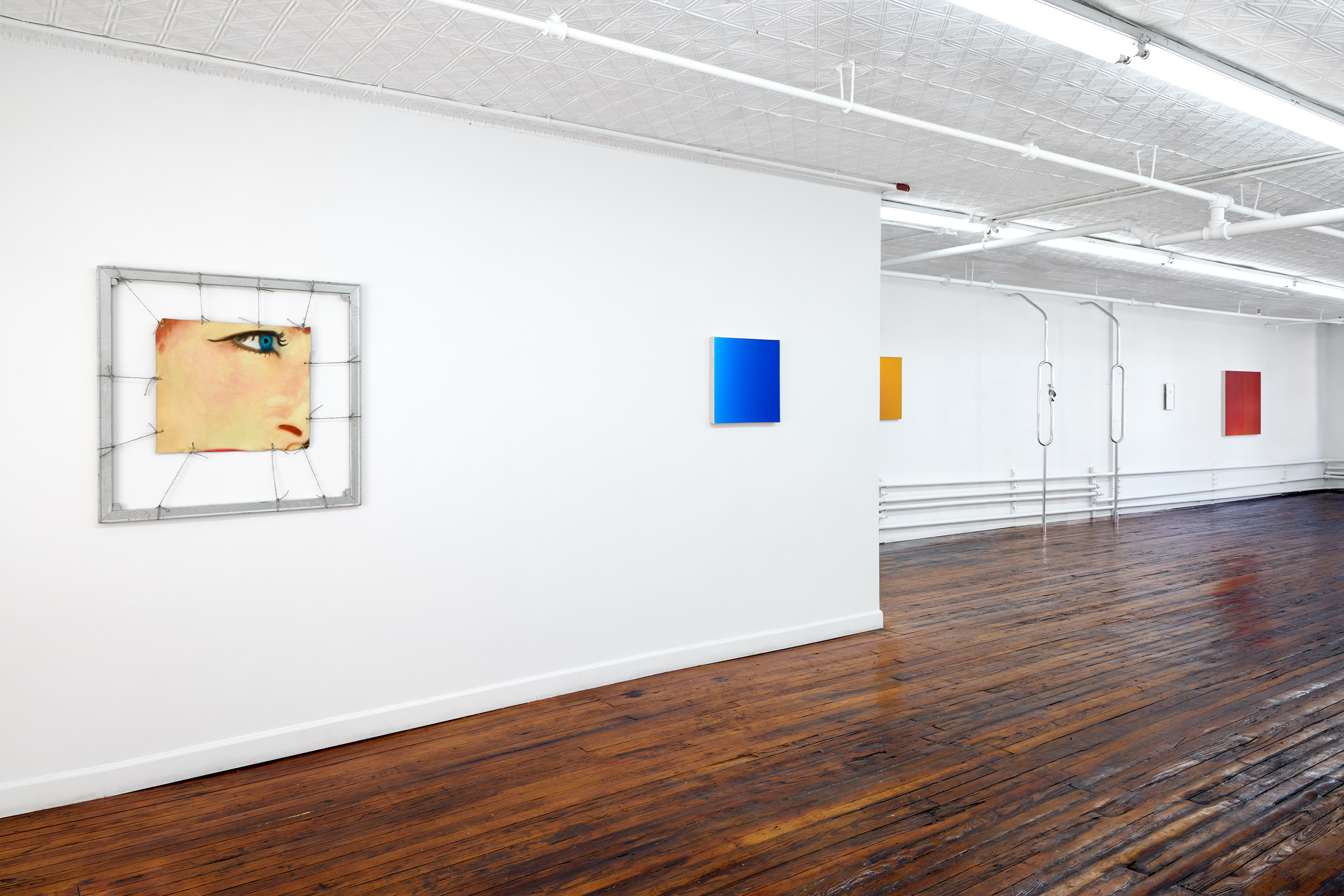
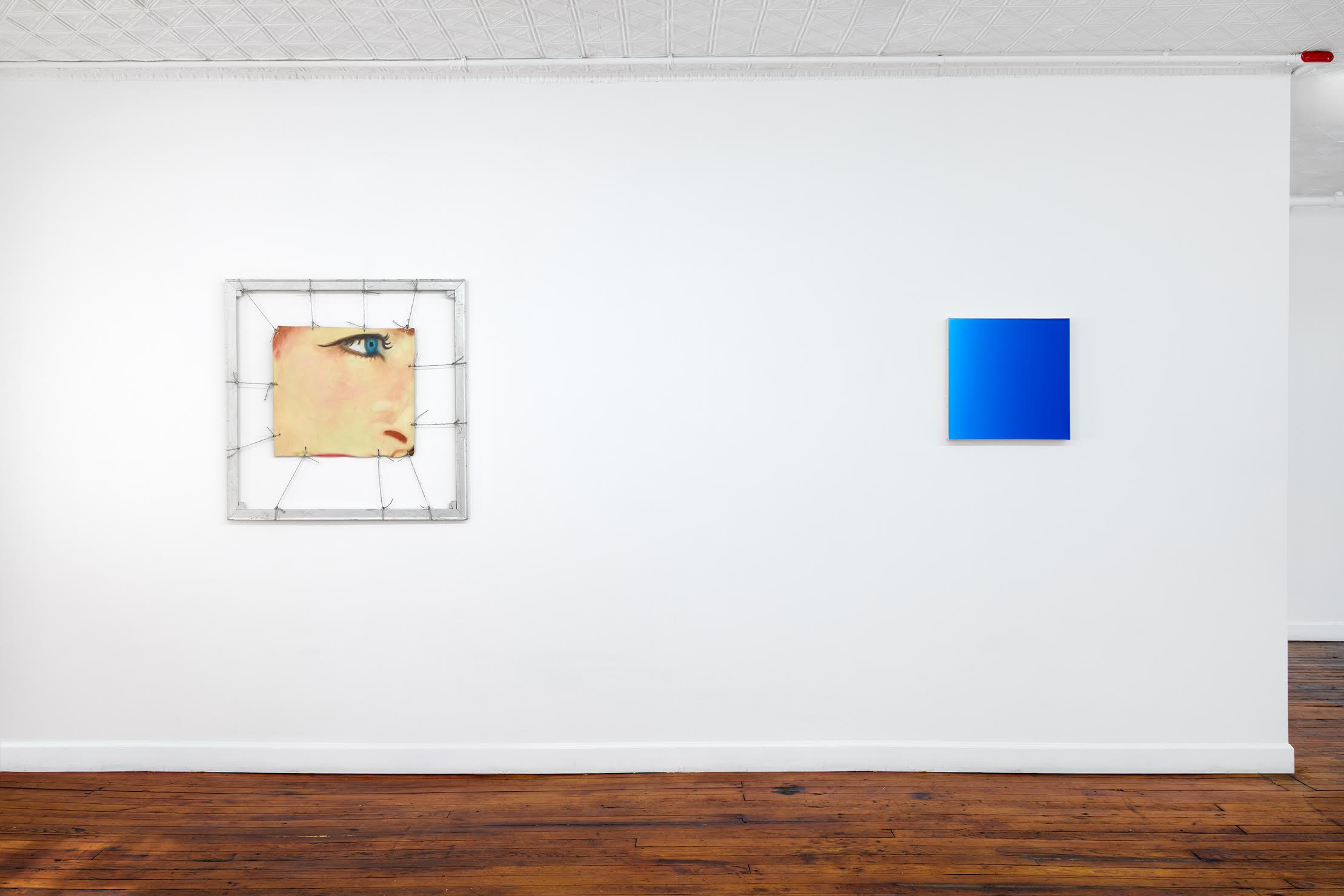
Anchored by “Bedspring,” 1962, an historical work from Rosenquist’s breakout year, depicting a fragment of a blue-eyed woman across a silver-painted wood frame, “Through” explores the ways in which artists experiment with the act of looking—not only at, but through, into and beyond surfaces, via porousness and gaps.
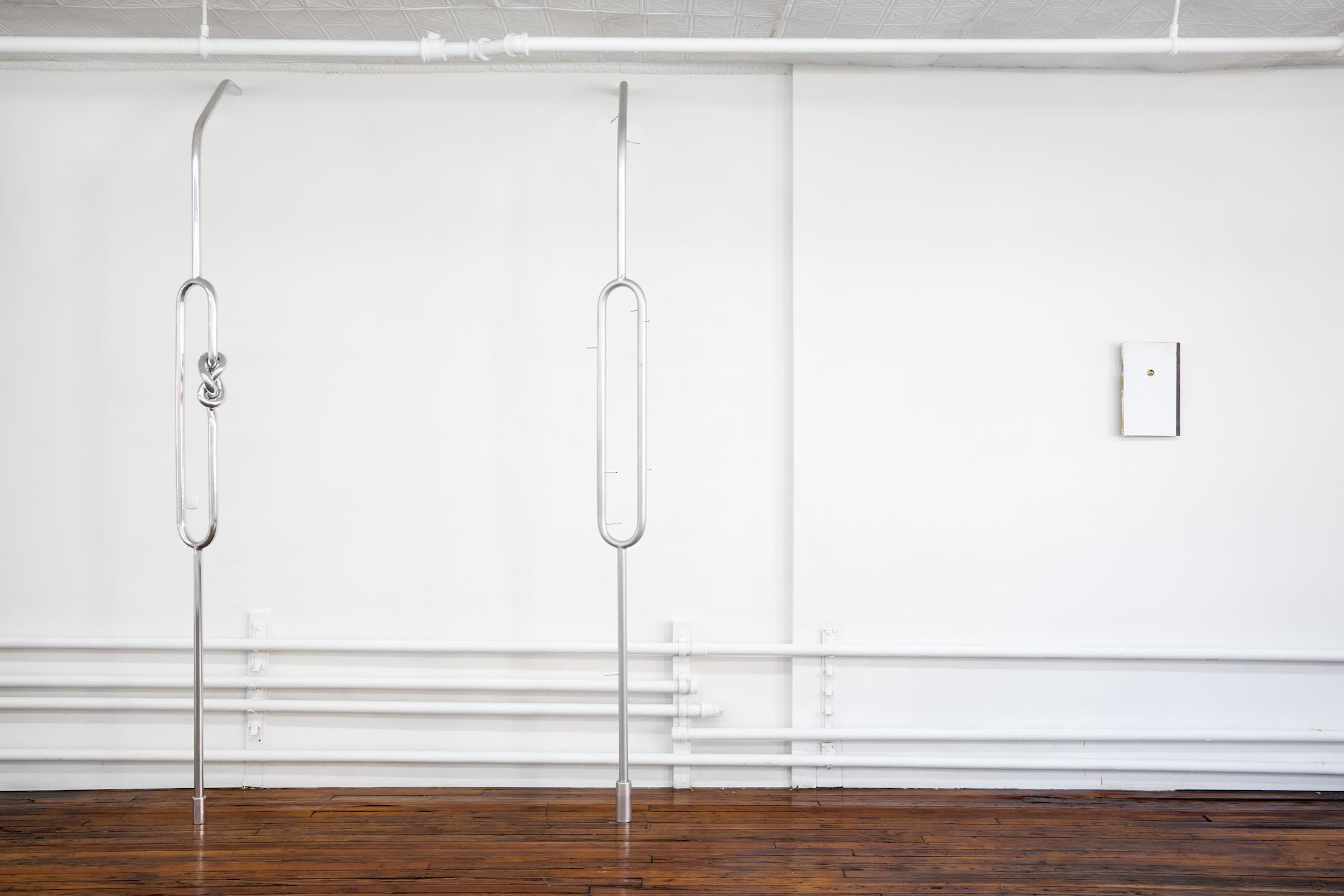
Included in the exhibition is “Peephole,” a fragment of a site-specific work from 1979 by the California artist Jane Reynolds, a cylinder of brass and glass that was once embedded within a wall at 84 West Broadway, an influential artist-run space in Tribeca founded by Peter Nadin and Christopher D’Arcangelo. For her part in the collective’s installation, Reynolds inserted two peepholes in the wall, allowing viewers to look into the private living quarters of Nadin while allowing Nadin to look back at the viewers.
—
Room A short story By Randy Kennedy
She was told that it was an art gallery but when she arrived that winter morning she found no sign, no name on a buzzer. She tried the door and found that it was unlocked, so she stepped tentatively out of the wind into the vestibule of the building, a high-ceilinged loft warehouse of the kind that lined the streets in that part of lower Manhattan. The interior smelled of floor wax and old dust. A staircase of wide, sagging risers directed her eyes to the first landing.
Hearing no one, she decided to go up. Along the hallway were four unnumbered doors, three of which seemed to be closed, but the door nearest the street was slightly ajar, admitting a stripe of daylight. She knocked. Hello? Hello? Is anyone here? Is this a gallery? Are you open? She waited and knocked again. When no one answered, she nudged the door and looked into a large, mostly white room in which short vertical green stripes had been painted along the baseboards and against the ceiling, ringing the room at top and bottom. Hello? Are you open today? Is there a show here?
She opened the door wider and put her head inside. The room was empty and bare save for the green stripes and a cheap wooden desk with a chrome-pipe diner chair in one corner near a radiator. The opposite corner was marked off by a huge, glowering, black-and-brown expanse of striped wall that she thought was maybe a minimalist painting or the idea of one. The floors were old, probably oak, heavily varnished, causing the planks to reflect the morning light upward in wavery lines.
She decided that whatever had been here was over and she had missed it.
She called out again and stepped inside fully to look around. The radiator seemed to be pumping at full bore because it was warm inside, almost muggy. Maybe someone had been here and just stepped out. She knew that she shouldn’t but she walked across the room to the desk in search of a card or announcement, finding nothing. She looked around the room again and thought that it seemed deliberate in a way that she couldn’t articulate. She wished that she had seen whatever had been here.
As she was turning to leave her eye caught the small black hole in the middle of the brown painting, halfway up the wall. Was it an accidental hole? Or was it a feature of the painting, some kind of punctum? She walked closer and saw immediately that it was a glass peephole of the kind installed in apartment doors. She looked at it and thought about it for a minute and then wondered if she was being watched, if her being watched or thinking she was being watched was the show, after all. She had been to art shows where less happened.
She decided that she couldn’t leave without putting her eye to the peephole, to see if it was the side that allows you to see in rather than the side that lets someone look out at you. She approached the wall and stooped slightly and drew near, immediately feeling self-conscious. She pulled her coat closed in front of her.
As she put her eye to the glass and allowed her vision to adjust, she was able to make out a partial, convex view of another room, a room raggedly furnished with a rug, a small television set on a stand, a black telephone affixed to the far wall, a desk, a wooden rolling chair and a scattering of shoes and clothes on the floor, a room where someone clearly lived. The television was on, showing some sort of choir on the screen, people in pleated robes, singing, though she could near no sound. She scanned this room from left to right trying to make out details, looking closely to see if anyone was inside. Where was the door to this other room? Was it a real room she was seeing or maybe some kind of video or film being presented to her through the peephole?
She quieted her breath and listened intently for several seconds. She heard nothing. But as she stood there so close to the wall she suddenly had the feeling that someone was standing just on the other side of it, listening for her movements, and she startled and stepped back and almost laughed and looked around again for a door to the other side of the wall.
She felt involved now, implicated in whatever this was supposed to be. She bent down and put her eye to the peephole again. The choir was still visible on the screen of the small television set, still singing soundlessly, and she thought about the fact that the television was playing and what this might mean about someone being in the room, watching the screen from almost the same vantage point as she was.
She considered knocking on the wall but she didn’t have the nerve. She looked through the glass again and decided, based on the items of clothing and the shoes on the floor, that the occupant of the room was most likely a man. The image on the television screen had changed. It seemed to be a car commercial now, a sports car racing down a country road with leaves flying up behind the wheels in its wake. Then the ad ended and the choir returned and she kept watching, strangely drawn now to what was happening on the television.
Her eye had been up to the glass for what seemed like minutes when she heard the unmistakable sound of coughing, as if from far away, and this time she jumped back and involuntarily let out an audible gasp. She took several steps back and waited. She heard what sounded like footsteps, like a body shuffling. Then silence and more footsteps and then silence again. She listened and knew that the person on the other side of the wall was now listening for her, too.
She stood very still and waited. As the visitor to this space, she felt that whatever move came next was not hers to make. She was interested in what would happen.
She waited for a long time and the continued silence began to feel like a game, a kind of standoff. Then came the knock on the wall, a knock that startled her though she had almost expected it, four rapid, expectant knocks like the knock of a traveling salesman.
She waited to see if it would continue and when it didn’t she walked slowly up to the wall and answered, knocking four times.
She waited for a response but one did not come. The room fell silent again and she listened for movement, for breathing. Slowly, her heart now beating a little faster, she lowered her eye to the peephole and even before she reached it she saw that it was covered, perhaps by another eye, or a face, or a body.
The person on the other side seemed to sense her nearness and suddenly she heard a voice, the low voice of a man. Whatever he was saying was heavily muffled by the wall and she was unable to make out any of the words.
She kept listening and when she heard nothing she decided to knock again, four times. After a moment the voice came again. It seemed to be saying the same thing, a rhythmic series of words, some kind of chant or poem. She knocked again and this time she turned her head and put her ear to the plaster, which was cold to the touch. Again the voice sounded and she was able to make out a few stray words. She knocked again, harder, using the palm of her hand, and she pressed her ear closely to the wall.
This time she heard, enunciated very loudly and slowly, with long pauses between phrases:
"My only concern What troubles me is Who will speak to me today? Who will call and want to play?"[1]
She wanted to make sure she had understood and she knocked again.
"My only concern What troubles me is Who will speak to me today? Who will call and want to play?"[2]
She decided not to speak, not to answer these questions but just to leave them. This seemed like the right role for her to play. She had never been part of a performance quite like this before.
She waited and turned and put her eye to the peephole again and this time she saw him, or a part of him, a pair of legs just below the knee, crossed at the ankles, black jeans and faded, painted-speckled leather shoes with fancy broguing at the toes and along the sides. He seemed to be sitting with his back against the wall, his back to her. She wondered if he gave this same performance to everyone who came in and stayed long enough to figure out that he was there on the other side of the wall. She wondered whether he might say other things if she stayed longer or maybe turn around and present his face to her when she looked through the peephole.
She looked through for a while longer, waiting for the presentation of a face, a logical conclusion to all that had just happened. But there was no further movement, no voice, no sound from the other room. She thought about knocking again but decided that the performance must have come to an end. She stood back and looked around the room, out the windows into the bright morning light. Then she crossed to the desk and took a pen from her purse and tore a scrap of paper from her checkbook and wrote her name and phone number on it and left it on the desk.
She never received a call from the man on the other side of the wall or anyone else who might have been able to explain her encounter.
Months later she went down the street again and found the building under scaffolding, under construction. She looked up to the loft and was able to see through the windows that the green stripes no longer ran along the ceiling, that the room had been repainted. For a long while afterwards, whenever she found herself in the same neighborhood, she walked with her eyes to the ground, scanning the shoes of the men she passed.
—
James Rosenquist (1933-2017) was born in North Dakota and moved to New York in the 1950s. He studied at the Art Students League of New York and worked as a billboard painter on a monumental scale before quitting to pursue painting full time in 1960. During that period, he also met fellow artists including Willem de Kooning, Robert Rauschenberg, and Ellsworth Kelly. He gained recognition in the early 1960s for his groundbreaking painting style, developed by combining images culled from advertising and other materials to surreal and innovative effect, a technique which differentiated Rosenquist from his peers and which he would later call ‘painting below zero’. Described by the late American curator Walter Hopps as 'visual poetry', his work has plumbed questions ranging from the economic, romantic, and ecological to the scientific, cosmic, and existential.
Unstoppably active throughout his six-decade career, Rosenquist pushed the boundaries of painting, collage, drawing, and printmaking. He demonstrated his mastery of those mediums from his earliest work and first solo exhibition at Richard Bellamy's Green Gallery in 1962, which sold out before it opened, through innumerable exhibitions, multiple retrospectives, collaborative projects, and colossal paintings created in his lifetime. Rosenquist’s work is included in major institutions including the Solomon R. Guggenheim Museum, Museum of Modern Art, Walker Art Center, Whitney Museum of American Art, Guggenheim Museum Bilbao, The Menil Collection, The Museum of Fine Arts Houston, Tretyakov Gallery, Museum Ludwig, Wallraf-Richartz Museum, among others. More recently, Rosenquist's first large-scale retrospective in Korea, titled “James Rosenquist: Universe,” was held at the Sehwa Museum of Art in Seoul in 2024. This year, “James Rosenquist: Waiting for an Idea” was exhibited at Off Paradise, New York.
Jane Reynolds is a California artist who lives and work in Los Angeles. She attended U.C. Irvine in the Fine Arts department in the 1970s, studied statistics, and is a good inductive thinker.
Maximilian Schubert (b. 1983, Rockford, Illinois) received his BFA from The School of the Art Institute of Chicago in 2007. Schubert’s work often straddles the boundaries between painting and sculpture. His luminous “canvases” are cast urethane objects—hybrids of painting and sculpture that cohere these distinct genres into a whole Employing the Old Master technique of glazing where thin layers of paint impart color, depth and luminosity to a surface, Schubert creates works composed entirely of layer upon layer of poured, translucent polyurethane. Schubert has exhibited in the US and abroad, including three solo exhibitions at Off Paradise, New York, “Doubles” in 2020, “Nocturnes” in 2023, and “Dissolves” in 2025; Saint Laurent, Paris; And Now, Dallas; Lisson Gallery, London; the Power Station, Dallas, Texas; Bjorn/Gundorf, Aarhus, Denmark; Van Doren Waxter, New York; Kinman, London; Eli Ping/Frances Perkins, New York; Stephane Simoens, Knokke, Belgium; Bureau, New York; The Warehouse, Dallas; Chart, New York, and CCA, Andratx, Mallorca. Schubert’s work is in private and corporate collections in the U.S. and Europe, including the JPMorgan Chase Art Collection. Schubert lives and works in Brooklyn, New York, and is represented by Off Paradise, New York.
Kristin Walsh (b. 1989 Emerald Isle, North Carolina) lives and works in New York, NY. She earned a BFA from the University of North Carolina at Charlotte in 2013 and an MFA from Columbia University in 2017. Walsh’s practice investigates the ways in which hidden and visible systems guide our thoughts and actions. Adopting the visual languages of machinery and public infrastructure, Walsh crafts flawless aluminum sculptures that conceal the artist’s hand. By removing familiar referents from their daily context and altering them, Walsh imbues her works with a dual nature: they are at once otherworldly and expository. Engineered, welded, and polished from stock metal, many of Walsh’s sculptures contain unseen mechanical elements that animate their surfaces, likening them to horological devices. In her work, ancient and modern technologies operate in tandem, examining the dynamics between industrial production, environmental crisis, and individual agency.
Walsh’s work has been included in exhibitions at Petzel, New York; MoMA PS1, Long Island City, Queens; the New Museum, New York; Helena Anrather, New York; Lisson Gallery, New York; CAPC Museum of Modern Art, Bordeaux; Downs and Ross, New York; Signal, New York; International Objects, New York; Foreign & Domestic, New York; Deitch Gallery, New York and others. Her work is included in the collection of the University of North Carolina at Charlotte.
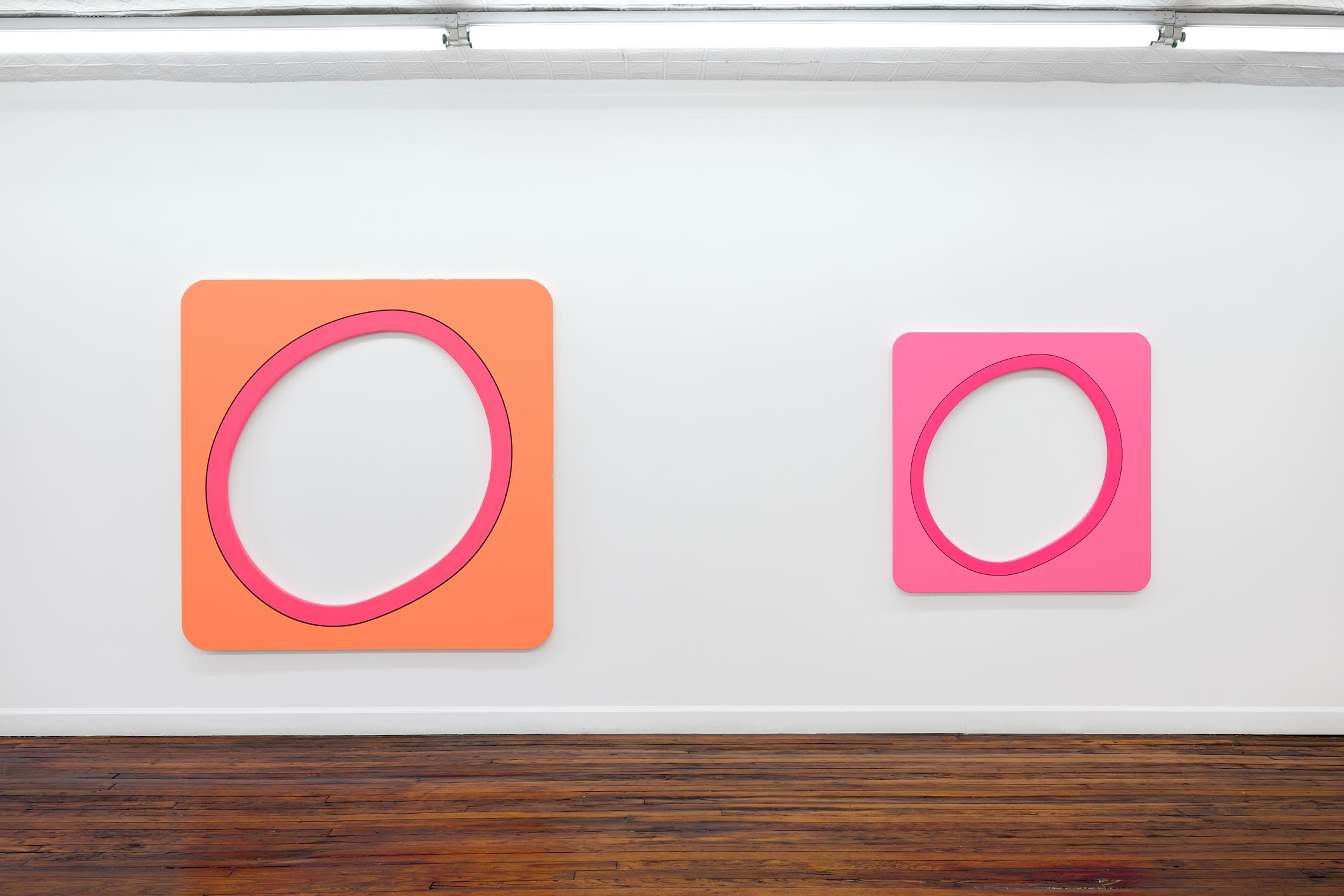
Greg Bogin (b. 1965, New York, New York) received his BFA from Cooper Union in New York in 1987. His canvases are big expanses of color, gradient, luminous, cheerful, and at times, confounding. They seem inspired by radiance and air, they also read like sculpture, outlining, cutting through and confining space. The eye follows the intensities of the colors, subtle shifts in the gradients, while the surfaces hearken back to memories of surfboards or custom cars of the quintessential Southern California pop movement. But Greg Bogin is a New Yorker. Conceived in grit, the works begin evincing little flaws in the surfaces that at first appear pristine. These flaws are fully embraced, a reminder of the humanity behind the object. There are forms, that may conjure weightlessness, drifting and evanescence, but are in fact determinate. And there are “holes” within the paintings that expose the blank wall underneath. Their presence brings one back to a certain reality. It is as if the appearance of weightlessness requires an underpinning of structure and heft.
He has had numerous international exhibitions, including at Marlborough Contemporary, in New York and London, at the Staatsgalerie Stuttgart, at Leo Koenig in New York, at the Museum für konkrete Kunst in Ingolstadt, at the Mary Boone Gallery in New York, at the Aldrich Museum for Contemporary Art, Ridgefield, Galerie Bruno Bischofberger in Zurich, Stadtgalerie Saarbrücken, Paolo Curti/Annamaria Gambuzzi & Co in Milan, Neues Museum Nuremberg, Galerie Jablonka in Cologne and the Daimler Art Collection in Stuttgart; and Buchmann Galerie, Berlin. Bogin lives and works in Brooklyn with his dog Monkey.
—
Off Paradise is a gallery located on Walker Street founded by Natacha Polaert in the fall of 2019. The name evokes the old neighborhood of Five Points, at the center of which was a small, triangular park, full of hopes and grime, called Paradise Square. It also invokes Paradise Alley, the artists’ and poets’ colony on the then-godforsaken corner of Avenue A and East 11th Street that is referenced in Jack Kerouac’s novel The Subterraneans. Off Paradise is a fictional place, right off Paradise, adjacent to it, but not exactly it.
1 - Peter Nadin, poem fragment from “Who Will Call?,” as collected in Still Life, Tanam Press, 1983
2 - Peter Nadin, poem fragment from “Who Will Call?,” as collected in Still Life, Tanam Press, 1983
About Off Paradise
Off Paradise is a gallery located on Walker Street founded by Natacha Polaert in the fall of 2019. The name evokes the old neighborhood of Five Points, at the center of which was a small, triangular park, full of hopes and grime, called Paradise Square.
More about Off Paradise →