Ended May 11
Resia Schor
War and Peace
Apr 11 – May 11, 2024
More from Resia Schor on Gallop
Satchel Projects is pleased to present War and Peace, an exhibition of mixed-media wall reliefs by Resia Schor (1910—2006).
This is the first time this body of work has been exhibited in New York. The show has been timed to coincide with daughter Mira Schor’s solo exhibition Wet, on view at Lyles & King Gallery.
Born in Poland, Resia Schor (née Ajnsztajnowna / Ainstein) began her artistic life as a painter, studying at the Warsaw Academy of Fine Arts (at a time when the Academy maintained a “numerus clausus” for Jewish students), later moving to Paris with her husband Ilya, where she studied art history at the École du Louvre. The Schors fled Paris ahead of Nazi occupation, eventually settling in New York City. While Ilya established himself as a multi-disciplined artist — a noted painter, jeweler, illustrator, and creator of Judaica — Resia pursued a career as a painter, working predominantly in gouache, creating abstract compositions that were in conversation with European and American artists such as Cézanne, Philip Guston and Jack Tworkov. Her paintings were exhibited under the name Resia Ain in Midtown at the Workshop Gallery, garnering positive reviews.
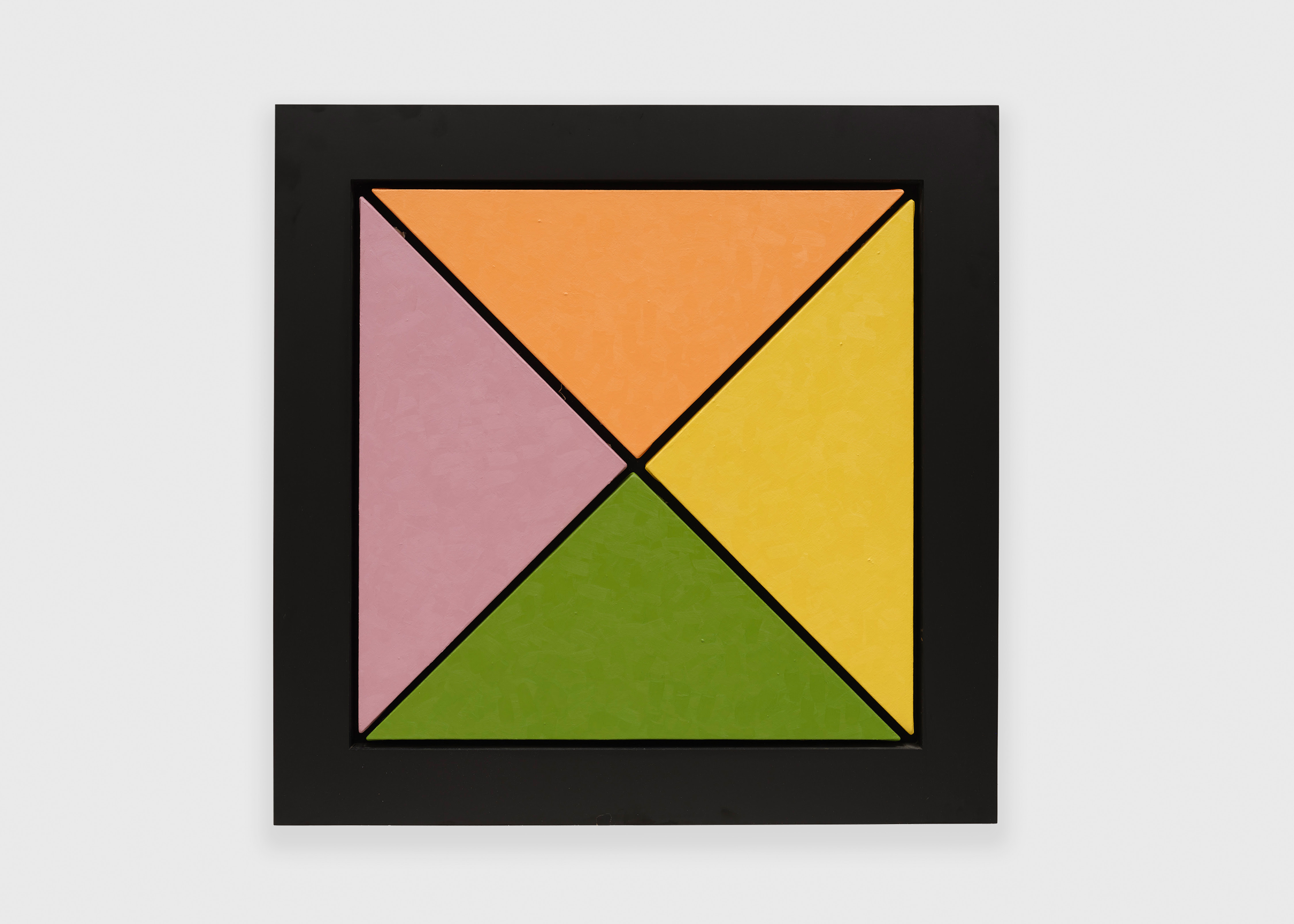
After Ilya’s death in 1961, Schor embarked on a decades-long engagement with metal and three-dimensional form, initially creating stunning works of sculptural jewelry, then moving onto the wall with increasingly ambitious, painterly mixed-media reliefs. For the latter, she employed diverse materials — brass and white metal, brightly-hued Plexiglas and painted paper, gold leaf — layered and joined together via an inventive, hand-cut “rivet” system.
These hybrid pieces are resolutely Modernist, yet they embody a remarkably distinctive and unconventional approach to material and form. Schor’s wall reliefs became a reflection of their time as well as of Schor’s own lived experience — both her rich internal life and events in the world around her.
Over the next three decades, as the works grew in size and ambition, the scope of Schor’s subject matter also became more expansive and expressive, its content deeper. Some works, such as Storm on the Cape and Red Sun, reflected her connection to the natural world. These pieces directly responded to the atmosphere and environment she encountered on Cape Cod, where she summered — the landscape, the light, the ocean, and the sun.
While Schor was responsive to the natural environment, she was also politically engaged, an interest that found expression in works that addressed politics and world events. This aspect of her work can be seen in Lockerbie, a jagged, fragmented piece she created in response to the 1988 terrorist attack, and B-2 Stealth, a work that uses geometry and symmetry to represent the deadly silhouette of the (then) state-of-the-art military aircraft.
Resia Schor’s art and life embodied a “lived feminism.” Encountering hardship, she responded with creativity and determination, and eventually persevered. Perhaps the most emblematic image in her later oeuvre was her Nike figure, based on the iconic statue The Winged Victory of Samothrace, which she had passed many times on her way to and from classes at the Louvre. A feminine symbol of military triumph, the Victory stands on a pedestal shaped like a ship’s bow, the wind blowing against her robes, striding forward, her wings outstretched.
In the last year of her life, Resia and Mira went together to see the Whitney Museum exhibition “Picasso and American Art,” which featured a selection of the Spaniard’s work alongside that of a dozen or so American artists. It was wintertime, and too cold to walk, so they decided to take a taxi home. Mira remembers her mother, then 95, sitting in the back seat, bundled up against the chill. She looked up at her daughter and said, “it’s the kind of show that makes you want to go back to the studio and work.”