Ended Apr 13
Thomias Radin
Hidden in Plain Sight
Mar 15 – Apr 13, 2024
More from Thomias Radin on Gallop
[Please scroll down for German version / Für Deutsch bitte scrollen Sie nach unten]
Esther Schipper is pleased to present Hidden in Plain Sight, a presentation by Thomias Radin. The artist has conceived of a site-specific environment to present two sculptures and three paintings in hand-carved artist frames.
Regardless of the medium, Radin’s practice is centered in an embodied knowledge formed by his background in dance as well as by growing up between the Caribbean Island of Guadeloupe and France. For Radin, the Black subjects of his paintings, sculptures, performances, and films are carriers of memory and movement. Movement that tells a story of deep spirituality, inherited, linked to ancient knowledge, yet still evolving and alive. The emphasis on movement goes hand in hand with one on the fluidity of meaning and the presence of the intangible throughout Radin’s practice.
Hidden in Plain Sight is an environment in which to experience form viscerally as well as to think about the wider significance and deeper connotations of the works. Profoundly influenced by his birth place, Guadeloupe, and his boyhood in France, Radin‘s art incorporates hand-carved woodwork alongside visual references such as marble and angels that reflect his engagement with European visual heritage and his interest in ancient Egyptian and Greek, as well as Christian mythologies. US ICARUS, 2024, draws on the ancient Greek myth, for example, restaging it in a turbulent ocean—perhaps a reference to his island or to the trafficking of enslaved people between Europe, West Africa, and the Americas. The black hand reaching down to the central figure could be read as the hand of God offering succor, just as the half-bitten apple could be referencing the banishment of Adam and Eve. Incorporating ancient myths and beliefs, the works nonetheless poignantly address contemporary social and political issues: Icarus here can be understood as a symbol of today’s crises- ridden moment. Lush and intricate, Radin’s works often include such disparate and at times conflicting visual cues.
A universalist at heart, Radin’s work finds a common thread in the power of archetypal motifs and ancient narratives that resonates across the boundaries of their sources. In music and dance for example, he can find concrete history and also an unifying force to engage his audience. Music and Dance enter formally into the painting practice with its fragmented bodies, animated lives, gestural brushstrokes, sampling, as well as through the rhythms of HipHop, Gwo Ka, and Capoeira. The syncopation of beating drums thus becomes palpable in form and execution.
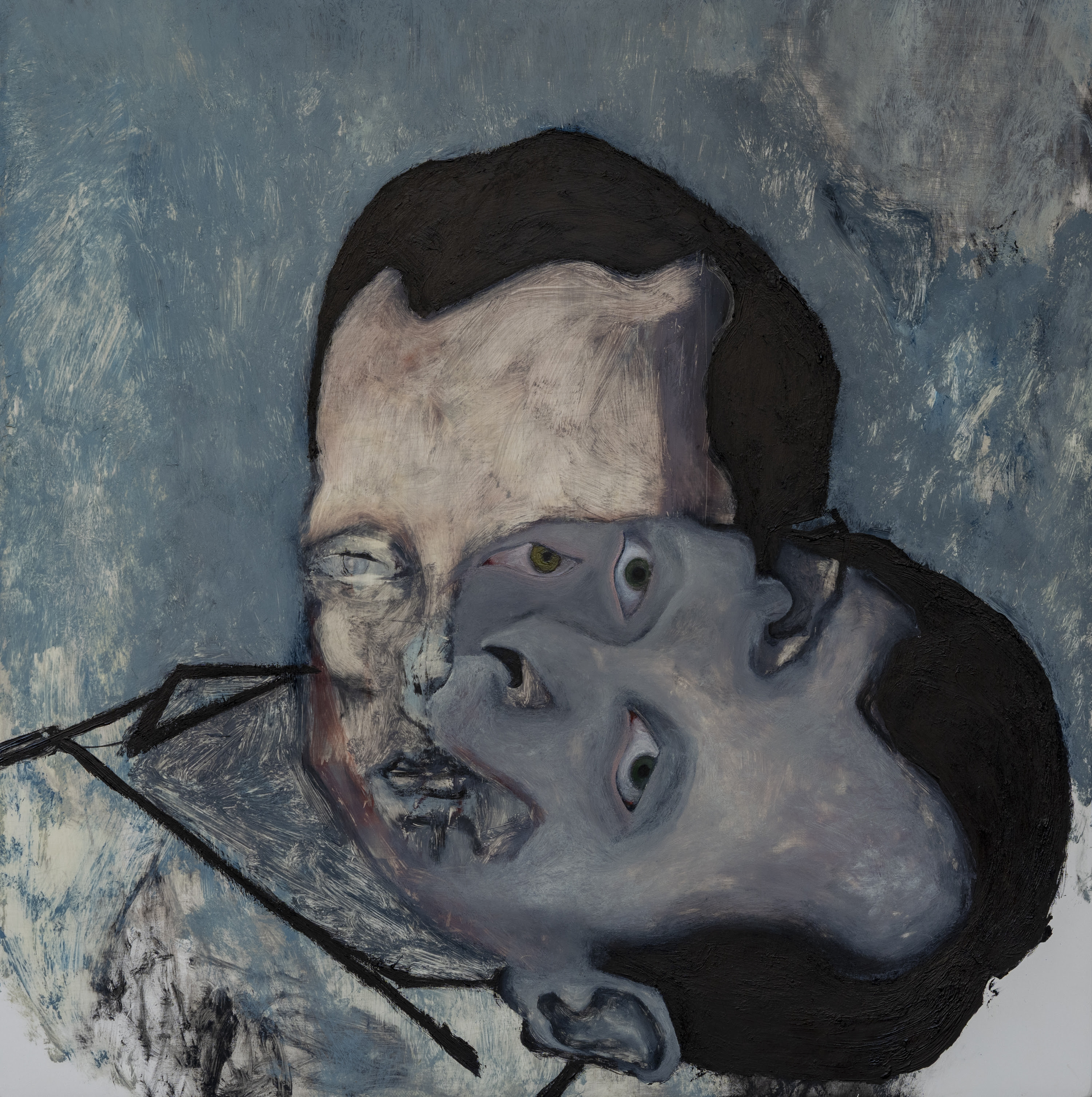
Akin to an improvisational performance, Radin’s painting process draws directly on his dance practice both formally and conceptually. The paintings often appear to be executed in broad dynamic gestures, their subjects appearing as if caught in mid-movement. Generally Black, young and masculine or androgynous, they are often seen only in fragments of muscular bodies. The figures are caught in momentary energetic poses and expressions of great physical prowess. Their movements are full of history and become instruments of storytelling. To the artist, dancers are engaged in a kind of spiritual communion, in a dialogue full of vulnerability and violence in which each gesture carries with meaning.
Sculptural works, such as KA Spirit I, 2023, are hand-carved from wood, decorated with figures and staining, and sometimes embellished with appliqués. The wooden structure combines shapes of drums commonly used in Guadeloupe (Ka) and in Cuba Cajon). Bespeaking the artist’s continuation of the tradition of woodwork practiced in his family over generations, both the carving and the playing of drums have a wider significance in the cultures of Guadeloupe, where they have deep-rooted political associations: the characteristic music of Gwo Ka was an act of remembrance and resistance for the enslaved population. The titles of the sculptures are derived from the ancient Egyptian concept of „ka“, a principal aspect of the soul of a human or divine being. In ancient Egypt, ka statues were believed to have acted as surrogates for the deceased, housing their spirit and providing a vessel to which their descendants could make offerings. Radin‘s work thus draws on the transformative power of movement for both body and spirit.
Thomias Radin was born in 1993 in Abymes, Guadeloupe. He received his BFA and MFA from the University of Rennes 2 in 2015 and 2018. The artist lives and works in Berlin.
Radin’s solo exhibitions include Polychrome - The Myth of Karukera & Cibuqueira, Galerie Wedding, Berlin (2023); Kimbé Rèd Pa Moli, Steve Turner, Los Angeles (2022); The Myth of Inner Landscapes, SAVVY Contemporary, Berlin (2019).
Amongst his group exhibitions are Poly: A Fluid Show, KINDL- Centre for Contemporary Art, Berlin (2023 – 24); Embodied Spaces: The Body as Architecture, Strada Gallery, New York (2023); Les Enchantées, Frontview, Berlin (2023); The Garden, The Curators Room, Amsterdam (2023); Trangressive: Nonkonforme Zugänge zu Kunst and Stadt, Kühlhaus Berlin, Berlin (2022); Non Playable character, The Fairest, 59th Venice biennale, Venice (2022); Home Alone, ATM Gallery, New York (2020); Berlin-Lagos Mobility and Heritage, Galerie Wedding, Berlin (2018).
Selected performances include The Myth of a Trinity II, Kindl - Centre for Contemporary Art, Berlin (2023); Oversea Riddim, Deutsche Oper, Berlin (2023); What a Time to Be Alive, The Curators Room, Amsterdam (2022); Gospel of Wealth: Monumental shadow, Savvy Contemporary, Berlin (2021); The Myth of a Trinity, Oyoun, Berlin (2020); The Myth of a Trinity, Temps fort, Saint Domineuc (2019); The Myth of a Trinity, Performing Arts Festival, K77 Studio, Berlin (2018).
*****
Esther Schipper freut sich, Hidden in Plain Sight anzukündigen, eine Präsentation von Thomias Radin. Der Künstler hat eine ortsspezifische Szenerie konzipiert, um zwei Skulpturen und drei Gemälde in handgeschnitzten Rahmen zu präsentieren.
Unabhängig vom Medium ist Radins Praxis von einem verkörperten Wissen geprägt, das durch seinen Hintergrund in Tanz und sein Heranwachsen zwischen der Karibikinsel Guadeloupe und Frankreich geformt wurde. Für Radin sind die Schwarzen Subjekte seiner Gemälde, Skulpturen, Performances und Filme Träger von Erinnerung und Bewegung. Bewegung, die eine Geschichte von tiefer Spiritualität erzählt, überliefert, mit altem Wissen verwoben und dennoch stets im Werden begriffen und lebendig. Die Betonung des Wandels ist verbunden mit einer Hervorhebung der Veränderlichkeit von Bedeutung und der Allgegenwart des Immateriellen und Unfassbaren in Radins Praxis.
Mit Hidden in Plain Sight ist eine Umgebung entstanden, in der man Form unmittelbar erleben und über die weitere Bedeutung und tiefere Konnotationen der Werke nachdenken kann. Radins Kunst ist stark von seinem Geburtsort Guadeloupe und seiner Kindheit in Frankreich beeinflusst und umfasst handgeschnitzte Holzarbeiten sowie visuelle Referenzen wie Marmor und engelsgleiche Wesen, die seine Auseinandersetzung mit europäischem visuellem Erbe und sein Interesse an altägyptischen, griechischen und christlichen Mythologien widerspiegeln. US ICARUS, 2024, greift beispielsweise auf den antiken griechischen Mythos zurück, wobei Radin ihn in einem turbulenten Ozean neu inszeniert – möglicherweise in Anspielung auf seine Insel und auf den Handel mit versklavten Menschen zwischen Europa, Westafrika und Amerika. Die schwarze Hand, die auf die zentrale Figur herabreicht, könnte als helfende Hand Gottes gelesen werden, ebenso wie der halb angebissene Apfel auf die Verbannung von Adam und Eva verweisen könnte. Die Werke greifen antike Mythen und Glaubensvorstellungen auf und setzen sich dennoch auf pointierte Weise mit aktuellen sozialen und politischen Themen auseinander: So kann Ikarus hier als Symbol für die gegenwärtige Krisensituation verstanden werden. Radins Werke sind opulent und vielschichtig und enthalten nicht selten unterschiedliche und bisweilen widersprüchliche visuelle Motive.
Als überzeugter Universalist zieht sich durch Radins Arbeit ein roter Faden, der in der Macht archetypischer Motive und uralter Erzählungen liegt und über die Grenzen ihrer Quellen hinweg mitschwingt. In Musik und Tanz zum Beispiel findet er sowohl konkrete historische Bezüge als auch eine verbindende Kraft, die sein Publikum anspricht. Musik und Tanz fließen mit ihren fragmentierten Körpern, ihrem bewegten Leben, ihren gestischen Pinselstrichen und ihrem Sampling ebenso in die Malerei ein wie die Rhythmen von HipHop, Gwo Ka und Capoeira. Die Synkopen der Trommelklänge werden so in Form und Ausführung spürbar.
Ähnlich einer improvisierten Performance bezieht sich Radins malerischer Prozess sowohl formal als auch konzeptionell direkt auf seine Tanzpraxis. Die Gemälde scheinen oft in großen dynamischen Gesten ausgeführt zu werden, wobei die dargestellten Personen wie mitten in der Bewegung festgehalten erscheinen. Sie sind in der Regel Schwarz, jung und männlich oder androgyn und oft nur als Fragmente von muskulösen Körpern zu erkennen. Die Figuren sind in schnellen, energiegeladenen Posen gefangen und vermitteln den Eindruck großer physischer Stärke. Ihre Bewegungen sind voller Geschichte und werden zu Instrumenten des Erzählens. Für den Künstler sind Tänzerinnen und Tänzer in eine Art spiritueller Vereinigung verwickelt, in einem Dialog voller Verletzlichkeit und Gewalt, in dem jede Geste eine bestimmte Bedeutung hat.
Skulpturale Werke wie KA Spirit I, 2023, werden von Hand aus Holz geschnitzt, mit Figuren und Lasuren verziert und manchmal mit Applikationen versehen. Die Holzstruktur kombiniert Formen von Trommeln, wie sie in Guadeloupe (Ka) und in Kuba (Cajon) verwendet werden. Sowohl das Holzhandwerk als auch das Trommelspiel haben in der Kultur von Guadeloupe eine tief verwurzelte politische Bedeutung: Die charakteristische Musik der Gwo Ka war für die versklavte Bevölkerung ein Akt des Gedenkens und des Widerstands. Die Titel der Skulpturen leiten sich vom altägyptischen Begriff „ka“ ab, einem wesentlichen Teil der Seele eines menschlichen oder göttlichen Wesens. Im alten Ägypten glaubte man, dass die Ka-Statuen die Verstorbenen repräsentierten, und eine Art Behältnis ihres Geistes darstellten, dem die Nachkommen Opfergaben darbringen konnten. Radins Arbeit basiert auf einer transformativen Kraft der Bewegung für Körper und Geist.
Im Sommer 2024 wird Thomias Radin eine Einzelausstellung im Kunstverein Göttingen haben.
Thomias Radin wurde 1993 in Abymes, Guadeloupe, geboren. Er erhielt seinen BFA und MFA an der Universität Rennes 2 in den Jahren 2015 und 2018. Der Künstler lebt und arbeitet in Berlin.
Zu Radins Einzelausstellungen gehören Polychrome - The Myth of Karukera & Cibuqueira, Galerie Wedding, Berlin (2023); Kimbé Rèd Pa Moli, Steve Turner, Los Angeles (2022); The Myth of Inner Landscapes, SAVVY Contemporary, Berlin (2019).
Zu seinen Gruppenausstellungen gehören Poly: A Fluid Show, Kindl-Centre for Contemporary Art, Berlin (2023 – 24); Embodied Spaces: The Body as Architecture, Strada Gallery, New York (2023); Les Enchantées, Frontview, Berlin (2023); The Garden, The Curators Room, Amsterdam (2023); Trangressive: Nonkonforme Zugänge zu Kunst and Stadt, Kühlhaus Berlin, Berlin (2022); Non Playable character, The Fairest, 59th Venice biennale, Venice (2022); Home Alone, ATM Gallery, New York (2020); Berlin-Lagos Mobility and Heritage, Galerie Wedding, Berlin (2018).
Zu den ausgewählten Performances gehören The Myth of a Trinity II, Kindl - Centre for Contemporary Art, Berlin (2023); Oversea Riddim, Deutsche Oper, Berlin (2023); What a Time to Be Alive, The Curators Room, Amsterdam (2022); Gospel of Wealth: Monumental shadow, Savvy Contemporary, Berlin (2021); The Myth of a Trinity, Oyoun, Berlin (2020); The Myth of a Trinity, Temps fort, Saint Domineuc (2019); The Myth of a Trinity, Performing Arts Festival, K77 Studio, Berlin (2018).