Opens Thursday
Lilia Carrillo
Mañana de Octubre
Nov 12, 2026 – Jan 30, 2027
More from Lilia Carrillo on Gallop
Kurimanzutto New York presents Lilia Carrillo: Mañana de Octubre, bringing together paintings and works on paper made between 1948 and 1974. Born in Mexico City in 1930, Carrillo is a central figure in the development of abstraction in Mexico. She is part of the Generacion de la Ruptura, whose artists challenge dominant figurative and nationalist traditions. Her own approach develops through sustained experimentation with color, pictorial space, and materials. The exhibition traces this exploration through works drawn largely from her personal collection, preserved after her death by her husband, the sculptor Manuel Felguerez.
At the exhibition's entrance, Autorretrato Escolar (School Self-Portrait, 1948) introduces a young artist already assured in her vocation. After training at La Esmeralda in Mexico City, Carrillo goes on to study in Paris from 1953 to 1955, where she broadens her engagement with European avant-garde painting. Painted after her return to Mexico, Mudo espía mientras alguien a mi voraz observa (Wordlessly I Spy While Someone Watches Me Voraciously, 1956) brings geometric structures and dynamic diagonals together in an imagined landscape, marking her growing departure from realism.
Carrillo's developing language draws on forms of abstraction that emerge from Surrealism in Mexico, particularly in the work of Wolfgang Paalen and Alice Rahon. Their conception of painting as a way to give form to something not yet present in the world encourages her experimentation. In El regreso de los pájaros (The Return of the Birds, 1957), densely layered strokes gather into dark forms against an ocher ground. The title evokes birds in flight, while the painted forms remain ambiguous. "In my paintings, there is always something that recalls something else--it may be a letter, it may be a small hand," Carrillo observes of her approach to abstraction, "as if I need to humanize the geometric thing."
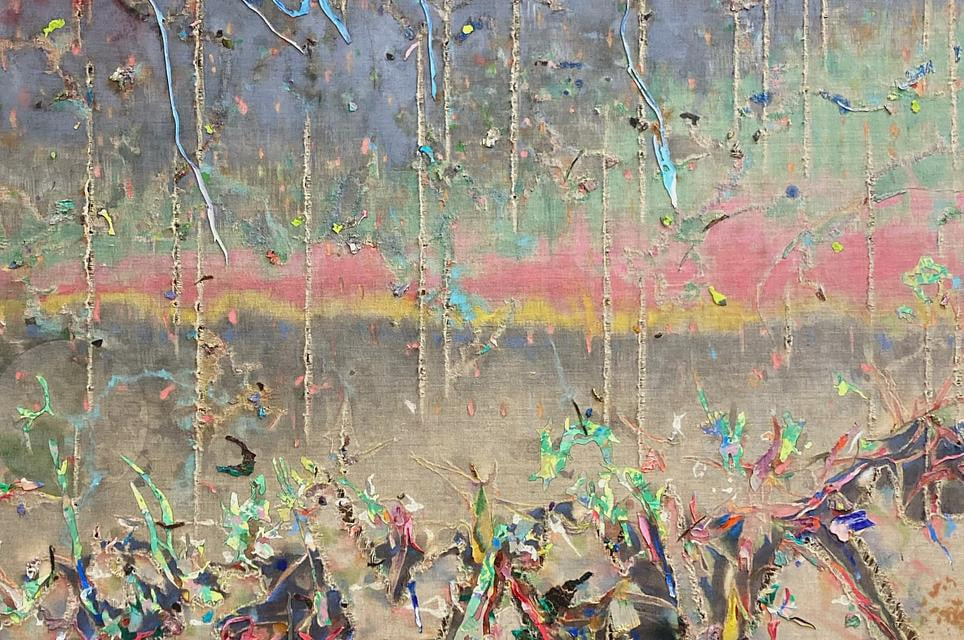
A visit to New York and Washington, D.C., in 1959-60 brings Carrillo into closer contact with Abstract Expressionism, broadening her exploration of gesture, texture, and the expressive qualities of paint. In the open, atmospheric field of Abstracción (Abstraction, 1961), forms hover, condense, and dissolve, suggesting a world in the process of taking shape. Textiles introduce another way of constructing pictorial space. In Mañana de octubre (October Morning, 1964), which lends the exhibition its title, Carrillo combines layers of paint and fabric. The visible weave introduces a grid within the gestural composition, while the interplay of color, texture, and light echoes the title's suggestion of a passing moment. Carrillo's exploration of textiles extends beyond the painted surface to the stage. Her collaborations with the experimental theater director Alejandro Jodorowsky are represented here by a costume study for his 1961 production of La sonata de los espectros, in which loosely woven fabric defines the figure's silhouette against a dark ground.
Printed images form part of Carrillo's material experimentation. In Untitled (ca. 1960), a postcard view of San Antonio, Texas, sits among pieces of loosely woven fabric. In Untitled (ca. 1970), newspaper clippings and a fragment of a Superman comic remain partly visible beneath pale passages of paint. Carrillo distinguishes her treatment of these materials from that of Pop artists, emphasizing how she dissolves their imagery into abstraction: "I disintegrate them, until they melt away, vanish and disappear; they are still there but only as subtle small details."
These explorations find a concentrated expression in Premonición (Premonition, 1970). Here, script-like marks trace the meeting of broad fields of white and dark brown, while bands of color gather at the upper right. Later that year, Carrillo suffers a spinal cord aneurysm that leaves her partially paralyzed and interrupts her practice. Following rehabilitation, she resumes painting in late 1972.
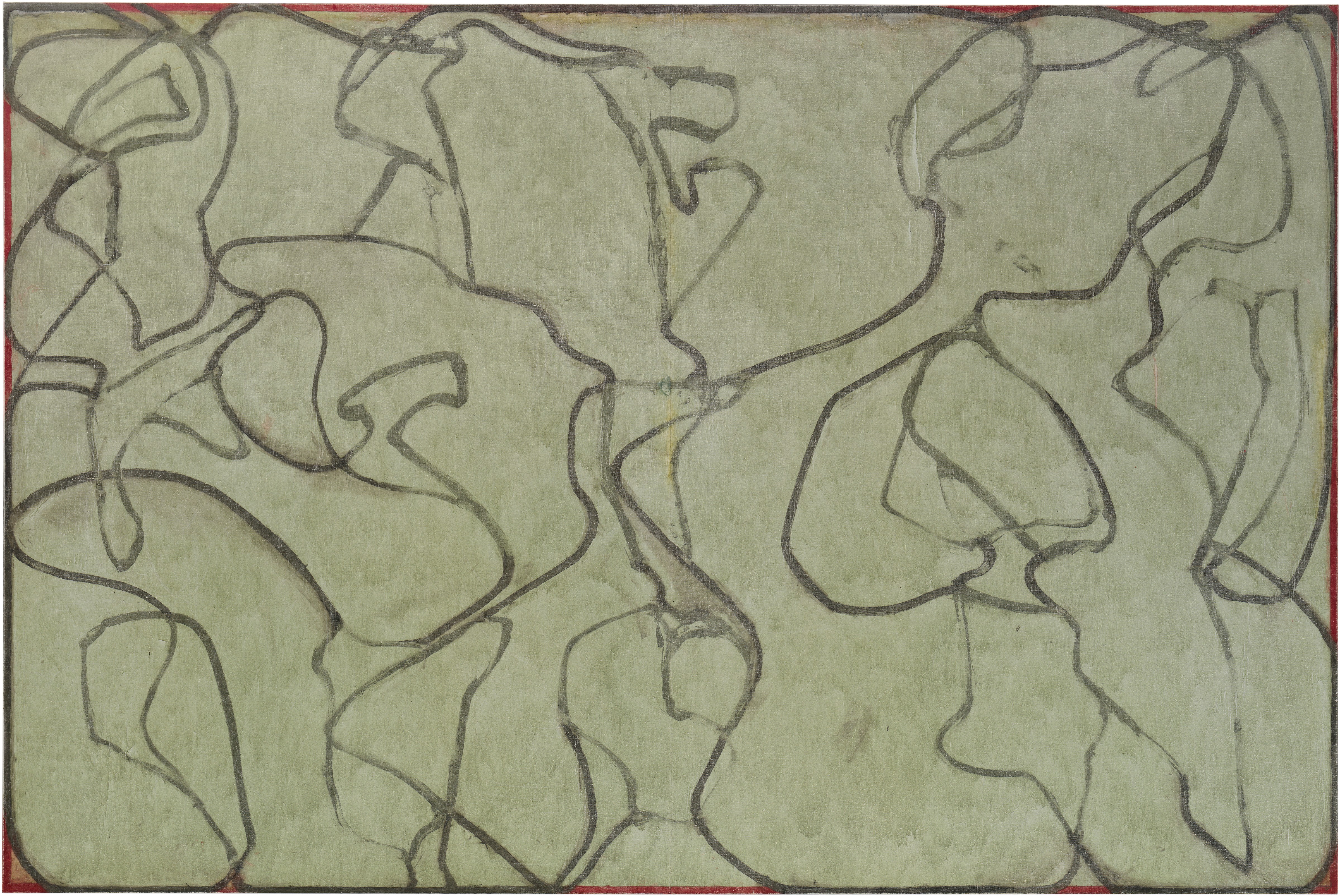
Her final works demonstrate the continued range of her approach. In works from 1973, she applies paint, drawing, and collage to lithographs, reworking her own printed compositions by hand. By contrast, in Untitled (1974), faint graphite lines and spare passages of color emerge across a largely open field. The painting appears unfinished, although whether Carrillo considered it complete remains unknown. Carrillo's death at forty-three cuts short a mature and distinctive practice, one whose expressive range she continues to expand in her final works.
Spanning more than twenty-five years of Carrillo's practice, the exhibition builds on renewed scholarly and institutional attention to her work, bringing her distinctive contribution to abstraction into sharper focus. The exhibition builds on renewed scholarship and her major retrospective at the Museo del Palacio de Bellas Artes in Mexico City and a recent presentation of her work at Americas Society in New York. Archival materials displayed alongside the works offer further insight into her life and practice. The presentation is accompanied by a new publication featuring essays by Daniel Garza Usabiaga and Megan Kincaid.